The Hidden Barriers for Women in Finance
21 October, 2026


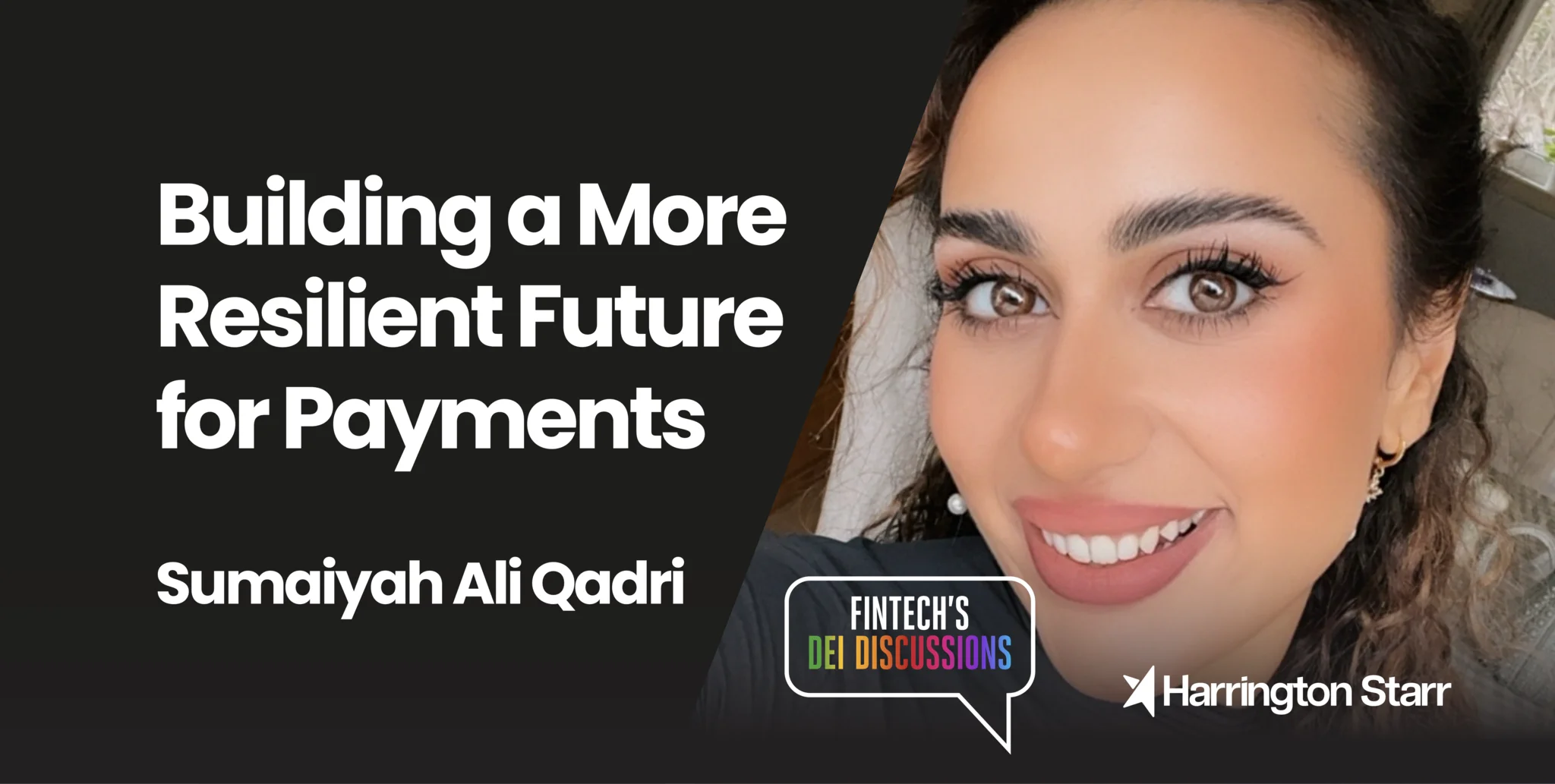
Sumaiyah Ali Qadri has spent her career solving some of the most complex challenges in financial services. From leading financial crime and regulatory compliance functions at organisations including Amazon, Monzo and Barclays, to launching her own payments technology business, her journey has been shaped by one central belief: technology should make financial systems stronger, smarter and more resilient. In this episode of FinTech's DEI Discussions, Nadia Edwards-Dashti sits down with the Founder of Zentra to discuss payment infrastructure, resilience, entrepreneurship, leadership and inclusion. The conversation explores not only the future of payments, but also the realities of building an ambitious FinTech business in today's market, making it essential listening for anyone working across financial technology, payments or FinTech recruitment.
Before founding Zentra, Sumaiyah built an impressive career spanning banking, financial technology and payments. With more than a decade of experience specialising in financial crime, anti-money laundering, sanctions and regulatory compliance, she developed an unusually broad perspective on how modern financial institutions operate. Her experience includes senior leadership positions at Amazon, Monzo, Barclays, Tandem Bank and Deloitte, where she worked across highly regulated environments requiring both technical precision and commercial awareness.
Throughout the conversation, one thing becomes immediately clear: Sumaiyah has never been content with understanding just one side of the industry. Rather than remaining solely within compliance, she invested time in learning engineering concepts, Python programming and machine learning to better understand how technology could solve operational challenges. That decision allowed her to bridge the gap between legal, regulatory and engineering teams, giving her a perspective that few professionals possess.
As financial technology recruitment continues to evolve, this type of multidisciplinary expertise is becoming increasingly valuable. Organisations are no longer searching purely for compliance professionals or purely for engineers. Instead, many firms are looking for individuals capable of understanding regulation, technology, customer experience and commercial strategy simultaneously. Sumaiyah's career reflects this wider trend across financial services, where the most valuable professionals increasingly combine technical knowledge with business understanding.
She explains that her motivation has always remained consistent throughout her career. Rather than simply managing regulatory obligations, she has focused on identifying where technology can improve both institutional performance and customer outcomes. That philosophy ultimately became the foundation for launching her own company.
When Nadia asks what inspired the creation of Zentra, the discussion moves beyond entrepreneurship and into one of the biggest strategic conversations currently taking place within financial services.
For Sumaiyah, the defining moment came when discussions emerged around the UK's dependency on Visa and Mastercard. She explains that approximately 95% of UK card transactions rely on these two payment networks, creating a significant concentration risk. While many people viewed the issue through a political or economic lens, she recognised it as a technology and infrastructure challenge that demanded a different solution.
Rather than questioning whether new payment methods were needed, Sumaiyah began asking a more fundamental question. Why should merchants, payment service providers or even countries rely on a single payment rail when multiple alternatives already exist?
That question ultimately became the foundation for Zentra.
Instead of attempting to replace existing payment networks, the business has been designed to sit above them. Its purpose is to intelligently select the most appropriate payment route in real time by considering resilience, latency, cost and performance before each transaction takes place. Rather than forcing organisations to replace existing infrastructure, the platform seeks to optimise the infrastructure that already exists.
This distinction is one of the most compelling themes throughout the episode. Innovation does not necessarily require replacing established systems. Sometimes the greatest opportunity lies in making those systems work together more intelligently.
For professionals working across payments, banking and financial technology, this reflects a much wider industry movement. Increasingly, organisations are looking beyond individual products towards ecosystems that enable greater flexibility, operational resilience and customer choice.
The discussion naturally develops into a broader conversation about operational resilience, a topic becoming increasingly important across financial services.
Sumaiyah argues that payment failures are not simply technical inconveniences. They represent commercial risk, customer experience challenges and, in some circumstances, national infrastructure concerns. Every failed payment creates friction for businesses and consumers alike, while dependence upon a single payment network introduces vulnerabilities that many organisations have historically accepted as unavoidable.
Her vision is different.
Rather than viewing resilience as a document produced for regulators or discussed only within board meetings, she believes resilience should exist within every transaction itself. Every payment should be intelligently routed according to real-time conditions, reducing unnecessary failures while simultaneously lowering costs and improving customer outcomes.
This concept sits at the heart of Zentra's proposition. The company is designed as a neutral decision engine capable of analysing multiple variables before selecting the optimal route for each individual transaction.
Importantly, Sumaiyah emphasises that the technology does not require businesses to abandon existing payment rails. Instead, it enhances them through intelligent orchestration.
That distinction highlights one of the biggest themes emerging across financial technology today. Organisations increasingly want solutions that improve existing infrastructure rather than requiring expensive replacement programmes. As financial institutions continue investing in digital transformation, demand continues to grow for professionals capable of designing, implementing and supporting these types of technologies.
From a FinTech recruitment perspective, this creates significant opportunities across software engineering, product management, cloud infrastructure, payments technology and regulatory technology. Businesses require talent capable of combining technical innovation with operational resilience, precisely the type of cross-functional thinking that Sumaiyah demonstrates throughout the conversation.
Another recurring theme throughout the episode is trust.
While payment speed and efficiency often dominate industry conversations, Sumaiyah argues that future infrastructure must also be transparent, explainable and fully aligned with evolving regulation. She references frameworks including the FCA, PRA and DORA as examples of how operational resilience is becoming an increasingly important expectation rather than simply a regulatory obligation.
For her, technology should never be separated from governance.
Instead, innovation should strengthen trust by making financial systems more reliable, more auditable and easier to understand. This balance between innovation and accountability is becoming increasingly important across financial services, particularly as organisations accelerate the adoption of AI, automation and real-time payments.
It also reflects changing hiring priorities throughout the sector. Financial technology recruitment is no longer focused exclusively on technical capability. Employers increasingly seek professionals who understand governance, regulation, customer outcomes and commercial impact alongside engineering excellence.
Throughout her career, Sumaiyah has consistently operated at this intersection between technology and regulation. That unique perspective not only shaped Zentra's mission but also provides valuable insight into where the wider industry is heading.
As Nadia notes during the conversation, Sumaiyah's ability to connect compliance, engineering, payments and product thinking demonstrates just how interconnected modern financial services have become. Success increasingly depends on bringing together disciplines that historically operated in isolation.
The second half of the discussion explores what it takes to build a FinTech company from the ground up, the realities of fundraising as a solo founder, why diversity remains a business issue as much as a social one, and the leadership qualities Sumaiyah believes will define the next generation of financial technology businesses.
While the vision behind Zentra is compelling, Nadia also encourages Sumaiyah to speak candidly about the realities of building the business. The conversation shifts towards fundraising, where Sumaiyah offers an honest assessment of the challenges she has faced as a solo, non-technical British Asian woman founder operating within one of the most male-dominated sectors of the economy.
Rather than relying on anecdotal experience alone, she explains how the wider statistics reflect the environment many founders continue to navigate. Female founders still receive only a small percentage of venture capital investment, despite evidence suggesting female-led businesses often generate stronger returns on invested capital. When ethnicity is added to the conversation, those funding gaps become even more pronounced, creating additional barriers for entrepreneurs from underrepresented backgrounds.
However, what makes this discussion particularly powerful is that it never becomes one solely about obstacles. Instead, Sumaiyah explains how these realities shaped her approach to preparation. Knowing that investors would challenge both her technical understanding and commercial vision, she invested heavily in building expertise well beyond her compliance background.
She deliberately immersed herself in software architecture, APIs, system design and engineering principles to ensure she could confidently explain not only why the business mattered, but exactly how it would work. Rather than allowing assumptions about her background to define investor conversations, she focused on ensuring every question could be answered with confidence and technical depth.
For anyone considering a career in financial technology or entrepreneurship, her story demonstrates the importance of continuous learning. Modern FinTech careers increasingly reward professionals who are prepared to develop expertise beyond traditional job descriptions, combining technical knowledge, commercial awareness and regulatory understanding to solve increasingly complex problems.
One of the most fascinating parts of the conversation centres on how Sumaiyah secured early validation for Zentra before building the product itself.
She explains how one of the company's earliest strategic partnerships came through a cold LinkedIn message to Devengo, a regulated payment institution licensed by the Bank of Spain. Rather than benefiting from an established network introduction, she had just ten minutes to explain the concept while the company's co-founder was travelling to catch a flight.
Without a live platform, product demonstration or working software, the conversation depended entirely upon the strength of her vision, her understanding of payments infrastructure and the credibility she had built throughout her career.
The result was a design partnership that became one of the company's earliest proof points.
Alongside this, Sumaiyah describes the significant amount of work completed before approaching investors. From securing external legal opinions confirming the regulatory position of the business to producing extensive architecture documentation and compliance mapping, she focused on reducing uncertainty wherever possible.
This approach highlights an important lesson for founders across financial services. Innovation alone is rarely enough. Particularly within regulated industries, trust is earned through preparation, governance and evidence.
As organisations continue hiring across payments technology, regulatory technology and financial infrastructure, these qualities are becoming increasingly valuable. Employers are seeking professionals who combine entrepreneurial thinking with operational discipline, ensuring innovation can scale safely within highly regulated environments.
For recruitment specialists working across financial technology, conversations like these provide valuable insight into the changing capabilities businesses now expect from future leaders. Technical expertise remains essential, but credibility increasingly comes from demonstrating the ability to bridge engineering, compliance and commercial strategy simultaneously.
Returning to the topic of regulation, Nadia asks how compliance and trend analysis will shape the future of financial services.
Sumaiyah offers one of the episode's most thought-provoking observations, suggesting that compliance and trend analysis are fundamentally "the same discipline wearing different clothes."
Drawing upon her background in financial crime, she explains that identifying suspicious activity, transaction anomalies and emerging risks relies upon recognising patterns before problems fully materialise. The same principle, she argues, applies equally to payments infrastructure.
Instead of analysing financial crime indicators, payment systems can analyse transaction success rates, latency, issuer behaviour and infrastructure performance in real time, enabling platforms to make intelligent routing decisions before failures occur.
This proactive approach reflects the wider direction of travel across financial services.
Rather than relying on retrospective reporting and manual intervention, organisations are increasingly embedding intelligence directly into operational processes. As regulatory expectations continue to evolve through frameworks such as the FCA, PRA, DORA and Instant Payments Regulation, resilience becomes something that must be demonstrated continuously rather than documented periodically.
For businesses investing in digital transformation, this creates growing demand for engineers, architects, product specialists and compliance professionals capable of working collaboratively across disciplines.
Financial technology recruitment increasingly focuses on these hybrid skillsets because the future of FinTech depends on professionals who understand both the technology itself and the regulatory environments in which it operates.
The conversation concludes by moving beyond technology and returning to the people responsible for shaping the future of financial services.
When asked what separates exceptional leaders from good ones, Sumaiyah's answer is refreshingly human.
Technical competence may help people enter the room, she explains, but empathy determines whether teams genuinely thrive. Drawing upon her experience leading financial crime teams, she describes the importance of creating environments where individuals feel safe raising concerns, admitting mistakes and challenging assumptions before problems escalate.
In highly regulated industries, psychological safety becomes more than a cultural aspiration. It becomes an operational necessity.
She argues that the best leaders encourage curiosity rather than certainty, recognising that regulation, technology and customer expectations continue to evolve. Rather than assuming today's solutions will remain correct indefinitely, successful leaders continue learning from colleagues, regulators and customers alike.
This emphasis on empathy forms a natural bridge into the episode's final discussion around diversity and inclusion.
Rather than encouraging organisations simply to mentor underrepresented talent, Sumaiyah advocates sponsorship. Her distinction is simple but powerful. Mentorship offers advice, whereas sponsorship means actively using your reputation and influence to create opportunities for someone else when they are not present.
She also encourages organisations to approach inclusion with the same analytical rigour they apply to compliance or operational performance. Instead of relying upon assumptions, businesses should measure where progression slows for underrepresented groups, identify patterns and implement meaningful improvements based on evidence.
The episode ends with a reminder that inclusion ultimately depends upon everyday behaviours rather than policies alone. Listening carefully to different experiences, demonstrating compassion and creating opportunities for others are practices that shape stronger teams, better organisations and a more resilient financial services industry.
For those working across financial technology, whether as founders, hiring managers or professionals considering their next career move, this episode demonstrates that the future of the industry will not be defined solely by innovation. It will also be shaped by leadership, trust and the willingness to build organisations where people can perform at their very best.