Who's Missing From the Room?
05 October, 2026


Artificial intelligence is no longer a future concept for financial services. It is already influencing how banks onboard customers, detect fraud, score credit applications, deliver customer support and help consumers manage their finances. As AI becomes embedded across the payments ecosystem, the conversation is rapidly shifting away from what the technology can achieve towards a much more important question: how do we ensure AI remains centred around people?
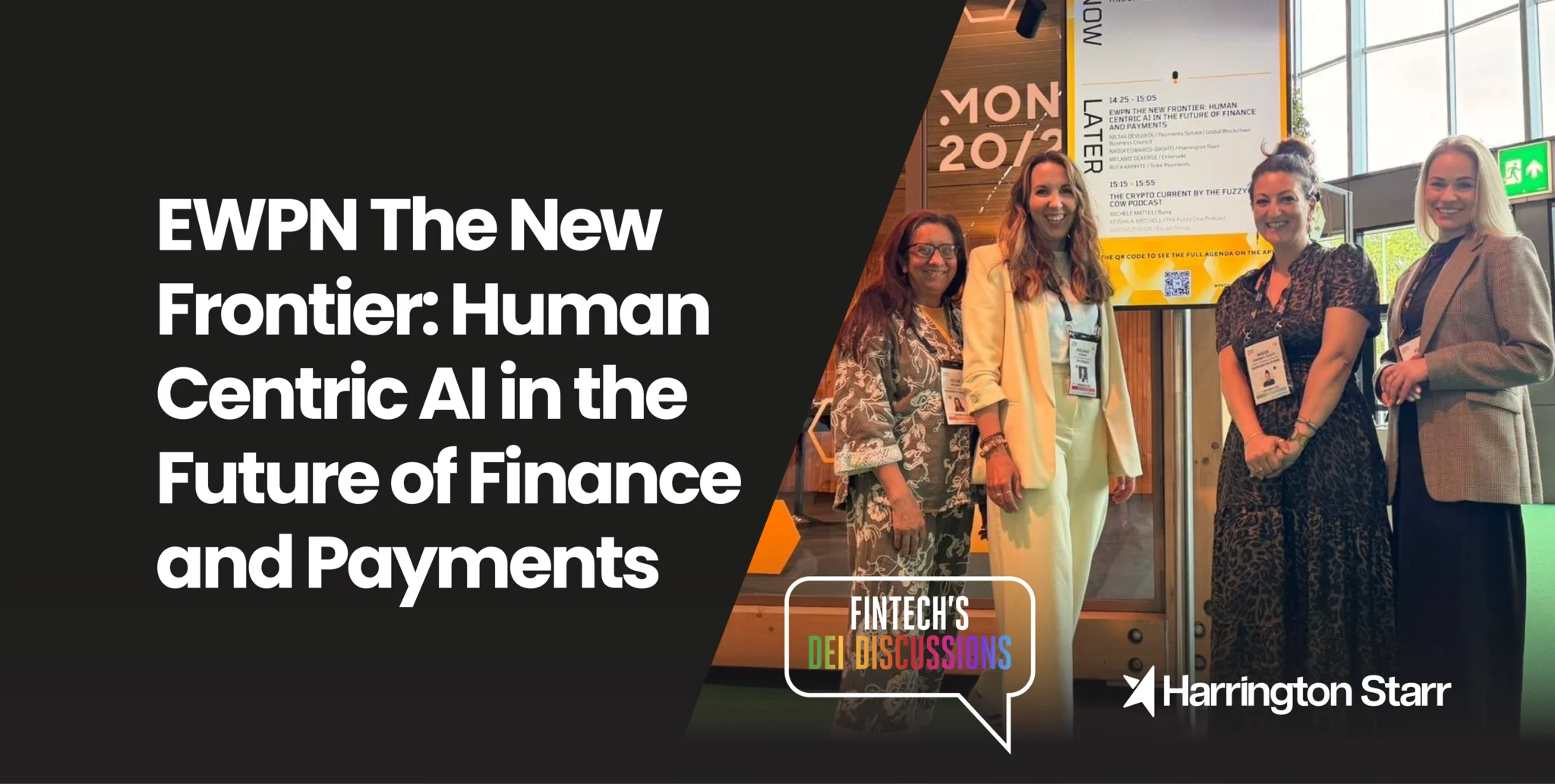
That was the focus of this special live episode of FinTech's DEI Discussions, recorded at Money20/20 2026, where host Nadia Edwards-Dashti welcomed Melanie Ockerse, VP Customer Success at Entersekt, Ruta Kairyte, Commercial Director at Tribe Payments, and Nilixa Devlukia, CEO of Payments Solved. Together, they explored the future of human-centric AI, discussing inclusion, accessibility, regulation, fraud prevention and the responsibility the financial services industry has as it embraces one of the most significant technological shifts in decades.
For those working across financial technology, payments, digital transformation and FinTech recruitment, the discussion provides valuable insight into how businesses can innovate responsibly while continuing to build products that genuinely serve customers. As organisations across financial services compete for AI talent and technology specialists, conversations like these are becoming increasingly important for employers looking to build diverse, forward-thinking teams that can shape the future of finance.
Opening the discussion, Nadia introduced the central theme of the episode by highlighting how AI is changing financial services at an unprecedented pace. However, technological progress alone is not enough. The real challenge lies in ensuring AI remains inclusive, safe, transparent and accessible to everyone who relies on financial products every day.
Each guest brought a unique perspective from different parts of the payments ecosystem. Melanie explained how Entersekt works with banks and financial institutions to strengthen digital banking security while maintaining a seamless customer experience. As fraud becomes increasingly sophisticated, particularly with AI accelerating cyber threats, the challenge is balancing stronger protection without creating unnecessary friction for customers.
Nilixa outlined her work advising both regulators and industry on payments regulation, digital assets, open banking and open finance. Her experience gives her a unique perspective on how policy must evolve alongside technology, ensuring innovation is supported while consumers remain protected.
Ruta explained Tribe Payments' role as a technology partner providing issuing, acquiring and fraud monitoring solutions for FinTechs, banks, crypto businesses and financial institutions. Alongside her commercial role, she also serves as Country Ambassador for Lithuania within the European Women Payments Network (EWPN), helping drive greater collaboration across the industry.
Together, their backgrounds created the perfect foundation for discussing one of the biggest issues currently facing financial services: ensuring AI serves humanity rather than simply accelerating technology for technology's sake.
One of the first discussions focused on the work of the European Women Payments Network (EWPN) and why organisations like it are becoming increasingly important.
Melanie explained that EWPN began as an organisation dedicated to supporting women working across payments and FinTech. Over time, however, its mission has expanded significantly. Today, the organisation champions diversity across every dimension, including gender, ethnicity, disability and neurodiversity, creating opportunities for a much broader range of voices to be heard.
Although financial services has undoubtedly made progress, Melanie acknowledged there is still considerable work to do before true representation exists across leadership and technology roles.
She also raised an important point that many businesses are currently scaling back their diversity, equity and inclusion initiatives. At precisely the moment AI is reshaping every aspect of financial services, losing diverse perspectives risks embedding bias into the very technologies that will define the industry's future.
EWPN therefore plays an increasingly valuable role by continuing conversations around inclusion, supporting professionals across the industry and ensuring diverse perspectives remain central to innovation.
For employers across payments and financial technology, this reflects an increasingly important hiring challenge. Organisations are no longer simply competing for AI engineers or data scientists. They are competing for professionals capable of combining technical excellence with diverse thinking, ethical leadership and customer understanding, qualities becoming essential within modern FinTech recruitment.
One of the strongest themes throughout the episode centred on who actually builds artificial intelligence.
Nilixa argued that creating human-centric AI starts long before customers ever interact with the finished product. It begins with the people designing, testing, governing and training AI systems.
If those responsible all come from similar educational, professional or cultural backgrounds, blind spots inevitably emerge.
AI may perform exceptionally well for one group while unintentionally disadvantaging others.
She stressed that creating genuinely inclusive AI requires much broader collaboration throughout development. Engineers alone cannot build systems that serve every customer fairly. Organisations also need behavioural scientists, accessibility experts, consumer advocates, regulators and, perhaps most importantly, representatives from the communities who will ultimately use the technology.
The conversation highlighted that diversity extends beyond people to include the data itself. AI systems trained primarily using one demographic naturally become less effective for other populations.
Importantly, Nilixa argued that this is not simply an ethical discussion. Inclusive design also creates better commercial outcomes by expanding customer reach, increasing trust and producing stronger financial products.
For organisations investing heavily in AI, this has significant implications. Successful digital transformation depends not only on recruiting exceptional technical talent but also on building multidisciplinary teams capable of identifying problems before they affect customers. That places greater emphasis on strategic hiring, diversity of thought and specialist financial technology recruitment capable of bringing together expertise from multiple disciplines.
Ruta expanded upon these ideas by discussing the practical consequences when diverse perspectives are missing from AI development.
She emphasised that development teams should actively involve specialists focused on accessibility, equal rights and inclusion throughout the design process rather than treating accessibility as an afterthought.
European regulation is already encouraging financial institutions to improve accessibility, but technology builders must go further by consulting directly with the people who may experience the greatest challenges when using financial services.
Ruta illustrated this with a powerful example.
Imagine someone living abroad, speaking limited English, sharing devices with family members or living with a disability. Automated fraud systems may incorrectly identify their behaviour as suspicious simply because it falls outside what algorithms consider "normal."
Those individuals may already be among the most vulnerable financial services users, making the consequences of incorrect AI decisions significantly more serious.
Rather than assuming every customer behaves identically, organisations must recognise that real life is inherently diverse. Human behaviour cannot always be reduced to standardised data patterns.
For payments providers, banks and FinTech businesses, this reinforces the importance of designing AI systems around genuine customer experiences rather than idealised assumptions.
As demand grows for AI specialists, product leaders and customer experience professionals across financial services, organisations increasingly need recruitment strategies that bring together individuals capable of combining technical innovation with empathy and practical understanding of diverse customer needs.
The discussion then shifted towards governance and the pace at which AI is developing.
Melanie described one of the biggest challenges facing financial services today as the widening gap between technological capability and effective governance.
AI can already deliver enormous improvements across fraud detection, customer support, credit scoring and risk management. However, organisations are often racing to implement new technologies before sufficient safeguards have been established.
She described the current environment as an "AI arms race."
Companies fear falling behind competitors if they pause innovation, yet moving too quickly introduces significant risks.
Europe faces a particularly delicate balancing act.
While maintaining high regulatory standards remains essential, Europe must also avoid falling too far behind global AI development. Melanie drew parallels with payments infrastructure, noting that many of the world's largest payment schemes originate outside Europe. She expressed hope that Europe would not become similarly dependent when it comes to artificial intelligence.
The panel agreed that AI should never become a solution searching for problems.
Businesses should first identify genuine customer challenges before deciding whether AI represents the appropriate tool.
The conversation also highlighted the dangers of feedback loops. Machine learning systems learn from historical data, meaning existing biases can become amplified over time if not carefully monitored.
False positives, inaccurate fraud decisions and unfair customer outcomes can therefore increase rather than decrease if governance fails to keep pace with technological advancement.
As financial institutions continue investing heavily in AI transformation, demand continues to rise for governance specialists, regulatory experts, cybersecurity professionals and technology leaders who understand both innovation and compliance. For organisations seeking this blend of expertise, specialist FinTech recruitment is becoming increasingly critical in supporting responsible growth across financial services.
One of the most thought-provoking parts of the discussion centred on fraud prevention and the real-world impact of false positives.
Financial institutions are increasingly relying on artificial intelligence to detect suspicious activity, identify fraud and protect customers. While these technologies are becoming more sophisticated, the panel stressed that incorrect decisions can have serious consequences for people's everyday lives.
Ruta explained that anti-money laundering systems continue to generate extremely high levels of false positives. In many cases, transactions flagged as suspicious ultimately prove to be completely legitimate.
For some customers, a declined payment is simply an inconvenience. Ruta shared her own recent experience of forgetting her PIN, describing it as frustrating but ultimately manageable because she had access to alternative payment methods.
However, she highlighted that many people do not have that luxury.
For vulnerable individuals, unbanked communities or those relying on a single payment card, a false positive can prevent them from buying food, paying for essential medication or travelling when they need to.
The discussion brought the technology back to its human impact.
AI systems may identify unusual behaviour, but they cannot always understand the context behind that behaviour.
Someone travelling abroad, sharing devices with family members or living an unconventional lifestyle may appear suspicious to an algorithm despite doing nothing wrong.
Ruta argued that AI should strengthen collaboration between technology and people rather than replacing human judgement altogether. The goal should not simply be detecting more suspicious activity, but reducing unnecessary disruption for legitimate customers.
Melanie added that the phrase "false positive" often sounds relatively insignificant, yet behind every incorrect decision is a real person experiencing stress, confusion and potentially significant financial hardship.
It was another reminder that successful innovation in financial services should ultimately be measured by customer outcomes rather than technical performance alone.
As financial institutions continue investing in fraud prevention, there is growing demand for professionals with expertise in AI, payments technology, cybersecurity, customer experience and risk management. Building those multidisciplinary teams is becoming an increasingly important priority for organisations undergoing digital transformation, reinforcing the growing importance of specialist FinTech recruitment and financial technology recruitment across the industry.
The conversation then moved onto one of the hottest topics currently dominating Money20/20: agentic commerce.
As AI agents become capable of making purchases and financial decisions on behalf of consumers, the panel explored whether existing safeguards are sufficient.
Ruta explained that while early experimentation is already taking place in the United States, Europe is taking a more cautious approach.
Rather than viewing slower adoption as a disadvantage, she suggested it offers valuable time to evaluate risks before introducing technology at scale.
One of the biggest challenges is ensuring consumers genuinely understand the permissions they are granting.
People with limited digital confidence, older generations or individuals living with disabilities may not fully appreciate what authority they are giving an AI system when they allow it to act on their behalf.
Ruta stressed that consent must be completely transparent and, equally importantly, mistakes must be reversible.
She also warned that fraudsters will inevitably seek to exploit AI systems, highlighting prompt manipulation as one potential area of concern.
Nilixa expanded the discussion further by comparing AI agents with traditional financial authorities.
Granting someone power of attorney or permission to manage a bank account involves extensive legal safeguards and oversight.
Yet today, consumers can authorise AI systems to spend money almost instantly.
That creates entirely new questions around accountability.
If an AI agent makes an incorrect purchase, who is responsible?
Is it the consumer?
The software provider?
The financial institution?
Or the organisation supplying the AI model?
She also pointed out that humans make purchasing decisions using context that AI may never fully understand.
When booking a flight, for example, people naturally consider timing, family commitments, finances and personal circumstances.
Unless every one of those variables has been explicitly programmed, an AI agent may make technically correct decisions that completely fail to reflect what the customer actually intended.
The panel agreed that trust will determine whether agentic commerce succeeds.
Consumers are unlikely to embrace autonomous financial decision-making unless transparency, accountability and robust regulation develop alongside the technology itself.
Although much of the discussion focused on potential risks, the conversation deliberately shifted towards the opportunities AI presents when deployed responsibly.
Nilixa highlighted language accessibility as one of the clearest examples.
AI-powered multilingual support has the potential to remove barriers that have traditionally prevented many people from engaging confidently with financial services.
Similarly, AI can improve accessibility for people living with dyslexia, visual impairments and other disabilities by presenting information in more personalised and understandable ways.
Beyond accessibility, AI could also help reduce the intimidation many consumers feel when dealing with complex financial products.
While professionals working in financial technology often take financial terminology for granted, many customers feel uncomfortable asking basic questions.
AI can provide a judgement-free environment where consumers build confidence at their own pace.
However, Nilixa reiterated that these opportunities depend entirely upon responsible deployment.
AI should not simply automate existing processes.
It should genuinely improve outcomes for customers while maintaining appropriate accountability.
Ruta then explored another exciting development: open finance.
Drawing on emerging developments in the United States, she described how AI could eventually combine information from multiple financial products to provide highly personalised financial guidance.
Consumers may one day ask AI questions about spending habits, debt management, savings goals or long-term financial planning, effectively creating a personal financial coach available whenever needed.
Naturally, this raises important questions around privacy, trust and data security.
Consumers must feel confident that sensitive financial information remains protected before these tools can achieve widespread adoption.
Nevertheless, the discussion illustrated how AI could move beyond efficiency gains to genuinely empower individuals to make better financial decisions throughout their lives.
One particularly compelling discussion focused on investing and financial confidence.
Melanie explained that many of the barriers preventing people from investing are not necessarily technical or financial.
Instead, confidence remains one of the greatest obstacles.
Investment products often appear intimidating, filled with unfamiliar terminology and processes that discourage participation.
Artificial intelligence has the potential to remove many of these barriers.
Rather than making investment decisions on behalf of consumers, AI can act as an always-available coach, explaining financial concepts in simple language, answering questions and providing personalised guidance that helps individuals make informed decisions.
Melanie emphasised that AI should support rather than replace human understanding.
Consumers should never blindly delegate responsibility for major financial decisions.
Instead, AI should improve financial education and help individuals feel more confident taking control of their own financial futures.
She also highlighted an example from within EWPN itself by recognising the work of fellow board member Rukiya and her investment platform, PaceUp Invest, which aims to help close the investment gap while embracing AI in a genuinely human-centric way.
The discussion perfectly captured the broader theme running throughout the episode.
Technology is at its most powerful when it empowers people rather than replacing them.
For organisations across financial services, this principle applies equally to customer products, workplace culture and hiring strategies.
Building inclusive AI requires not only exceptional engineers but also behavioural specialists, accessibility experts, compliance professionals and product leaders capable of understanding the people ultimately using the technology.
That multidisciplinary approach is rapidly becoming one of the defining characteristics of successful organisations across financial technology, payments and FinTech recruitment.
As the discussion drew to a close, Nadia asked each guest to identify one change they would like to see the financial services industry make in order to ensure AI remains genuinely human-centric.
Ruta's answer focused on something simple yet incredibly important: systems should always provide opportunities to reverse mistakes.
Nilixa encouraged organisations to judge success by human outcomes rather than technological performance alone.
Innovation should not simply be measured by efficiency or automation but by whether people's lives genuinely improve.
Melanie returned to one of the episode's strongest themes.
While recognising the competitive pressure driving rapid AI adoption, she encouraged organisations to slow down where it matters most.
Innovation should never outpace trust, transparency, accountability or common sense, particularly when people's finances are involved.
The episode concluded by returning to the mission of the European Women Payments Network.
Ruta explained that EWPN's annual event aims to encourage honest conversations about AI using accessible language rather than technical jargon. The objective is to bring together diverse voices, ask difficult questions and help influence the people responsible for shaping future regulation, governance and industry standards.
Closing the discussion, Nadia reflected on why this conversation matters far beyond Money20/20.
Artificial intelligence will continue transforming financial services, but success will not ultimately be determined by the sophistication of algorithms.
It will be determined by whether the industry continues placing people at the centre of every decision.
For businesses across financial services, payments and financial technology, that message extends beyond product development.
It also applies to leadership, workplace culture and recruitment.
As AI continues reshaping the sector, organisations will increasingly depend on diverse teams capable of balancing innovation with empathy, regulation with opportunity, and technology with trust.
For Harrington Starr, that future reinforces the growing importance of specialist FinTech recruitment, financial technology recruitment, payments recruitment, AI talent acquisition and helping organisations build the multidisciplinary teams that will shape the next generation of financial services.