Inclusion is Not Charity
15 October, 2026

As FinTech businesses grow, the conversation around scale often centres on technology, infrastructure, products and commercial expansion. But what happens to the people, values and culture that helped build the business in the first place?
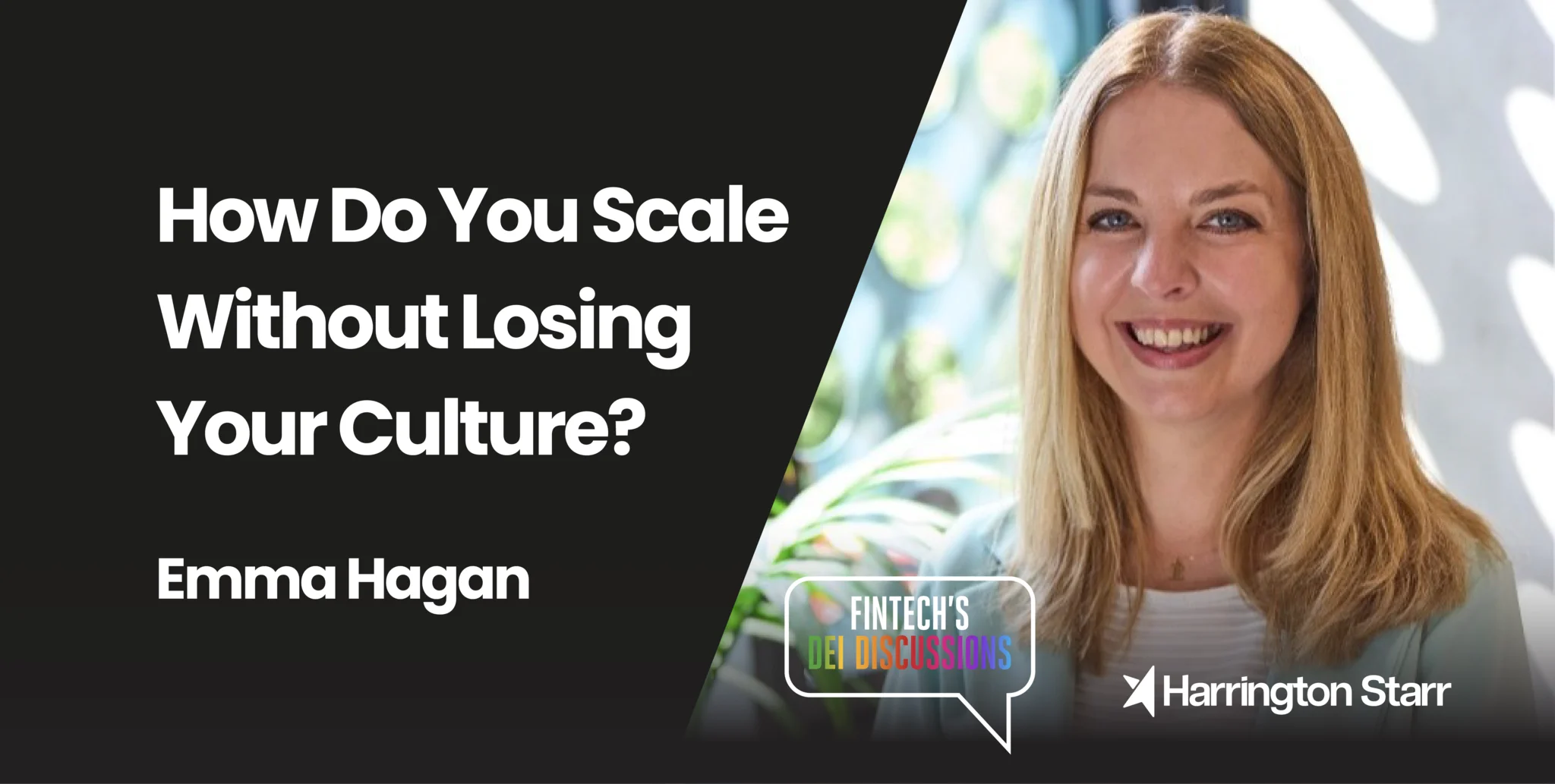
In this episode of FinTech's DEI Discussions, Nadia Edwards-Dashti is joined by Emma Hagan, UK CEO of ClearBank, for a conversation exploring the relationship between FinTech growth, inclusive leadership, workplace culture and belonging. Drawing on more than 20 years in banking, Emma shares her journey through traditional financial services and innovative, high-growth organisations, as well as her perspective on what businesses need to protect as they scale.
The discussion moves beyond diversity and inclusion as standalone initiatives. Instead, Emma explores how inclusion can become part of the everyday decisions a business makes, from hiring and career development to workplace policies and organisational growth.
With the FinTech sector continuing to evolve, the episode raises an important question for leaders across financial technology: how do you scale without losing your culture?
ClearBank's story begins around a decade ago, against the backdrop of a changing banking landscape. Digital challenger banks were emerging and reshaping expectations around how consumers and small businesses interacted with financial services.
Emma explains that while businesses such as Monzo and Starling were bringing innovation to the front end of banking, access to clearing and payment rails remained dominated by incumbent providers and legacy technology.
ClearBank was founded to address that challenge by creating a modern, scalable and digital-ready platform for accessing clearing rails. The business has since expanded its proposition, including embedded banking, working with financial institutions that have strong customer-facing propositions while ClearBank provides the underlying banking infrastructure.
At the heart of this approach is the ambition to create greater competition, access and choice for consumers and small businesses.
But ClearBank's journey has also been one of significant organisational growth. From its beginnings, the company has scaled across products, transactions, accounts and client types. Emma also discusses ClearBank's expansion into Europe following the granting of its European banking licence in the Netherlands.
That expansion brought its API and cloud-driven technology approach to a wider market, supporting innovative companies and FinTech businesses looking to scale.
Emma's description of this journey provides important context for the wider conversation. Scaling FinTech is not simply about increasing capacity or entering new markets. Growth changes organisations, teams and the environment in which people work.
Emma's career has remained rooted in banking, but her experience has progressively moved closer to the centre of financial technology innovation.
She began her career within traditional banking, which gave her structured training and a grounding in how banking infrastructure works, including Bacs, Faster Payments and CHAPS, as well as a broader understanding of the communities that banks serve.
Around five years into her career, she moved to Silicon Valley Bank, which she describes as a startup within a larger organisation as it looked to establish its UK bank at the time. This introduced Emma to a different environment: one characterised by growth, innovation and the challenges of scaling.
As her career moved from traditional banking towards businesses focused on innovation and FinTech, Emma found herself increasingly drawn to organisations and individuals with a clear mission and sense of purpose.
For Emma, one of the most exciting aspects of FinTech is the opportunity to support people who are actively trying to solve problems and serve areas of the economy that may previously have been underserved.
This journey eventually led her to ClearBank, combining traditional elements of banking, such as accounts and payments, with a technology stack built for a new era of digital financial services.
It is an experience that has also shaped Emma's approach to FinTech leadership.
Over more than two decades in banking, Emma's leadership style has evolved through the people she has worked with, the advice she has received, the successes she has witnessed and the mistakes she has made.
Rather than expecting every individual to excel in exactly the same areas, Emma describes a leadership approach focused on helping people maximise their existing strengths while supporting them with areas for development.
She acknowledges that a development area may never become someone's greatest strength, but leaders can help people develop those skills while creating opportunities for them to succeed in the areas where they naturally perform best.
Openness, honesty, support and authenticity are therefore central to her leadership style.
Emma also speaks about approaching leadership with an element of mentorship, helping people identify opportunities that are genuinely right for them. Importantly, that means looking beyond job titles.
Finding an organisation whose values fit the individual can have a significant impact on someone's experience at work. Given the amount of time people spend in their workplaces, Emma argues that finding an organisation aligned with what someone wants from their career and suited to their working style matters enormously.
For FinTech recruitment and financial technology recruitment, this is a particularly relevant point. Building successful FinTech teams is not simply about matching technical skills to a vacancy. Long-term success can also depend on the alignment between people, leadership, purpose, working environment and organisational values.
The conversation turns to the connection between technology and inclusion and how ClearBank has approached creating change.
Emma explains that the organisation attracts people who care about its mission, but also people who want to create a better environment for the next generation. Rather than focusing solely on talking about inclusion, ClearBank has sought to make tangible changes through action.
One example is its work with Code First Girls, supporting more women to enter technology and creating routes for people to join the organisation. ClearBank has also worked with Progress Together around socioeconomic diversity and Women in Finance around gender diversity.
These partnerships reflect a broader question for the industry: how can financial technology create more opportunities for people to build careers in the sector?
FinTech can appear daunting from the outside, particularly for someone who does not see themselves reflected in the traditional image of who they think works in technology or financial services.
Changing that perception requires more than one major initiative. Emma emphasises the cumulative impact of smaller decisions and processes.
That includes considering whether hiring processes attract balanced groups of candidates and whether recruitment itself is inclusive enough to encourage people who may not otherwise have considered applying.
Not everything will work immediately. Emma openly discusses the role of trial and error, recognising that organisations sometimes need to test new approaches, understand their impact and learn from the outcome.
For businesses building technology teams across financial services, this willingness to learn is an important part of developing a more inclusive workplace culture.
Against a wider environment where Emma believes there is significant opportunity for division and polarisation, her definition of inclusion focuses heavily on listening, perspective and belonging.
Inclusion means listening to other views and appreciating different perspectives. It means creating an environment where everyone can experience a genuine sense of belonging.
Within the workplace, that translates into people feeling valued, seen and heard. It means knowing that people care and recognising both the differences between colleagues and the experiences they share.
This sense of belonging connects directly with the earlier discussion around mission and purpose.
Having a compelling mission can motivate employees, but purpose alone is not enough. The way people feel when they arrive at work matters too.
Employees may believe deeply in what an organisation is trying to achieve, but if they do not feel included, listened to or cared about, that connection to the mission can only go so far.
For inclusive leadership, workplace culture and employee experience, the lesson is clear: belonging is created through people's everyday experiences of work.
One of the central themes of the episode emerges when Nadia asks Emma what firms often overlook as they scale.
For Emma, one of the biggest challenges is culture.
Businesses naturally spend significant time considering how to scale their technology platforms, operational processes and controls. Increasingly, they may also ask how AI can help them become more efficient or support future growth.
But there is another question that Emma believes receives less attention: how do you retain the cultural characteristics that made the business successful in the first place?
The culture of a small startup can be very different from that of a scaling financial technology company.
At the beginning, employees may know everyone in the organisation by name. Colleagues may know one another's families, communication can be direct and informal, and employees generally know exactly who to contact when something needs to happen.
Rapid growth changes that dynamic.
A scaling business may be hiring large numbers of new employees. Teams expand, organisational structures become more complex and people no longer know everybody across the company. New hires can also bring elements of cultures from their previous workplaces into the organisation.
None of these changes are inherently negative. They are a natural part of growth. But they create a challenge for leadership.
Organisations need to understand which aspects of their culture are fundamental to their identity and success, while recognising that culture will inevitably evolve as the business becomes larger.
When growth happens at pace, the amount of change employees are expected to absorb can be enormous.
Supporting people through that transition while staying true to the values that made the company successful is, in Emma's view, one of the most important and frequently overlooked elements of scaling.
Looking ahead, Emma considers the responsibility of the wider UK FinTech ecosystem.
Compared with major financial services organisations, FinTech businesses may not always have access to the same resources or internal expertise. This creates an opportunity for businesses across the industry to work together, pool efforts and support initiatives that can create wider impact.
Partnerships such as Code First Girls are one example of how collective action can support progress.
But Emma also argues that inclusion must remain part of the FinTech growth conversation.
The industry's headlines frequently focus on growth, valuations and other tangible measures of success. Those metrics matter, but they should not become the only way the sector measures progress.
Emma describes FinTech as a "jewel in the UK crown", highlighting the importance of the sector to the country's wider innovation landscape. With that position comes an opportunity to consider the long-term impact the industry creates alongside its commercial and technological achievements.
For organisations hiring across FinTech, payments, banking technology and the wider financial technology ecosystem, growth creates demand for skills, but it also raises questions about what type of workplaces the sector is building as it expands.
The episode concludes with a practical challenge for everyone working across financial technology.
Emma encourages people to think about the decisions they make through the lens of inclusion.
Organisations make countless micro decisions every day. Individually, they may appear relatively insignificant. Collectively, however, those decisions can move a workplace towards or away from the culture it intended to create.
Emma uses return-to-office policies as an example.
Rather than considering a mandatory office policy purely as an operational decision, leaders can also ask what it means for inclusion. Will the decision help or hinder the organisation's efforts to create an inclusive workplace? Where there could be a negative impact, what mitigation could be introduced?
This does not mean businesses cannot make difficult decisions. It means considering the wider consequences of those choices before implementing them.
The eventual culture of an organisation is therefore not determined only by major DEI programmes, partnerships or public commitments. It is also the accumulation of smaller choices made every day by people throughout the business.
Crucially, that means inclusion is not solely the responsibility of senior leadership, HR or DEI teams.
Everyone can influence the decisions around them, regardless of their position.
Emma's conversation with Nadia highlights why people and culture cannot be separated from the future of financial technology.
The FinTech industry continues to evolve through new technologies, digital banking models, embedded banking, payments innovation and the growth of cloud and API-driven financial infrastructure. Yet the businesses leading that transformation still depend on people.
As organisations scale, their hiring decisions can influence not only whether they have the skills required for growth, but also what their culture becomes.
For Harrington Starr, this conversation closely reflects the challenges we see across FinTech recruitment and financial technology recruitment. As firms grow, enter new markets and build increasingly sophisticated technology platforms, finding the right talent means considering technical capability alongside the environment in which those people will work and grow.
Across areas such as software engineering, product, data and AI, payments technology, cloud, cyber security and leadership, financial technology businesses need teams capable of delivering innovation at scale. But sustainable growth also depends on creating organisations where talented people can contribute, develop and feel that they belong.
Emma's perspective demonstrates that the human side of scaling should not become secondary to the technical one.
Technology platforms need to scale. Operations need to scale. Controls need to scale. Products and client propositions need to evolve.
Culture must evolve alongside them.
Perhaps the most important message from this episode of FinTech's DEI Discussions is that culture cannot simply be preserved by declaring a set of values.
It has to be reinforced through action.
From ClearBank's growth alongside the digital banking ecosystem to Emma's own journey through more than 20 years of banking, the discussion demonstrates how closely innovation, leadership, people and purpose are connected.
Emma's approach to leadership focuses on helping individuals maximise their strengths, supporting development, creating opportunities and recognising the importance of finding the right values fit. Her perspective on inclusion similarly centres on something tangible: whether people feel valued, heard, seen and included in the workplace around them.
As FinTech firms scale, those principles can become harder to maintain. New people join. Structures change. Teams expand. New markets open. The informal relationships of a startup give way to the systems and processes required by a larger organisation.
The answer is not to resist that evolution. It is to understand what made the culture valuable in the first place and make conscious decisions about how those qualities can continue as the organisation grows.