Inclusion is Not Charity
15 October, 2026


After more than three years of challenging conditions across financial services and FinTech recruitment, there are early signs that the hiring market could be beginning to change.
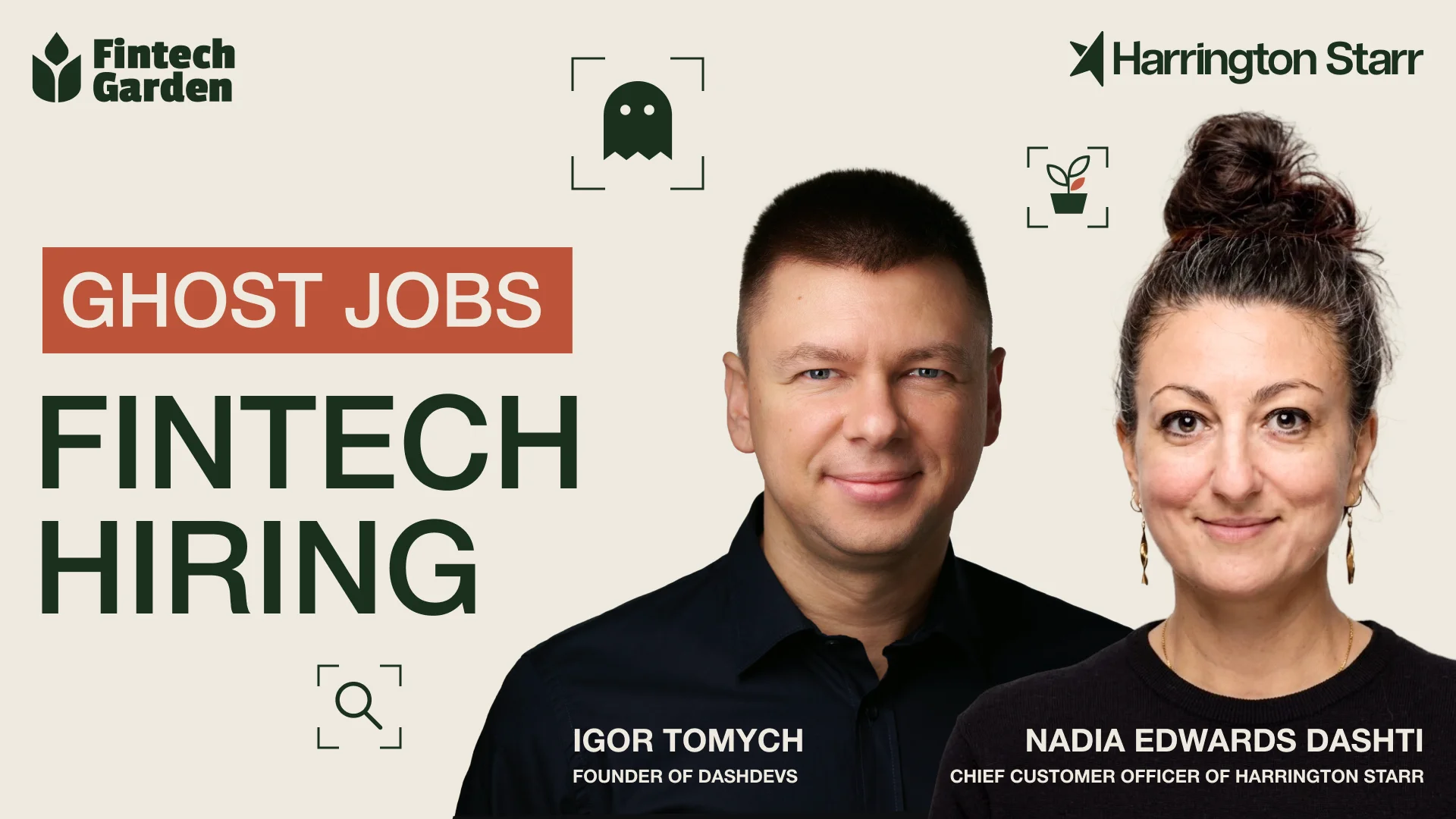
That was one of the central themes explored by Nadia Edwards-Dashti, Co-Founder and Chief Customer Officer at Harrington Starr, during her recent appearance on the FinTech Garden podcast.
Drawing on 22 years of recruitment experience and Harrington Starr’s visibility across the financial technology hiring market, Nadia discussed what the last few years have meant for employers and professionals, why the current market differs from previous downturns, and what businesses need to consider as hiring activity begins to return.
From AI and automation to candidate experience, retention, junior hiring and succession planning, the conversation highlighted a fundamental challenge facing the FinTech industry: businesses may be focused on becoming leaner today, but are they building the talent they will need tomorrow?
The UK FinTech hiring market has experienced a difficult period.
Nadia describes the past three and a half years as a significant downturn for hiring across financial services and financial technology, with more redundancies and fewer genuine growth positions.
Rather than recruiting to support expansion, many businesses have been replacing departing employees, restructuring teams or reorganising existing responsibilities.
The push for efficiency has played an important role in this.
As FinTech businesses have focused more heavily on their bottom line, many have looked to operate with leaner teams. In practice, that has sometimes meant employees taking responsibility for work that would previously have been spread across two or three positions.
For professionals seeking a new FinTech job, promotion or salary increase, Nadia describes this period as the toughest she has experienced during her 22 years working in recruitment.
There is, however, reason for cautious optimism.
Nadia is beginning to see more vacancies entering the market and more professionals who have been searching for work securing new positions.
For employers, this shift creates an important moment. A market that has favoured businesses for several years will not necessarily remain that way indefinitely.
Unlike the 2008 financial crisis, the recent downturn cannot easily be attributed to one event.
Nadia characterises the experience as a “slow punch”: a series of challenges arriving one after another rather than a single moment of disruption followed by recovery.
The pandemic was followed by an extraordinary hiring boom across technology and FinTech. Businesses competed aggressively for talent, teams expanded quickly and salaries rose.
That expansion was followed by a correction.
Some FinTech companies concluded that they had overhired during the boom, while changing economic conditions placed greater pressure on growth, profitability and valuations.
At the same time, businesses have had to navigate geopolitical instability, higher living and operating costs and rapid developments in artificial intelligence.
Combined, these factors have created prolonged uncertainty around investment and FinTech hiring.
The result has been very different from a traditional boom-and-bust cycle. Businesses have had to continually reassess what skills they need, where they invest and how large their teams should be.
For leaders building technology, data, sales, product, cyber security, risk and executive teams across financial services, that makes workforce planning increasingly important.
Hiring only for the immediate problem may no longer be enough.
Artificial intelligence has inevitably become part of the conversation around the future of FinTech recruitment.
However, Nadia challenges the assumption that AI simply means replacing people.
The more important question is how businesses combine human skills, experience and accountability with increasingly capable technology.
AI may automate elements of existing positions. It may allow teams to complete certain tasks more quickly and it may change which skills organisations value most.
But somebody still needs to be accountable for the outcome.
Businesses still need professionals who can recognise when something does not work, challenge an output, understand a customer experience and create the next product, process or idea.
That distinction matters enormously for financial technology hiring.
The question facing employers should therefore not simply be, “Which jobs can AI replace?”
It should be: “What skills will our organisation need as AI changes the way these jobs are performed?”
That creates a very different talent strategy.
Rather than seeing AI exclusively as an opportunity to reduce headcount, businesses can consider how technology can increase the capabilities of their existing people and what new expertise will be required as their organisation evolves.
For a sector built on challenging the status quo and finding better ways of working, Nadia argues that this ability to adapt should remain central to FinTech.
During a difficult hiring market, it can be easy to assume that existing employees have limited alternatives.
That can quickly become dangerous.
Nadia contrasts the current environment with the FinTech hiring boom of 2022. At that point, the prospect of losing a significant proportion of a workforce would have been a major concern for employers.
Companies invested heavily in retaining people, improving flexibility and responding to what employees wanted from work.
As hiring slowed and more professionals became available, that balance changed.
But a business that assumes there will always be another candidate available risks undervaluing the knowledge already inside its organisation.
And as FinTech recruitment activity increases, professionals who have delayed moving jobs may begin reconsidering their options.
People who wanted a promotion, a different challenge or an opportunity to work with new technology but stayed because of market uncertainty could become increasingly open to new roles.
This makes retention a strategic hiring issue.
Businesses should understand where their critical knowledge sits, which employees are ready to progress and where people feel their career has stalled.
Waiting until an experienced employee resigns means that conversation has come too late.
Another major theme from the discussion was the treatment of candidates during the hiring process.
A difficult job market can create enormous application volumes. Employers may advertise a position and receive hundreds of applications, creating a significant workload for internal recruitment and talent teams.
But volume does not remove the responsibility to communicate.
Nadia highlights the impact that unclear hiring processes, abandoned vacancies and a lack of feedback can have on both candidates and employer brands.
Automation can make recruitment more efficient, but if that automation removes communication from the process, candidates can be left repeatedly applying for positions without understanding whether they are still being considered.
For someone already navigating redundancy or a prolonged job search, that uncertainty can be incredibly difficult.
There is also a commercial reason businesses should care.
Candidates are part of a company’s wider reputation.
Someone who has an excellent experience but does not secure the position can still leave with a positive perception of the organisation. They may apply again, recommend the company or encounter the business later as a customer, partner or industry peer.
Poor recruitment experiences can have the opposite effect.
Transparency can solve much of this.
Setting expectations around when applications will be reviewed, what the interview process involves and when candidates can expect a decision gives professionals clarity while helping employers build trust.
Candidate experience should not disappear simply because there are more candidates available.
Perhaps the biggest long-term issue raised in the conversation is the reduction in junior hiring.
When businesses are under pressure to operate efficiently, hiring someone who requires training can seem less attractive than recruiting an experienced professional who can make an immediate impact.
AI creates another consideration because some of the tasks historically performed in entry-level positions can increasingly be automated.
But removing junior opportunities today could create a serious talent shortage tomorrow.
Nadia points to what happened following the 2008 financial crisis.
Businesses reduced investment in inexperienced talent. A few years later, employers began asking where all the professionals with approximately three years of experience had gone.
They did not exist in sufficient numbers because organisations had not hired and developed them three years earlier.
The FinTech industry risks repeating the same cycle.
The roles required in 2028 or 2029 may look different from those required today, particularly as artificial intelligence changes software engineering, data, cyber security, operations and financial technology products.
But those future specialists still need opportunities to enter the industry and gain commercial experience.
A company cannot suddenly create a pool of experienced professionals when demand returns.
Talent pipelines take time to build.
This is why succession planning becomes so important.
Hiring strategy should not only answer the question of what a company needs now. It should consider what the organisation expects to need two, three or five years from now.
Which employees could become future leaders?
Which skills are likely to become business critical?
Where does the organisation rely too heavily on one person?
Which employees could be retrained as technology changes?
And where will the next generation of experienced professionals come from?
Nadia argues that businesses should be having these conversations with the people already inside their teams.
Someone may be ready for greater responsibility. Another employee may want exposure to a new technology. Someone else may have the potential to move into leadership but has never been given the opportunity.
Internal progression can simultaneously improve retention and create opportunities elsewhere in the organisation.
Succession planning therefore becomes more than an HR exercise. It is part of building a resilient FinTech workforce.
Solving future skills shortages will also require businesses to reconsider where talent comes from.
FinTech recruitment has traditionally placed significant value on direct industry experience. For some positions, particularly highly specialised roles, that knowledge remains essential.
But requiring every hire to have already worked in precisely the same environment can dramatically reduce the available talent pool.
Nadia highlights the value of professionals entering financial technology from other industries.
Someone who has delivered a major transformation elsewhere may bring expertise that translates effectively into FinTech. Professionals from education, for example, have moved into areas including cyber security and financial crime and brought different perspectives to those environments.
As technology changes existing roles and creates new ones, transferable skills could become increasingly important.
The businesses that successfully identify potential, rather than simply matching previous job titles, may have access to a much broader talent pool.
Nadia closes the conversation with a challenge that sits at the centre of many of these issues: how do organisations identify potential?
And, critically, how do they identify it fairly?
If FinTech companies want to develop future leaders, attract people from different industries, retrain employees and create meaningful succession plans, they need to recognise capability before someone has already performed the exact job.
Historically, leaders can feel more comfortable hiring or promoting people who demonstrate qualities they recognise in themselves.
But innovation depends on different perspectives.
Identifying potential means understanding the behaviours, capabilities and experiences that suggest someone could succeed at the next level rather than expecting them to already be there.
Once businesses can identify that potential, they can invest in it.
That could mean developing an existing employee, giving someone their first opportunity in financial technology, retraining a professional whose role is changing because of AI or backing a future leader before they have an established leadership title.
The result is a stronger talent pipeline and a more adaptable workforce.
The FinTech hiring market may be improving, but the lessons of the last few years should not disappear as vacancies return.
Businesses have spent several years becoming leaner, reorganising teams and scrutinising headcount. Now they need to consider whether those decisions have created gaps that will become increasingly visible as the market grows.
The organisations best positioned for the next phase will not necessarily be those that simply start hiring more people.
They will be the businesses that understand exactly what talent they have, what talent they need and how those requirements are changing.
They will invest in retention before valuable employees decide to leave. They will consider junior talent before skills shortages appear. They will use AI to augment people rather than viewing technology and talent as competing investments. They will communicate transparently with candidates and protect their employer brand. And they will build succession plans before vacancies become urgent.
Above all, they will continue to recognise the value of people.
Technology may transform how financial services businesses operate, but businesses still need people who can challenge, innovate, take responsibility and understand when something can be better.
For Harrington Starr, these questions sit at the heart of financial technology recruitment.
We work across the FinTech and financial services ecosystem, helping organisations understand talent markets and build the teams required to support their next stage of growth.
Our recruitment expertise spans technology, sales, risk and senior leadership, with visibility across FinTech businesses including payments, digital assets and more traditional financial services organisations.
As hiring conditions evolve, access to the right talent is only part of the challenge. Businesses also need to understand where skills are becoming scarce, how candidate expectations are changing and what their competitors are doing to attract and retain people.
Whether you are planning future headcount, responding to a critical skills gap, expanding into a new market or reconsidering the structure of an existing team, Harrington Starr can help you navigate the financial technology talent market.
The FinTech hiring market is beginning to move.
The question for employers is whether their talent strategy is ready to move with it.