Artificial intelligence has rapidly become one of the most talked-about developments in financial technology. Much of the conversation focuses on the potential of AI to transform trading, risk modelling, and data analysis. Yet one of the most significant shifts is happening earlier in the technology lifecycle: in the way software itself is being built.
Across financial markets, software engineering teams are beginning to integrate AI into the development process. From code generation tools to automated testing and debugging, AI-assisted development is enabling engineers to work more efficiently and focus more time on solving complex architectural problems. Rather than replacing engineers, these tools are increasingly augmenting their capabilities.
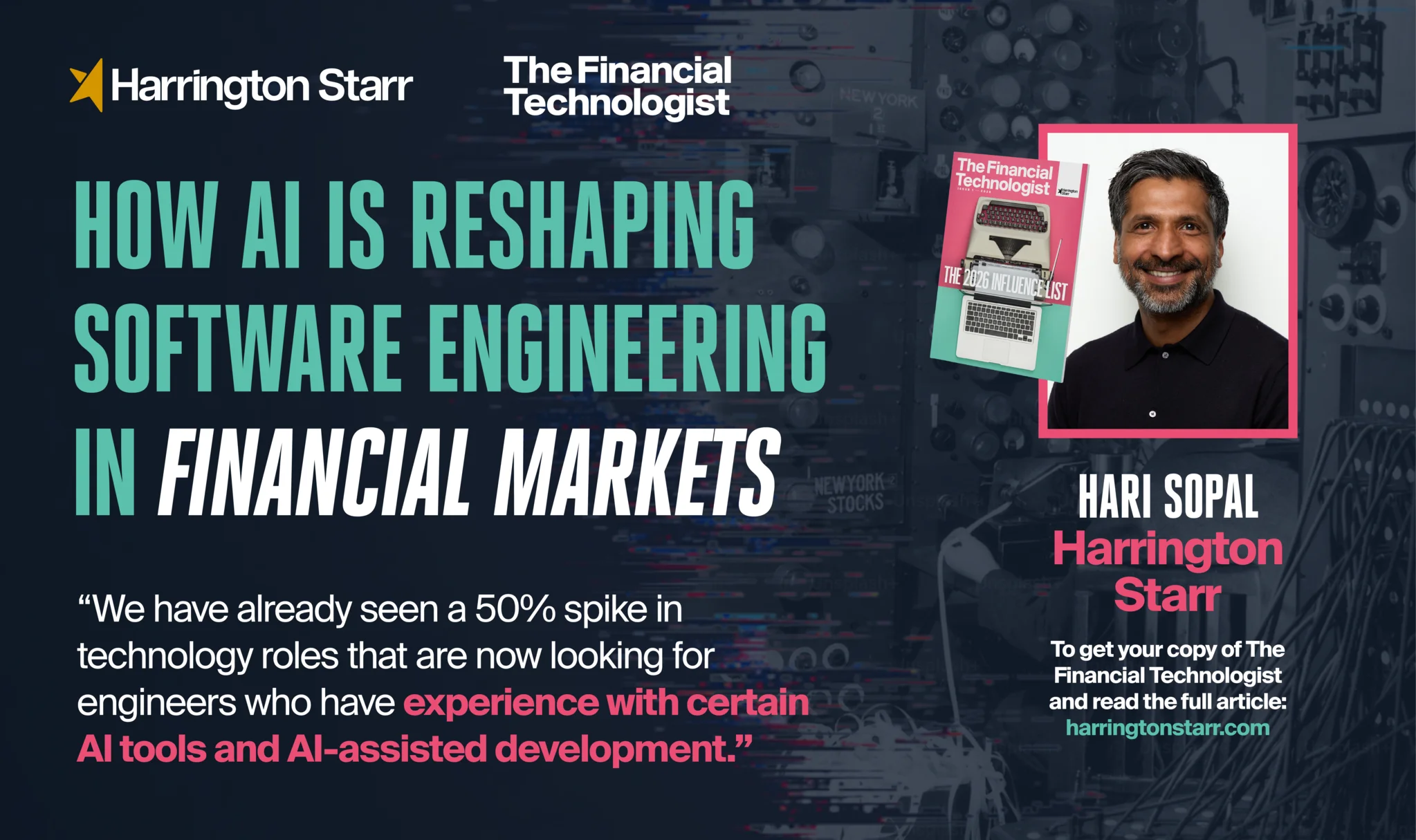
We have already seen a 50% spike in technology roles that are now looking for engineers who have experience with certain AI tools and AI-assisted development. Platforms like Codex/ Copilot, etc., are now front and centre of technology job specs. Finding engineers with AI-assisted development or an AI-enabled/ polyglot mindset is the key.
AI-enabled development tools are allowing engineers to prototype faster, explore alternative approaches to system design, and reduce time spent on repetitive coding tasks. In practice, this means engineering teams can focus more on higher-value work such as system architecture, scalability, and resilience. For financial institutions that depend on reliable technology platforms, these capabilities are becoming increasingly important.
At the same time, the broader technology landscape within financial markets is evolving. Firms are modernising legacy platforms, adopting cloud infrastructure, and integrating advanced data and analytics capabilities into their systems. These changes are creating more complex technology environments, where software engineers must work across distributed architectures, data pipelines, and real-time systems.
In this environment, the role of the software engineer is evolving. Technical depth remains essential, but engineers are increasingly expected to understand how their systems interact with data platforms, infrastructure layers, and automated processes. The ability to design systems that are both scalable and resilient is becoming just as important as writing efficient code.
AI is also introducing new opportunities for experimentation within engineering teams. By accelerating development cycles and lowering the barrier to testing new ideas, these tools enable firms to iterate more quickly when building new financial applications. This flexibility is particularly valuable in a market environment where innovation cycles are shortening, and new technologies are emerging rapidly.
However, the introduction of AI into the development process does not remove the need for experienced engineers. Financial systems operate in highly regulated and mission-critical environments, where stability, reliability and security remain paramount. Engineers continue to play a central role in designing the systems that ensure markets function smoothly and securely. The key is being able to utilise AI to improve software development practices, and the human element will remain an essential part of development. Engineers must understand how to apply AI effectively for it to be a successful partnership.