What this means for marketing, leadership, and brand in financial services
Financial services has always been an industry where reputation matters. What has changed is the pace at which that reputation is built, shaped and shared. It is no longer something developed quietly over time. It is happening in real time, through conversations, content and visibility.
There is now a clear expectation that individuals and businesses show up, contribute, and engage. Visibility is no longer optional. It plays a direct role in how credibility is formed.
What is becoming increasingly clear, however, is that while more people are showing up, much of what is being shared is starting to look and sound the same.
In a market where everyone has access to the same tools, the same platforms, and increasingly the same AI-driven outputs, differentiation is not getting easier. It is getting harder.
This is where the pressure on marketing teams is most visible. There is an expectation to keep pace with the speed of AI, while still delivering everything else the role demands. Content, events, data, analytics, brand, leadership visibility and team management all sit alongside the need to constantly evolve.
There is also a growing misconception that marketing can simply be automated. That everything can be pushed through AI and scaled without much thought. The reality is very different. While AI is a powerful tool, it cannot replace the depth, context and creativity that comes from being close to your audience and your market.
And this is not a future risk. It is already happening. As more teams rely on the same tools and the same sources of information, outputs are starting to converge. In trying to move faster, many teams are becoming less distinct.
This is a consistent theme across conversations with marketing leaders in financial technology. At a recent roundtable, the same concern came up repeatedly. As reliance on shared tools increases, individuality becomes harder to maintain. Alongside this, there was a clear focus on practical application, from demand generation to customer experience. It reinforced how quickly AI has moved from concept to operational priority.
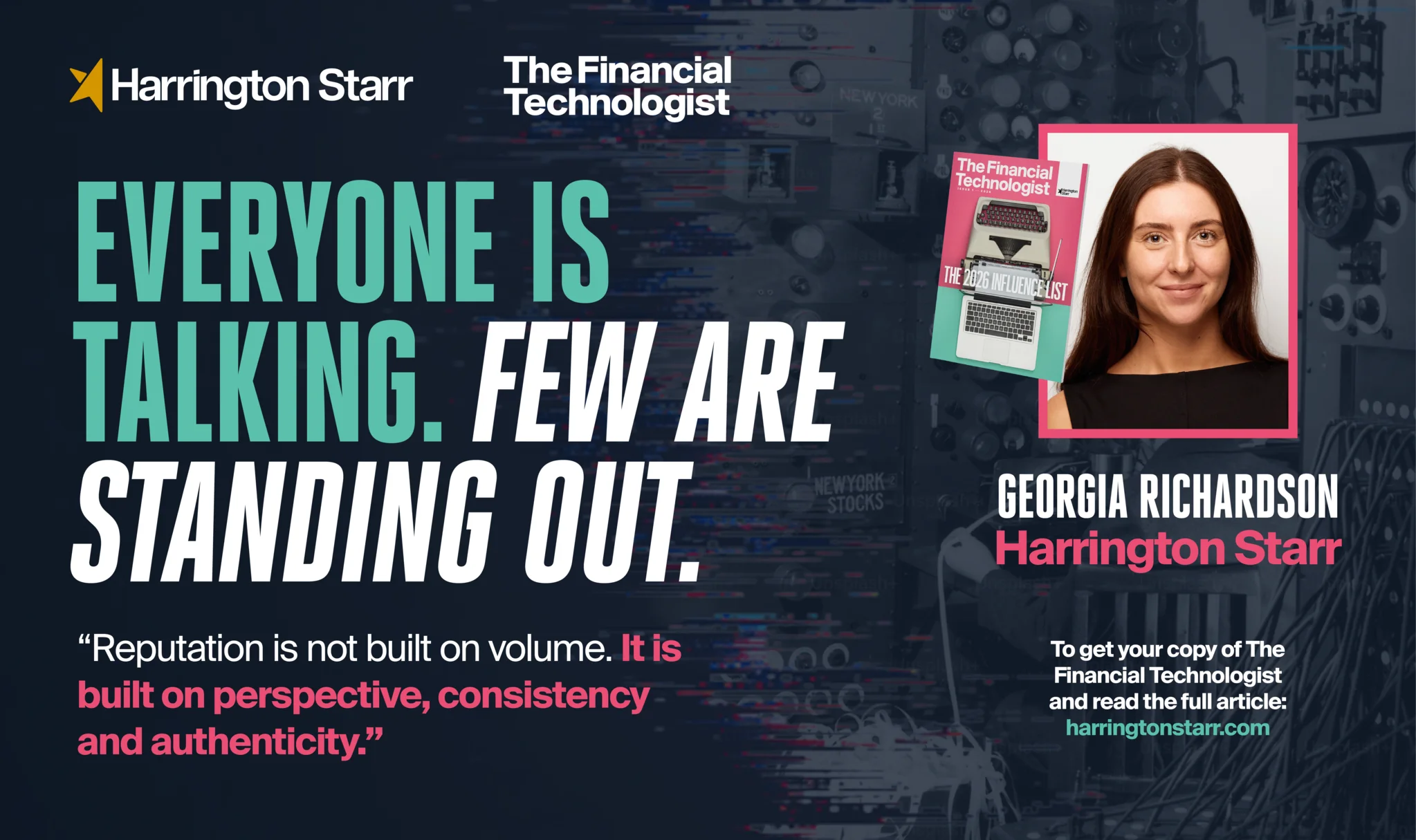
In an industry that is already highly competitive, that lack of differentiation becomes a problem. Reputation is not built on volume alone. It is built on perspective, consistency and authenticity.
That perspective does not come from tools alone. It comes from proximity to the market, from real conversations and from consistently showing up in the right places.
A clear example of where this plays out differently is in the moments where people and organisations step beyond standard content and into real conversation.
Harrington Starr’s International Women’s Day event, Leadership That Opens Doors, brought together more than 275 professionals across the industry. What stood out was not just the scale, but how strongly the message resonated across the room. It was not a conversation limited to one audience. It was a reminder to reflect on who opened doors for us, and who we are opening doors for now.
Moments like Tribeni Chougule bringing the person who opened the door to her career at VISA are the ones that stay with you. They cut through everything else and bring the focus back to people, relationships and impact.
That same dynamic is visible across the industry. Whether it is moderating panels at events like PAY360, hosting conversations through platforms such as FinTech Focus TV, or creating spaces for meaningful dialogue, these moments shape how individuals and organisations are perceived. They create visibility, but more importantly, they create substance behind that visibility.
This is where marketing is no longer a support function. It is central to how a business is understood. It is not just about promoting a business. It is about shaping how that business shows up in a fast-moving, highly visible environment.
In a market where everyone is visible, standing out is no longer about volume. It is about having something worth saying.
The challenge is not just keeping up with change, but doing so in a way that still feels human.
Because while technology will continue to evolve, it is still people who build relationships, create trust and open doors for others. And in an era where everything is moving faster than ever, that human element is what will continue to set individuals and organisations apart.
This is an article from The Financial Technologist: Influence List - page number: 60-61