Is This the End of Enterprise Architecture as We Know It?
07 October, 2026

Investment management technology is entering a period of fundamental change. After years of cost pressure, increasingly complex operating models and reliance on technology that was not always built for the demands firms face today, the buy side is reassessing what it needs from its infrastructure. Cloud-native architecture, open APIs, better access to data and the rapid development of artificial intelligence are creating new possibilities, but they are also changing expectations around what good financial technology should deliver.
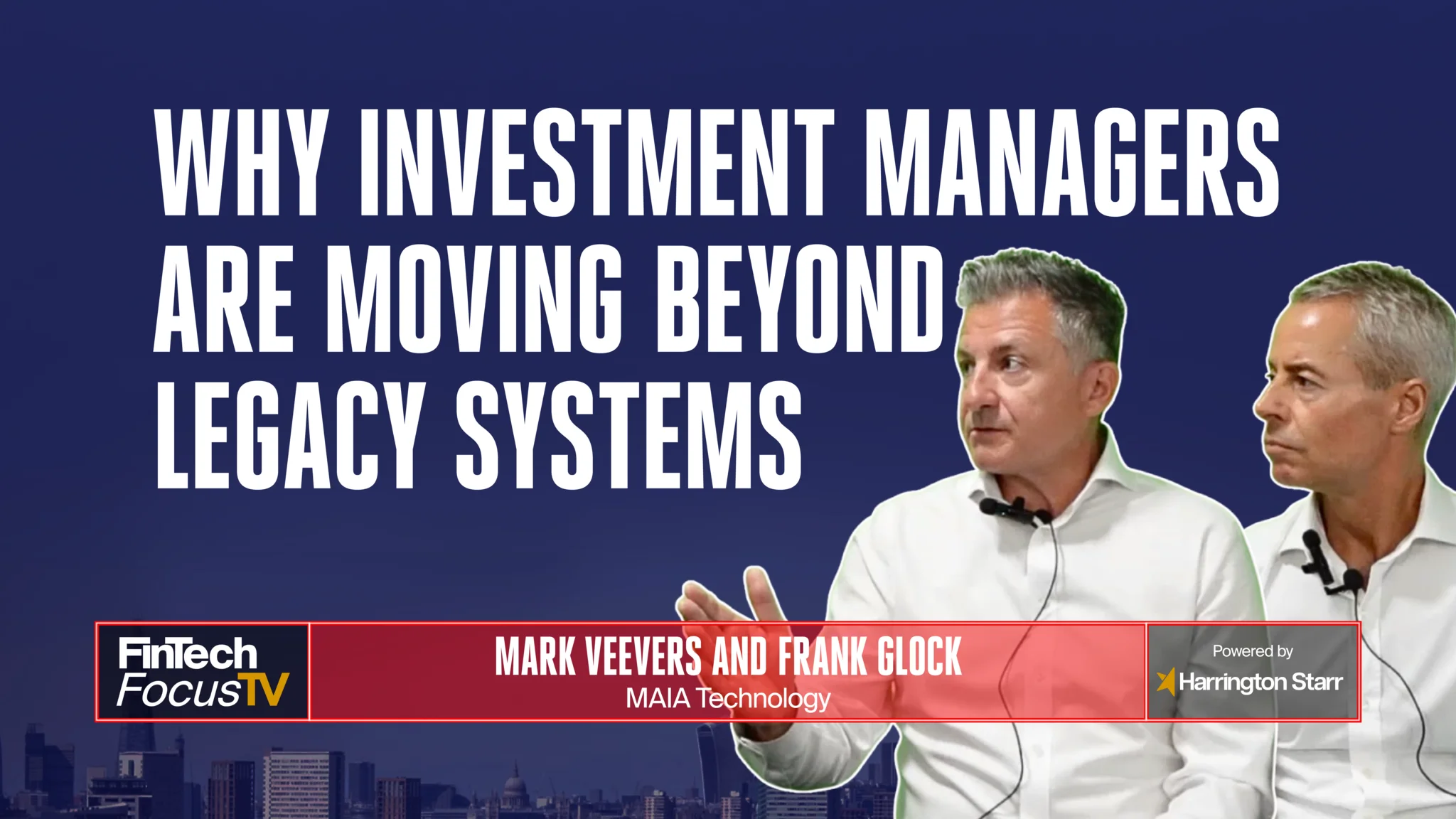
In this episode of FinTech Focus TV, Harrington Starr CEO Toby Babb is joined by Mark Veevers, Chief Executive at MAIA Technology, and Frank Glockf, Chief Revenue Officer at MAIA Technology, to discuss this transformation and what it means for investment managers.
Drawing on decades of experience across financial technology, asset management and commercial leadership, Mark and Frank explore the evolution of MAIA Technology, the challenges facing investment firms, the changing role of legacy systems and why composable, API-led infrastructure is becoming increasingly important. They also discuss AI in financial services, operational efficiency, customer success, cybersecurity and what it takes to build and grow a financial technology company in a risk-conscious industry.
MAIA Technology’s story begins not as an external software proposition, but as an internal technology project designed to solve genuine investment management challenges.
Mark explains that the technology underpinning MAIA was originally built within Fulcrum Asset Management. One of the first challenges it sought to address was parallelising econometric backtesting, but the platform’s remit expanded significantly from there. It was cloud-native from its beginnings and developed to support order and execution management for a complex investment business trading across numerous asset classes and handling thousands of orders each day.
Over time, the platform evolved into a full front-to-middle-office solution. Today, it sits at the centre of clients’ business operations, allowing them to interrogate portfolio information, perform compliance and risk functions and implement investment decisions through order raising. Its coverage also extends across trading and execution and into post-trade workflows, including position lifecycle events and shadow NAV.
Turning technology created for one investment manager into a commercially deployable financial technology platform required another stage of development. Mark explains that MAIA’s first two years were largely focused on creating the infrastructure required for a repeatable, resilient and monitorable commercial platform.
Built as a cloud-native, single-tenant solution on AWS, this foundation enabled the business to move beyond its origins and begin serving a wider market.
MAIA initially grew organically without a dedicated professional sales function. That changed when Frank joined the business in 2023 and designed its go-to-market strategy, helping increase MAIA’s visibility and commercial presence in the investment management technology market.
One of the clearest themes of the conversation is the sheer pace of change taking place across investment management.
Frank argues that more has happened across the industry in the past two or three years than in the previous 20. Historically, success for an asset manager could be defined heavily by assets under management and the ability to generate investment alpha. Today, he believes operational alpha has become equally important.
Investment firms are facing pressure to become more efficient while dealing with increasingly complex businesses, technology environments and client requirements. That is forcing organisations to look more critically at whether their existing technology actually enables them to operate effectively.
Frank identifies two models that have dominated over the past two decades. The first is bottom-up procurement of individual point solutions. Over time, that can leave firms with highly federated technology infrastructures and disconnected systems. The alternative has been large front-to-back platforms. These played a transformational role in financial services technology, but some have become increasingly rigid and can dictate how a firm operates rather than adapting around the way that firm wants to work.
The industry is now moving towards another model. APIs, cloud computing, data orchestration and AI are creating an environment where firms can seek greater interoperability and flexibility without necessarily returning to disconnected desktop systems.
For financial technology businesses, investment managers and the professionals building these platforms, this represents a significant change in what the market requires.
The evolution of technology is also changing the people using and procuring it.
Mark highlights a major shift in the technical capabilities found across investment firms. He explains that at almost every MAIA client, people within the front office can code, people within the middle office can code and people within the back office can code.
That change in financial technology talent has fundamentally altered the way firms procure systems and what they expect those systems to be capable of doing.
Rather than simply using a fixed piece of software in a prescribed way, technically capable users increasingly want to interrogate their own data, interact programmatically with systems and build additional solutions around a core platform. API-first systems are consequently becoming a natural choice for firms that want greater control and flexibility.
This is particularly relevant to the wider financial technology recruitment market. As investment management technology becomes more open, configurable and data-driven, the skills required across financial services are evolving alongside it. Technology expertise is no longer confined to traditional IT departments. Coding, data, cloud and technology capabilities are increasingly embedded across front, middle and back-office teams.
Mark points to examples of firms that would not traditionally describe themselves as technology-led already using tools such as ChatGPT, Codex and Claude to accelerate outcomes. The ability of financial services professionals to use technology effectively is becoming an increasingly important part of how firms respond to complexity and scale.
The episode does not simply argue that all legacy technology is bad. Instead, Frank offers a more nuanced way to assess it.
Functionally, he says, there may be nothing inherently wrong with legacy technology. It has served an important purpose across the financial services industry. The problem arises when firms ask whether that technology is still saving them time and money.
Frank compares legacy systems to classic cars. As time passes, the parts and specialist skills required to maintain them can become more obsolete and expensive. The same can happen with financial technology. A system may continue to function while becoming increasingly costly to support and less capable of enabling the organisation to grow.
The real question is therefore commercial and operational: is the technology still the right fit for the business?
Technology should enable scale and generate return on investment rather than becoming a cost centre or impediment to growth.
Mark adds another dimension to this problem: complexity compounds inefficiency. When an investment manager operates across multiple disconnected systems without a single source of truth, obtaining real-time visibility into portfolio information, cash or future cashflows becomes considerably more difficult.
These inefficiencies have a direct financial impact.
At the same time, investment managers have spent years dealing with margin pressure. There is only so far organisations can go by repeatedly cutting costs. The discussion therefore turns towards productivity and the ability to do more with less.
This changes the strategic role of technology. Rather than simply being viewed as a cost, modern financial technology can increasingly act as an accelerator for the business.
So what does modern investment management infrastructure look like?
For Mark, several characteristics are essential.
The first is the ability to manage technology effectively in a cloud environment. MAIA operates as a single-tenant platform, with upgrades, maintenance and client systems managed centrally. Mark notes that single tenancy has historically represented a gold standard in areas including security and scalability, while cloud infrastructure has helped address some of the historical challenges around managing and maintaining such environments.
The second requirement is interoperability and openness.
Investment managers operate in complicated ecosystems. They may use multiple data sources while interacting with numerous prime brokers, execution venues, custodians and other providers. Those relationships and requirements will continue changing over time.
Modern infrastructure therefore needs to evolve without every change requiring extensive development.
The third component is API accessibility. Clients increasingly expect to be able to interact with platforms programmatically, control workflows and access their data. The data belongs to them, and technology needs to allow them to obtain maximum value from it.
These characteristics help explain why open architecture and API-led financial technology are becoming so important across investment management.
Different investment firms naturally have different technology requirements.
Frank explains that MAIA changes how it approaches the market depending on both the type of firm and the people within that organisation.
For startup hedge funds and emerging managers, a simplified front-to-back operating model can be particularly attractive. Smaller organisations are often trying to achieve more with fewer resources, meaning a platform capable of supporting multiple functions without unnecessary operational complexity can resonate strongly.
The proposition changes for larger, more established investment managers or firms scaling their businesses.
Here, Frank discusses what MAIA describes as a “composable operating model”. Advances in data orchestration and cloud computing are supporting more API-led approaches in which a central platform can operate as the central nervous system of an investment firm while other capabilities exist as plug-and-play building blocks.
Those blocks can evolve, scale or change without requiring an organisation to overhaul its entire operating model.
This offers an alternative to lengthy implementations and upgrades. Rather than replacing everything at once, established asset managers can focus on specific areas of their businesses and use API-led solutions to address individual problems.
Configurability is central to this approach. Mark makes an important distinction between configurability and customisation. Customisation may solve an immediate requirement, but it can also create tomorrow’s technology debt. A configurable system can instead evolve as the client’s requirements change.
No conversation about modern financial technology would be complete without discussing artificial intelligence.
Toby notes that AI has dominated industry conversations for several years, but the discussion is now beginning to move beyond hype and towards practical applications. Instead of focusing exclusively on replacement, organisations are increasingly considering how AI can augment people and improve productivity.
For Mark, successful AI starts with data.
The best AI use cases sit alongside consistent, homogeneous datasets. Investment firms are inundated with information ranging from ESG data to position valuations and profit and loss. Bringing those datasets together into a central repository creates a much stronger foundation from which AI can deliver value.
Simply acquiring an AI tool, however, does not guarantee success.
Organisations also require a permissionable framework that ensures the right people can access the right data while preventing inappropriate access. Control over how users and systems interact with information through AI is essential, particularly in an industry dealing with sensitive financial data.
Governance therefore becomes critical.
Mark also addresses one of the biggest questions surrounding AI and financial technology talent: whether AI will replace people. His view is that while there may be areas where replacement occurs, the more likely scenario is that people who use AI will replace people who do not.
Human ownership remains. What changes is the ability of individuals to achieve more through technology.
For financial services employers and FinTech recruitment businesses, this creates an important talent question. The future may be less about separating “technology people” from the rest of an organisation and more about finding professionals who can combine their existing expertise with the ability to use emerging technology effectively.
Technology is only one part of MAIA’s growth story.
Frank also discusses the go-to-market strategy he developed after joining the company and why the business deliberately framed his position as Chief Revenue Officer rather than simply Head of Sales.
For Frank, a traditional sales leadership role can often be heavily focused on owning a revenue number. A Chief Revenue Officer has a broader responsibility.
At MAIA, that encompasses three areas: designing and executing the go-to-market strategy while understanding the voice of the customer, developing the partners and alliances network, and ensuring strong client advocacy.
Together, those responsibilities create what Frank describes as the connective tissue across the commercial organisation.
This customer-led approach also shapes how MAIA sells its technology. Rather than beginning conversations by asking which system a prospective client wants to replace, the team tries to understand what the organisation is attempting to achieve. The focus is on outcomes rather than replacement for replacement’s sake.
That philosophy reflects a wider message running throughout the episode: technology needs to fit the business, rather than forcing the business to fit the technology.
For a relatively young technology provider selling into investment management, trust is crucial.
Mark points out that MAIA’s clients manage financial risk for a living and are naturally risk-conscious. The barriers to entry for smaller financial technology providers can therefore be high.
Building credibility requires more than strong software.
MAIA has worked to demonstrate the integrity of its business and the quality of its technology, but Mark places particular emphasis on delivery and ongoing support. Customer success has been built into the foundations of the organisation, with the company structured around putting clients at the centre of its decisions.
As MAIA’s client footprint has grown, its customer-facing function has evolved too, including bringing experienced professionals from across the industry into the organisation.
This reflects another important lesson for growing FinTech companies. Winning the initial client is only one stage of the relationship. Successful implementation, support and continued client advocacy can be just as important to sustainable growth.
With greater access to technology and data comes greater responsibility.
When Toby asks what keeps him awake at night as a business leader, Mark identifies the pace of change across the industry as one major challenge. A flexible technology framework helps MAIA respond through configuration, but the company must continually ensure that customer needs influence decisions around product, infrastructure and customer success.
Cybersecurity is another significant priority.
Clients trust technology providers with data that can be highly sensitive, including information relating to investment strategies. MAIA therefore invests continually in its cybersecurity capabilities as a core part of both its infrastructure and corporate strategy.
AI adds another dimension to this challenge.
Throughout the episode, the discussion largely focuses on AI as an enabler, but Mark acknowledges that the same technology can be used maliciously. That raises the standard required of cloud-native software vendors and reinforces the need for continued cybersecurity investment.
The challenge is ultimately one of balance: remaining flexible enough to keep pace with client requirements while maintaining the security needed to protect their data.
Looking ahead, MAIA plans to continue growing its footprint while remaining focused on its core platform and customer base.
Frank explains that the company intends to expand geographically and move into adjacent vertical markets, but not at the expense of what it already does well. Rather than heavily diversifying, the ambition is to remain highly focused on its software and client service.
That focus provides an appropriate conclusion to a conversation that spans technology, people, commercial strategy and the changing demands of investment management.
The transformation taking place across the buy side is not simply a story about replacing old software with new software. It is about changing how investment firms think about technology itself.
Cloud-native infrastructure, open APIs, composable operating models and AI are enabling organisations to rethink what is possible. At the same time, technically capable professionals across front, middle and back-office functions are changing how systems are selected and used. Data quality and governance are becoming essential to successful AI adoption. Cybersecurity remains fundamental. And years of margin pressure mean that technology increasingly needs to prove that it can create productivity and enable scale.
For the financial technology recruitment market, these changes matter because technology transformation is ultimately dependent on people. Financial services businesses need professionals capable of operating in increasingly technical, data-driven and AI-enabled environments, while FinTech companies need talent that can build, commercialise, implement, secure and support the platforms powering that transformation.