The Quant Advantage is Disappearing
14 October, 2026

Artificial intelligence has dominated conversations across financial services for the last few years. But as firms move beyond experimentation, the conversation is beginning to change. The question is no longer simply how businesses can access AI. It is how they can turn AI into something that genuinely changes the way people work.
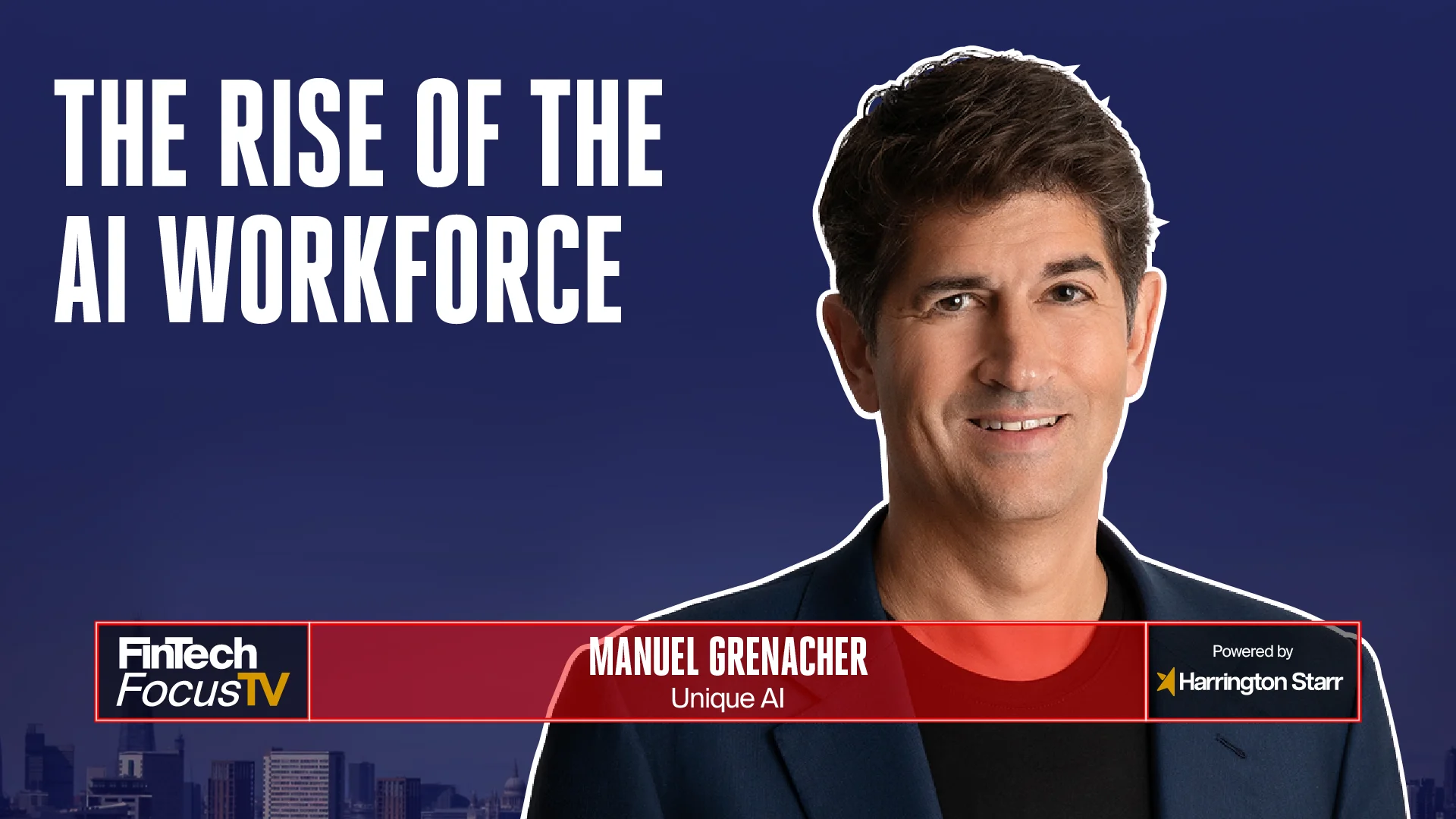
In this episode of FinTech Focus TV, host Toby Babb is joined by Manuel Grenacher, CEO of Unique AI, to explore the next stage of AI in financial services and why the industry needs to start thinking beyond the traditional AI copilot.
From AI teammates and agentic AI to wealth management, forward deployed engineers and the future of work, Manuel shares his perspective on what it takes to move AI from experimentation into production. He also explains why the biggest opportunity may not be replacing people at all, but changing where they spend their time and allowing financial institutions to grow without continually increasing their administrative costs.
The discussion explores the journey Unique AI has taken, the lessons Manuel has learned from building technology businesses, and what he believes the next 12 to 24 months could look like as AI agents become a more established part of the financial services workforce.
Manuel’s journey into technology started long before the current wave of generative AI. Growing up on a farm in Switzerland, his introduction to technology came when his uncle brought him a Mac. Fascinated by what computers could do, Manuel and his neighbour even built an early network to communicate with each other.
Unique AI is now Manuel’s third company. His previous businesses were acquired, including one by SAP, before he and his co-founder became interested in transformer models around five years ago.
They believed these models could completely change the enterprise office environment. What they did not initially know was which industry they should focus on.
That changed when their first client became a wealth manager in Geneva. Working alongside that business gave the team an opportunity to understand how AI could be applied within financial services and ultimately helped shape the direction of Unique AI.
Today, Manuel describes the company's mission as building AI teammates for the wealth management front office. He explains that Unique AI has developed different AI teammates for areas including relationship management, KYC and investor relations, with financial professionals now using its technology globally.
But throughout the conversation, Manuel makes an important distinction. The future he sees is not simply one where every employee has another generic AI assistant open on their computer. It is one where AI becomes capable of taking responsibility for increasingly meaningful pieces of work.
One of the central themes of the conversation is the difference between an AI copilot and a genuine AI workforce.
Generic tools can already help people summarise information, find answers and accelerate basic tasks. However, Manuel argues that the challenge becomes much greater when financial institutions want AI to produce high-quality outputs for specialist processes.
A client briefing, for example, requires more than a generic prompt. The same applies to KYC work and other processes where the quality, context and accuracy of the output matter.
Manuel argues that financial institutions therefore need specialised AI capabilities built around the work their people actually perform. If an employee has to spend too much time prompting an AI system or correcting what it produces, the efficiency gain quickly disappears.
This becomes particularly important when businesses begin thinking about AI agents rather than assistants.
Towards the end of the episode, Manuel describes the shift as moving away from the idea of a small copilot towards a real AI workforce. Instead of asking AI to find a piece of information more quickly, the goal is to have trusted agents complete tasks, work with one another and prepare work for the human professional.
For a relationship manager, Manuel imagines arriving at their desk in the morning with work already prepared by AI overnight, rather than having to tell a system exactly what to do each time.
That shift from reactive AI assistants to proactive AI teammates sits at the heart of his vision for the future of financial services.
Any conversation about an AI workforce naturally raises questions about jobs.
Toby highlights the widespread narrative that AI and agentic technology will shrink workforces, particularly across middle and back-office functions. But he also points to what Harrington Starr is seeing across the financial services hiring market, where demand for people continues to exist even as organisations invest more heavily in automation.
This leads to a wider discussion about whether AI will result in the displacement of people or the movement of talent into different areas of organisations.
Manuel says that most of the clients he works with are not simply replacing existing employees. Instead, some are stopping additional hiring in particular functions while developing people into more front-facing roles.
In wealth management, he remains convinced that the relationship manager will continue to play an important role. Wealth management is fundamentally built around human relationships, particularly when clients are discussing their money.
The opportunity for wealth management AI, therefore, is to change what sits behind that relationship.
If AI agents can take responsibility for more administrative and support work, relationship managers can spend a greater proportion of their time working directly with clients. Financial institutions could then potentially grow their client-facing operations without having to scale administrative functions at exactly the same rate.
For the financial technology recruitment market, this also points towards an evolving skills landscape. The roles businesses need may change as AI adoption develops, but the conversation suggests that human expertise, technical understanding and specialist financial services knowledge will remain central to successful transformation.
The availability of AI technology does not automatically lead to successful AI adoption.
Manuel acknowledges that transformation can be difficult even within a company built around AI. Developers and other employees still need to learn how to use AI effectively across their work rather than assuming that adding more people will always produce better results.
For financial institutions, that challenge can be even greater.
Manuel believes businesses need to build a culture in which employees learn how to delegate work to AI. At the same time, firms need tools and processes around those AI capabilities to ensure the quality of the output remains high.
This is particularly important in wealth management, where businesses operate with sensitive client information and within highly regulated environments.
According to Manuel, one of the problems with generic AI tools is that users can end up spending too much time on prompt engineering. That may be acceptable for straightforward tasks, but it becomes a significant barrier when the desired output involves specialist financial services processes.
For AI adoption to scale, the technology has to produce results people actually trust and want to use.
If the quality is poor and employees constantly need to polish the output, adoption falls away. This is why Manuel sees specialisation as such an important part of the next phase of financial services AI.
Unique AI's focus on financial services was shaped by experience rather than being completely defined from the beginning.
After selling his previous business, Manuel knew that transformer technology presented a major opportunity, but the team initially considered several industries. Winning a wealth management client early in the company's journey gave them the chance to learn how AI could be applied in a highly regulated and data-sensitive environment.
The company then built more financial services expertise internally.
Rather than relying entirely on clients to explain their processes, Unique AI hired people from banking and KYC backgrounds who could bring domain knowledge into the business. The team developed expertise around workflows including wealth advice, KYC, investor relations and asset management.
That combination of technology and financial services expertise has become central to Manuel's view of AI transformation.
He argues that successful vertical AI is not purely a software play. The people building and implementing the technology also need to understand the industry they are working within.
Unique AI has therefore created an internal AI academy to help technical employees and data scientists understand banking processes, wealth management, source of wealth and client onboarding.
For Manuel, this is part of what separates vertical AI solutions from broad horizontal platforms.
This need to combine technology with domain expertise leads into one of the most relevant talent discussions in the episode, the rise of forward deployed engineers.
Toby highlights the increasing demand Harrington Starr is seeing for forward deployed engineering talent and describes the role as an evolution of traditional implementation consulting and technology-enabled sales engineering.
For Manuel, the best forward deployed engineers cannot rely on technical and data science expertise alone. They also need to understand the processes of the industry they are working in.
This is why he recommends that startups and scaleups operating within specialist industries develop internal training capabilities. Clients do not necessarily want a data scientist arriving and repeatedly asking them to explain basic elements of how their business operates.
Instead, forward deployed engineers can become much more valuable when they understand both the technology and the business processes surrounding it.
Manuel is also seeing financial institutions begin to develop similar capabilities internally.
He believes AI transformation cannot be driven exclusively from central technology or group IT teams. The people responsible for implementation need to be close to the business, understand daily workflows and continually improve how AI is being used.
This makes forward deployed engineering particularly significant for the future of FinTech recruitment. As more financial institutions move AI into production, professionals who can bridge technical expertise, data, financial services knowledge and business implementation could become increasingly important to that transformation.
For much of the last two years, Manuel says financial institutions have been experimenting.
Proofs of concept allowed firms to learn about generative AI and explore potential applications. But the market is now entering a different stage.
Businesses increasingly need to identify genuine use cases, build business cases and demonstrate measurable impact.
Manuel explains that costs increase as AI initiatives expand, and organisations naturally become more cautious when earlier experimentation has not produced significant business results. In his view, however, part of the problem is that many proofs of concept were never designed to make it into production.
The next stage of AI adoption therefore requires businesses to focus much more heavily on production value.
For mid-sized and larger firms, Manuel recommends working with scaleups where appropriate. His reasoning is straightforward. A scaleup needs its technology to reach production because it needs to generate revenue. This can create a shared incentive between the financial institution and the technology provider to turn experimentation into something that actually works.
The conversation reflects a broader change in the FinTech AI market. The excitement around what generative AI could potentially achieve is increasingly being replaced by questions about what it is actually delivering.
One of the most interesting elements of the episode is Manuel's focus on growth rather than solely cost reduction.
Financial services firms have spent years looking for ways to manage increasing costs. People, systems and infrastructure have all become more expensive, creating constant pressure on margins.
AI productivity is often presented as another way to reduce those costs.
But Toby argues that there is a limit to how much businesses can cut. The bigger opportunity emerges when sensible cost management is combined with greater productivity and growth.
Manuel gives the example of a relationship manager who may currently spend between 40% and 50% of their working day on administrative rather than client-oriented tasks.
AI can already begin to reduce some of that workload. Over the coming years, Manuel believes a much larger proportion could be handed to an AI workforce, including client pitches, briefings, KYC tasks, onboarding work and other administrative responsibilities.
The potential benefit is not simply having fewer tasks to complete.
If relationship managers can spend significantly more time with clients while AI supports outreach, follow-ups, pitch generation and investment proposals, Manuel believes they could potentially serve substantially more clients.
That creates the possibility of simultaneously improving the cost base and increasing the top line.
Rather than viewing AI automation purely as a cost-cutting exercise, the episode makes the case for considering how technology can create additional capacity for people to perform the work that contributes most directly to business growth.
As AI agents take responsibility for more meaningful financial services work, trust becomes increasingly important.
Manuel explains that Unique AI's Swiss origins have influenced its approach to data and security. The company does not build its own foundation models and therefore does not need client data to train a future model.
Instead, he describes the objective as helping clients use the most appropriate models securely and at the right cost.
For many financial institutions, the ability to keep control of client information is critical. Manuel explains that Unique AI can deploy its technology into clients' own environments and private clouds, an approach that he believes differentiates the company within the market.
The importance of governance increases further as businesses move from simple AI copilots towards agentic AI.
If an AI system is going to take responsibility for complete tasks rather than simply providing information to a human, financial institutions need appropriate compliance, governance and guardrails around it.
This reinforces one of the episode's recurring themes. AI transformation in financial services cannot be separated from the particular requirements of the industry in which it operates.
Predicting the future of AI is difficult when the technology is developing so quickly, but Manuel sees a clear direction over the next 12 to 18 months.
AI teammates will become capable of taking delegated work and completing more of it independently, potentially coming back to the human employee when additional information or a decision is required.
For wealth management, this could significantly reduce the amount of administrative work performed by relationship managers.
But Manuel's vision is not one in which humans disappear from financial services.
Instead, AI agents take responsibility for more of the preparation, administration and repeatable work surrounding the human relationship. People can then focus their time on clients, decisions and activities where human expertise creates greater value.
It is this distinction that makes the move beyond the AI copilot so significant.
The first stage of generative AI gave professionals tools that could help them work. The next stage could give them AI teammates capable of actually taking work away from them.
For financial institutions, technology companies and the wider FinTech recruitment market, that shift will inevitably create new questions about skills, organisational structures and the type of talent required to successfully implement AI at scale.
Manuel Grenacher's conversation with Toby Babb ultimately paints a picture of an industry moving from curiosity towards implementation.
Financial institutions have experimented with generative AI. They have rolled out copilots, tested proofs of concept and explored what large language models can do. The next challenge is turning those capabilities into high-quality AI systems that people trust enough to use every day.
Doing that requires more than access to the latest model.
It requires financial services expertise, high-quality implementation, governance, secure data practices, forward deployed engineers and a clear understanding of the business problem being solved.
Most importantly, it requires firms to think differently about the relationship between humans and technology.
The future Manuel describes is not simply about giving every financial services professional another AI tool. It is about creating AI teammates capable of taking on meaningful work while allowing people to focus on relationships, clients and growth.
For an industry facing continued pressure to improve productivity while maintaining quality, compliance and client trust, that could prove to be one of the most significant opportunities presented by AI.
As financial services AI continues to evolve, the organisations that make the biggest impact may not be those experimenting with the greatest number of tools. They may be those that successfully move beyond the AI copilot and build AI into the way their people actually work.
Watch the full episode of FinTech Focus TV with Toby Babb and Manuel Grenacher, CEO of Unique AI, to hear their full conversation on AI teammates, agentic AI, wealth management, forward deployed engineering and the future of financial services.