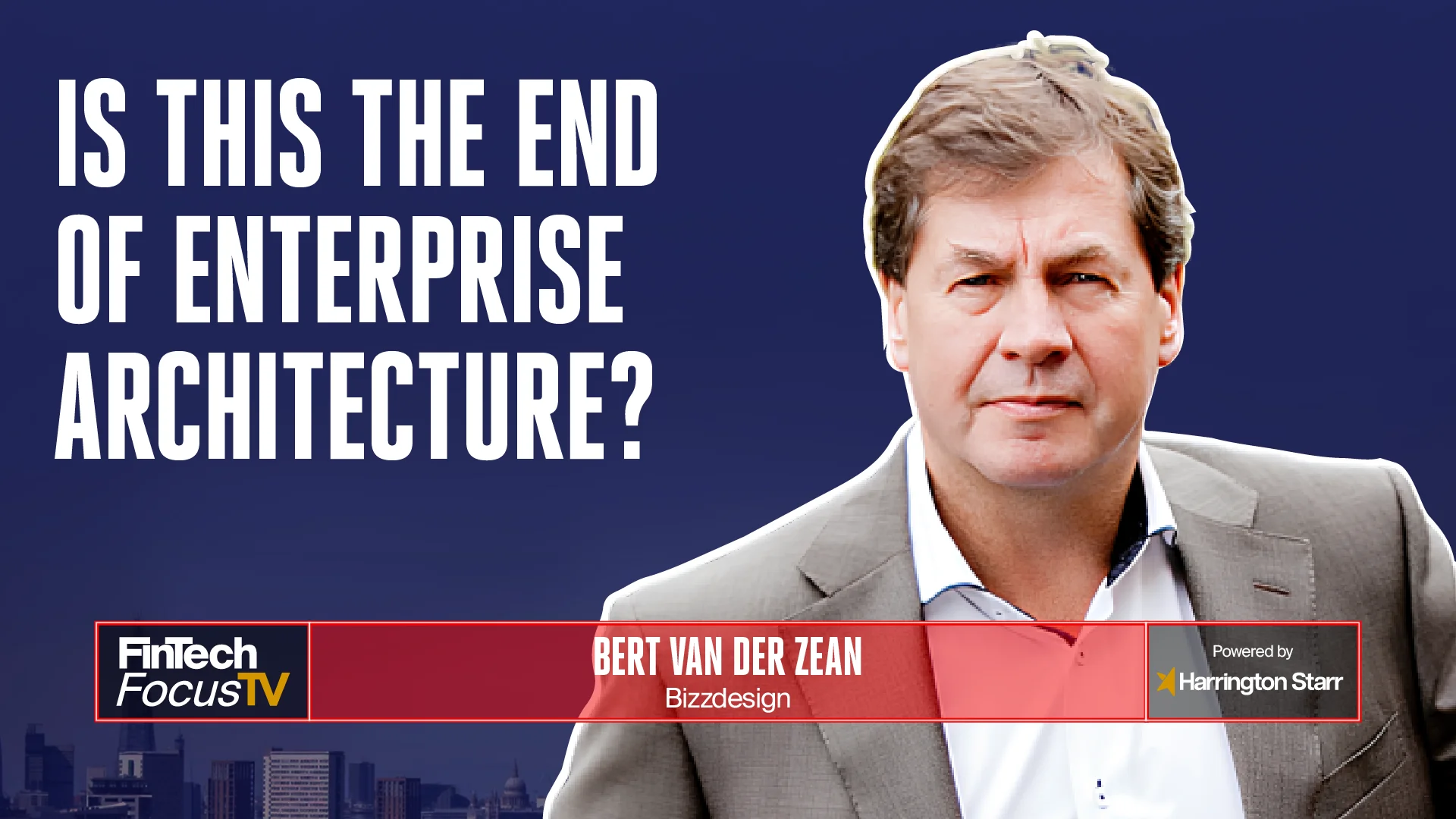
Enterprise architecture is entering a period of significant change. Artificial intelligence, AI agents and new approaches to software development are challenging long-established ideas about how enterprise technology should be built, managed and used. For large organisations navigating complex technology estates, the implications could stretch far beyond simply adding AI capabilities to existing systems.
In this episode of FinTech Focus TV, Harrington Starr CEO Toby Babb is joined by Bert van der Zwan, CEO of Bizzdesign, for a conversation about the future of enterprise architecture, the evolution of SaaS, the rise of agentic AI and the changing relationship between humans and technology.
With a career spanning finance, SaaS, sales and general management, Bert brings a commercial perspective to a technology landscape moving at considerable speed. He explains why he believes we may be approaching both the end of SaaS as we know it and the end of traditional enterprise architecture, while also acknowledging that nobody can know exactly where the current period of AI innovation will ultimately lead.
Rather than attempting to predict every technological development, the conversation focuses on what businesses can control. How can organisations use AI to create meaningful value? How should large enterprises approach experimentation when governance, risk and compliance remain critical? And what happens to enterprise architecture when AI makes technology increasingly accessible to people across the wider business?
The Future of SaaS Could Look Very Different
Bert’s relationship with SaaS stretches back to his time at WebEx, and he explains that two characteristics originally made the model particularly attractive to him.
The first was scalability, particularly through multi-tenancy. The second, reflecting his financial background, was predictability. Multi-year contracts and recurring revenue created a model that could be understood and scaled effectively.
Artificial intelligence could now disrupt some of those foundations.
Bert believes developments in generative AI and agentic AI are making it increasingly easy to develop tailored applications and experiences. Instead of relying entirely on standardised software designed to serve many organisations or users in broadly the same way, businesses may increasingly be able to create technology around individual use cases and user personas.
He describes the direction as “bespoke from the cloud”. At first glance, that might appear to conflict with the principles that helped make SaaS successful. However, AI could make personalisation achievable at a scale that was previously difficult to imagine.
For Toby, this links to a wider shift towards hyper-personalisation. Consumers have become accustomed to technology adapting seamlessly to their preferences in their personal lives, while B2B environments can still be dominated by legacy systems and rigid processes.
AI agents could begin closing that gap, allowing enterprise software to become more responsive to the actual way individuals and businesses need to work.
AI Agents and the Opportunity to Increase Productivity
The potential of AI agents extends beyond personalisation.
Toby highlights productivity as one of the most significant opportunities created by artificial intelligence. Businesses have faced sustained pressure to reduce costs, but there is a limit to how far cost reduction alone can take an organisation. Increasing productivity offers another route to protecting and improving performance.
Bert agrees that the opportunities are numerous. If businesses can tailor solutions more precisely to customer requirements and do so significantly faster, they can create products and services around individual needs in ways that were previously difficult or expensive.
However, speed introduces its own challenges.
The growing accessibility of AI-powered software development and vibe coding means people can build and connect applications increasingly quickly. While that creates enormous potential for experimentation, Bert questions what happens when those individual solutions begin accumulating inside the technology landscape of a major enterprise.
The software industry has spent years trying to move away from difficult legacy environments and complex “spaghetti” architecture. If organisations rapidly build, connect and modify applications without understanding the long-term consequences, AI could inadvertently contribute to the next generation of the same problem.
For smaller businesses, Bert believes these issues may be easier to identify and correct. Within large enterprises, however, the scale of the technology estate makes the risk much more significant.
AI in Enterprise Architecture Needs Governance
This tension between experimentation and control becomes particularly important for businesses operating in highly regulated environments.
Bizzdesign works with large enterprises, financial organisations and governments where governance, risk and compliance requirements cannot simply be ignored in the pursuit of innovation.
Bert explains that his baseline is straightforward. Technology should only enter the software stack when the consequences can be understood and overseen.
That does not mean organisations should stop experimenting with artificial intelligence. Bizzdesign itself continues to test different possibilities alongside its formal product roadmap. The distinction is between experimentation and deploying unproven technology into critical enterprise environments.
For the core product, Bert says proven technology and proven approaches are required. Outside that environment, there can still be room to test, learn and understand what AI might make possible.
This distinction is particularly relevant to financial technology. Financial services organisations operate within significant governance and regulatory frameworks, meaning a “try and error” approach cannot necessarily be transferred from less regulated industries into financial technology environments without considering the consequences.
Bert observes that many businesses are concerned about missing the AI opportunity. Organisations know they need to engage with artificial intelligence, but that can create pressure to use AI simply because it is AI.
His view is that AI should remain a tool rather than becoming the objective itself.
Artificial Intelligence Is More Than Another Technology Hype Cycle
The technology industry has experienced major hype cycles before.
Bert points to blockchain as a previous example. It was once presented as a technology capable of transforming almost everything, with distributed ledger technology attracting enormous attention.
He does not believe artificial intelligence will follow exactly the same path.
AI, in his view, will play a much bigger and more permanent role. At the same time, he believes expectations around what it can deliver in the immediate future are too high. There is a gap between the long-term importance of AI and some of the short-term expectations currently surrounding it.
That distinction matters for enterprise AI strategy.
Businesses do not necessarily need to assume that every current promise surrounding AI will materialise immediately in order to recognise that the technology is changing how people work and how software is created.
Different industries will also need different approaches.
A consultant may have considerable freedom to experiment with AI tools and refine their use through trial and error. Financial services organisations face a different set of responsibilities. Experimentation still matters, but it needs to happen within appropriate boundaries and controlled environments.
For technology vendors such as Bizzdesign, the question therefore becomes where sustainable value can be created beyond the capabilities businesses can access themselves.
Bizzdesign Unify and AI-Native Enterprise Technology
One answer for Bizzdesign is Unify.
At the time of the conversation, Bert explains that Unify had only been publicly available to new customers for around three months, following several years of development and an earlier soft launch with existing customers.
The platform has been designed to approach enterprise architecture from an AI-native perspective.
Bert is conscious that terms such as “AI native”, “AI first” and “AI embedded” have become widespread across the technology market. In the case of Unify, he says AI has been built in as a fundamental part of the product.
The platform is designed to work with the huge, complex and often hybrid application landscapes found within large enterprises. It can help organisations understand their current application environment before looking towards the future state they want to achieve.
The difference between those two positions creates the transformation journey.
Bert describes the path from the “as is” environment to the desired future state as the organisation’s strategy. Unify is intended to help businesses establish a clear and integrated way of defining and executing that journey.
That can involve an enormous variety of enterprise technology. A large organisation may still operate applications spanning older systems, client-server technology, on-premise infrastructure and different generations of SaaS alongside more modern technology.
Bringing that information together becomes critical when businesses are trying to understand what should stay, what should change and where they ultimately want their enterprise technology environment to go.
Human-Led AI and the Future of Decision-Making
Despite the increasing role of artificial intelligence, Bert does not see the future as a choice between humans and machines.
His description is “human led, AI executed”.
That does not mean limiting AI to repetitive or routine tasks. Bert expects artificial intelligence to increasingly support and influence decision-making itself.
The important distinction is that there should still be a human reflection point.
Whether people describe the model as human-first or human-last, Bert believes humans need to validate what AI is suggesting. That becomes particularly important when considering the data underpinning AI-generated recommendations.
Businesses need to understand whether a system is working from internal data, external information or a combination of both. Policies and governance therefore become part of creating an environment in which organisations understand the basis on which AI is producing its outputs.
The conversation moves beyond the idea of humans competing with technology. Instead, the focus is on how artificial intelligence and human judgement can work together.
For organisations building an AI strategy, this distinction could become increasingly important as AI moves further into areas previously associated with human analysis and decision-making.
Enterprise Software Is About What You Build With AI
As the discussion turns towards the technology underpinning artificial intelligence, Bert is deliberately cautious about trying to identify a single platform or model that will dominate.
His view is that the major technologies are likely to become good enough to support what businesses need.
He draws an analogy with enterprise software categories from his own background. Organisations can spend considerable time debating different providers, but many established platforms are capable of delivering the fundamental functionality businesses require. Their strengths may differ, but the technology itself is only part of the equation.
The same principle could increasingly apply to AI.
For companies such as Bizzdesign, Bert argues that the bigger question is not simply which underlying technology is selected. The differentiator is what a company builds with it and what additional value it can provide to customers.
As artificial intelligence becomes more widely accessible, the technology itself may therefore become less important than the problems organisations can solve with it.
Is This the End of Enterprise Architecture as We Know It?
It is when the conversation turns directly to AI’s impact on enterprise architecture that Bert makes one of his strongest predictions.
He believes the industry is looking at the end of enterprise architecture as we know it.
Enterprise architecture has existed as a distinct category for decades, alongside related areas including application portfolio management, business process management, solution architecture and strategic portfolio management.
There is already considerable overlap between these disciplines. Functionality associated with enterprise architecture can also appear within application portfolio management or solution architecture, for example.
Bert expects these adjacent categories to converge.
He compares the shift to an earlier development within enterprise software. Accounting, payroll, CRM and project management once existed as more distinct categories before many related capabilities became connected through the broader ERP market.
He expects something similar to happen around enterprise architecture.
The eventual category may have a completely different name, but Bert believes three areas will become particularly important for large enterprises: application portfolio management, business process management, and governance, risk and compliance.
Large organisations will continue to have huge, complex and hybrid application landscapes. They will still need to manage those applications and make their business processes more efficient. At the same time, both areas will need to operate within appropriate GRC frameworks, particularly in heavily governed industries such as financial services.
Application Portfolio Management, BPM and GRC Are Converging
This convergence represents more than a change in terminology.
It could alter who actually uses enterprise architecture technology.
Traditionally, enterprise architecture tools have primarily been designed for specialist users such as enterprise architects. Bert expects the next generation of these platforms to reach a much broader audience.
Operational teams, CIOs, strategists and other business users could increasingly interact with the same technology.
That shift changes the requirements of the product itself.
Enterprise architecture software cannot remain something only experts understand. If it is going to support collaboration across an organisation, it needs to become significantly easier to use and more closely aligned with business requirements.
Bert uses an example from his previous experience with online accounting software to illustrate the difference between expert users and business users. A product could be extremely strong from a technical or auditing perspective while still being difficult for an everyday customer to navigate.
The same challenge exists in enterprise architecture.
Historically, expert users may have prioritised the depth and quality of functionality over the user experience. As the audience expands, usability becomes fundamental.
If technology is too difficult for people across an organisation to use, adoption will suffer regardless of how powerful the underlying product may be.
Digital Transformation Requires Technology People Will Actually Use
For Toby, this connects directly to his own experience of implementing technology within a business.
A platform may have an obvious top-down business case, but that alone does not guarantee success. If employees do not understand the technology, find it difficult to use or fail to see how it supports their work, the expected benefits can quickly disappear.
The future of enterprise architecture may therefore be as much about accessibility as technical capability.
AI could accelerate that shift by reducing barriers between complex enterprise technology and the people who need to use it. Instead of architecture remaining the domain of a relatively small number of experts, AI-enabled tools could make relevant information available across a much wider section of the organisation.
For financial technology businesses and other large enterprises, that could have implications not only for software but for people and skills.
As enterprise technology becomes more integrated with business strategy, organisations will need professionals who can operate across traditional boundaries. Technology expertise remains important, but so does an understanding of processes, governance, risk, commercial priorities and how people actually interact with systems.
The Next Chapter for Bizzdesign and Enterprise Technology
Looking towards the end of 2026 and into 2027, Bert expects AI to play an increasingly significant role within Bizzdesign’s products.
At the same time, the company is positioning itself around the convergence he describes throughout the episode.
Rather than remaining predominantly focused on enterprise architecture, Bizzdesign plans to move further into a combination of application portfolio management, business process management and GRC.
Unify sits at the centre of that direction.
The goal is to bring Bizzdesign’s experience across those different areas together within one platform, while making the technology available not only to new customers but also to existing customers looking to migrate to the newer platform.
Importantly, Bert stresses that existing customers will be offered a route to migrate rather than forced onto a new platform.
It reflects the broader theme running throughout the conversation. Transformation does not mean adopting new technology simply because it exists. Whether businesses are considering artificial intelligence, AI agents, enterprise software or a wider digital transformation, technology needs to solve a genuine problem and create sustainable value.
What AI Means for the Future of Enterprise Architecture
The future of enterprise architecture may not carry the same name, involve the same categories or be used by the same group of specialists as it has in the past.
Artificial intelligence is accelerating a change that could see previously separate disciplines converge, while enterprise architecture technology moves closer to the everyday business users responsible for strategy, operations and transformation.
At the same time, the rise of agentic AI and increasingly accessible software development creates new questions. The ability to build faster does not automatically mean businesses should build without constraints. For large enterprises, particularly within financial services, governance and an understanding of the wider technology landscape remain essential.
Bert’s perspective throughout the episode is one of opportunity balanced with caution. He sees enormous potential in AI but does not pretend every question has already been answered. He expects AI to remain a permanent part of enterprise technology, while arguing that some of the immediate expectations surrounding it will need to normalise.
Above all, the conversation makes the case for technology that remains connected to human judgement.
AI may increasingly execute, recommend, personalise and influence decisions, but people still need to determine what they are trying to achieve.
For businesses navigating the future of SaaS, enterprise architecture and digital transformation, that may prove to be one of the most important distinctions of all.
Watch the full episode of FinTech Focus TV as Toby Babb speaks with Bert van der Zwan, CEO of Bizzdesign, about AI in enterprise architecture, the future of SaaS, AI agents, enterprise software and why the next generation of enterprise technology could look very different from the one businesses know today.