Inside the Future of Trading
Trading is changing, and many of the conversations that once centred on what might happen next are quickly becoming conversations about what the industry needs to do now.
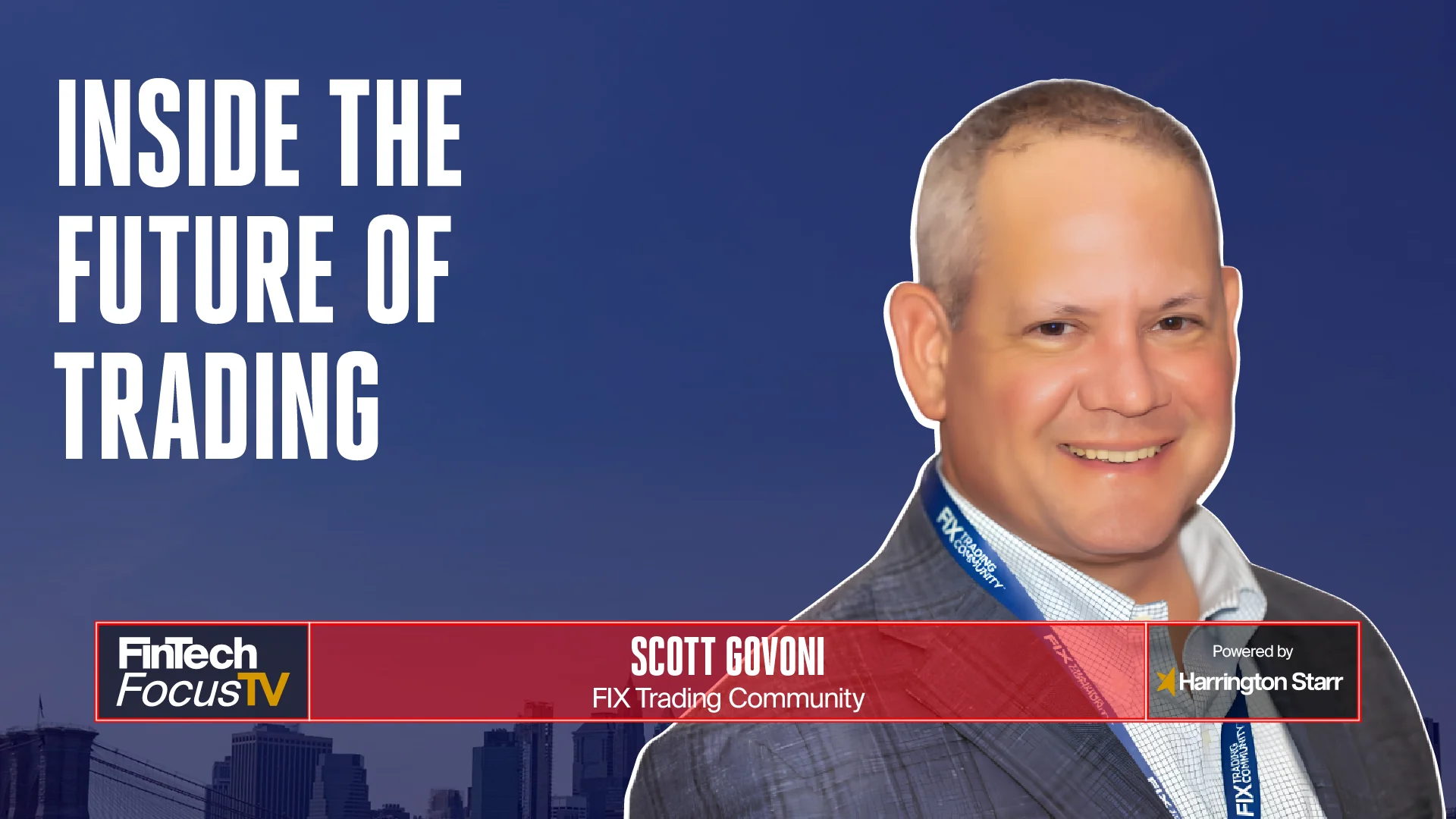
In this episode of FinTech Focus TV, Toby Babb is joined by Scott Govoni, Regional Director - Americas at FIX Trading Community, for a look ahead to the Americas Trading Conference in New York on 29 October.
The conference provides the backdrop for a much wider conversation about the future of trading and capital markets. From 24-hour trading and prediction markets to tokenisation, digital assets, ETFs and artificial intelligence, Scott discusses some of the developments currently commanding the industry's attention. More importantly, he explains how the FIX Trading Community is bringing market participants together to work through the practical questions behind them.
The conversation also explores the growth of the FIX Trading Community across the Americas, the importance of collaboration between firms that ordinarily compete, and why relationships across the buy side, sell side, vendors and exchanges matter as electronic trading continues to evolve.
The future of trading takes centre stage in New York
This year's Americas Trading Conference comes at an interesting point for the industry. Scott explains that registrations are already considerably higher than they were the previous year, while sponsorship and engagement with the FIX Trading Community's working groups and committees have also increased.
For Scott, the event is an opportunity to demonstrate the progress being made across the Americas. Rather than the conference existing separately from the wider work of the community, its programme is directly connected to the issues being addressed by its working groups and committees.
That creates an agenda covering some of the biggest questions facing capital markets and trading technology today.
There will be sessions dedicated to 24-hour trading, ETF trading and prediction markets, alongside two sessions focused on digital assets and tokenisation. AI and the future of market connectivity will also be on the agenda, reflecting the move towards more practical applications of artificial intelligence within financial markets.
It is a broad range of subjects, but there is a connection between them. The way markets operate, when they operate, the assets being traded and the technology connecting participants are all evolving.
Later in the conversation, Scott points towards a fireside discussion looking at the next decade of capital markets. As he explains, topics including prediction markets, overnight trading and tokenisation are increasingly converging. The question is therefore not simply what each individual trend means today, but what capital markets could look like five or ten years from now.
24-hour trading and the changing structure of markets
One of the major topics on the conference agenda is 24-hour trading.
As expectations around market access continue to develop, the possibility of trading across longer windows creates questions for the infrastructure and participants supporting electronic markets. The conference will bring this conversation directly to the people already working on it.
Scott explains that the 24-hour trading panel will include leadership from the FIX Trading Community's overnight trading working group. This reflects a broader approach to the event. Rather than simply putting popular topics on an agenda, FIX wants the people actively involved in its working groups to be part of the conversations on stage.
That distinction matters to Scott.
The conference may feature many of the same headline subjects appearing across the wider financial technology industry, but the intention is to connect those subjects with practical work already taking place within the community.
It is a theme that runs throughout the episode. The future of trading is not treated as something distant or theoretical. The discussions around it are already moving into working groups, committees and collaborative initiatives designed to determine how the industry can respond.
Tokenisation and digital assets move beyond the question of ‘if’
Digital assets and tokenisation will have a particularly prominent position at this year's conference, with two sessions dedicated to the subject.
Scott believes the nature of the conversation around tokenisation has already changed.
The question is no longer simply whether it is going to happen. Attention is moving towards how the industry is going to support it.
That shift creates another challenge. Scott discusses the work required to bridge the gap between decentralised finance and traditional finance, arguing that technology itself may not be the biggest barrier. Instead, there is a cultural challenge in bringing different parts of the financial ecosystem together and establishing common ground.
For digital assets and tokenisation to develop further within established capital markets, collaboration will be essential.
It is here that Scott sees one of the strengths of the FIX Trading Community. Firms may compete intensely through the products and services they provide, but they still depend on common infrastructure that allows the wider industry to function efficiently.
FIX provides an environment in which those organisations can temporarily put that competition aside, work through common problems and then return to the marketplace.
As tokenisation develops and traditional and decentralised finance increasingly interact, that ability to establish common standards and solve shared challenges could become increasingly important.
AI in trading becomes practical and real
No conversation about the future of financial technology would be complete without artificial intelligence, and AI also features on the Americas Trading Conference agenda.
The discussion will focus specifically on AI and the future of market connectivity.
Toby notes how difficult it has become to attend a major industry conference without artificial intelligence appearing somewhere on the programme. But Scott's response points to why AI remains relevant. It is beginning to be used for practical purposes.
For the trading technology industry, this is an important distinction.
AI is no longer being discussed purely as a future concept. The focus is increasingly on where it can be applied, how it fits into existing financial technology and what it means for the infrastructure underpinning capital markets.
The same pattern can be seen elsewhere in the conversation. Tokenisation is moving from asking whether it will happen to asking how it can be supported. Around AI, attention is similarly shifting towards practical implementation.
That creates new questions for firms across financial technology. Market connectivity, infrastructure and electronic trading are highly interconnected environments. New technologies therefore have to work alongside established systems, standards and processes rather than existing in isolation.
For a FinTech recruitment business such as Harrington Starr, these conversations are particularly relevant because they show how quickly the technology landscape surrounding financial markets continues to develop. As firms explore AI, digital assets and new approaches to connectivity, the skills and expertise required to build and support financial technology continue to evolve alongside them.
FIX Trading Community puts collaboration at the centre of electronic trading
Collaboration is arguably the strongest theme running through Toby and Scott's conversation.
Scott describes the FIX Trading Community as providing an environment where organisations can come together to solve common industry problems, even when those same organisations compete elsewhere.
The objective is straightforward. FIX wants to make electronic trading as efficient as possible.
Achieving that requires participation from across the market.
The Americas Trading Conference will bring together representatives from the buy side, sell side, vendors and exchanges. Scott also expects media, regulatory agencies and trade association partners to be present.
That mix is important because the changes facing trading technology rarely affect just one part of the market.
Whether the conversation concerns 24-hour trading, ETF trading, prediction markets, digital assets or market connectivity, developments in one area can have consequences throughout the wider ecosystem.
Bringing different participants together creates an opportunity to address those challenges collectively.
The conference panels themselves are designed to reflect that principle. Scott explains that many of the people appearing on stage are also involved directly in FIX working groups and committees. The intention is therefore not simply to discuss what might happen, but to share the progress being made by those already working on the relevant issues.
ETF trading and industry partnerships
ETFs are another area receiving dedicated attention at the conference.
Scott discusses the FIX Trading Community's partnership with the Security Traders Association and describes how the two organisations can complement one another.
In his view, the STA can help determine where the industry wants to go, while the FIX Trading Community can help work out how best to get there.
That relationship will be reflected in the ETF panel, which will include representation from the STA's ETF committee alongside the work taking place within FIX.
It is another example of the wider collaborative approach Scott describes throughout the episode.
The future of trading technology cannot be shaped by one organisation, one type of market participant or one part of the financial ecosystem alone. Partnerships between industry groups can help connect strategic conversations about the direction of markets with the technical and operational work required to support that direction.
Prediction markets join the conversation
Prediction markets are also receiving attention from the FIX Trading Community.
At the time of the conversation, Scott explains that FIX does not yet have a prediction markets working group, but says one is expected shortly.
The topic has already been part of FIX activity in the Americas, with a recent Chicago FIX Forum focused on prediction markets. It will now feature as part of the Americas Trading Conference as well.
Its inclusion shows how the organisation's agenda is adapting as new areas attract interest from market participants.
Rather than viewing topics such as prediction markets, overnight trading and tokenisation independently, Scott sees a broader convergence taking place across capital markets.
That convergence is one reason why looking five or ten years ahead becomes so difficult. The future market structure may be influenced by several changes happening simultaneously, rather than one technology or trend developing on its own.
For firms operating across capital markets technology, that means understanding not only individual innovations but also how they may interact with existing trading systems and market infrastructure.
Growing the FIX Trading Community across the Americas
The episode also looks beyond the New York conference to the wider growth of FIX across the Americas.
When Scott joined the organisation a couple of years ago, FIX had very little event activity outside New York City. The lingering effects of the pandemic had disrupted the regional community, and one of the priorities was rebuilding those connections.
That work has since expanded.
Scott discusses regional meetings in Boston and Chicago and a networking event in Toronto. The Toronto gathering marked FIX's return to the city after around a decade, and Scott says there was significant appetite to resurrect the Canadian Regional Committee.
The organisation is also considering opportunities for further expansion, including activity on the West Coast and more regional events in New York.
But Scott is careful to distinguish these events from the organisation's core purpose.
FIX does not exist simply to run events.
Regional meetings, forums and networking opportunities are intended to drive awareness and adoption of the organisation's work while encouraging more people to participate. Events create the relationships and engagement that can then support the working groups, committees and collaborative work happening throughout the year.
Why networking matters in capital markets
The importance of those relationships becomes particularly clear when Toby and Scott discuss networking around the Americas Trading Conference.
For Scott, networking is not simply an additional benefit alongside the conference content. It is essential to how the community functions.
When market participants need to come together to solve a shared problem, having established relationships already in place makes collaboration easier.
The conference therefore includes several opportunities for attendees to connect outside the formal sessions. A pre-event reception is scheduled for the evening before the conference, followed by networking during the event itself and an after-hours reception.
This combination of formal content and informal interaction reflects the wider philosophy Scott describes throughout the conversation.
Trading technology depends on systems, protocols and infrastructure, but progress also depends on people being able to work together.
For a global financial technology sector dealing with rapid changes in AI, digital assets, market structure and electronic trading, those relationships remain a critical part of turning ideas into practical industry progress.
Growing support for the Americas Trading Conference
Another sign of increased engagement is the growth in sponsorship.
Scott explains that previous conferences typically attracted around seven or eight sponsors. At the time of recording, the 2026 event already had 18, with several more potentially expected.
As a nonprofit organisation, sponsorship plays a practical role for the FIX Trading Community.
Regional FIX Forums can be hosted by individual members, but a full-day conference in New York creates significant costs. Sponsorship helps offset those costs and allows the organisation to continue delivering the event for its membership.
Scott says the level of support from members has been particularly encouraging.
It also sits alongside the wider increases he has seen in registrations, working group participation and regional engagement.
Taken together, these developments suggest a community becoming increasingly active around the issues shaping modern electronic trading.
Bringing the buy side, sell side and trading technology ecosystem together
So who is the Americas Trading Conference for?
Scott describes an audience that reflects the FIX Trading Community itself.
That includes the buy side, sell side, technology vendors and exchanges, alongside regulatory agencies, media and trade association partners.
FinTech Focus TV will also be on site, speaking with participants across the event.
It is a broad mix, but one that makes sense given the topics being discussed.
The future of trading will not be determined by one part of the market. Longer trading hours require coordination across infrastructure and market participants. Tokenisation creates questions spanning traditional and decentralised finance. AI has implications for market connectivity and financial technology. ETFs, prediction markets and digital assets each bring their own operational and technological considerations.
The common thread is connectivity, both technological and human.
What comes next for capital markets and trading technology?
One of the most interesting aspects of this episode is how often the conversation moves from individual technologies towards a bigger question about the future structure of capital markets.
24-hour trading, prediction markets, tokenisation, digital assets and AI are significant subjects individually. Together, however, they point towards an industry undergoing change across multiple fronts at the same time.
Scott's conversation with Toby does not attempt to predict exactly what trading will look like in a decade. Instead, it highlights the work already happening to prepare for that future.
Working groups are examining practical industry challenges. Regional communities are being rebuilt. Partnerships are bringing organisations together. Conferences are creating a forum where that work can be shared and developed.
For financial technology professionals, employers and those working across trading technology, these developments offer an insight into where attention is moving and the types of challenges the industry is preparing to solve.
At Harrington Starr, we work across the global financial technology ecosystem, connecting businesses with talent across areas including software engineering, infrastructure, data and AI, quantitative finance, product, change and transformation, cybersecurity, support and sales. Conversations such as this one on FinTech Focus TV help bring the people shaping financial technology together and provide a closer look at the trends influencing the sector.
As trading technology continues to develop, the connection between people, infrastructure and innovation will remain central to how the industry moves forward.
The Americas Trading Conference offers a snapshot of that change in action.
From 24-hour trading and ETF trading to prediction markets, tokenisation, digital assets, AI and the future of market connectivity, the agenda reflects an industry already working through the questions that could define the next decade of capital markets.
Watch the full episode of FinTech Focus TV with Toby Babb and Scott Govoni, Regional Director - Americas at FIX Trading Community, to hear more about the Americas Trading Conference, the growth of the FIX community and what lies ahead for the future of trading.