Europe’s T+1 Settlement Deadline Is Looming
18 November, 2026


FIX Protocol has been central to electronic trading for decades, but its importance extends beyond connecting traditional financial institutions. As trading technology develops, digital assets gain attention and market participants explore longer trading hours, the ability to communicate across different systems remains essential.
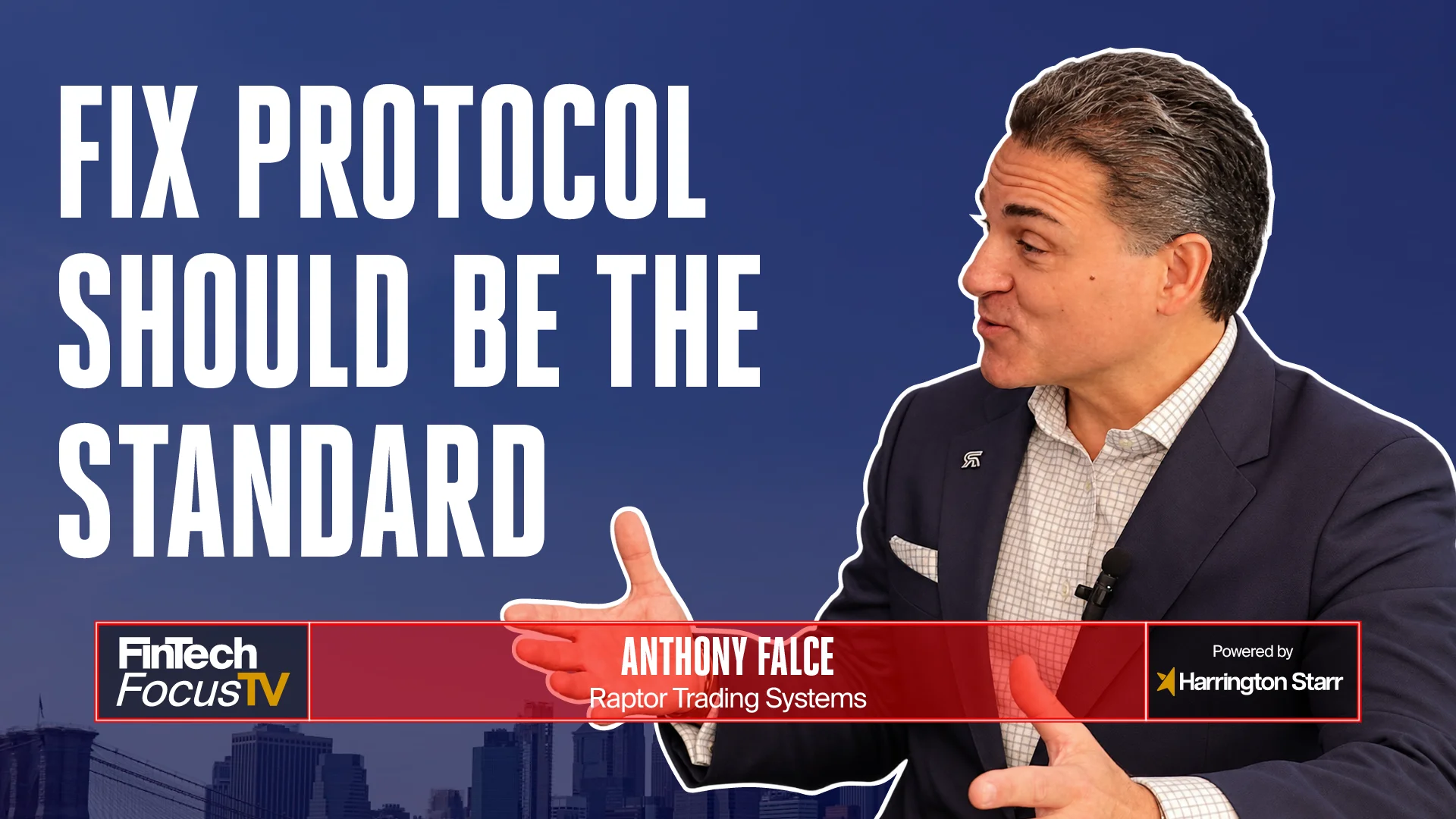
Recorded live at the FIX Americas Trading Conference in New York, this episode of FinTech Focus TV brings together Toby Babb and Anthony Falce, Vice President at Raptor Trading Systems, to discuss FIX connectivity, trading infrastructure and the challenges of integrating technology across financial markets.
Drawing on more than 30 years of financial services experience, Anthony explains why established communication standards remain valuable, how Raptor approaches trading system interoperability and why technical capabilities alone are not enough to build lasting client relationships.
The Financial Information eXchange (FIX) Protocol is a messaging standard used to communicate trading information between financial institutions, brokers, exchanges and technology platforms.
Its importance lies in standardisation. Electronic trading depends on multiple organisations exchanging information accurately, even when their internal systems and technology requirements differ.
For US capital markets participants, including broker-dealers, investment banks, asset managers and trading firms, connectivity is an important consideration when selecting trading technology providers.
Anthony sees FIX as a fundamental part of this infrastructure. Speaking at the New York conference, he discusses how the protocol brings different market participants together and supports communication across an increasingly diverse trading environment.
However, the existence of a common standard does not mean every trading system processes information identically.
This distinction is central to understanding why FIX connectivity specialists remain relevant.
One of Anthony's most detailed explanations concerns the complexity of managing order flow across different trading platforms.
Raptor Trading Systems positions its technology in front of a client's order management system (OMS), allowing it to receive information from different sources before passing that information into the receiving platform.
Anthony explains that FIX is Raptor's speciality, including working with different protocol versions and message tags.
Although two financial institutions might both use FIX, their implementations and data requirements can differ. These differences can create additional integration work when establishing trading relationships.
Raptor's approach involves interpreting and normalising incoming data so that the receiving system can process it.
Anthony claims that certain data normalisation tasks which might take other providers months can be completed by Raptor within a day or two. This is his assessment of the company's capabilities rather than an independently verified industry benchmark.
For financial institutions evaluating trading infrastructure, the wider lesson is that interoperability requires more than simply adopting a messaging standard.
It also requires technology capable of accommodating different implementations and operational requirements.
This is particularly relevant to the trading and exchange infrastructure sector, where connectivity, execution systems and market infrastructure form part of the technology supporting institutional trading.
Another important theme emerging from the FIX Americas discussion is the relationship between established trading standards and newer financial technologies.
Anthony reflects on attending a cryptocurrency conference where some participants appeared interested in moving away from established communication protocols.
He questions the practical implications of that approach:
"How are we gonna link all these markets if everybody's used to different protocol?"
His argument is not that every financial market must use FIX exclusively. Rather, it highlights the importance of interoperability when traditional financial infrastructure and emerging technologies need to communicate.
Digital asset trading, blockchain-based systems and conventional securities markets may operate differently, but connectivity remains a shared requirement.
For US financial institutions exploring digital assets, this raises questions about how newer platforms interact with existing trading infrastructure.
The challenge is not necessarily replacing established technology. It is determining how different technologies can work together effectively.
This relationship between FIX, automation and market connectivity also features in another FinTech Focus TV discussion, Why FIX Is More Important Than Ever, which examines FIX workflows and the opportunities presented by AI-driven automation.
Anthony also references the industry's movement towards extended trading hours, including discussions around 24-hour markets.
For US electronic trading firms, longer operating windows introduce important questions about technology availability, operational support and the ability to maintain reliable communication between platforms.
Systems designed around traditional market sessions may need to accommodate different trading patterns and additional operational demands.
Although the episode does not examine specific US exchange proposals or implementation timelines, Anthony's comments reinforce the continuing relevance of connectivity infrastructure.
As market structures develop, financial institutions still need dependable ways to exchange information.
For technology providers, this places importance on adaptable systems that can operate alongside existing infrastructure rather than requiring every client to adopt identical technology.
Artificial intelligence is another area Anthony identifies as important to Raptor's development.
He confirms that the company has a team working on AI and is exploring its integration into Raptor's technology offering.
The discussion does not provide details about specific AI products, implementation timelines or measurable performance improvements. Nevertheless, Anthony makes clear that the company considers AI an area requiring attention and investment.
This reflects a wider question facing US financial technology businesses: how can organisations introduce AI into established financial systems while maintaining reliability and operational control?
The challenge extends beyond the technology itself to the people responsible for developing, implementing and supporting it.
Harrington Starr's The Financial Technologist Influence List 2026 explores the relationship between AI investment, digital infrastructure and the specialist capabilities required to deliver meaningful results.
Anthony also discusses Raptor's international growth, including additional hires in Europe and Brazil.
Although the company operates internationally, its presence at FIX Americas in New York places this conversation within an important US capital markets environment.
New York remains a significant centre for financial services technology, while other American cities contribute to the wider FinTech ecosystem. Harrington Starr's US FinTech hotspots map provides further context on financial technology talent markets across New York, Chicago, Boston, Austin, Miami and other US locations.
Perhaps the most distinctive part of Anthony's conversation is his emphasis on customer service.
Despite discussing FIX connectivity, data normalisation and AI, he repeatedly returns to the importance of personal relationships.
Anthony has worked across broker-dealers and technology vendors, including roles involving compliance, operations, support, sales and account management. He was also previously a Raptor client.
That experience informs his perspective on what financial institutions expect from technology providers.
He argues that clients should be able to speak directly with people who understand their requirements, rather than navigating complicated support processes.
For trading technology vendors, this creates an important distinction between delivering a functioning product and building a relationship that customers genuinely value.
Anthony also emphasises flexibility. He explains that Raptor is willing to work alongside competing providers when different products fulfil different client requirements.
This is particularly relevant in institutional financial services, where technology environments frequently involve multiple vendors.
For US FinTech companies, customer success and account management can therefore require a combination of commercial understanding, technical knowledge and the ability to build trust.
Harrington Starr's 2026/27 UK and US FinTech sales salary guide examines the importance of specialist commercial expertise, including account management and customer success, within financial technology businesses.
Anthony's discussion demonstrates how trading technology combines specialist technical knowledge with operational experience and commercial understanding.
FIX connectivity, OMS integration, data normalisation and client support all require professionals who understand how financial markets operate.
For employers building electronic trading teams in New York and across the United States, the ability to combine financial markets knowledge with technical expertise can be particularly valuable.
Harrington Starr's Financial Services and Financial Technology Salary & Hiring Report 2026/27 provides US salary benchmarks and recruitment commentary across software engineering, infrastructure, application support, data and AI, and commercial specialisms.
These areas connect naturally with the capabilities discussed throughout the episode, although Anthony does not make specific claims about US salary levels or hiring shortages.
For businesses assessing specialist recruitment requirements in American financial markets, Harrington Starr's New York FinTech recruitment team provides a local point of contact.
The central message from Anthony Falce's conversation is that established trading standards continue to serve an important purpose, even as the surrounding technology develops.
FIX Protocol provides a foundation for communication, but effective trading connectivity also depends on handling different implementations, normalising data and integrating existing systems.
As financial institutions consider digital assets, extended trading hours and AI, those practical requirements remain relevant.
Equally, Anthony's perspective highlights something that can be overlooked in technical discussions, the importance of experienced people, responsive support and trusted relationships.