Trading is No Longer Business as Usual
16 November, 2026

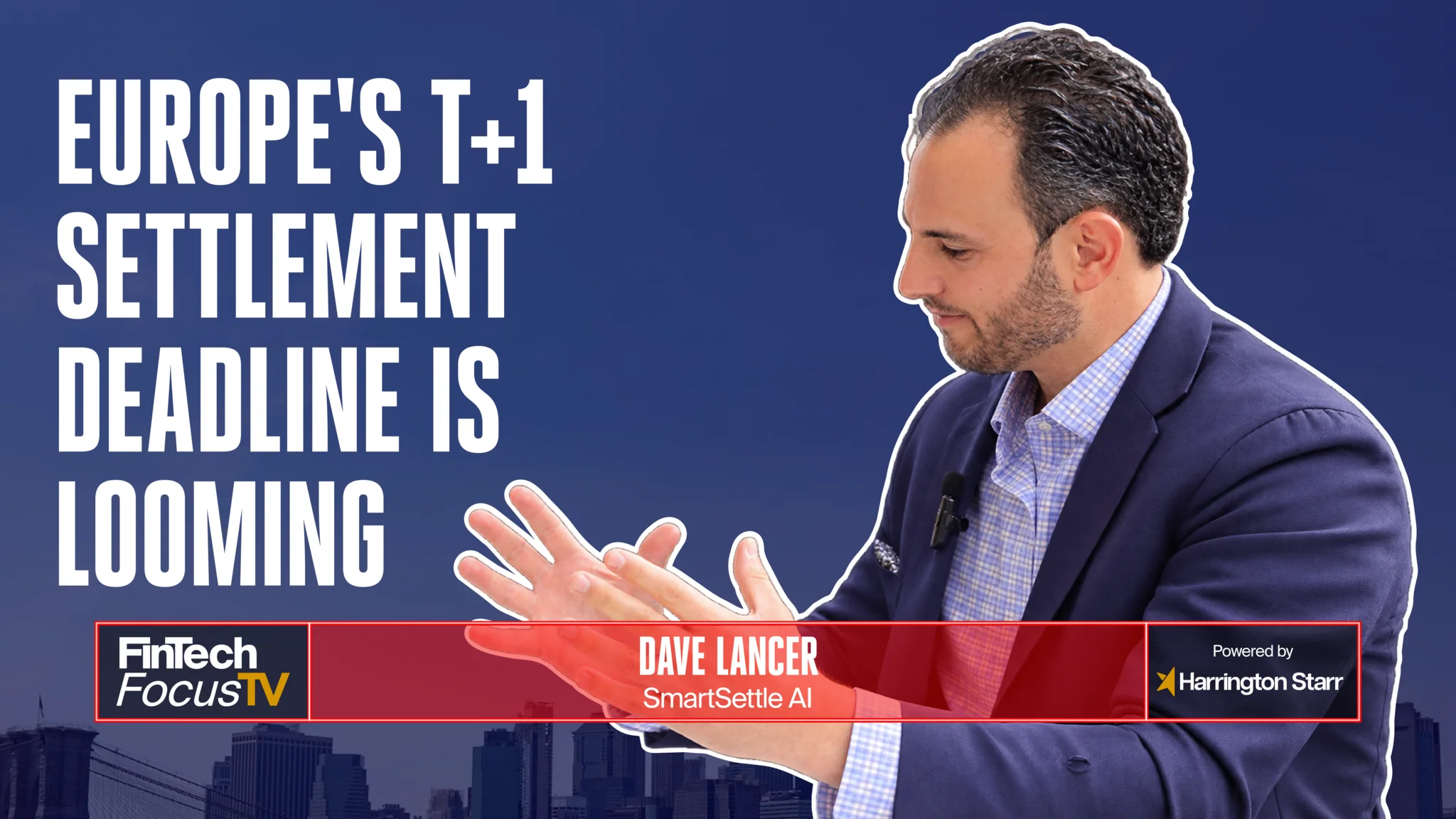
Europe's transition to T+1 settlement in October 2027 is putting renewed pressure on financial institutions to modernize their post-trade operations. For US investment managers, broker-dealers and financial technology providers operating internationally, the challenge extends beyond meeting another regulatory deadline. It raises fundamental questions about settlement automation, operational efficiency and the technology needed to prevent failed trades.
Filmed in New York for FinTech Focus TV, Toby Babb speaks with David Lancer, CEO of SmartSettle AI, about why Europe's settlement environment presents challenges that differ from the US market and how artificial intelligence could transform post-trade operations.
Having founded Middle Office Solutions, subsequently acquired by Bloomberg in 2014, David brings experience developing technology for settlement exception management. His central argument is that financial institutions must move beyond reacting to failed trades and identify potential settlement problems before they occur.
The US transitioned to T+1 settlement in May 2024, shortening the standard settlement cycle for most applicable securities transactions from two business days to one.
Europe's planned October 2027 transition presents a different operational challenge.
David highlights the fragmented structure of European settlement infrastructure, contrasting the US environment with Europe's numerous central securities depositories (CSDs), multiple currencies and differing settlement locations.
This fragmentation matters because successfully matching a trade does not necessarily mean the securities are available in the correct location for settlement.
An investment manager might hold an asset with one custodian while the transaction requires settlement elsewhere. Moving those securities between locations can introduce additional operational steps and potential delays.
Under T+1, firms have less time to resolve these issues.
David warns that European settlement fail rates could rise significantly if financial institutions do not improve their processes before October 2027.
For US financial institutions with European trading exposure, experience from the domestic T+1 transition provides a useful foundation. However, it does not eliminate the need to understand Europe's distinct settlement infrastructure.
This is particularly relevant to firms managing cross-border investment activity, where buy-side technology and operational expertise must support increasingly complex settlement requirements.
Settlement failures occur when securities or cash are not delivered as required on the agreed settlement date.
David argues that one of the industry's longstanding weaknesses is its reliance on reactive exception management.
Historically, operations teams have often identified problems after a trade has already failed, using reports and custodian systems to investigate the cause.
SmartSettle AI's approach is to identify potential problems earlier, using trade information, custodian inventory and operational data to assess settlement risk on trade date, or T+0.
David explains:
"Now it's how do I prevent fails from occurring?"
This distinction is central to the episode.
Rather than waiting for a settlement failure, firms can potentially identify whether securities are held in the correct location, whether a depot movement is required or whether securities lending activity could affect delivery.
David also references research from DTCC and The ValueExchange, citing substantial daily costs associated with late and failed European trades and an increase in settlement failures between 2024 and 2025.
These figures are presented as David's references to external research, rather than independently established findings within the episode.
The broader operational argument remains clear: shorter settlement cycles reduce the time available to correct errors, making earlier visibility and intervention increasingly important.
Artificial intelligence in capital markets is often associated with trading strategies, market analysis and investment research. David's discussion demonstrates how AI could also address practical problems within post-trade infrastructure.
SmartSettle AI combines information from order management systems, matching utilities, custodians and other sources to build a more comprehensive view of settlement activity.
The objective is to identify the underlying cause of an exception rather than simply report its existence.
For example, an incoming trade could be checked against available inventory to identify whether the securities are held at the appropriate settlement location.
If a depot movement is required, the relevant operations team could be alerted while there is still time to act.
This approach also creates opportunities for natural-language analysis.
David describes how users can ask questions about failed trades, counterparties and root causes without manually assembling information across multiple systems.
For financial institutions investing in data and AI capabilities, the implications extend beyond developing sophisticated models. Reliable data integration, operational knowledge and the ability to deploy AI within existing workflows are equally important.
One of the episode's most significant discussions concerns agentic AI in finance and its potential to improve communication between counterparties.
Settlement exception management frequently involves investment managers, brokers and custodians exchanging information through separate systems, emails and manual processes.
David describes SmartSettle AI's ambition to provide an orchestration layer through which different organizations and their AI agents can communicate.
For example, if a broker cannot deliver securities, an AI agent could potentially exchange information with another agent to investigate and resolve the exception.
Importantly, David distinguishes this ambition from capabilities already operating across the industry. Cross-organization agent communication remains an area SmartSettle AI is developing.
He also emphasizes that more complicated issues will continue to require human intervention.
The implications for capital markets technology are significant. Instead of relying exclusively on individual applications, firms may increasingly need interoperable infrastructure that allows systems and agents to exchange information securely.
That creates opportunities for technology providers, but it also introduces questions about permissions, auditability, cybersecurity and governance.
David acknowledges these challenges, discussing penetration testing, procurement requirements and the importance of meeting institutional security expectations.
For firms adopting agentic AI, technical capability alone is insufficient. Trust and operational control remain essential.
The growing use of AI in financial services inevitably raises questions about workforce transformation.
When Toby asks whether agentic AI will replace operations professionals or augment their work, David responds:
"It's definitely value add."
David's view is that automation can help operations teams increase productivity and manage greater volumes without proportionately increasing manual workloads.
Rather than spending their days navigating multiple custodian portals or repeatedly contacting counterparties, professionals could devote more attention to complex exceptions, operational improvement and strategic activities.
This creates an important distinction for financial services employers.
Automation does not remove the need for settlement expertise. It changes how that expertise can be applied.
Professionals who understand market infrastructure, exception management and operational risk may become particularly valuable when working alongside engineers developing AI-enabled platforms.
Harrington Starr's 2026/27 Financial Technology Salary & Hiring Report provides additional context for this workforce shift.
Its US AI and machine learning salary benchmarks place AI Engineers between $145,000 and $310,000+, while Heads of AI range from $200,000 to $400,000+. These are estimated annual base salary ranges, not compensation figures specific to post-trade technology.
The report also highlights the increasing importance of practical AI deployment, reinforcing the need for professionals who can translate technical capabilities into operational outcomes.
New York provides a relevant setting for this conversation because of its concentration of investment banks, hedge funds, asset managers and financial technology businesses.
Although Europe's T+1 transition is the immediate regulatory catalyst, the technologies discussed have applications across international capital markets.
For US FinTech companies developing settlement infrastructure, international growth requires more than a technically effective product. Firms must understand institutional procurement, local market practices and the operational requirements of their customers.
David's experience illustrates the importance of combining product development with industry expertise.
He discusses recruiting Cynthia Manna, formerly an operations leader at PIMCO, as SmartSettle AI's president. For David, strengthening operational leadership complements his own technology and product background.
This connection between specialist experience and technical innovation is also relevant to FinTech recruiting in New York, particularly for employers building teams across capital markets technology, AI engineering and financial infrastructure.
Harrington Starr's US and international FinTech talent hotspots offer further context for businesses assessing where to build specialist technology teams.
The challenge is not simply attracting developers. It is assembling teams that understand the financial processes their technology must improve.
David's central message is that firms should not treat Europe's T+1 deadline as a reason to delay modernization until the final stages of implementation.
The US experience demonstrated the importance of timely trade matching. Europe's complexity places additional emphasis on inventory visibility, settlement location management and earlier identification of exceptions.
AI-powered settlement automation could help firms address these problems, but successful implementation depends on reliable data, effective integration and appropriate governance.
David also describes SmartSettle AI's plans to expand into claims management, connecting settlement exceptions with the subsequent processes for determining responsibility and managing claims.
The wider opportunity is to create a more connected post-trade environment, where operational information supports decisions throughout the settlement lifecycle.
For US and European financial institutions, the approaching deadline makes these questions increasingly relevant.