Is This the End of Enterprise Architecture as We Know It?
07 October, 2026

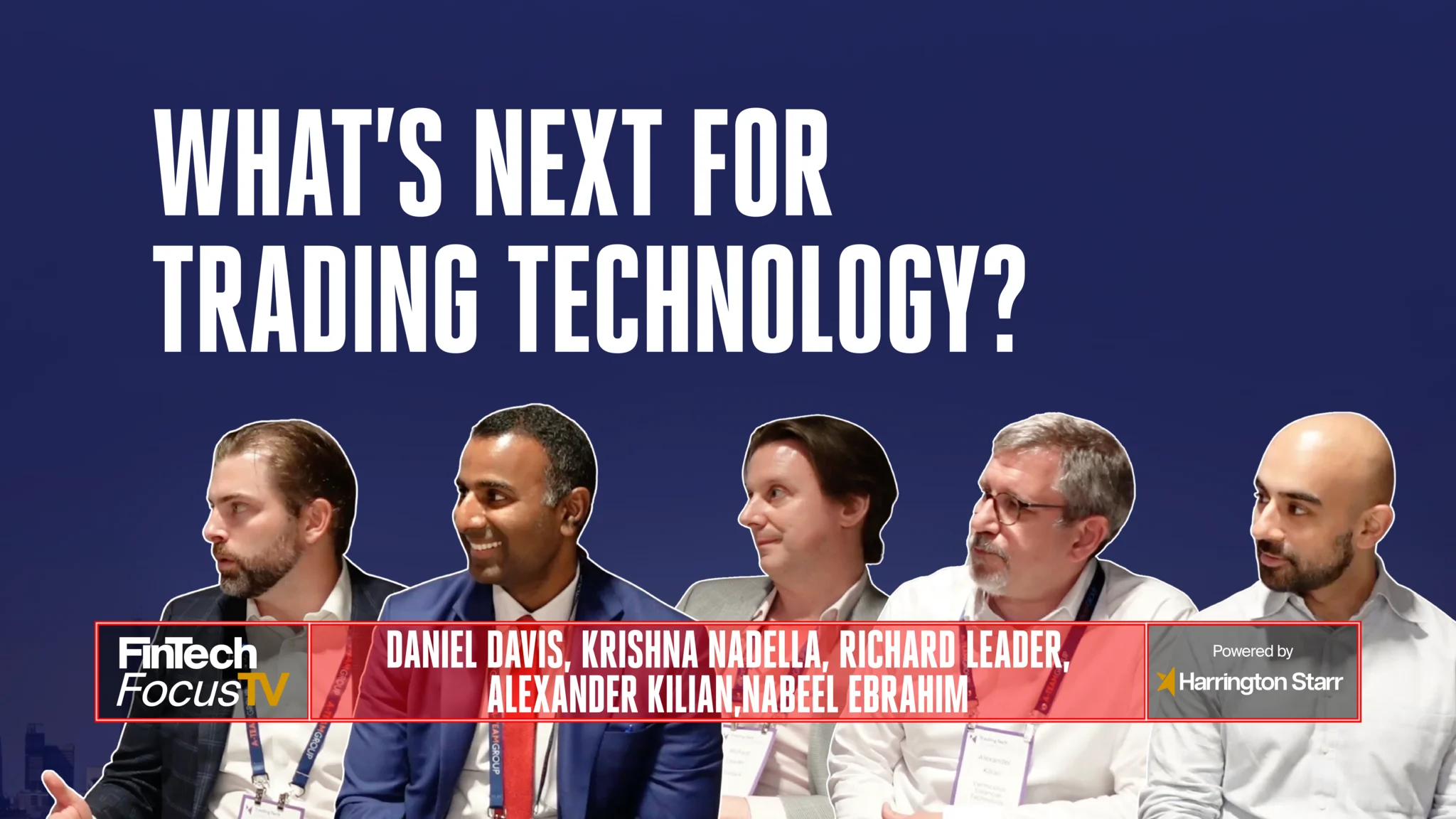
The future of trading technology is being shaped by a combination of artificial intelligence, automation, modern market infrastructure, new asset classes and changing expectations around the people building and operating financial markets. Recorded at TradingTech Summit New York 2026, this episode of FinTech Focus TV brings together five industry leaders to explore what the next generation of capital markets could look like and, crucially, whether firms are prepared for the pace of change ahead.
Joining the conversation are Daniel Davis, CRO at Connamara Technologies; Krishna Nadella, Head of US Sales, Financial Services at ITRS; Richard Leader, Co-founder at FXswapX; Alexander Kilian, Principal Architect at Vermiculus Financial Technology; and Nabeel Ebrahim, Chief Revenue Officer at Behavox.
Across the episode, the guests tackle three central questions: what will define the next generation of trading technology and market infrastructure, what are financial services firms currently underestimating, and which skills and capabilities will become most valuable over the next five years?
The answers reveal an industry where technological change cannot be separated from talent. From agentic AI and real-time clearing to 24/7 markets, modernisation and AI literacy, the future of financial technology will depend not only on what firms build, but on the people capable of applying these technologies effectively.
One of the clearest themes to emerge from TradingTech Summit New York is that the infrastructure underpinning capital markets is changing.
Daniel Davis discusses Connamara Technologies’ work across matching and exchange technology, clearing technology and market surveillance. The company works with organisations looking to create new venues, introduce new assets or approach existing markets differently. This includes areas such as prediction markets, power markets, perpetual futures, crypto and tokenised stocks.
For Davis, one opportunity lies in making it easier for operators to bring new markets and products to life. He describes an end-to-end approach where exchange functionality, clearing and market surveillance can be integrated rather than requiring firms to recreate the underlying technology themselves.
That ability to focus resources on differentiation rather than rebuilding established infrastructure could become increasingly important as the number and variety of tradable markets expand.
Davis also points towards changes in the relationship between brokers, exchanges and clearing houses. As different components of the market structure become more closely integrated, he sees the potential to move closer towards real-time clearing and real-time risk. Faster movement of assets and faster risk calculation could, in turn, create opportunities for greater capital efficiency.
For businesses hiring across trading technology and financial technology, developments such as these reinforce why specialist capital markets knowledge remains valuable. The technology may be changing quickly, but understanding the underlying mechanics of trading, clearing, risk and market infrastructure continues to matter.
Alexander Kilian offers another perspective on where capital markets infrastructure is heading, identifying the move towards 24/7 markets as a major trend.
Vermiculus Financial Technology builds exchange, clearing and central securities depository systems for organisations globally. Kilian explains that its trading systems have been developed with 24/7 operation in mind from the outset rather than having continuous trading requirements added retrospectively.
Alongside 24/7 markets, he identifies tokenisation and prediction markets as important areas of development.
This raises a wider issue around modernising legacy trading infrastructure. When asked what firms are currently underestimating, Kilian points directly to modernisation. Many systems across the industry remain old, and organisations can find themselves attempting to reinvent or modernise existing platforms rather than considering the possibility of starting again with technology designed for the next generation of markets.
He also highlights the relationship between technology and exchange rule books. Existing rules can be built around previous generations of trading systems, meaning new technology may then have to fit into structures originally designed around older systems.
It is a reminder that capital markets transformation is rarely a matter of simply deploying new software. Technology sits within a complex ecosystem of rules, processes, regulation and established market structures. For financial technology recruitment, this creates an equally complex talent requirement: firms need people who can understand both the technical possibilities and the environment in which those systems must operate.
Artificial intelligence is another major thread running through the episode, but the discussion goes considerably further than basic AI use cases.
Krishna Nadella explains that ITRS focuses on real-time observability and monitoring across capital markets, covering areas including payments, market data and electronic trading. The company is now applying an agentic roadmap to infrastructure that can sit both on-premises and in the cloud, with agents focused on areas such as site reliability engineering and reliability engineering.
His broader point is that organisations need to think carefully about what they actually want agentic technology to achieve.
Rather than simply inserting AI into an existing workflow and accelerating the same processes, Nadella argues for thinking about the human being “on the loop”. The distinction is important: the objective should not simply be doing existing work faster, but maintaining oversight and asking whether technology is taking the organisation in the right direction.
The question for financial institutions therefore becomes much bigger than whether they should adopt AI. They must decide what their relationship with agentic capabilities should be and how those capabilities can meaningfully transform the business.
For FinTech businesses, this could have significant implications for technology strategy and talent strategy alike. As AI becomes embedded deeper into financial infrastructure, demand will increasingly centre on professionals capable of understanding where AI can add value, how it interacts with existing systems and where human judgement remains essential.
Nabeel Ebrahim brings governance, data and surveillance into the discussion around the next generation of market infrastructure.
Behavox works with structured and unstructured data, including communications and transaction data, to identify areas including financial and non-financial misconduct and support policy lifecycle management.
When considering the future of infrastructure, Ebrahim identifies build versus buy as an important question. As organisations experiment with increasingly sophisticated AI capabilities, he warns against overlooking fundamentals such as data lineage, liability, defensibility and explainability.
Those foundations become particularly important as AI moves into more advanced capital markets use cases.
Ebrahim argues that some firms are still thinking about generative AI primarily in terms of research summarisation, note summarisation or writing emails. Yet the potential use cases are already moving beyond this. He discusses the possibility of using agentic AI for cross-product market surveillance, connecting activity in areas such as prediction markets with activity across equities and allowing systems to conduct broader analysis.
Agentic workflows could therefore act as a force multiplier. However, the ability to use them effectively depends on having the right foundations, installed technology, approvals and AI governance in place.
This creates an important distinction in the wider conversation around AI in financial services. Moving quickly matters, but moving quickly without governance, explainability and robust data foundations creates another set of challenges.
Richard Leader approaches modernisation through the FX swaps market.
He explains that FXswapX is focused on automating part of the inter-dealer FX swaps market, an area he describes as still being heavily reliant on voice or voice-equivalent trading despite its enormous daily volumes.
That reliance can introduce brokerage costs, operational inefficiency and compliance risks. The opportunity, therefore, is to modernise how the market operates.
However, Leader makes an important distinction between modernisation and disruption. Rather than pursuing disruption for its own sake, FXswapX is developing a solution intended to work with banks and enable a smoother transition.
That philosophy is particularly relevant in capital markets, where replacing established infrastructure can be significantly more complex than launching technology into less regulated industries.
Looking further ahead, Leader expects the rate of innovation, development and adoption to accelerate substantially. Banks have historically faced slow onboarding processes for new services, but he sees signs of this improving. At the same time, AI tools are dramatically increasing what engineering teams can achieve within shorter periods.
The result could be a future that is more automated, more agentic and characterised by a much faster rate of technological progress.
The question of what firms are underestimating produces some of the episode’s most interesting answers because each guest identifies a different challenge.
For Davis, one overlooked opportunity is the continued emergence of new markets and new asset classes. He believes demand exists for people to participate in markets connected more closely to the things they care about, whether those relate to sports, rates, events or other areas.
Technology is also reducing some of the barriers to creating venues. Davis explains how cloud infrastructure has changed the economics of launching exchanges because operators no longer necessarily need to invest upfront in physical server capacity designed for potential peak demand. Cloud technology allows resources to scale alongside liquidity.
Kilian focuses instead on the scale of the modernisation challenge, particularly when legacy systems and established rule books continue to influence what new technology can do.
Nadella gives perhaps the most talent-focused answer: firms are underestimating people.
Nadella argues that the industry needs to stop viewing artificial intelligence purely as a talent killer. Instead, he describes AI as a talent enhancer and an accelerator.
A new generation is entering the workforce having grown up with AI. These professionals increasingly understand how to create agents and how AI can be applied to existing workflows to make functions faster, more productive and potentially more profitable.
For Nadella, these are the people who will help drive the industry forward. The response should therefore be investment in talent rather than immediately looking at where headcount could be removed because processes have become more agentic.
This has major implications for FinTech recruitment and capital markets recruitment.
The skills required by financial technology firms are evolving, but the episode repeatedly challenges the idea that technology simply removes the need for people. Instead, AI changes what high-value human contribution looks like.
For businesses building trading platforms, market infrastructure, AI capabilities and financial technology products, recruitment strategies will increasingly need to consider a combination of technical skills, domain knowledge, adaptability and AI literacy.
When the guests are asked which skills, capabilities and mindsets will become most valuable over the next five years, adaptability emerges as a recurring theme.
Davis emphasises the value of people who can think ambitiously, remain flexible and change their opinions as facts change. With prediction markets, perpetual futures, tokenised assets and crypto continuing to develop, new ways to trade and new tradable assets are likely to create opportunities for people capable of responding to a changing environment.
Kilian highlights the importance of combining different generations of talent. Vermiculus brings together seasoned professionals with decades of industry experience and younger professionals joining from university. The business also works closely with a university in Umeå as it looks to attract young talent and help prepare people to contribute to its team.
That combination of established market expertise and emerging technical capability could become increasingly significant across capital markets.
Ebrahim develops this idea further by looking at the two ends of the talent spectrum.
For experienced professionals, he believes institutional and tribal knowledge will continue to command value. AI may be highly capable of producing new analysis, but organisations still need people who understand regulation, know how to communicate with regulators and understand how their organisations operate.
For these experienced professionals, the opportunity is to become AI literate and use the technology to expand their capabilities and coverage.
At the other end of the spectrum, Ebrahim believes younger professionals need to understand the importance of real-world relationships. Even as AI removes silos and allows individuals to achieve more with technology, human interaction and relationship-building remain differentiators.
For financial technology employers, this points towards a more nuanced approach to talent. Technical ability alone will not necessarily be enough. Firms may increasingly need people who can combine AI literacy with financial markets expertise, regulatory understanding, communication and strong relationships.
Leader offers another view of how working with AI could change the skills required in capital markets.
His argument is that people will need to become much better at giving instructions. As humans move away from manually keying information into systems and towards controlling groups of AI agents, the ability to communicate precise instructions becomes increasingly important.
He goes beyond prompt writing and discusses the need to create loops that can reinforce those instructions. In his view, professionals could increasingly operate as “loop engineers”, directing agents to carry out work effectively.
Leader also warns that firms may be underestimating both the quality of the instructions required by AI systems and how much they could ultimately spend on these tools. As frontier models continue developing, compute and token costs could become a much bigger consideration for financial institutions.
For software engineering recruitment in capital markets, the implications are significant. The strongest engineers may not simply be those who can write code using established approaches. The value of professionals who know how to combine software engineering knowledge, financial markets expertise and sophisticated use of AI tooling could continue to increase.
Taken together, the conversations at TradingTech Summit New York present a capital markets industry moving towards greater automation, faster innovation and increasingly sophisticated infrastructure.
24/7 markets, real-time clearing, prediction markets, tokenisation, agentic AI, cross-product surveillance and modernised trading systems all feature in the discussion. Yet the human element remains present throughout.
The next generation of capital markets will still require experienced professionals with deep institutional knowledge. It will need younger talent entering the industry with AI-native capabilities. It will need technologists who understand how to provide effective instructions to increasingly autonomous systems, and people who can combine technical expertise with an understanding of trading, regulation, governance and relationships.
This is where the relationship between technological transformation and financial technology recruitment becomes particularly important.
As the market evolves, hiring cannot simply focus on replacing one technical skill with another. Organisations need to consider how roles themselves are changing and which combinations of skills will allow their teams to adapt as new technology becomes embedded across trading workflows and market infrastructure.
There is no single technology defining the future of trading. Instead, this episode of FinTech Focus TV demonstrates how several changes are converging at once.
Infrastructure is becoming capable of supporting 24/7 markets and more real-time processes. Cloud technology has lowered barriers for new venues. AI is moving from basic productivity use cases towards agentic workflows and more sophisticated applications such as cross-product surveillance. Legacy platforms still need to be modernised, while governance, explainability and data foundations cannot be ignored.
At the same time, firms need to prepare their people for this changing environment.
The message from TradingTech Summit New York is therefore not that technology is replacing the human element of capital markets. It is that the relationship between people and technology is changing.
The financial technology professionals who thrive in this environment could be those who understand their market deeply while remaining willing to adapt. Experienced professionals can combine institutional knowledge with greater AI literacy. Emerging talent can bring AI-native capabilities while developing the relationships and domain expertise that technology alone cannot provide. Engineers can evolve from simply creating systems towards directing increasingly sophisticated tools and agents.
For capital markets firms, trading technology businesses and FinTech employers, that makes the coming years as much a talent challenge as a technology challenge.