The Quant Advantage is Disappearing
14 October, 2026


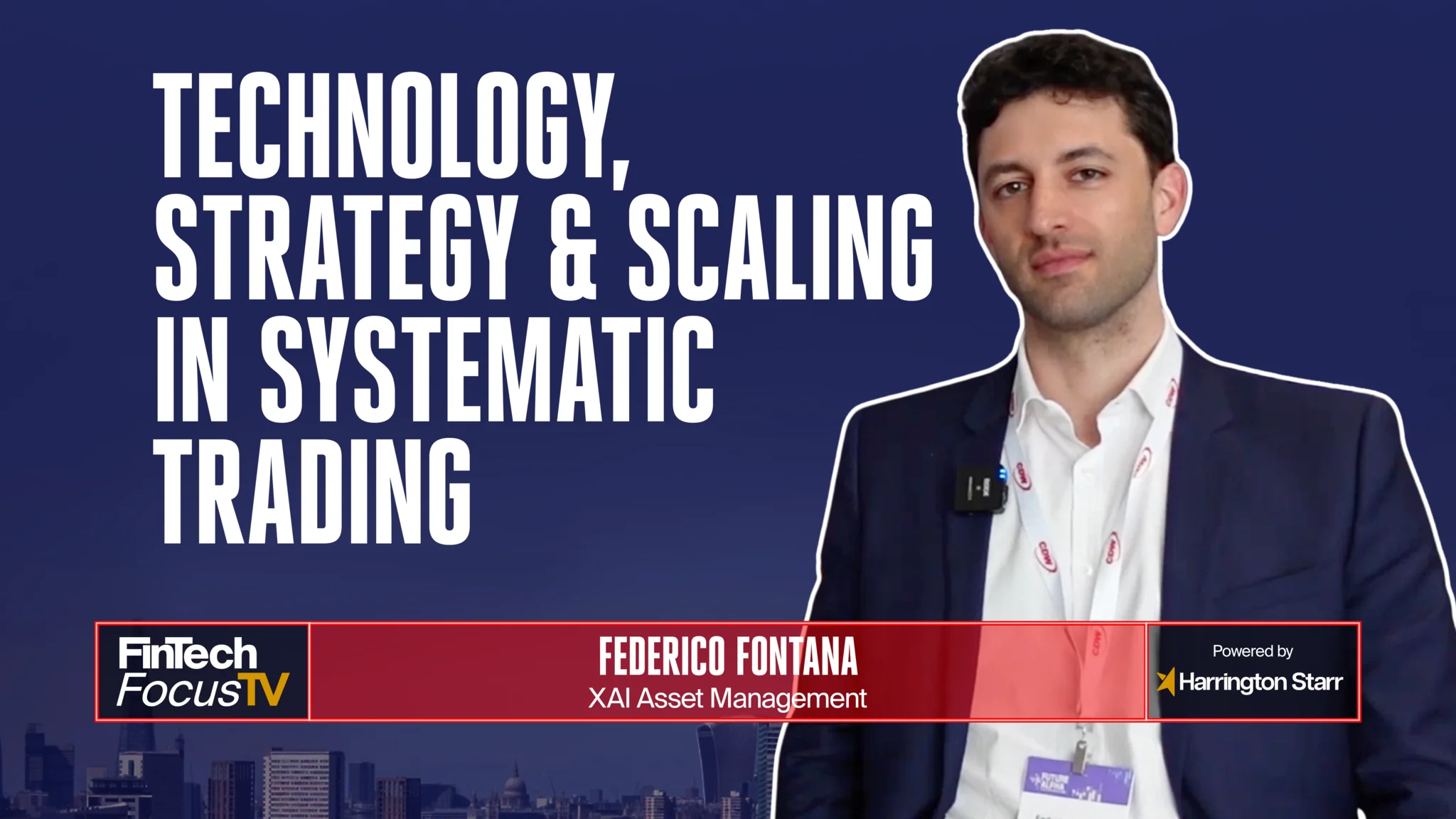
At the Future Alpha event in New York 2026, FinTech Focus TV host Oli Knight sat down with Federico Fontana to explore the realities of building and scaling a systematic trading firm in today’s highly competitive financial technology landscape. This conversation offers a grounded and practical perspective on quantitative finance, moving beyond theory to examine what it actually takes to launch, operate, and grow a hedge fund powered by systematic trading strategies.
Federico begins by outlining his role as Chief Technology Officer at XAI Asset Management, a firm focused on trading liquid futures across multiple asset classes using a mid-frequency, systematic approach. The firm’s objective is to deliver a diversified and cash-efficient strategy for its investors, a goal that has taken years of development, iteration, and refinement. Having joined the business from day one, Federico has been deeply involved in building not only the technological infrastructure but also contributing to research and development and shaping the overall investment product. This breadth of responsibility reflects the reality of working within early-stage quantitative trading firms, where technology, strategy, and execution are tightly intertwined.
One of the most compelling aspects of the conversation is the insight into what it truly means to build a systematic trading business from scratch. Federico explains that while launching a hedge fund may initially appear complex, once the direction and niche of the business are clearly defined, many of the key decisions around technology and infrastructure begin to fall into place naturally. This includes choices around programming languages, cloud providers, and overall system architecture.
Rather than becoming overwhelmed by the sheer number of decisions required, Federico highlights the importance of clarity in the firm’s strategic direction. Once a firm understands its niche and value proposition within the broader financial markets, the technological decisions become more straightforward, emerging as solutions to clearly defined problems.
For firms operating within capital markets, this also underscores the growing demand for professionals who can operate across both technical and strategic domains. As a quantitative finance recruitment business, Harrington Starr sees firsthand how valuable these hybrid skill sets are, particularly within systematic trading and quantitative finance environments where technology underpins every aspect of performance.
Efficiency emerges as a central theme throughout the episode, particularly when discussing the realities of scaling a trading business. Federico emphasises that for smaller or growing firms, resources are inherently constrained, making it essential to be deliberate and thoughtful about where time and effort are invested. Unlike larger organisations that can allocate significant resources to multiple initiatives simultaneously, early-stage firms must prioritise carefully and focus on what will drive the greatest impact.
This focus on efficiency extends to both operational processes and system design. Federico warns against the temptation to build overly complex or bespoke solutions too early in a firm’s lifecycle. While it can be appealing to design systems with future scale in mind, there is a significant risk of overengineering. Instead, he advocates for solving problems incrementally, thinking one step ahead rather than attempting to anticipate every future requirement.
This approach is particularly relevant within quantitative finance hiring, where there is often a tension between building scalable systems and maintaining agility. Candidates who understand this balance, who can deliver practical, efficient solutions without unnecessary complexity, are highly sought after in today’s market. For organisations looking to hire within systematic trading, this mindset can be a key differentiator between teams that scale successfully and those that become bogged down by their own infrastructure.
A major focus of the discussion centres on the concept of “edge” within systematic trading, a term that is often used but not always clearly defined. Federico is candid in his assessment that firms must distinguish themselves within the market, as failing to do so would simply result in becoming a copy of existing participants. However, he also challenges the idea that this differentiation can be artificially created from the outset.
Instead, he argues that a firm’s edge must emerge naturally over time, shaped by its intellectual property, research efforts, and the core skills of its team. This perspective is particularly valuable for both founders and hiring managers, as it emphasises the importance of building teams with the right capabilities rather than attempting to force a predefined strategy onto the market.
Federico provides a practical example of how this philosophy has influenced XAI Asset Management’s approach. As a commodity trading advisor operating within liquid futures markets, the firm competes alongside many others with similar mandates. Rather than attempting to differentiate through the sheer breadth of instruments traded, XAI has taken a more focused approach. The firm deliberately trades a smaller number of instruments, allowing it to develop deeper insights and more sophisticated signals within those markets.
This decision reflects a trade-off between diversification and depth. While diversification can provide a form of “free lunch” in terms of risk management, it can also dilute the effectiveness of a firm’s edge. By concentrating their efforts, XAI has been able to develop strategies that have historically been uncorrelated with other diversified trading businesses. This highlights the importance of intentional decision-making within systematic trading and reinforces the idea that edge is often a byproduct of focused expertise rather than broad coverage.
Another critical theme explored in the episode is the role of technology infrastructure in supporting systematic trading strategies. Federico’s experience building trading platforms from the ground up provides valuable insight into how firms should approach system design in a rapidly evolving environment.
He emphasises that while it is important to have a long-term vision for the business, it is equally important not to overbuild too early. Systems that are designed for a scale that does not yet exist can quickly become inefficient, costly, and difficult to maintain. As the business grows, previously built systems may become obsolete, requiring continuous refactoring and reinvention.
This iterative approach to system design aligns closely with modern best practices within software engineering and financial technology. It also highlights the importance of hiring individuals who are comfortable working within evolving environments, where change is constant, and adaptability is essential.
For firms operating within capital markets, this has significant implications for recruitment strategy. The ability to attract and retain talent that can navigate both the technical and strategic complexities of building trading systems is critical to long-term success. As a leading quantitative finance recruitment business, Harrington Starr continues to see strong demand for professionals who can bridge this gap, particularly within areas such as cloud engineering, data infrastructure, and algorithmic trading systems.
The conversation concludes with a discussion on talent and what makes individuals successful within a systematic trading environment. While XAI Asset Management is still in the earlier stages of growth and does not yet have a fully developed HR function, Federico shares some key observations based on his experience working with interns and early-career professionals.
He highlights curiosity and a genuine motivation to solve problems as two of the most important traits for success. In an industry driven by data, technology, and constant innovation, individuals who are naturally inquisitive and driven to understand complex challenges are more likely to thrive. This aligns closely with broader trends within quant hiring, where soft skills such as problem-solving ability and intellectual curiosity are increasingly valued alongside technical expertise.
For organisations looking to build high-performing teams within systematic trading, this reinforces the importance of hiring for mindset as well as skill set. Technical proficiency can be developed over time, but the intrinsic motivation to explore, learn, and solve problems is far more difficult to teach.
This episode of FinTech Focus TV provides a compelling and realistic view of what it takes to succeed within systematic trading and quantitative finance. From building a hedge fund from the ground up to developing a sustainable edge and scaling efficiently, Federico Fontana’s insights offer valuable guidance for both practitioners and hiring managers within the industry.
For firms, the key takeaway is the importance of alignment between strategy, technology, and talent. Success in systematic trading is not driven by any single factor, but by the integration of these elements into a cohesive and adaptable business model. As the industry continues to evolve, the demand for professionals who can operate at this intersection will only increase.
At Harrington Starr, we work closely with organisations across capital markets, trading technology, and quantitative finance to identify and secure the talent required to drive this kind of innovation. Whether it is building out systematic trading teams, hiring for data and infrastructure roles, or scaling technology functions within hedge funds, the ability to connect the right people with the right opportunities remains critical.
As this conversation highlights, the future of systematic trading will be defined not just by technological advancement, but by the people who design, build, and operate these systems. For firms looking to stay ahead, investing in the right talent is not just an advantage, it is a necessity.