Quant Trading Is Becoming Agentic
04 November, 2026


Prediction markets are gaining attention across US capital markets, raising an important question for financial institutions: is existing trading infrastructure ready for markets that never close?
For institutional investors, trading firms and FinTech providers, the challenge extends beyond accessing new markets. Firms must consider liquidity, portfolio risk, execution technology and how emerging asset classes interact with traditional investments.
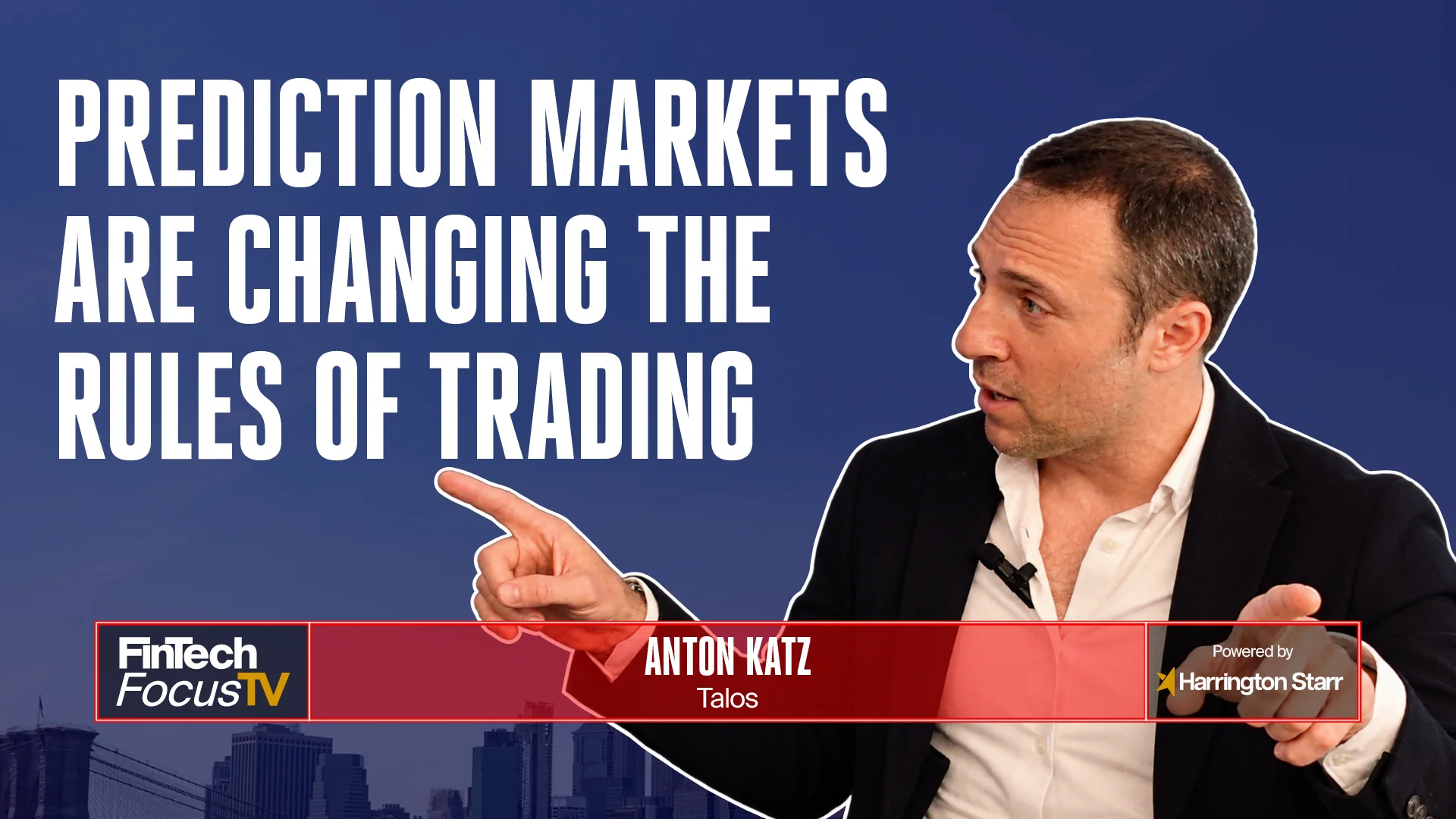
Recorded live at the FIX Americas Trading Conference in New York City, this special episode of FinTech Focus TV features Toby Babb, speaking with Anton Katz, Co-Founder and CEO of Talos.
Anton discusses how prediction markets, digital assets and 24/7 trading are changing institutional requirements, alongside the importance of building financial technology around genuine customer demand.
Prediction markets allow participants to trade contracts linked to the outcomes of specific events. Their growing prominence creates opportunities for trading firms while introducing new operational challenges.
Anton explains that retail and institutional participants are increasingly interacting within these markets. However, their requirements differ considerably.
Retail traders may focus on individual contracts. Institutional investors must consider how positions affect wider portfolios, including exposure to other asset classes.
This distinction is particularly relevant to the US capital markets industry, where institutional trading operations involve complex technology, multiple trading venues and sophisticated risk management.
For American trading firms exploring prediction markets, access alone is insufficient. They also need reliable market data, execution capabilities and infrastructure that supports the complete investment lifecycle.
These requirements reinforce the importance of specialist trading and exchange infrastructure, particularly as financial institutions expand into emerging markets.
One of the central themes of the discussion is the transition towards continuous trading.
Cryptocurrency markets already operate 24/7, while prediction markets introduce additional environments where trading can continue outside conventional market hours.
For institutional investors, the implications extend beyond availability.
Anton asks:
“How does my risk change during the weekend?”
This question highlights the difficulty of managing portfolios containing assets that operate on different trading schedules.
An American investment firm might hold cryptocurrency and prediction market positions alongside equities or derivatives. Changes in continuously traded markets could affect its overall exposure while traditional markets remain closed.
Institutions therefore need systems capable of monitoring positions, managing risk and supporting trading activity throughout the week.
Continuous trading places additional demands on technology and operations.
Trading platforms must remain available, market data must be accessible, and institutions need processes for managing incidents, execution and settlement outside conventional working hours.
Anton explains that Talos's experience supporting cryptocurrency markets required infrastructure designed for continuous operation.
For US financial services employers, these requirements reinforce the importance of professionals specialising in trading application support, platform reliability and production systems.
The challenge is not simply extending trading hours. It is ensuring that technology, operational processes and risk controls can support those hours reliably.
Historically, capital markets technology providers have often specialised in individual functions, such as market data, order management, execution or portfolio management.
Anton argues that institutional customers increasingly need these capabilities to work together.
He describes how Talos evolved from an order and execution management system, or OEMS, into a broader platform supporting the investment lifecycle.
An OEMS helps traders manage orders and execute transactions. An end-to-end trading platform can also connect market data, portfolio management and settlement processes.
This integration becomes particularly important in 24/7 markets, where institutions need consistent information across trading and post-trade activities.
For US trading technology companies, the challenge is developing infrastructure that can accommodate multiple markets without introducing unnecessary operational complexity.
Talos initially developed infrastructure for institutional cryptocurrency trading, providing technology across execution, portfolio management, data and settlement.
Anton explains that the company has since expanded into additional digital asset markets.
During the conversation, he discusses Talos's involvement in a DTCC pilot covering tokenised equities and Treasuries, alongside its integration of prediction market capabilities.
These developments reflect a broader ambition to support institutions trading across multiple asset classes.
However, each market introduces different challenges.
Prediction markets, for example, may contain contracts with limited liquidity. Institutions seeking to establish or hedge positions need execution strategies suited to those conditions.
Anton describes how Talos has connected prediction market access with its algorithmic trading environment.
This highlights the importance of quantitative research, market structure expertise and execution technology when developing multi-asset platforms.
For US hedge funds, proprietary trading firms and market makers, these capabilities are closely connected to the specialist expertise sought through quantitative finance recruitment.
Anton identifies tokenisation and artificial intelligence as two developments that could substantially change financial market infrastructure.
Tokenisation involves representing assets digitally, potentially changing how financial instruments are issued, traded and settled.
However, Anton challenges the assumption that new technology automatically creates demand.
He explains that tokenisation had been widely discussed for years before customers began driving more meaningful adoption.
His argument is that technology providers must respond to institutional use cases rather than assume innovation alone will persuade customers to change established processes.
The same principle applies to AI in financial services.
Artificial intelligence may offer opportunities across trading technology, analytics and operational processes, but businesses still need to determine where it solves a genuine problem.
These questions connect with wider discussions of digital transformation and market infrastructure featured in The Financial Technologist – The Influence List 2026.
For American FinTech businesses, the important consideration is whether technology can deliver measurable value to institutional customers.
One of the strongest insights from the episode concerns how successful financial technology products are developed.
Anton explains that Talos works closely with customers when deciding which capabilities to build.
He describes the company as being particularly resistant to:
“solutions that are in search of a problem.”
Rather than developing technology independently and attempting to generate demand afterwards, Talos involves design partners early in the development process.
Customers participate in prototypes and provide feedback while products are being developed.
This approach helps the business identify practical requirements, refine its technology and avoid investing in features that do not address meaningful problems.
However, customer-led development also requires prioritisation.
As FinTech companies grow, clients may request capabilities in many different directions. Technology leaders must decide which opportunities align with their strategy and which should be declined.
For US FinTech founders and technology executives, this demonstrates the importance of combining technical expertise with commercial judgement and customer understanding.
The expansion of prediction markets and institutional digital asset trading has implications for financial technology hiring across the United States.
Businesses developing multi-asset trading platforms need professionals with expertise in electronic trading, market connectivity, quantitative research, execution algorithms and financial market infrastructure.
Harrington Starr's Financial Services & Financial Technology Salary & Hiring Report 2026/27 provides a useful perspective on US hiring conditions.
Its quantitative finance analysis identifies continued demand across options trading, ETF market making, systematic equities, futures and low-latency infrastructure.
The report also highlights the difficulty of finding professionals who combine technical expertise with commercially applicable trading experience.
Its US salary benchmarks place senior quantitative developers at approximately $225,000–$350,000, illustrating the investment required to attract experienced quantitative technology professionals. These are salary benchmarks rather than total compensation figures.
This is relevant to employers building institutional trading infrastructure, where specialised technical capability can influence execution performance, system resilience and product development.
Anton's emphasis on adaptable, multi-asset technology also has implications for where US firms build their teams. Different financial technology markets offer access to different combinations of trading expertise, engineering capabilities and institutional clients. Harrington Starr's US FinTech Hotspots resource provides additional context for employers considering the geographical distribution of specialist financial technology talent.
As institutions expand into prediction markets and digital assets, employers must identify professionals whose experience can transfer between traditional capital markets and emerging trading environments.
For businesses developing specialist teams in New York, Harrington Starr's New York financial technology recruitment team can support hiring across trading technology, quantitative finance and financial services.
Prediction markets are part of a wider shift towards interconnected, increasingly continuous financial markets.
For US institutional trading firms, this creates opportunities alongside challenges involving liquidity, portfolio risk and operational resilience.
For financial technology providers, Anton's message is that successful innovation depends on understanding what institutions actually need.
The organisations best positioned to adapt will be those that combine flexible trading infrastructure, specialist expertise and meaningful customer collaboration.