Is This the End of Enterprise Architecture as We Know It?
07 October, 2026
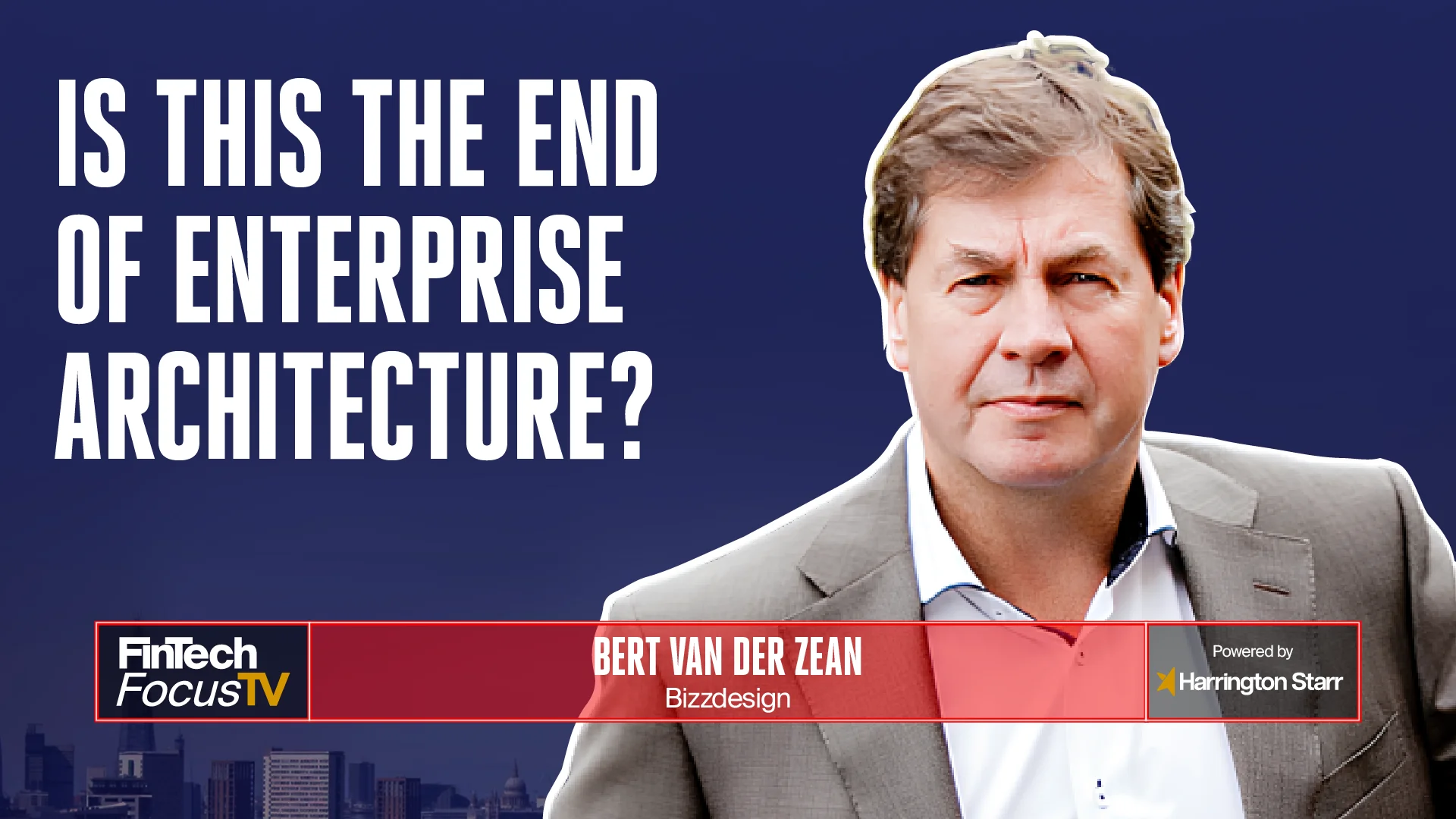

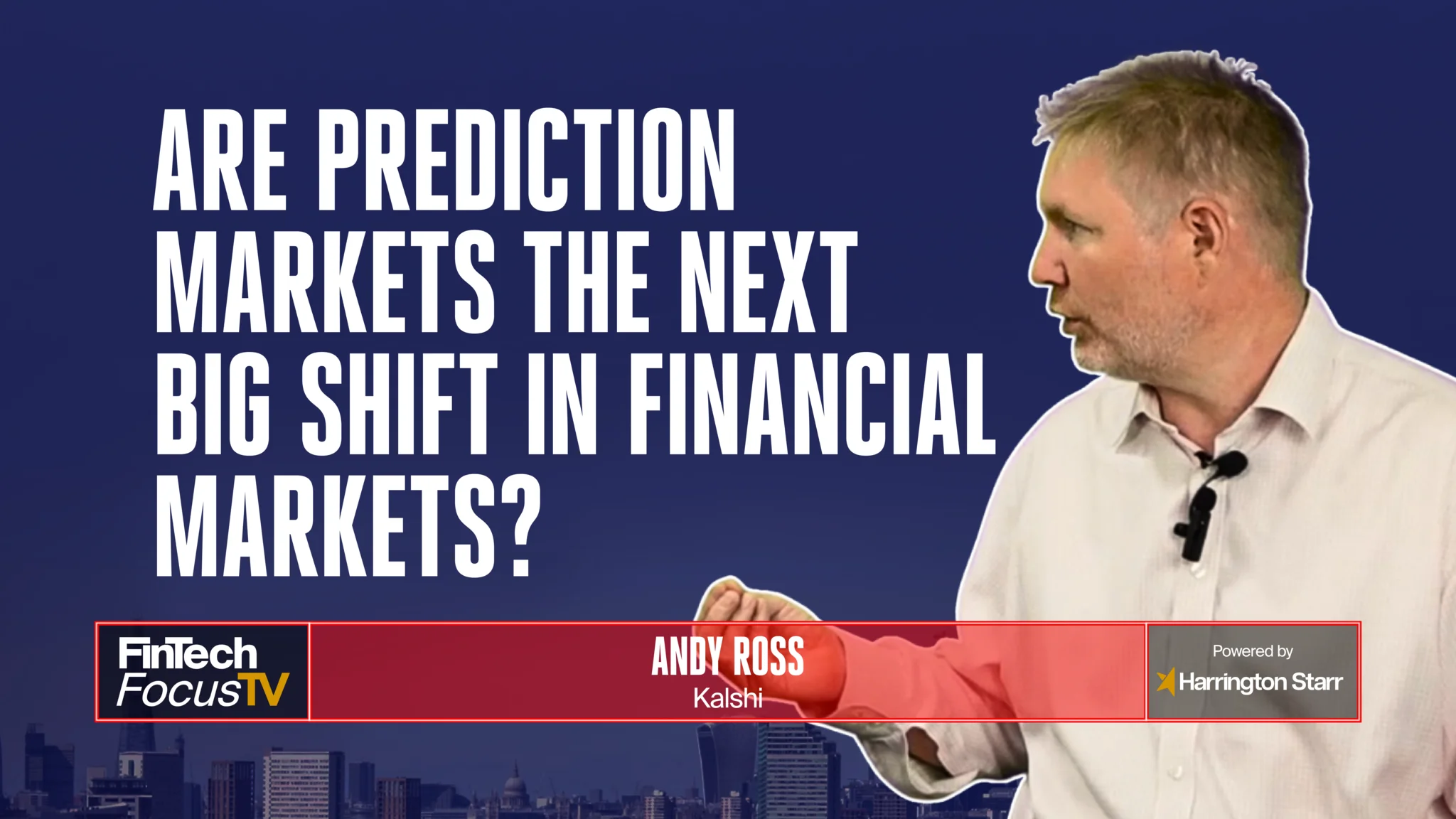
Financial markets are experiencing a period of significant change. New technology, evolving regulation, changing market structures and emerging financial products are challenging established ideas about how markets should operate. Among the developments attracting increasing attention are prediction markets, and for Andy Ross, Head of Institutional at Kalshi, their potential goes far beyond being a new way to trade.
In this episode of FinTech Focus TV, Harrington Starr CEO and Toby Babb sits down with Andy Ross to explore the rapid growth of prediction markets, the institutionalisation of Kalshi and what the next generation of financial markets could look like. Their conversation moves from Andy’s extensive career in traditional finance to regulation, institutional adoption, market infrastructure, talent, culture, AI and the differences he sees between innovation in the US, UK and Europe.
At the heart of the discussion is a bold belief from Andy: he fundamentally sees prediction markets as the biggest change to financial markets since the Eurodollar. It is a statement that sets the tone for a conversation about an industry that he believes is only beginning to demonstrate its potential.
Andy’s move into prediction markets comes after a career spanning some of the most established areas of institutional finance. He spent around 18 years at Morgan Stanley, beginning his career picking up paper tickets and entering them into a mainframe system before moving through risk management and CVA trading, ultimately running the CVA trading desk in Europe.
Following the collapse of Lehman Brothers, his career moved towards clearing. Andy went on to establish an OTC clearing business at Morgan Stanley before leaving to run CurveGlobal, an exchange within London Stock Exchange Group. After six years there, he joined Standard Chartered, where he spent nearly four years as Global Head of Prime Brokerage. He then made the move to Kalshi, attracted by what he describes as the exciting, cutting-edge and novel opportunity presented by prediction markets.
For a financial technology recruitment business like Harrington Starr, Andy’s journey highlights something particularly interesting about the evolution of FinTech talent. Innovation does not necessarily mean leaving decades of institutional experience behind. Instead, emerging areas of financial technology can benefit from combining that experience with new technology, products and ways of thinking.
Toby describes this as a form of convergence. Professionals with deep institutional backgrounds are increasingly being attracted to areas at the forefront of changing markets. Andy’s role at Kalshi is, in many respects, about bringing the knowledge accumulated throughout his career into a rapidly growing business and helping ensure its infrastructure can serve institutional participants.
One of Andy’s central messages is that not all prediction markets are the same. He describes Kalshi as an institutional platform, pointing to its status as a CFTC-regulated derivatives contract market and designated clearing organisation. For Andy, this regulatory foundation is central to the proposition and to the work required to increase institutional participation.
His remit involves building on that foundation and making sure the platform works from an institutional perspective. That means thinking about liquidity, technology and the infrastructure institutions already use. It also means developing relationships with clearing brokers and, crucially for Andy, increasing participation from bank clearing brokers.
This is where the growth of prediction markets intersects directly with established capital markets infrastructure. Institutional adoption is not simply about generating interest in a new product. It requires connectivity, clearing, compliance, risk management and technology capable of fitting into the workflows of sophisticated financial organisations.
That creates an important theme for the wider financial technology recruitment market. As new asset classes, trading models and market structures emerge, businesses need professionals who can bridge the gap between innovation and institutional requirements. Experience across trading technology, clearing, risk, compliance, software engineering and market infrastructure can become increasingly valuable as emerging businesses mature.
Andy’s conviction around prediction markets is strongly linked to the information they can produce. He discusses the quality of data generated by Kalshi’s markets and explains that the value comes from the participants forming those markets rather than Kalshi itself making prices. Kalshi operates as an exchange connecting buyers and sellers, with market participants collectively generating the signals.
The conversation explores how this could be applied to more granular questions affecting companies and financial assets. Andy uses Tesla as an example, discussing potential markets around issues such as self-driving approvals and other individual factors that could influence a company’s risk profile.
This ability to break larger risks into individual components opens interesting possibilities for investors and institutions. Rather than treating a market view as one broad outcome, prediction markets could potentially provide signals around the individual events that contribute to that outcome.
Crypto is another area discussed during the episode. Andy explains how Kalshi structures certain crypto-related markets and talks about the importance of robust contract design. The broader point is that he sees opportunities for new forms of data, products and risk-management tools that could have genuine institutional applications.
The scale of potential product creation becomes particularly clear when the discussion turns to commodities and compute. Andy argues that prediction markets can provide opportunities around risks and underlying factors that may not have highly liquid conventional products available today.
At the time of the conversation, he says Kalshi has launched just under 10,000 markets. He also discusses the launch of a compute market covering areas including GPUs, DRAM, chip sensitivities, energy costs and token costs, with the intention of generating a market-derived forward curve for compute.
For Andy, one advantage of prediction markets is their ability to respond quickly as the world changes. New contracts can be created around emerging developments, providing a degree of agility that is especially relevant to rapidly evolving areas such as computing technology.
He explains the fully funded framework behind these contracts and describes the ability to develop new products, test them, deliver them to customers and move rapidly onto the next opportunity. That speed, he argues, reflects both the nature of prediction markets and Kalshi’s organisational culture.
This agility speaks to a much broader trend across financial technology. Whether in trading technology, digital assets, market data, AI or financial infrastructure, firms increasingly need technology talent capable of building at speed without losing sight of resilience, regulation and risk.
Talent becomes a major theme as Toby and Andy move from products into the culture behind Kalshi’s growth.
Andy describes the organisation as deliberately flat, combining exceptional talent coming out of universities with people who bring significant industry experience. He talks about a high level of collaboration, a shared goal and a culture where people are expected to take ownership rather than wait for instructions to move through a traditional hierarchy.
For Andy, high-quality people drive one another to achieve more. He characterises the culture not as individuals trying to outperform each other, but as “hyper-collaboration” focused on achieving a common objective. Employees are empowered to take hold of problems, drive projects and make things happen.
He is equally clear that this environment will not suit everybody. The hours can be long, the pressure high and the pace demanding. Kalshi is rolling out new products and developing new markets rapidly, which requires people to work at a speed they may not experience in more traditional organisations.
This is particularly relevant to FinTech recruitment and the competition for specialist talent. Hiring for high-growth financial technology businesses is not only about finding candidates with the correct technical skills. Businesses also need to understand whether someone can thrive within their particular pace, structure and culture.
The conversation then turns to geography and one of Andy’s strongest views: the current environment for innovation in the United States.
Kalshi remains relatively lean despite its growth and visibility. Andy says the company has around 150 people, with only two based in London at the time of recording. His own role involves significant travel between the UK and US, giving him direct exposure to both markets.
Andy is enthusiastic about what he describes as the go-getting culture in America. He sees an entrepreneurial attitude, appetite for success and regulatory environment that supports raising capital and creating high-growth businesses.
His concern is that the UK and Europe risk focusing on incremental questions while other markets tackle more fundamental changes.
Drawing on a recent panel discussion, Andy contrasts European conversations around issues such as MiFID, dark and lit pools and reporting with developments including 24-hour markets, tokenisation and prediction markets. While he acknowledges that the European regulatory questions matter, he considers them second-order compared with the structural changes taking place elsewhere.
For the capital markets recruitment landscape, these geographical differences matter. Where innovation occurs affects where investment flows, where businesses grow and ultimately where demand for specialist financial technology talent is created.
Regulation runs throughout the episode, but becomes particularly important when Toby returns to Andy’s point that not all prediction markets are the same.
Andy explains some of the controls surrounding participation on Kalshi in the US, including identity information and employer information. He discusses the ability for compliance functions to monitor employee activity and compares this with the oversight financial institutions already apply to brokerage accounts.
The conversation also addresses insider trading and manipulation. Andy stresses that surveillance and enforcement are critical components of operating a credible market. He describes monitoring trading activity for anomalies and points to the importance of AML, KYC and exchange monitoring in maintaining standards comparable with established exchange groups.
This is an essential part of the institutionalisation story. Innovation in financial services cannot be separated from trust. If prediction markets are to become more embedded within institutional finance, their infrastructure must address the same questions around compliance, surveillance and risk management that exist across established capital markets.
It also demonstrates why risk and compliance recruitment, trading technology expertise and market infrastructure knowledge remain critical as FinTech evolves. New technology does not remove the need for governance. In many cases, innovation creates entirely new requirements for people who understand both the technology and the regulated environment surrounding it.
Looking ahead, Andy discusses several areas of expansion. Kalshi had recently launched perpetuals at the time of recording, and he explains that the business plans to expand the assets available, subject to CFTC approval.
Andy does not position perpetuals as a replacement for futures. Having previously run both a futures exchange and futures clearing business, he describes futures as a strong product. Instead, perpetuals provide customers with another choice, particularly for those who do not want the cost associated with rolling futures positions.
He also discusses plans around FX and gold and the continued development of institutional infrastructure.
One of his biggest priorities is securing a bank FCM connection. Andy acknowledges that this process has been slower than he would like, but also recognises the regulatory and risk processes banks must work through. In his view, the arrival of a bank FCM would be a significant marker of institutional demand and adoption.
The opportunity extends further. Andy mentions conversations around structured products, including a principal-protected note with a payoff based on a Kalshi market, as well as ETFs and indexes. The picture he paints is of prediction markets becoming connected to a much broader financial ecosystem rather than remaining an isolated product category.
The final part of the episode brings another major financial technology theme into the conversation: artificial intelligence.
Toby argues that the most interesting application of AI is not simply asking how much work can be removed. Instead, he asks what happens when technology augments exceptional people and enables them to achieve significantly more.
Andy strongly agrees.
He describes Kalshi as having highly skilled engineers who are supported by a range of AI tools. The combination of strong people and technology, rather than technology alone, is what he believes allows the company to operate so efficiently. He also describes AI and other tools being used across marketing to produce presentations, documents and visuals.
Importantly, this adoption sits within what Andy describes as a regulated perimeter, with clear information-security rules governing what people can and cannot do. The objective is to enable people to use technology while maintaining appropriate frameworks.
Andy ultimately argues that Kalshi’s team of around 150 people is doing work comparable to what might otherwise require approximately 1,500. That productivity still requires hard work and responsibility, but it also demonstrates his belief in what can happen when talented people are given effective technology and the freedom to use it.
For the future of FinTech talent, this may be one of the most significant themes in the entire conversation. AI does not necessarily make exceptional people less important. In Andy and Toby’s discussion, the opposite is true: the quality of the individual becomes even more valuable when technology can amplify what that person is capable of achieving.
Throughout the episode, prediction markets provide the central subject, but the conversation ultimately touches on many of the forces reshaping financial technology hiring.
Institutional experience is moving into emerging markets. Trading technology is evolving. New products require new infrastructure. Regulation remains essential. AI is changing productivity. High-growth businesses are challenging traditional organisational structures. Meanwhile, competition between financial centres could determine where the next generation of companies and talent choose to build their futures.
For Harrington Starr, these trends closely reflect the conversations taking place across FinTech recruitment, financial technology recruitment and capital markets recruitment. As financial markets evolve, firms need people capable of operating across increasingly blurred boundaries between technology and finance, innovation and regulation, and traditional infrastructure and emerging products.
The demand is not simply for technical ability in isolation. The growth of businesses operating at the intersection of technology and institutional finance creates a need for software engineers, trading technology specialists, infrastructure professionals, risk and compliance experts, data specialists and leaders who understand how financial markets actually work.
Andy’s own career provides a clear example of that convergence. Decades of institutional experience have not kept him anchored to traditional finance. Instead, they have become part of what he brings to an emerging area of the market.
Toby closes the conversation by reflecting on a renewed sense of excitement he has noticed across financial technology. Over the past year, he says he has increasingly seen people become energised by their work and by the opportunities being created through change and innovation. That enthusiasm is particularly evident in Andy’s perspective on Kalshi and prediction markets.
The conversation demonstrates that the story is about far more than predicting individual outcomes. It is about data, price discovery, new financial products, institutional infrastructure, regulation, technology, talent and the potential evolution of market structure itself.
For financial institutions, FinTech businesses and the professionals building careers across financial technology, that evolution creates both opportunities and challenges. Firms will need to move quickly while maintaining trust. They will need to embrace new technology while retaining deep market expertise. And they will need to attract people who are comfortable operating in an environment where the boundaries of financial markets continue to change.