The Hidden Barriers for Women in Finance
21 October, 2026


Artificial intelligence is changing almost every aspect of financial services. From automation and compliance to customer service and decision-making, AI is helping organisations work faster, analyse more data and unlock new efficiencies than ever before. Yet as technology continues to evolve, one question remains at the centre of every successful business: what role do people play in the future of financial services?
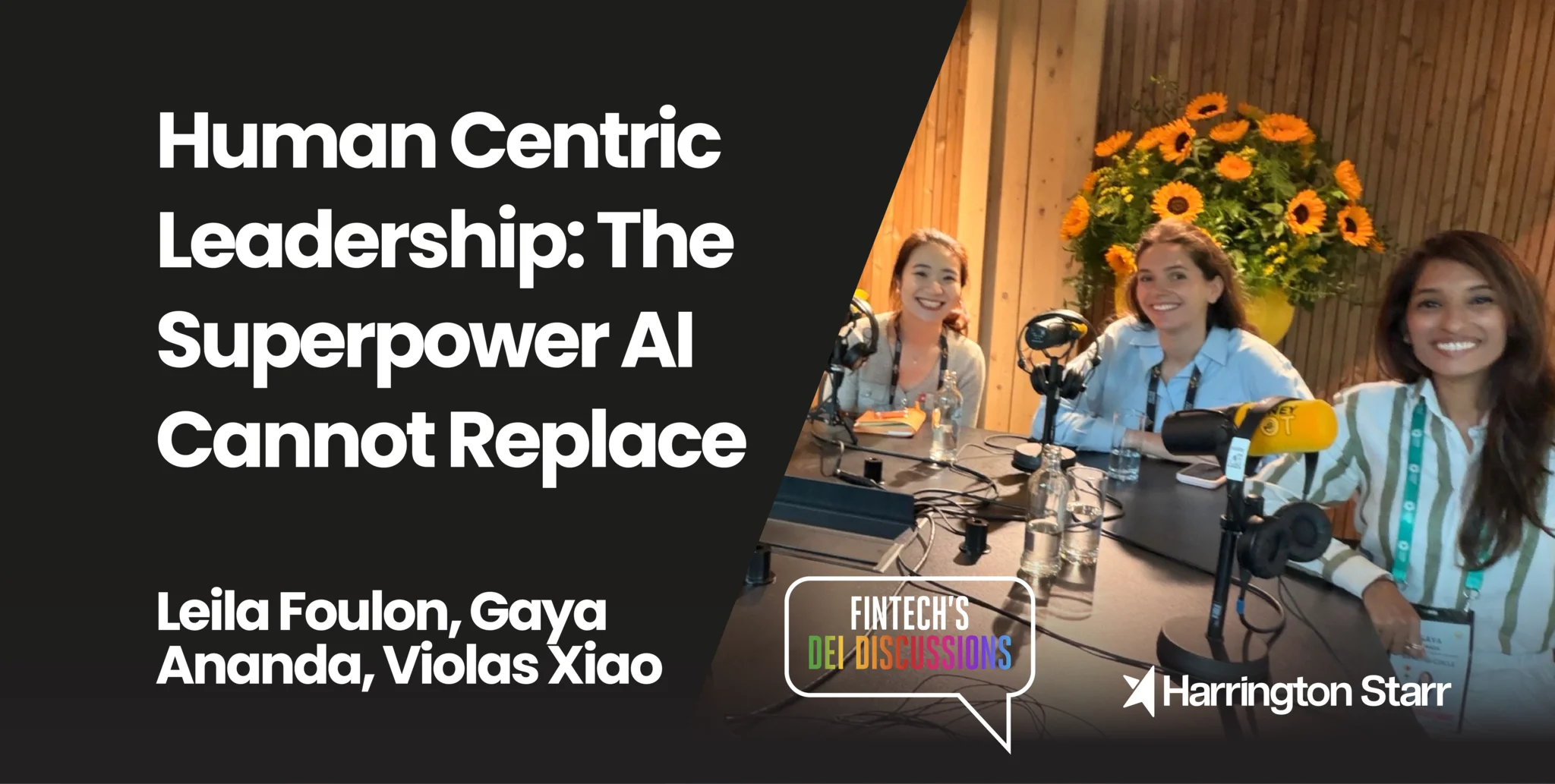
That question sits at the heart of this episode of FinTech's DEI Discussions, where Nadia is joined by Leila Foulon, Gaya Ananda and Violas Xiao for a live conversation exploring why human-centric leadership remains one of the greatest competitive advantages any organisation can have. Recorded live, the discussion examines how leaders can embrace AI without losing the empathy, judgement, curiosity and trust that drive innovation, improve workplace culture and ultimately create stronger businesses.
For organisations across financial technology, these conversations have never been more relevant. As demand for AI skills continues to grow, so too does the need for exceptional leadership capable of developing people alongside technology. At Harrington Starr, we see these conversations reflected every day through FinTech recruitment, leadership hiring and the evolving skills businesses need to remain competitive. While technical expertise remains essential, organisations increasingly recognise that leadership, culture and employee development are becoming major differentiators when attracting and retaining the best financial technology talent.
The discussion begins with each guest sharing their own career journey and the motivations behind the work they do today. Rather than focusing solely on commercial success, every story centres around solving real problems for customers and creating meaningful impact.
Violas Xiao explains how growing up in Guangzhou, one of China's major trading cities, exposed her from an early age to the challenges faced by importers and exporters. Having later worked in banking before joining XTransfer, she saw an opportunity to help underserved small and medium-sized businesses gain access to secure and compliant financial services that had previously been difficult to obtain. Her motivation extends beyond building financial infrastructure; it comes from seeing businesses she understands personally become more confident operating globally because barriers around payments and cross-border finance have been removed.
That sense of purpose becomes an important thread throughout the discussion. Rather than viewing leadership simply as delivering results, the panel repeatedly returns to the importance of creating outcomes that improve people's lives, whether that means customers, employees or colleagues.
For businesses investing in financial technology recruitment, purpose has become increasingly important when attracting experienced professionals. Candidates are no longer evaluating organisations purely on salary or job title. They also want to understand the company's mission, its leadership philosophy and whether their work contributes towards something meaningful. As financial services careers continue to evolve, organisations with clearly defined values often find themselves better positioned to attract high-performing talent.
When asked what defines great leadership in FinTech today, Gaya Ananda identifies three principles that underpin successful organisations: clarity, courage and curiosity. Rather than presenting leadership as a collection of management techniques, she explains these pillars as practical tools that help businesses navigate rapid technological change.
Clarity, she explains, has become increasingly valuable because financial services organisations are surrounded by constant innovation. Artificial intelligence, stablecoins, digital assets and new payment technologies all compete for attention. Strong leaders therefore provide clear direction by defining not only what their organisation will pursue, but equally what it will choose not to pursue. That clarity enables teams to make better decisions while maintaining autonomy within an agreed strategic framework.
Courage becomes equally important because many of today's technology decisions are being made before markets, regulation, or customer behaviour have fully matured. Organisations cannot always wait for certainty before innovating. Leaders therefore need confidence to make informed decisions despite incomplete information, recognising that delaying progress often creates greater competitive risk than moving forward thoughtfully.
Perhaps the most compelling pillar, however, is curiosity. As AI tools become increasingly capable of generating answers, Gaya warns against allowing technology to replace independent thinking. Human judgement still requires leaders to ask questions, challenge assumptions and seek perspectives from customers, colleagues and diverse teams. AI can accelerate information gathering, but curiosity remains uniquely human.
This balance between technology and human decision-making reflects a broader trend across financial services recruitment. Organisations increasingly seek professionals who combine technical capability with commercial judgement, communication skills and the ability to collaborate across multidisciplinary teams. As AI automates routine tasks, uniquely human skills continue to increase in value.
Rather than presenting AI as a threat, the conversation positions it as a tool that amplifies both strengths and weaknesses within organisations.
Nadia highlights the danger of relying too heavily on AI-generated outputs without questioning the assumptions behind them. While she actively encourages organisations to embrace AI, she also stresses the importance of maintaining human oversight and asking critical questions before accepting technology-generated recommendations.
Building on this, Gaya raises an issue that many organisations have yet to fully consider: the human cost of working at AI-driven speed. She argues that businesses have traditionally rewarded outputs, yet AI now performs many output-based tasks almost instantly. As a result, organisations risk overlooking the human effort involved in developing ideas, collaborating across teams and solving complex problems. Recognition may become increasingly disconnected from the behaviours that actually create long-term success.
She also questions how younger professionals will develop critical workplace skills if AI increasingly removes opportunities to learn through experience. Observation, experimentation and even failure have traditionally played important roles in developing future leaders. Without those experiences, organisations may unintentionally weaken their own leadership pipelines.
These reflections are particularly relevant as organisations invest heavily in AI across financial services. While automation undoubtedly improves efficiency, sustainable digital transformation depends equally on workforce development, leadership capability and organisational culture. The most successful firms will likely be those that invest in both technology and people simultaneously rather than viewing them as competing priorities.
One of the strongest themes throughout the discussion focuses on the distinction between diversity in recruitment and genuine inclusion throughout an employee's career.
Drawing on her experience within finance, Leila Foulon explains that improving representation at the recruitment stage does not automatically lead to equal opportunities within the workplace. Organisations may successfully diversify their hiring pipelines, yet still struggle to provide equal progression, mentorship, sponsorship and visibility once employees have joined the business.
She notes that AI introduces another important consideration. As entry-level work becomes increasingly automated, businesses must think carefully about how they continue creating opportunities for emerging talent. If graduate and junior positions become more limited, organisations will need more deliberate strategies for developing future leaders through alternative career pathways.
Nadia expands this discussion by challenging the assumption that recruitment only occurs when someone joins a company. She argues that recruitment continues every day through promotions, project allocations, speaking opportunities and internal development decisions. Every time a leader selects someone to lead an initiative, represent the business externally or participate in strategic discussions, another recruitment decision is taking place.
Leila reinforces this point by explaining that equal hiring numbers mean little if high-profile work, stretch assignments and strategic opportunities continue flowing towards the same individuals. Fair progression requires organisations to examine not only who they hire but also who receives visibility, sponsorship and opportunities to grow.
For organisations focused on FinTech hiring, this broader perspective is particularly valuable. Successful recruitment does not end once an offer has been accepted. Long-term retention depends upon creating workplaces where employees continue developing their careers, building new skills and seeing clear opportunities for advancement.
The discussion makes one message abundantly clear: in an era increasingly shaped by artificial intelligence, organisations cannot afford to overlook the human side of leadership. While AI will undoubtedly continue transforming financial services, sustainable success will depend upon leaders who invest just as heavily in developing people as they do in adopting new technology.
As the conversation develops, the panel moves beyond leadership theory and into a practical example of how inclusive leadership directly affects business performance. Rather than treating diversity and inclusion as separate initiatives, Violas Xiao demonstrates how creating an environment where everyone feels confident speaking up can reduce risk, strengthen decision-making and ultimately protect an organisation.
She recalls leading a product launch across Southeast Asia and Latin America when a junior member of her team raised concerns about a potential compliance issue. The project was close to launch, significant resources had already been invested and delaying the release would almost certainly affect delivery timelines. Faced with the choice between maintaining momentum or listening to someone with less experience, Violas chose to pause the project and bring together colleagues from multiple departments to review the concern.
The team quickly discovered that the concern was valid. By stopping to investigate, they prevented what could have become a serious compliance issue and protected both their customers and the company's reputation before the product reached the market. For Violas, the lesson was not simply about avoiding risk. It reinforced the importance of creating a workplace where every employee, regardless of seniority, feels confident enough to raise concerns when something does not seem right.
She explains that this experience fundamentally changed how she leads meetings. Rather than allowing the loudest or most senior voices to dominate discussions, she now actively encourages junior colleagues and quieter team members to speak first. Although this only adds a few minutes to each meeting, it sends a powerful message that every perspective matters and that ideas are evaluated on merit rather than hierarchy.
For organisations operating within financial services, where regulatory requirements, operational resilience and customer trust are paramount, this approach offers a valuable reminder. Strong workplace cultures are not simply good for employee engagement. They contribute directly to better governance, stronger compliance and improved business outcomes.
Gaya builds on this example by highlighting another leadership quality that often receives too little attention: the willingness to admit when someone else is right. As leaders become more senior, they are frequently expected to have all the answers. Yet she argues that the strongest leaders are those prepared to step back, listen and acknowledge that another member of the team has a better solution. That humility builds the psychological safety that allows innovation to flourish.
For employers focused on attracting and retaining top FinTech talent, this type of leadership culture is becoming increasingly important. High-performing professionals are far more likely to remain with organisations where they feel trusted, respected and genuinely able to influence decisions.
Another compelling theme throughout the discussion centres on recognising strengths rather than simply managing job descriptions.
Leila argues that effective leaders identify what makes individuals exceptional instead of trying to make everyone fit the same mould. Rather than viewing differences as gaps that need correcting, strength-based leadership recognises them as assets that can unlock creativity, innovation and better business outcomes. Diverse perspectives naturally generate more original thinking than teams optimised purely for similarity.
She explains that leadership therefore involves more than assigning tasks. It requires understanding what each individual is uniquely good at, even when those strengths fall outside their formal responsibilities. Creating an environment where people feel comfortable sharing ideas, challenging assumptions and contributing outside their traditional role enables organisations to discover talent that might otherwise remain hidden.
Leila illustrates this with an example from her own organisation. An engineer joined a commercial client meeting simply to provide technical support while another colleague was unavailable. During the conversation, however, it became clear that he possessed exceptional communication skills and connected naturally with customers. Rather than treating the experience as a one-off, the leadership team began inviting him onto more client meetings, exploring whether this aspect of the role aligned with his interests and giving him opportunities to develop those capabilities further.
For Nadia, this example reflects one of the biggest opportunities available to employers today. Too often, organisations automatically recruit externally whenever a vacancy appears instead of first considering the untapped potential already within their workforce. Internal mobility, retraining and career development not only maximise existing talent but also strengthen employee loyalty at a time when retention remains a significant challenge across financial services.
This discussion aligns closely with broader trends within financial technology recruitment. Increasingly, organisations are recognising that long-term success depends not simply on acquiring new talent but also on identifying, developing and retaining the people already contributing to the business.
The conversation then returns to the importance of trust and empowerment within modern leadership.
Violas explains that every decision made within financial services carries real consequences. Product launches, regulatory requirements, customer experience and organisational reputation all depend upon people making informed decisions quickly and confidently. Without trust, employees hesitate to raise concerns or take ownership. Without empowerment, every decision becomes dependent on senior leadership, reducing agility and slowing innovation.
She describes leadership as providing clear strategic direction while empowering teams to determine how those objectives are achieved. Once employees understand the organisation's long-term vision, they should be trusted to exercise their own judgement within that framework. This not only increases operational efficiency but also develops future leaders throughout the business.
One of her most memorable observations summarises this philosophy perfectly. Rather than creating followers, she wants to create more leaders. Sustainable organisations cannot rely on every decision flowing through one individual. Instead, success depends upon building capability, ownership and confidence at every level of the business.
As financial services organisations continue investing in digital transformation and AI adoption, leadership models based on empowerment rather than control are becoming increasingly valuable. The pace of technological change makes it impossible for a handful of senior executives to oversee every decision. Organisations instead need distributed leadership supported by trust, accountability and shared purpose.
Perhaps the most forward-looking part of the discussion focuses on succession planning and the future leadership pipeline across financial services.
Nadia raises an important concern that resonates across the recruitment industry. As AI transforms workplaces and organisations reduce entry-level hiring, who exactly will become tomorrow's leaders? While businesses focus heavily on technology adoption, succession planning often receives far less attention.
For Gaya, the answer begins with sponsorship rather than mentorship alone. Every leader should intentionally champion one or two individuals whose names they actively recommend in rooms where they are not present. Opening doors, creating opportunities and giving emerging talent visibility become critical responsibilities for today's leaders. Mentorship helps people develop, but sponsorship actively accelerates careers by creating opportunities that otherwise would not exist.
Violas agrees, explaining that succession planning begins from the moment someone joins an organisation. Recruitment should never end with filling a vacancy. Employers must also create structured pathways that help employees understand how they can continue developing towards future leadership positions. Without clear progression, organisations risk losing talented individuals long before they realise their full potential.
Gaya also challenges traditional hiring practices. Rather than focusing exclusively on previous experience and qualifications, she encourages employers to look for curiosity and passion. What are candidates reading outside work? What topics genuinely fascinate them? What motivates them to continue learning? In a rapidly changing industry, these qualities may prove far more valuable than following a conventional career path.
For specialist FinTech recruitment businesses such as Harrington Starr, these observations reinforce a broader shift occurring across the market. Increasingly, employers are seeking adaptable professionals who combine technical capability with learning agility, commercial awareness and strong interpersonal skills.
As the discussion concludes, each guest leaves listeners with a practical lesson that captures the central message of the episode.
Violas encourages leaders to remember that people are not simply resources but the true source of insight, resilience, innovation and long-term value. AI can undoubtedly improve efficiency, but it cannot replace the responsibility leaders have for developing future talent. Organisations must therefore create environments where employees feel trusted, supported and confident making decisions regardless of seniority.
Leila encourages leaders to ask employees what they are best at rather than focusing solely on what appears in their job descriptions. Organisations that recognise hidden strengths, create internal opportunities and invest in career progression build stronger loyalty while unlocking talent that external hiring alone could never deliver.
Finally, Gaya reminds listeners that empathy, curiosity, creativity and human judgement remain irreplaceable. AI will continue transforming productivity, but successful organisations will be those that combine technological innovation with genuine human-centred leadership. Rather than choosing between people and technology, the future depends upon ensuring both evolve together.
For Harrington Starr, this conversation perfectly reflects many of the leadership discussions taking place across the global financial technology sector. As organisations compete for exceptional talent, embrace AI and navigate continual change, success will depend on far more than technical expertise alone. The businesses that attract the best people, retain high-performing teams and build future leaders will be those that invest in trust, inclusion, curiosity and meaningful career development.
Technology will continue reshaping financial services for years to come, but the qualities that inspire teams, encourage innovation and build resilient organisations remain profoundly human. As Nadia concludes, one simple truth brings the entire discussion together: people make this industry.