Insights from FIX EMEA Trading Conference 2026
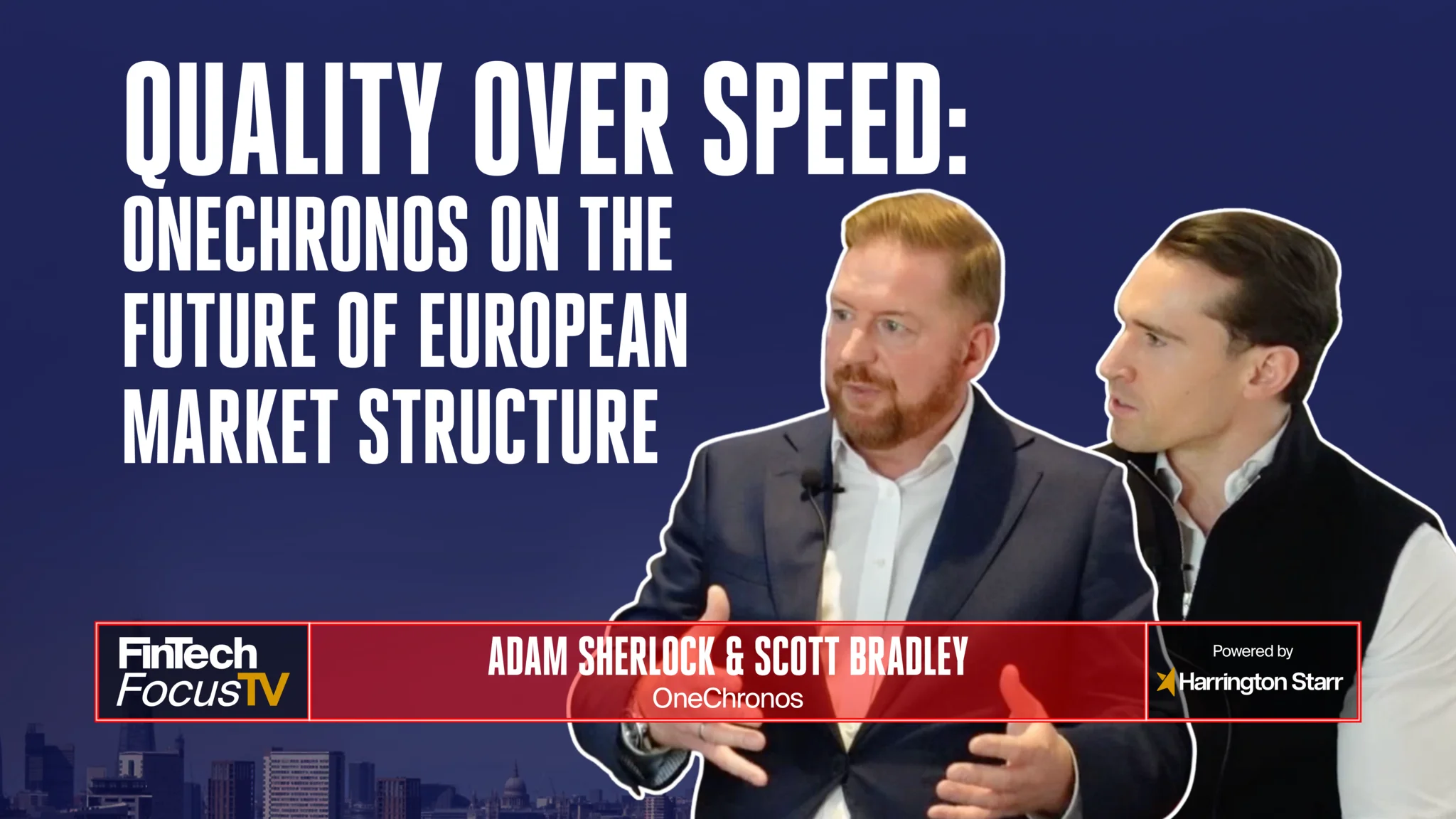
Recorded live at the FIX EMEA Trading Conference, this episode of FinTech Focus TV brings together some of the most important voices shaping modern market structure. Hosted by Toby Babb, the conversation features Adam Sherlock and Scott Bradley from OneChronos, offering a deep dive into innovation, trading infrastructure, and the future of capital markets.
From the outset, the tone is clear: this is not just another conversation about incremental change. Instead, it is a discussion about genuine innovation in financial markets, and what it really takes to shift an industry that has historically evolved slowly. As Toby opens the episode, he highlights the significance of being back at FIX, a conference that consistently brings together the largest and most influential participants across trading, technology, and regulation.
Scott Bradley, who heads up OneChronos Markets UK, sets the scene by explaining that the firm is currently preparing to launch a new multilateral trading facility (MTF) in both the UK and Amsterdam. This is not simply a regional expansion, but part of a broader strategy to introduce a fundamentally different market model to European equities. Adam Sherlock, leading the Netherlands operation, reinforces this by outlining their pan-European ambitions and the work already underway to bring this vision to life.
Trading Innovation vs Evolution: What’s Really Changing in Financial Markets
One of the most compelling themes throughout the episode is the ongoing debate between innovation and evolution in financial markets. Scott makes a clear distinction between the two, noting that while many developments in trading infrastructure are often framed as innovation, they are in reality incremental improvements moving in the same direction. True innovation, he argues, involves stepping outside of established frameworks to deliver fundamentally better outcomes.
This perspective becomes particularly relevant when discussing the regulatory environment. Both Scott and Adam reference the regulatory panel at FIX, where there was a strong emphasis on building frameworks that actively foster innovation. For OneChronos, this is a crucial validation point. Hearing regulators talk about enabling new models rather than simply maintaining existing ones signals a shift in mindset across the industry.
Adam builds on this by highlighting another key theme from the conference: data accessibility. The discussion around making market data available on a reasonable commercial basis is particularly important for firms like OneChronos, which rely on accurate and accessible pricing data to support their trading model. The potential introduction of a more standardised and commercially friendly market data framework, alongside the consolidated tape, is seen as a positive step forward.
Growth of Trading Venues: OneChronos’ Journey from US Success to European Expansion
The episode then turns to the remarkable growth journey of OneChronos in the United States. Scott shares that the firm launched its alternative trading system (ATS) just over three years ago and has since experienced what he describes as “gangbusters” growth. A recent milestone saw the platform record its highest ever trading day, with 260 million shares traded, equating to approximately $17.8 billion in average daily traded value.
This level of activity positions OneChronos as a top 10 venue according to FINRA rankings, a significant achievement in a highly competitive market. While this represents around 1.5% of the US market on a volume-adjusted basis, Scott is quick to point out that there is still substantial room for growth. However, the trajectory itself is what matters, demonstrating strong market adoption and validating the firm’s approach.
Crucially, this success in the US is not viewed as an endpoint, but as a foundation for further expansion. The team is now focused on bringing this momentum into Europe, leveraging both their existing relationships and the growing appetite for alternative trading models. As Adam explains, the European launch will involve a dual-MTF structure, with operations based in both the UK and the Netherlands, supporting a pan-European equities strategy.
The Future of Capital Markets: Multi-Asset Trading and New Market Models
Beyond equities, the conversation also explores the firm’s move into new asset classes. Scott reveals that OneChronos is launching its smart market model into the foreign exchange market, starting with G10 spot FX. This represents a significant step towards becoming a multi-asset trading venue, reflecting a broader industry trend towards integrated trading solutions.
Toby picks up on this point, noting the strategic tension between remaining niche and expanding across asset classes. For OneChronos, the decision to pursue multi-asset capabilities is clearly aligned with their long-term vision. Scott emphasises that the ability to trade across regions and asset classes is not just a competitive advantage, but a natural evolution of capital markets.
Central to this strategy is the concept of expressive bidding, which allows traders to incorporate constraints and optimise across portfolios rather than individual instruments. This approach, underpinned by combinatorial auction theory, represents a departure from traditional price-time priority models. Instead of focusing purely on speed, the emphasis shifts towards achieving optimal outcomes for participants.
Quality Over Speed in Trading: A New Approach to Liquidity and Execution
Perhaps the most defining theme of the episode is the shift from speed to quality in trading. Scott explicitly states that OneChronos wants to be synonymous with “quality over speed,” a message that resonates strongly throughout the discussion. In a market historically dominated by latency and execution speed, this represents a meaningful change in priorities.
The firm’s model is designed to democratise access to liquidity, creating an environment that protects investors while enabling more efficient trading. By focusing on notional price improvement and equitable distribution of outcomes, the platform aims to deliver better execution quality for all participants.
Adam reinforces this by explaining how the firm’s offering fits within existing trading workflows. While periodic auctions have become mainstream, accounting for approximately 15% of the European market, OneChronos is not simply another venue operating within this framework. Instead, it offers a differentiated model that can be integrated as a distinct liquidity destination.
This distinction is critical. Rather than competing directly with existing periodic auction mechanisms, OneChronos positions itself as a complementary solution, providing traders with additional choice and flexibility. This aligns with their broader narrative around innovation, offering something genuinely different rather than a marginal improvement.
Market Fragmentation and Choice: Why More Trading Venues Can Be a Positive Force
Another important theme explored in the episode is market fragmentation. Historically, fragmentation has often been viewed as a challenge, increasing complexity and making it harder for participants to access liquidity. However, Adam offers a different perspective, suggesting that fragmentation can be a positive outcome when it reflects genuine innovation and choice.
He explains that while the proliferation of trading venues can create operational challenges, it also enables participants to select environments that best suit their needs. The key is differentiation. If multiple venues offer similar outcomes, fragmentation becomes problematic. But when new models introduce distinct trading experiences, fragmentation becomes a driver of progress.
This perspective is particularly relevant in the context of OneChronos’ entry into the European market. By offering a new approach to liquidity and execution, the firm aims to contribute to a more diverse and dynamic trading ecosystem. Rather than adding to the noise, it seeks to provide meaningful choice.
Scott adds that this differentiation also impacts how traders integrate the platform into their routing strategies. Because the model is fundamentally different, it can be positioned uniquely within smart order routing logic, further reinforcing its value proposition.
FinTech Recruitment and Trading Technology Talent: Building the Future of Capital Markets
While the episode is focused on trading innovation, it also highlights a critical underlying factor: talent. The development and deployment of new market models, particularly those involving advanced concepts like combinatorial auction theory, require highly specialised skills. This is where FinTech recruitment plays a vital role.
As a global FinTech recruitment business, Harrington Starr operates at the intersection of technology, trading, and talent. The themes discussed in this episode, market structure innovation, multi-asset trading, and data accessibility, are all driving demand for expertise across software engineering, quantitative research, data science, and trading technology.
The expansion of firms like OneChronos into new markets further accelerates this demand. Building and scaling trading venues requires not only technical capability but also deep domain knowledge, regulatory understanding, and the ability to engage with a wide range of market participants. For organisations looking to compete in this space, securing the right talent is a strategic priority.
The Future of Trading in Europe: What Comes Next for OneChronos
As the episode draws to a close, the focus shifts to the future. Adam outlines that the European launch is expected in the first half of the year, with technology already in place, data centres being installed, and clients actively connecting and testing. The firm is awaiting final regulatory approvals in the Netherlands, but momentum is clearly building.
Both Adam and Scott emphasise the importance of collaboration with market participants during this phase. Integrating a new trading venue is not just a technical exercise; it requires alignment on expectations, workflows, and outcomes. By working closely with clients, the firm aims to ensure a successful launch and long-term adoption.
Toby reflects on the journey so far, noting that the combination of a strong team, a differentiated model, and clear market demand creates a compelling proposition. He highlights the importance of tracking this evolution over time, expressing enthusiasm for revisiting the conversation in the future to see how the European expansion unfolds.
Scott echoes this sentiment, acknowledging that while significant progress has been made, there is still much work to be done. Building trust in new markets takes time, and success will ultimately depend on delivering consistent results. However, the foundation is in place, and the outlook is positive.
Driving Conversations That Shape Financial Technology
This episode of FinTech Focus TV exemplifies the role that thought leadership plays in shaping the future of financial technology. By bringing together industry leaders and exploring the themes that matter most, the podcast provides valuable insights for both market participants and those working within the broader FinTech ecosystem.
For firms operating in trading, capital markets, and financial technology, staying ahead of these developments is essential. Whether it is understanding new market models, navigating regulatory changes, or securing the talent needed to drive innovation, the landscape is evolving rapidly.
As Adam Sherlock and Scott Bradley make clear, the future of trading will be defined not just by incremental improvements, but by bold ideas that challenge the status quo. With its expansion into Europe and beyond, OneChronos is positioning itself at the forefront of this transformation, offering a glimpse into what the next generation of trading infrastructure could look like.
For those looking to understand where financial markets are heading—and how to build teams capable of operating within them—this conversation offers both insight and inspiration.