Why FinTech Must Rethink Hiring | FinTech Connect 2026 Preview
20 October, 2026


The financial technology industry is evolving at an extraordinary speed. From AI transformation and changing customer expectations to evolving hiring strategies and increasing pressure on revenue generation, the demands placed on marketing leaders have never been greater. But beyond pipeline generation and brand awareness, there is another conversation happening across the FinTech sector: what responsibility does marketing have when it comes to creating a more inclusive, accessible, and forward-thinking industry?
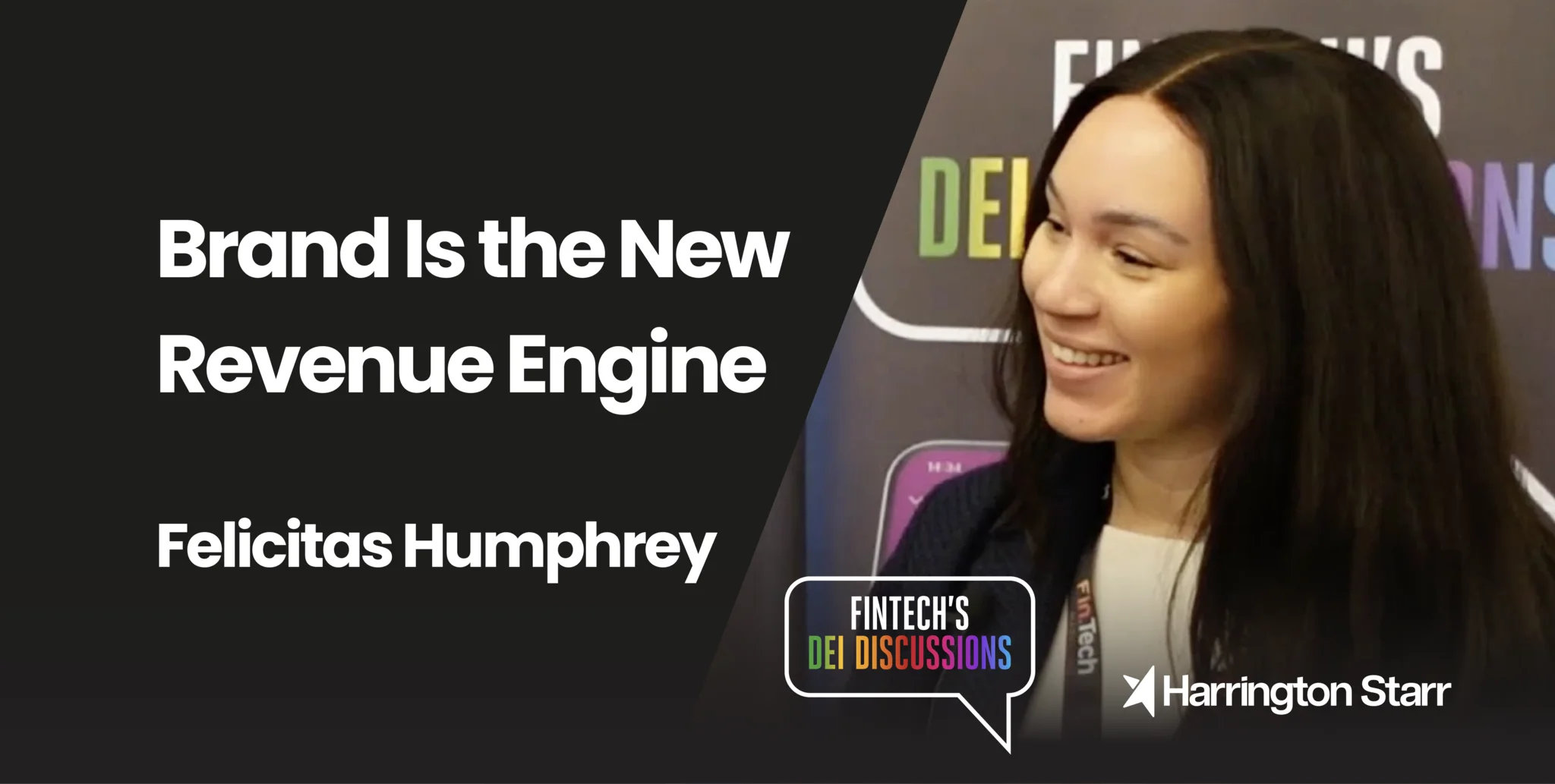
That was the focus of this episode of FinTech’s DEI Discussions, hosted by Nadia Edwards-Dashti, Chief Customer Officer at Harrington Starr, featuring Felicitas Humphrey, Global Head of Marketing at ActiveViam. Recorded live at the FinTech Marketing Community Conference 2026 in London, the discussion explored how marketing teams are shaping the future of the financial technology industry, why diverse hiring matters more than ever, and how FinTech brands can stand out in an increasingly crowded market.
As a global FinTech recruitment business, Harrington Starr continues to spotlight the conversations shaping the future of financial technology, leadership, inclusion, hiring, and innovation. This episode offered a particularly honest perspective on how FinTech marketing, DEI, and commercial growth are now more connected than ever before.
The episode began with Felicitas Humphrey sharing her personal background and career journey in the financial technology industry. Growing up in Germany with a German mother and an Ivorian father, she described how her multicultural upbringing shaped her perspective and ambitions from an early age.
Felicitas explained that growing up near Frankfurt during the 1990s was not always easy as a mixed-race child in an environment that lacked diversity. However, those experiences ultimately gave her a strong sense of focus and determination. Travelling internationally while growing up helped shape her ambition to build a global career and experience different cultures and perspectives.
After spending time in the United States and completing university studies in Germany, she eventually moved to London to pursue a career in sales. Interestingly, she explained that her move into FinTech was not necessarily planned. Instead, she “landed in FinTech almost by accident,” discovering that her strengths in sales, commercial strategy, and translating complex problems into digestible solutions naturally aligned with the financial technology industry.
That journey reflects a broader truth about FinTech recruitment and careers within financial technology. Many of the most successful professionals in the sector come from diverse backgrounds and unconventional career paths. As the FinTech industry continues to evolve, businesses are increasingly recognising the value of transferable skills, adaptability, creativity, and commercial thinking.
For companies hiring within financial technology, particularly across areas such as FinTech marketing, product strategy, customer growth, and go-to-market leadership, this discussion reinforced the importance of looking beyond traditional hiring models and textbook CVs.
One of the strongest themes throughout the episode was the responsibility marketing teams hold when it comes to diversity, equity, and inclusion within the financial technology industry.
Nadia Edwards-Dashti asked a powerful question early in the discussion: if businesses want to create a more inclusive and accessible industry, what role does marketing have to play in driving that change?
Felicitas argued that marketing leaders carry enormous influence because they are often the storytellers behind the scenes while also controlling budgets, visibility, partnerships, and opportunities. She highlighted that the decisions marketers make around sponsorships, speakers, campaigns, and representation directly shape who gets visibility within the FinTech ecosystem.
One of the most striking moments of the conversation came when she explained that “when you hold the key to the money, you automatically also hold the responsibility for access.” That statement perfectly captured the wider theme of the discussion. Marketing is not simply about generating awareness anymore. It also influences who gets heard, who gets opportunities, and whose perspectives are amplified across the industry.
The discussion also touched on hiring practices within FinTech businesses. Felicitas explained that as AI rapidly changes how businesses operate, companies need to rethink what they define as a “safe hire.” Traditional hiring models that prioritise familiarity or conventional career paths risk overlooking talented individuals who can bring fresh perspectives and innovation to organisations.
This is particularly relevant within FinTech recruitment today. Financial technology businesses across London, New York, and global markets are competing aggressively for talent in areas such as marketing, software engineering, AI, data, quantitative finance, cyber security, product management, and revenue operations. Businesses that continue to hire only from familiar networks or identical backgrounds risk limiting both innovation and long-term business growth.
Another major theme throughout the episode was the changing role of marketing within the financial technology sector.
Felicitas described what she called a “marketing rebrand,” where modern marketing functions are no longer purely focused on creative campaigns or lead generation. Instead, marketing now sits much closer to revenue, customer strategy, differentiation, and overall business growth.
She explained that technological advancements and AI have fundamentally changed how products are built and launched. Because it is now easier than ever to develop and ship products, businesses are facing far greater competition. As a result, brand identity, differentiation, and customer trust have become increasingly important.
This is especially relevant across FinTech companies and SaaS businesses operating within highly competitive markets. Buyers now have more vendor options than ever before. In that environment, companies cannot rely solely on functionality or product features to stand out. Their brand needs to mean something.
For FinTech marketing leaders, this shift creates both opportunity and pressure. Marketing teams are now expected to connect every campaign, tactic, and initiative directly back to revenue impact and commercial growth.
The discussion explored how marketing and sales functions have historically operated separately, often measured against completely different success metrics. Felicitas highlighted how this disconnect created inefficiencies and confusion within businesses, particularly when marketing teams focused on vanity metrics instead of pipeline influence or revenue generation.
Today, however, those silos are disappearing. Revenue growth requires alignment between marketing, sales, customer success, and brand strategy. This changing landscape is reshaping the skills businesses now look for when hiring marketing professionals within financial technology.
For recruiters and hiring managers within FinTech, this means demand is growing for professionals who combine creativity with commercial awareness, strategic thinking, analytics, storytelling, and customer understanding.
Artificial intelligence also featured heavily throughout the conversation, particularly regarding its impact on marketing, hiring, and career development.
Felicitas noted that AI is accelerating change across every industry, including financial technology. While AI creates efficiencies and new opportunities, it also forces businesses and professionals to adapt rapidly.
Interestingly, she explained that the rise of AI has actually increased the importance of strong branding, storytelling, creativity, and differentiation. With products becoming easier to build and launch, businesses must work harder to stand out in the marketplace.
She also referenced reports of seven-figure salaries being offered for writers and creative professionals at major AI companies, reinforcing how valuable communication, creativity, and strategic storytelling are becoming in the AI era.
This shift has important implications for FinTech recruitment and hiring strategy. Technical skills remain critical across software engineering, cloud infrastructure, quantitative finance, cybersecurity, and AI development. However, businesses are increasingly seeking professionals who can combine technical expertise with communication, adaptability, and customer-centric thinking.
As a specialist FinTech recruitment business, Harrington Starr continues to see strong demand for professionals who can bridge commercial and technical functions within financial technology businesses.
Another powerful theme throughout the discussion was the renewed importance of customer value and trust within financial technology.
Felicitas explained that while many industries chase trends and tactics, FinTech businesses operate within highly regulated environments where trust matters enormously. Because of that, businesses need to stay focused on delivering meaningful customer value instead of simply following market noise.
She emphasised that creating valuable customer experiences should remain the “North Star” for marketing and business strategy. This means genuinely understanding customer problems, delivering clear solutions, and building long-term trust.
For FinTech businesses operating in competitive markets, this message is increasingly important. Whether companies are building payments platforms, trading infrastructure, banking software, AI tools, or wealth management technology, long-term growth depends on credibility, customer experience, and trust.
This also influences hiring priorities across the industry. Businesses increasingly seek professionals who understand both customer needs and commercial outcomes. That applies across marketing, product management, client success, engineering leadership, and sales roles within financial technology firms.
The episode concluded with an honest discussion around the current state of diversity, equity, and inclusion within the financial technology sector.
Felicitas expressed concern that conversations around DEI have slowed down in recent years, with some organisations becoming complacent or reverting back to old hiring habits. She highlighted how many senior leaders continue to hire people who look like them, sound like them, and share similar backgrounds and experiences.
Importantly, she argued that this is not only unfair but also commercially damaging. Diverse leadership teams and organisations consistently outperform more homogenous businesses, yet many companies still fail to challenge unconscious bias within hiring and leadership decisions.
This conversation remains highly relevant across the global FinTech industry. As competition for talent intensifies, businesses that prioritise inclusive hiring, diverse perspectives, and equitable opportunities are more likely to attract top professionals and build stronger long-term cultures.
For FinTech recruitment businesses, these discussions are increasingly important when advising clients on hiring strategy, employer branding, talent retention, and leadership development.
This episode of FinTech’s DEI Discussions provided a timely and thought-provoking look at the evolving relationship between marketing, diversity, hiring, and commercial growth within financial technology.
Through her honest reflections and industry experience, Felicitas Humphrey highlighted how FinTech marketing is no longer simply about campaigns or lead generation. Marketing now sits at the centre of brand identity, customer trust, business growth, inclusion, and industry influence.
The conversation also reinforced broader themes shaping the future of financial technology: the impact of AI, the need for diverse hiring, the importance of customer value, and the growing alignment between commercial strategy and brand leadership.
For businesses operating within FinTech, capital markets, banking technology, SaaS, payments, and financial services, these conversations are becoming increasingly important when building teams, strengthening culture, and remaining competitive in rapidly evolving markets.
As a global FinTech recruitment business, Harrington Starr continues to spotlight the voices driving meaningful conversations across financial technology through FinTech Focus TV, FinTech’s DEI Discussions, The Financial Technologist magazine, and industry events across London, New York, and beyond.