The Quant Advantage is Disappearing
14 Oct, 2026


Economic sanctions once sat at the edge of financial markets, enforced through lists, static...

Economic sanctions once sat at the edge of financial markets, enforced through lists, static controls and post-trade checks. In 2026, they are increasingly embedded in the market lifecycle itself. Sanctions now influence which securities can be traded, which counterparties can access liquidity, how settlement is routed, where assets are held under custody, and which payment rails are used.
Sanctions shape liquidity formation, fragment clearing and settlement networks, and accelerate the emergence of alternative rails. The transformation of markets is therefore not only about faster settlement or new assets. It is about compliance becoming inseparable from how value moves through the system.
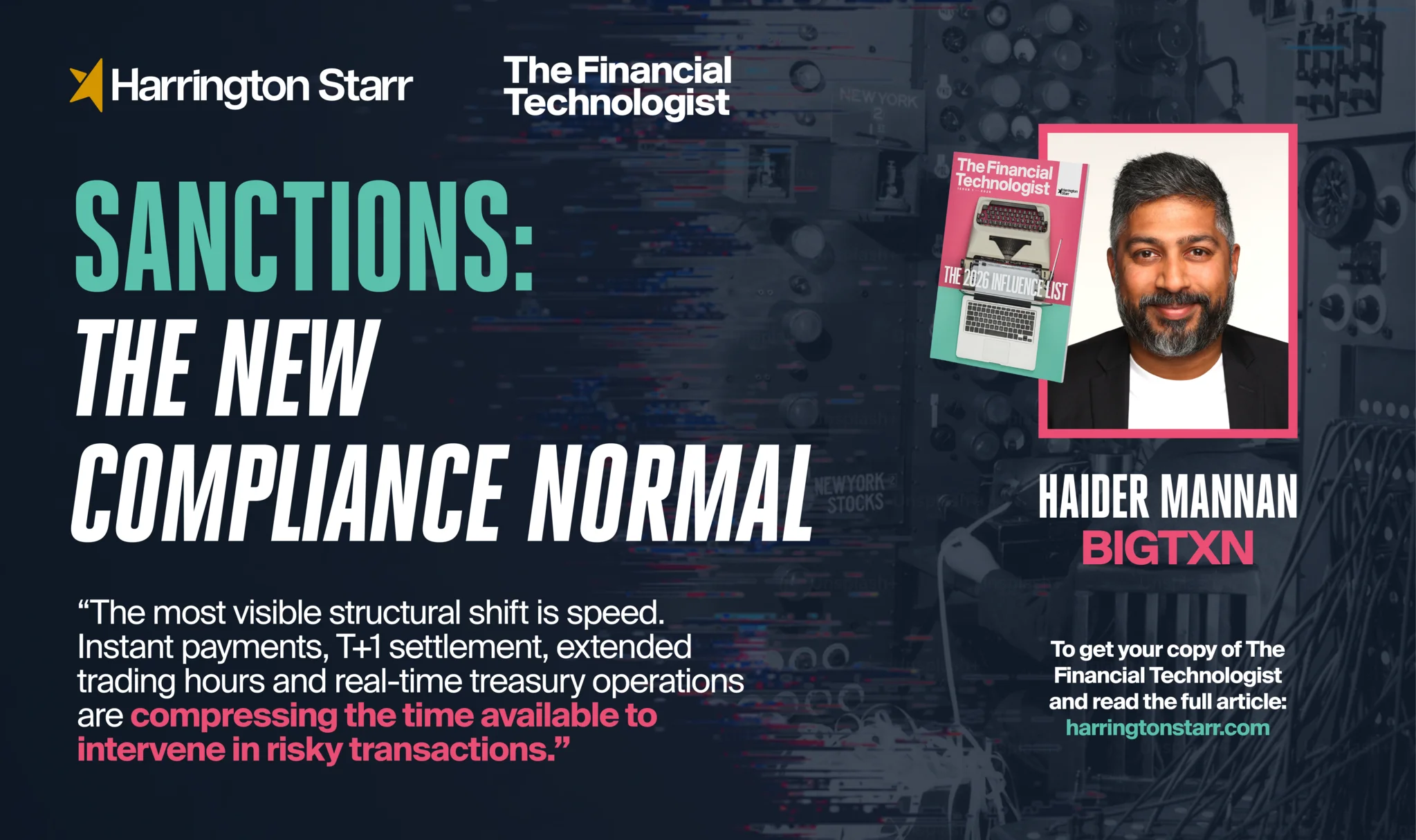
The most visible structural shift is speed. Instant payments, T+1 settlement, extended trading hours and real-time treasury operations are compressing the time available to intervene in risky transactions.
This affects the entire securities lifecycle, which briefly consists of:
■ Pre-trade: onboarding, counterparty screening, instrument eligibility and restricted issuer checks must occur before orders are routed.
■ Execution: real-time sanctions screening is required for high-frequency, DMA and cross-border flows.
■ Post-trade: settlement instructions, cash legs, corporate actions and custodian routing must be screened continuously but not in overnight batches.
Batch-based compliance no longer aligns with markets that operate continuously.
AI-driven automation is becoming essential to keep pace. But
regulators do not outsource accountability to models. OFAC’s compliance framework and supervisory model-risk guidance emphasize governance, explainability, validation and auditability. The message is clear: move faster, but remain transparent and defensible.
In practice, this means AI is becoming a regulated control layer across the trade lifecycle, not merely a productivity tool.
Tokenization and atomic settlement promise fewer reconciliations, automated corporate actions and faster delivery-versus-payment. But when assets and cash coexist on programmable infrastructure, compliance can no longer be a perimeter control.
Instead, it becomes embedded in issuance logic, wallet permissions, settlement workflows and custody rules.
BIS initiatives such as Project Agorá and unified ledger concepts illustrate the direction of travel: shared infrastructure, multi-asset settlement and near-instant execution. This creates direct implications for capital markets:
■ Primary issuance requires sanctions screening of issuers and beneficial owners at token minting.
■ Secondary trading increasingly relies on embedded restrictions rather than manual intervention.
■ Custody shifts toward wallet-level controls that mirror account-level screening.
■ Settlement removes time buffers, forcing pre-settlement compliance validation.
Data quality becomes critical. The industry’s migration to ISO 20022 highlights that structured, standardized data is no longer an IT upgrade, it is compliance infrastructure. In real-time markets, the difference between
“clear” and “block” often comes down to whether data is usable at machine speed.
Sanctions exposure does not only emerge from direct trades. It increasingly flows through passive investment vehicles and index-linked products.
ETFs introduce complex exposure chains. Index rebalances can introduce sanctioned securities, authorized participants may face blocked creations or redemptions, fund administrators must manage restricted holdings, and custodians may be unable to safekeep certain assets.
The result is timing risk between regulatory announcements, index updates, portfolio rebalancing cycles and settlement processes. Passive strategies can inherit sanctions exposure rapidly and at scale.
For asset managers and service providers, this requires tighter integration between index governance, portfolio compliance engines, transfer agency workflows and custodian controls.
Custodians now operate at the center of sanctions risk. They touch settlement, asset safekeeping, corporate actions, collateral movements and securities lending.
Exposure arises through:
■ Sub-custodian network dependencies
■ Cross-border asset chains
■ Corporate action processing
■ Margining and collateral substitution
■ Securities financing counterparties
As collateral becomes more mobile and margin cycles shorten, sanctions controls must operate at the asset, account and transaction level simultaneously.
A restricted counterparty or frozen asset can cascade into settlement fails, liquidity stress and operational disruption.
Crypto’s promise is programmable transfer, its vulnerability is the same.
FATF’s recent findings show that stablecoins now dominate much of on-chain illicit activity. This is no longer a niche concern limited to exchanges. It affects broker- dealers offering tokenized securities, banks providing crypto settlement rails, custodians supporting digital assets, and asset managers experimenting with tokenized funds.
Sanctions enforcement increasingly relies on wallet-level intelligence, transaction graph analysis and real-time monitoring, not just traditional name screening.
The compliance challenge is not whether crypto can be misused, it is where controls are most effective: issuers, centralized venues, blockchain analytics layers and fiat on- and off-ramps.
Stablecoins increasingly function as the “cash leg” of digital markets and tokenized securities pilots. This makes them systemically relevant.
They carry familiar financial risks: reserve transparency, liquidity concentration, governance and operational resilience — but also new sanctions challenges. Peer-to-peer transfers
bypass intermediaries. Velocity reduces investigation windows. Cross-chain bridges expand exposure paths.
Compliance teams must treat stablecoins as payments infrastructure, not just digital assets. That means issuer due diligence, real-time wallet screening, smart contract risk assessment and clear freeze and escalation playbooks.
SWIFT remains foundational, but the geopolitical lesson of the past several years is that messaging dominance does not eliminate incentives to diversify. China’s CIPS, Russia’s SPFS, local- currency settlement arrangements and multi-CBDC experiments all reflect a broader trend — more payment pathways, more fragmentation and more compliance complexity.
Project mBridge reached a “minimum viable product” stage in mid-2024, exploring cross- border CBDC settlement on distributed ledger technology. Even if pilots evolve slowly, the direction is important — some participants want settlement options that are not dependent on the same intermediaries. Meanwhile, major banks have taken steps such as joining CIPS directly, a signal that clients are asking for optionality in renminbi- based flows.
For markets, the compliance challenge is not simply “new rails.” It is “many rails.” Screening policies, data standards and auditability must travel with transactions across heterogeneous systems. Fragmentation can create blind spots, especially when regulatory expectations differ across jurisdictions. That raises the bar for interoperability, shared identifiers, and common definitions of beneficial ownership, control and risk.
The winning design is neither maximal friction nor uncontrolled speed. It is controlled velocity.
Sanctions, AML and fraud controls are moving from post-trade checks to inline decisioning across the securities lifecycle: from onboarding and order routing to settlement, custody, collateral and corporate actions.
Tokenization compresses intervention windows, real-time settlement removes buffers, crypto expands transaction surfaces and alternative rails increase fragmentation.
The strategic shift is clear: compliance is no longer a back-office function, it is infrastructure.
Institutions that succeed will treat AI as an accountable control layer, data as a risk asset, custody as a compliance perimeter, ETFs as exposure multipliers and new rails as opportunities to hard- code resilience rather than inherit fragility.
This is an article from The Financial Technologist: Influence List - page number: 36-38


Lorem ipsum dolor sit amet, consectetur adipiscing elit. Etiam sit amet est id augue molestie pharetra suscipit et enim. Donec maximus hendrerit augue, eu posuere eros venenatis eu.