Who's Missing From the Room?
05 October, 2026


What really determines who gets ahead in banking and financial services? Talent and hard work matter, but career progression can also depend on something far less visible: access to opportunity, sponsorship, relationships, feedback and an understanding of how organisations really work.
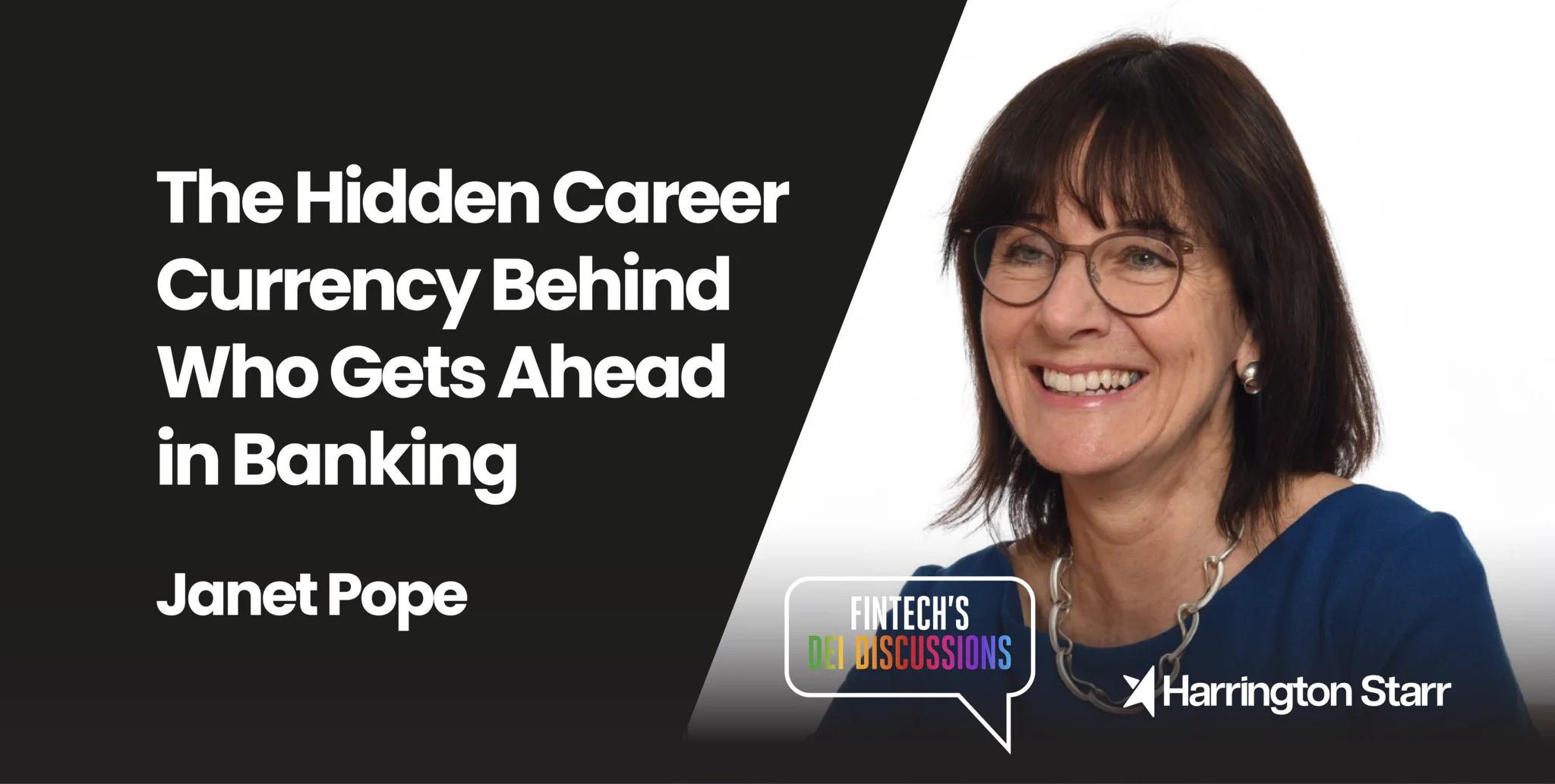
In this episode of FinTech’s DEI Discussions, Nadia Edwards-Dashti is joined by Janet Pope, DCMS Audit & Risk Chair, Chair of CAF Bank, RemCo Chair and Environment & Social Purpose Chair at Yorkshire Building Society, and StepChange Trustee. Drawing on a career that has included senior leadership positions at Lloyds Banking Group, Janet shares her experiences of opening doors for others and explores what organisations can do to create more inclusive routes into leadership.
Their conversation moves beyond diversity and inclusion policies to examine what meaningful workplace inclusion looks like in practice. From sponsorship and psychological safety to succession planning, career progression and what Janet describes as “employment capital”, the discussion asks an important question for leaders across banking, financial services and FinTech: are organisations simply identifying diverse talent, or are they actively creating the conditions that allow that talent to succeed?
Janet begins by looking back at her own career and the opportunities she received early on. She describes Malcolm Williamson, whom she worked for in her first job at Girobank, as a constant influence who took an interest in her career and continued to provide opportunities as she progressed.
Having experienced the difference that this kind of support could make, Janet became increasingly interested in how she could create similar opportunities for other people.
That became particularly significant when she joined Lloyds Banking Group later in her career. After running the savings business, Janet became Chief of Staff, giving her the opportunity to take responsibility for areas she felt strongly about. Her remit eventually included sustainability, inclusion and diversity, philanthropy and work designed to make Lloyds a more inclusive organisation.
The central challenge became how to create more opportunities for people for whom those opportunities had historically been less accessible.
Janet describes an initiative influenced by work undertaken by Deborah McWhinney at Citibank. At Lloyds, they initially identified 15 senior women they believed had the potential to progress and then spoke individually to them about what they needed.
Crucially, Janet says the programme did not begin from the assumption that these women needed to be “fixed”. Instead, the question was what each person needed to feel liberated to be the best version of themselves.
That could mean support with presenting to a board, building confidence, managing teams or navigating other aspects of senior leadership. The objective was to give individuals the specific support they believed would allow them to perform at their best.
One of Janet’s most practical examples of inclusive leadership comes from what happened when women presented to the Group Executive Committee at Lloyds.
She describes how intimidating that environment could feel. Rather than simply expecting someone to walk into the room and perform perfectly, Janet would sometimes walk with them to the front of the room, introduce them positively and establish their credibility before allowing them to begin.
It was a small intervention, but one designed to create a safer environment in which someone could succeed.
If the presenter then lost their thread or struggled with a point, Janet also felt an obligation to help them recover. Afterwards, she might send an email explaining what had worked particularly well and where the presentation could have been even stronger.
The result was not permanent dependence. It was about helping somebody succeed once so they had greater confidence the next time.
As Janet puts it during the episode, “Success begets success.”
This feeds into a wider discussion between Nadia and Janet about authenticity and psychological safety. Janet recalls being told that one of the most valuable things she had done was demonstrate that people did not always have to be perfect. She could stand on stage, occasionally muddle her words and continue.
For workplace inclusion, this matters. If only certain people feel they can make mistakes, ask questions or admit uncertainty, an organisation may have inclusive policies without creating a genuinely inclusive culture.
Nadia connects Janet’s experiences with a challenge facing many organisations: policies may exist, but employees do not necessarily feel safe enough to use them.
Shared parental leave is one example raised in the conversation. A business can technically offer a policy, but if employees believe using it could negatively affect how they are perceived or how their career progresses, its existence alone does not create inclusion.
This is where psychological safety becomes an essential part of diversity and inclusion.
Nadia reflects on the many different roles Janet has effectively played for others throughout her career: advocate, mentor, sponsor and coach. Janet, however, emphasises that supporting someone has to go beyond giving them a little time or occasional advice.
That distinction leads to one of the episode’s strongest discussions: the difference between mentorship and sponsorship.
Janet believes sponsorship comes with an obligation to actively help people move forward.
Rather than simply offering advice, a sponsor can identify opportunities, introduce someone to influential people and advocate for an individual who might otherwise be overlooked. It could mean telling another leader that there is someone they should meet, even if that person’s existing profile might not automatically get them shortlisted.
This is particularly relevant when considering career progression and diverse talent.
Janet discusses work undertaken at Lloyds following Black Lives Matter, when the organisation sought to identify Black colleagues who could progress into more senior positions. Greater representation at senior levels could, in turn, make progression feel more achievable for other Black employees.
The issue Janet identified was not necessarily a lack of ability. She says they found colleagues who had been “perfectly promotable for long periods of time”, but that progression simply had not happened.
Sponsorship therefore involved helping create that next opportunity. Importantly, the responsibility did not end once somebody secured a promotion.
Janet argues that organisations also need to consider what people will require to succeed after they arrive in a new role. Simply giving somebody the job and leaving them to navigate it alone is not enough. People need support around them when things do not go as planned, particularly when they are entering unfamiliar territory.
For organisations focused on talent attraction and retention across financial services, this raises a broader question. Hiring diverse talent is one part of building an inclusive organisation, but what happens after that person joins or progresses may be equally important.
The conversation then turns to succession planning and how organisations can build more diverse leadership pipelines over time.
Janet describes the approach at Lloyds as highly analytical.
Women and people with other diversity characteristics were placed into the longer-term stages of succession plans. However, the objective was not simply to put a name on a chart and revisit it a year later.
There needed to be a plan attached.
If someone was considered three to five years away from being ready for a particular level of leadership, the organisation needed to determine what experiences, opportunities and development they would require during those years to move towards being “ready now”.
Janet describes using colour coding to make representation across succession plans visible. If an entire division had no women progressing through its leadership pipeline, that became something that could be challenged directly.
As Janet says, “What gets measured gets done.”
But effective succession planning also meant looking beyond straightforward vertical progression. Someone might not ultimately reach the most senior position within their existing function, but that did not mean their leadership potential ended there.
Janet explains how Lloyds engineered cross-company movement to expose people to different areas of the business. She gives the example of a woman she had promoted in savings who later completed a secondment in the commercial bank, broadening the possible directions her career could take.
This kind of mobility could create more rounded leaders and provide talented people with multiple potential pathways to progression.
Perhaps the most distinctive idea in the episode emerges when Janet discusses what people need to understand when entering a new role.
She talks about the importance of building relationships with senior management and gives the example of a colleague who was particularly effective at doing this. When given something difficult to deliver, this colleague would speak to members of the Group Executive Committee individually and ask what success would look like from their perspective.
This achieved two things. It helped her understand what senior stakeholders expected, but it also meant she was building relationships with those stakeholders before returning with recommendations.
Janet also discusses the importance of asking for feedback in the moment and understanding how performance is actually assessed.
Her analogy comes from her daughter helping disadvantaged sixth-form students prepare for their A levels. Knowing everything about a subject was not enough; students also needed to understand the marking scheme.
Janet sees an employment equivalent.
People need to understand what an organisation is looking for and how it will judge whether they have been successful. Rather than excelling in a small part of a role while overlooking other expectations, employees need to decode what good performance looks like across the board.
This contributes to what Janet calls “employment capital”.
Not everyone enters financial services with equal access to that knowledge.
Janet argues that working-class people, women and Black, Asian and minority ethnic employees may not always have had the same exposure to the unwritten rules of organisational life. She recalls speaking with a Black mentee at Lloyds who was the first person in her family to build a successful career outside the music business.
She therefore did not have an existing source of knowledge telling her how to be successful in banking. She depended on others for signposts, feedback and help to course-correct
when necessary.
This is the hidden career currency at the heart of the episode.
It is not simply about what someone knows technically. Career progression can also be shaped by whether someone understands how to navigate an organisation, has access to influential relationships, receives useful feedback and has people willing to advocate for them.
For financial services recruitment and FinTech recruitment, this is an important consideration when thinking about talent. Organisations may be competing for highly capable professionals, but creating an environment in which those people can build careers requires more than successfully filling a vacancy.
In the final part of the episode, Nadia asks Janet what more everyone can do to drive inclusion in the workplace.
Janet’s answer is clear: inclusion cannot be the responsibility of one individual.
Even when someone has a job title that suggests responsibility for diversity and inclusion sits with them, meaningful change requires a wider organisational commitment. Otherwise, progress can accelerate when enthusiastic individuals are pushing it forward and then slide backwards when circumstances change.
Janet reflects positively on Lloyds as an organisation founded on respect, while acknowledging that catalysts were still required to make the workplace more inclusive.
Measurement was one of those catalysts.
She explains that divisions were given realistic targets around increasing the representation of women rather than being given arbitrary goals disconnected from their starting position. These objectives became part of balanced scorecards, making progress less optional.
Over time, the approach expanded to include other diversity characteristics, including targets relating to people with disabilities in senior management positions.
Accountability also means being prepared to speak when something goes wrong.
Janet recalls advice from John Amaechi, who supported Lloyds with its work following Black Lives Matter. The lesson she took from that conversation was that people have an obligation to challenge behaviour they know is inappropriate rather than quietly tolerating it.
That principle extends across racism, misogyny, discrimination against people with disabilities and other forms of exclusion.
Janet also stresses that challenging language or behaviour does not always have to mean being confrontational. In organisations where people generally want to behave respectfully, sometimes it means simply suggesting that there might be a better way to phrase something.
Once one person starts doing that, others may become more comfortable doing the same.
Throughout this episode of FinTech’s DEI Discussions, Nadia Edwards-Dashti and Janet Pope move the conversation beyond statements of intent and towards the practical actions that can influence who progresses in banking and financial services.
The discussion demonstrates how inclusive leadership can appear in seemingly small moments: introducing somebody positively before a difficult presentation, helping them recover when something goes wrong, providing immediate feedback, putting their name forward for an opportunity or explaining the unwritten expectations of a new role.
But it also shows why those individual actions need to sit alongside structural change.
Succession planning needs measurable development plans. Diverse talent needs access to genuine opportunities. Newly promoted employees need support after they step into bigger positions. Leaders need to understand their responsibility as sponsors. Organisations need to measure progress and employees need to feel able to challenge exclusion when they encounter it.
Perhaps most importantly, the episode challenges the idea that career progression is determined solely by talent and effort.
People also need access to employment capital: the relationships, feedback, advocacy, organisational understanding and support that help individuals navigate their careers successfully.
For leaders across banking, financial technology and the wider financial services industry, that creates an important challenge. If some employees have greater access to this hidden career currency than others, how can organisations make it more widely available?
For Harrington Starr, conversations like this sit at the heart of understanding the changing financial technology talent landscape. As a FinTech recruitment business working across financial services and financial technology, we see the importance of not only attracting exceptional talent but understanding the workplace cultures, leadership structures and career opportunities that enable people to thrive once they arrive.
FinTech recruitment and financial services recruitment are ultimately about people. Businesses can compete for skilled professionals across technology, data, product, transformation, cyber security, quantitative finance and other specialist areas, but attracting talent is only one part of the challenge. Retaining and developing people requires organisations to think seriously about career progression, inclusive leadership, workplace diversity and access to opportunity.
Janet’s experiences provide a powerful reminder that creating an inclusive workplace is not achieved through a single initiative, policy or individual. It happens when people across an organisation recognise their responsibility to open doors, advocate for others, challenge exclusion and actively help talented people succeed.