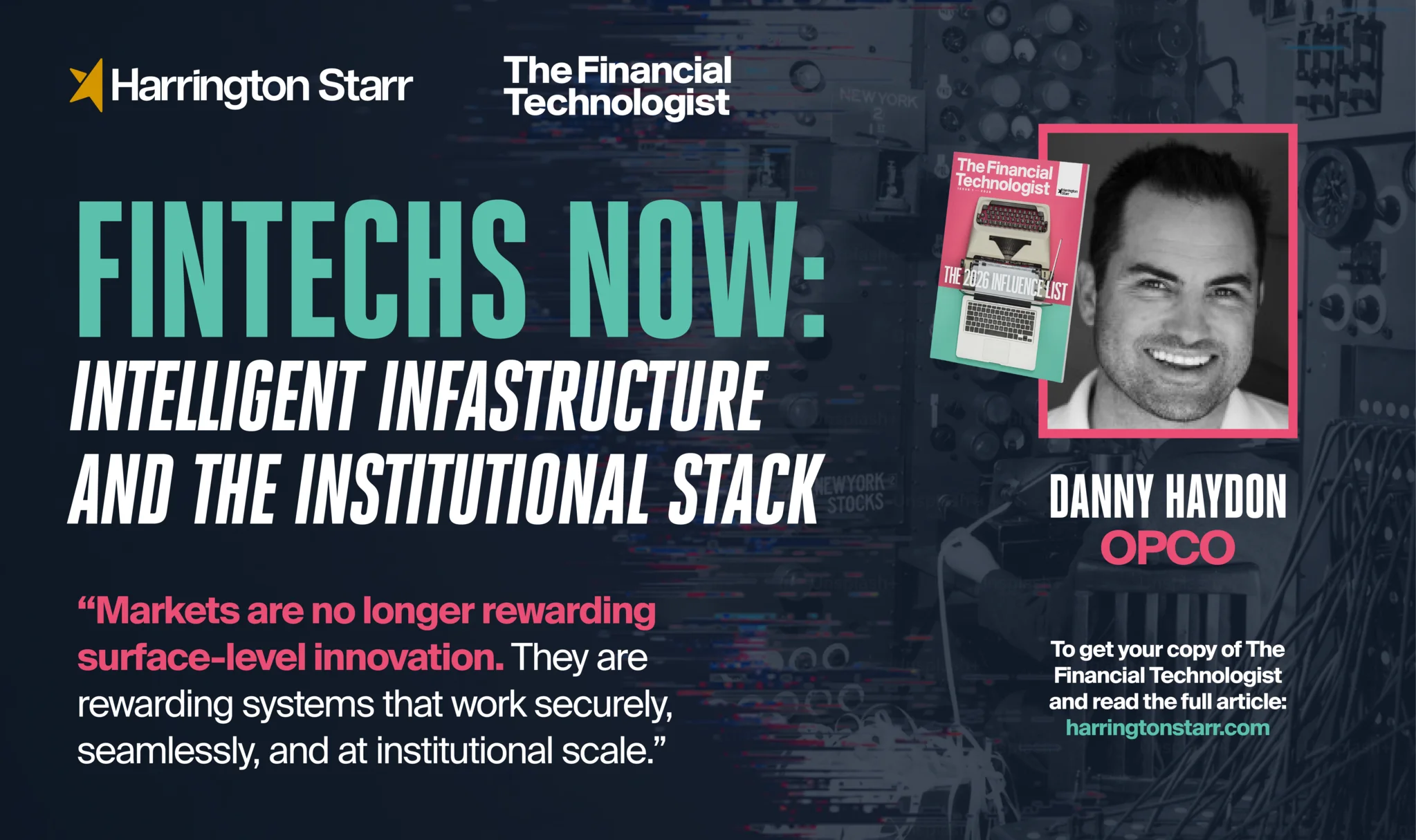
Fintech in 2026 is defined less by disruption and more by discipline. The industry has moved decisively into a phase where resilience, embedded intelligence, and infrastructure depth determine competitive advantage. Markets are no longer rewarding surface-level innovation. They are rewarding systems that work securely, seamlessly, and at institutional scale.
At OPCO, we are seeing a clear pattern: fintech is becoming the connective tissue of financial markets. The momentum is concentrated in verticals that strengthen the financial stack; integration layers, capital markets infrastructure, AI-embedded, and enterprise data governance.
Modern Capital Markets Infrastructure
A second area of acceleration is capital markets infrastructure modernisation. Many financial institutions are reaching the performance and integration limits of legacy systems. Latency, scalability, and interoperability are now strategic priorities.
The market is favouring modular, cloud-native architectures that reduce vendor lock-in while improving reliability. Rather than wholesale system replacement, institutions are pursuing controlled evolution, replacing brittle components with composable, performance-oriented layers.
This vertical includes execution technology, workflow orchestration, and institutional-grade performance tooling. The defining characteristic is architectural durability: systems designed to handle volatility, regulatory complexity, and cross-asset workflows without introducing operational fragility.
Every few years, advances in technology compel organisations to adopt or revisit existing tech stacks and infrastructure. What makes this timing unique is that there are two additional concurrent waves that are making the technology infrastructure more intriguing – one being the expansion of asset coverage (private markets, private credit and tokenised securities), all of which have different characteristics and possess nuances that need careful thinking when upgrading infrastructure. Companies in the market include Adaptive and ZeroBeta.
Data Governance and Decision Intelligence
Abundant data has not reduced risk; unmanaged data has amplified it. Institutions are moving from volume-driven analytics to precision-driven governance. High-quality, structured, and audit-ready data is now central to trust.
Data infrastructure, including lineage tracking, reconciliation engines, and AI-ready data environments, is becoming foundational. As AI systems rely on clean training inputs and regulators intensify scrutiny of model risk, the integrity of underlying data is paramount.
We anticipate increased investment in control layers that provide transparency across data flows, model monitoring frameworks, and immutable audit trails. Firms like viaNexus that can deliver decision-ready intelligence with embedded governance will define the next standard.
Embedded AI as Core Infrastructure
AI has moved beyond experimentation. The early wave focused on productivity enhancements and generative interfaces. Useful, but incremental. The structural shift now is toward embedded AI that materially improves liquidity forecasting, anomaly detection, compliance monitoring, and operational reconciliation.
Institutions are increasingly demanding governance, explainability, and measurable outcomes. AI must reduce operational friction, lower risk exposure, or enhance decision precision. Solutions that strengthen post-trade controls, automate exception management, and augment compliance workflows are gaining traction because they directly impact resilience and cost efficiency.
Over the next 12–24 months, AI will become native to treasury systems, execution environments, and regulatory frameworks. The most durable deployments will combine human oversight with machine intelligence, embedding AI into institutional processes rather than layering it on top.
Large organisations will need to address foundational aspects of data organisation and technical architecture in order to fully benefit from AI. Some of the firms we have seen addressing these foundations include ADI, SageX, 3Forge, Finbourne and Xenomorph, amongst others.
Enterprise Integration and Composability
Interoperability has become mission-critical. Financial institutions operate across a web of execution venues, treasury platforms, custodians, compliance engines, and data providers. Seamless integration between these systems is no longer optional.
The integration layer of API-first architectures, event-driven frameworks, and real-time synchronisation has emerged as one of the most strategic verticals in fintech. Composability enables firms to adapt to regulatory shifts, new asset classes, or evolving client demands without destabilising operations.
Over the coming year, expect continued investment in orchestration platforms and connective infrastructure that reduce complexity while preserving institutional control. Firms leading the charge include Here, Rebar and Deep Systems.
Operational Model Restructuring
Modern capital markets infrastructure, anchored in cloud-native architecture, API-driven integration, governed data ecosystems, and AI embedded at the core of decision intelligence is fundamentally reshaping operating models toward leaner, more automated, and highly composable enterprises. As these technologies reduce manual intervention and compress workflows, they not only lower headcount requirements but more importantly redefine roles, placing significant pressure on HR and operating leaders to reskill talent, redesign functions, and manage the organisational implications of a more intelligence-led, machine-augmented workforce.
The Near-Term Outlook
The next phase of fintech will be defined by operational alpha: smarter liquidity deployment, automated compliance mapping, faster settlement cycles, and resilient architectures capable of absorbing volatility and set up for AI.
AI will become embedded, not experimental. Vendor stacks will continue to rationalise around high-performance infrastructure partners. Human-machine collaboration will outperform automation alone. Infrastructure depth will outweigh marketing polish.
From our vantage point at OPCO, the trajectory is clear: LLMs are systematically dismantling the moats that made vertical software defensible. But not entirely. The result is a redrawing of what makes vertical software valuable and the multiple it deserves.
Integration layers, capital markets performance platforms, AI-driven risk intelligence, and enterprise data governance are shaping the next generation of financial infrastructure.
The era of performative innovation is closing. The era of AI-driven intelligent infrastructure is firmly underway.
This is an article from The Financial Technologist: Influence List - page number: 62-63