Stop Hiring the Same People
13 October, 2026

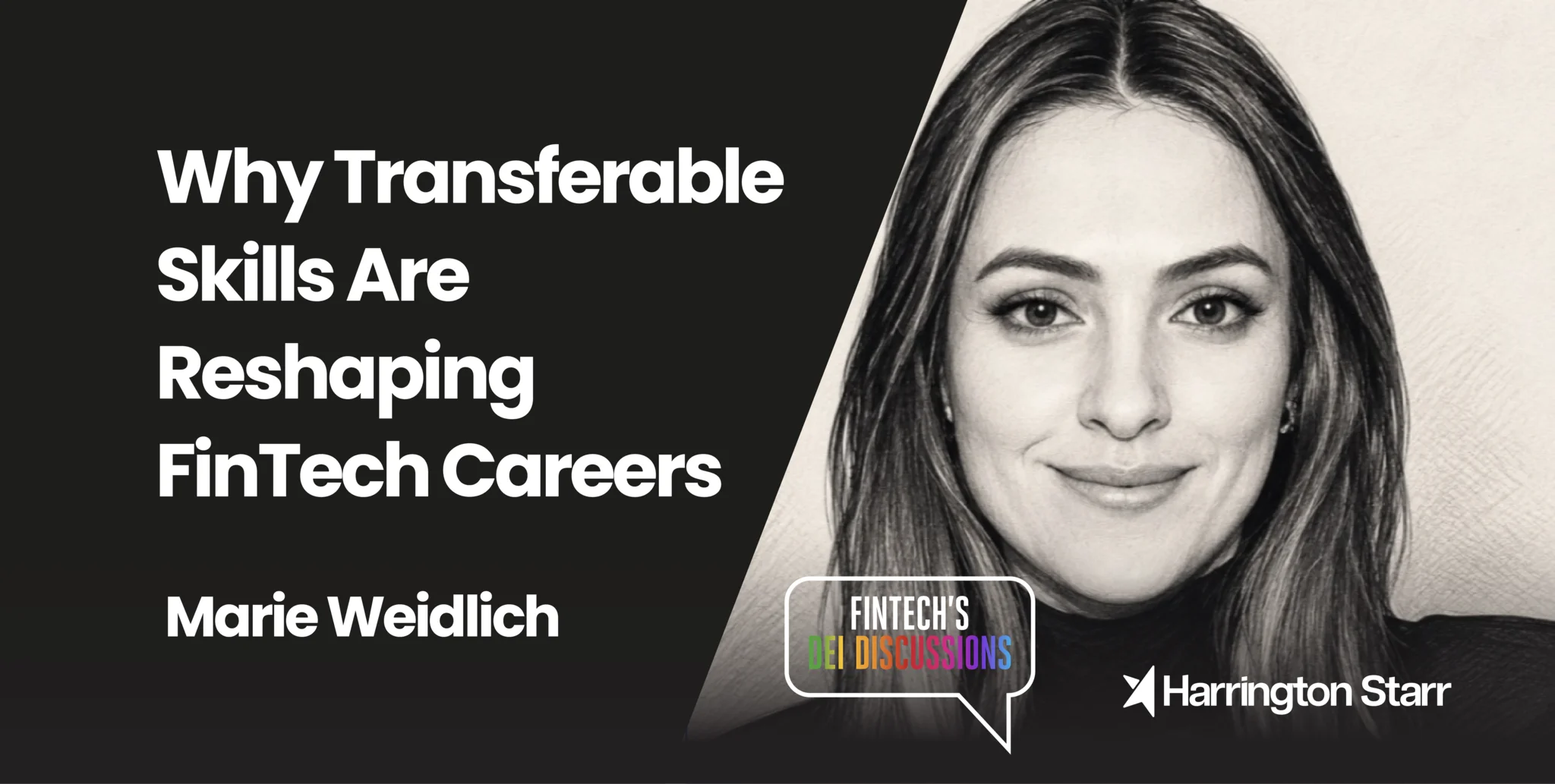
In this episode of FinTech's DEI Discussions, Nadia Edwards-Dashti sits down with Marie Weidlich to explore the growing importance of transferable skills, adaptability, neurodiversity, leadership, and innovation across the FinTech industry. The conversation delivers an honest and insightful look into how careers in financial technology are evolving and why the future of FinTech recruitment, leadership, and hiring will increasingly favour professionals who can think beyond traditional career pathways.
Marie opens the episode by sharing her unique career journey, which perfectly reflects the central theme of the discussion. Born in Brazil to an Italian-German background, before moving to London over a decade ago, Marie originally came to the UK to study fashion journalism. She never initially expected to work in financial services, yet her interest in innovation and technology naturally led her towards the rapidly evolving FinTech sector.
This journey is particularly relevant in today’s financial technology hiring market because it highlights something many FinTech recruitment businesses, including Harrington Starr, are increasingly recognising: the best talent does not always come from conventional backgrounds. The modern FinTech industry is no longer purely searching for linear CVs. Instead, businesses are placing greater value on adaptable professionals who can bring fresh perspectives, transferable skills, and innovative thinking into high-growth environments.
Throughout the episode, Marie discusses her experience working across challenger banks, scale-ups, startups, B2B marketing, and investment management. She explains how each environment required continuous learning and adaptation as technology and innovation transformed the financial services landscape.
This reflects a major shift taking place across FinTech careers globally. The industry has evolved at such speed that many professionals now build careers through multiple pivots rather than one fixed discipline. Financial technology firms increasingly require individuals who can move between functions, understand multiple areas of the business, and adapt to changing technological trends including AI, automation, digital assets, cloud transformation, and decentralised finance.
Nadia highlights this perfectly during the discussion when she speaks about her growing focus on career pivots and transferable skills within the industry. She explains that businesses should be thinking more broadly about hiring talent based on potential, adaptability, and adjacent experience rather than rigidly focusing on identical backgrounds.
This is particularly important for FinTech recruitment in 2026 and beyond. As demand for specialist technology talent continues to outpace supply, employers across financial technology, banking, payments, trading technology, and digital finance are being forced to rethink traditional hiring strategies. The firms that embrace transferable skills and diverse career journeys are often the ones able to unlock stronger innovation and more resilient teams.
One of the most impactful moments of the episode comes when Marie discusses receiving her neurodiversity diagnosis and how it transformed her understanding of diversity, inclusion, and leadership.
She explains that working within highly competitive industries often creates pressure to constantly improve, upskill, and perform at speed. However, her diagnosis helped her become more empathetic towards herself while also understanding the importance of advocating for her own needs and the needs of others in the workplace.
This conversation reflects a broader shift currently happening across financial services and FinTech organisations. Diversity and inclusion conversations are evolving beyond compliance exercises and becoming increasingly focused on workplace culture, empathy, communication, and psychological safety. Businesses are beginning to recognise that inclusion is not simply about representation; it is about creating environments where people feel safe contributing ideas, challenging opinions, and bringing their authentic selves into the workplace.
Marie makes the important point that diversity and inclusion should never be viewed as static concepts. Instead, they should evolve continuously alongside society, technology, and changing workplace expectations.
For leaders within financial technology firms, this is becoming a critical consideration. The future of FinTech leadership will require far greater emotional intelligence, adaptability, and self-awareness than ever before. High-performing organisations are increasingly those capable of building inclusive cultures where different personality types, experiences, and ways of thinking are genuinely valued.
The core theme of the episode centres around transferable skills and why they are becoming essential within the future workforce. Marie describes skills as an “ever-changing line” that can continuously adapt depending on where someone wants their career to go.
She explains that throughout her career, innovation has been the constant thread connecting every role she has held. Whether working in journalism, marketing, fintech, or investment management, her focus on innovation and technology allowed her to continuously apply existing skills in new ways.
One of the strongest examples she shares involves the rise of AI language models. Although her professional background had shifted into B2B marketing, she realised that the journalism skills she developed years earlier suddenly became incredibly valuable when learning how to structure prompts and communicate effectively with AI tools.
This point is hugely relevant across today’s financial technology sector. Artificial intelligence is rapidly reshaping hiring requirements across FinTech, banking, payments, data, cybersecurity, quantitative finance, and software engineering. Yet many of the most valuable AI skills are not purely technical. Communication, adaptability, critical thinking, research, creativity, and storytelling are increasingly becoming differentiators within AI-enabled workplaces.
Marie summarises this perfectly when she says:
“The more you feel things are transferable and adaptable, the more you will realise there’s something you know that can be applied.”
This mindset is becoming increasingly valuable within FinTech recruitment and talent acquisition strategies. Employers are no longer only searching for technical specialists; they are searching for people who can continuously learn, evolve, and apply knowledge in new environments.
The conversation then shifts towards leadership and what it means to lead effectively within modern financial services organisations. Marie describes leadership not as authority or hierarchy, but as the ability to create impact and guide systems towards improvement.
She explains that the most memorable leaders are those who bring their own personality, perspective, and unique ideas into the workplace rather than simply repeating existing corporate narratives.
This perspective is particularly important in the current FinTech landscape, where innovation often comes from individuals willing to challenge traditional thinking. Financial technology companies operate in highly competitive environments shaped by rapid technological change, evolving regulation, and shifting customer expectations. Leadership within these businesses increasingly depends on authenticity, adaptability, and the ability to inspire trust through meaningful action.
Nadia also reflects on the importance of creating workplace environments where individuals feel safe contributing ideas, disagreeing constructively, and challenging norms.
This conversation highlights an important shift happening across financial technology recruitment and executive hiring. Employers are no longer solely prioritising technical expertise when hiring senior leaders. Increasingly, organisations are searching for leaders capable of building culture, driving innovation, and fostering inclusive collaboration within highly diverse teams.
Community-building is another major theme explored throughout the episode. Marie discusses how digital platforms and online networks have transformed the way communities are formed, allowing people from different industries, backgrounds, and locations to connect more easily than ever before.
However, she also points out the growing loneliness that many individuals experience despite living in an increasingly connected world. While technology enables constant communication, it does not always create meaningful human connections.
This is particularly relevant within modern workplaces and financial services environments where remote working, digital communication, and high-pressure cultures can sometimes reduce opportunities for genuine collaboration and support.
Marie argues that successful communities are built through empathy, openness, and shared values. She explains that people often come together around common challenges or experiences, and meaningful change usually begins when someone feels comfortable enough to openly share their story.
Within the FinTech sector, communities continue to play a vital role in career growth, networking, leadership development, and diversity initiatives. Industry podcasts, events, networking groups, and leadership communities increasingly provide professionals with opportunities to learn from one another while also helping individuals feel less isolated within fast-moving industries.
Towards the end of the episode, the discussion turns towards the future of finance and how technology could reshape individuals’ relationships with financial services over the next decade. Marie acknowledges that predicting the future is impossible, particularly given the exponential pace of AI and technological innovation.
However, she believes decentralisation and innovation will significantly redefine how individuals engage with finance. She discusses the potential for consumers to gain greater ownership and control over their data and financial journeys as technology continues to evolve.
This aligns closely with many of the trends currently driving hiring across FinTech and financial technology markets globally. Open finance, decentralised technologies, AI-driven automation, data ownership, embedded finance, and digital identity are all creating major transformation projects across banking, payments, wealth management, and trading technology firms.
As these technologies continue reshaping financial services, the industry’s talent requirements will also continue evolving. Businesses will increasingly require professionals who combine technical understanding with creativity, adaptability, empathy, and strategic thinking.
This episode of FinTech’s DEI Discussions ultimately delivers a powerful message about the future of work within financial technology. Careers are no longer fixed pathways. Skills are no longer confined to one industry or one job title. The professionals who thrive in FinTech will increasingly be those capable of adapting, learning, and applying their experiences in innovative ways.
Marie Weidlich’s journey perfectly reflects this evolution. From journalism and marketing to fintech, investment management, AI experimentation, and community leadership, her story demonstrates how transferable skills can become some of the most valuable assets within modern careers.
For businesses operating across financial technology, banking, payments, trading, and digital finance, this conversation also reinforces an important hiring lesson. The future of FinTech recruitment will belong to organisations willing to think beyond traditional career boxes and recognise the value of diverse experiences, perspectives, and ways of thinking.