The Quant Advantage is Disappearing
14 October, 2026


What would banking look like if the industry could be redesigned from scratch today?
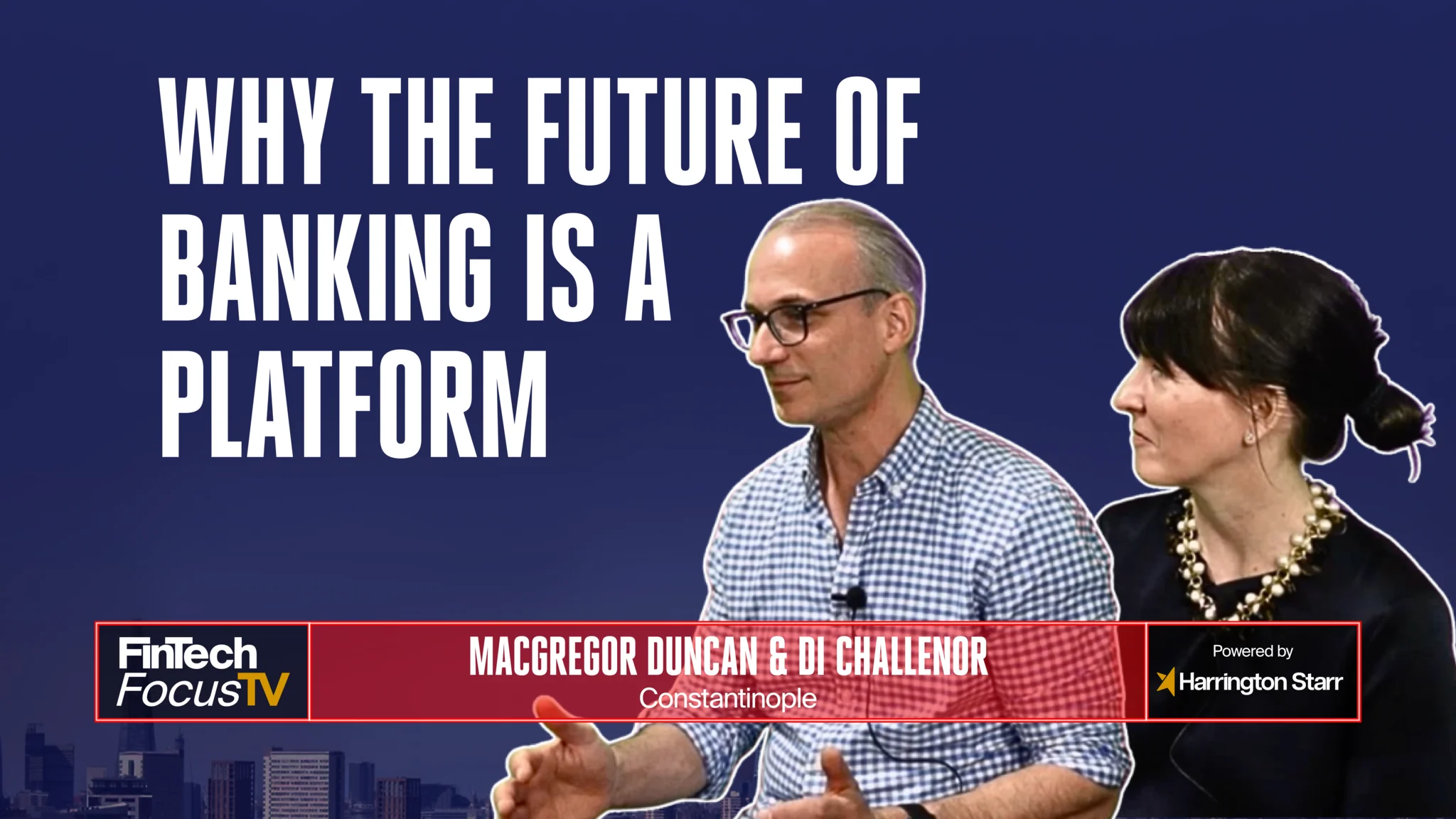
It is a question that sits at the heart of this episode of FinTech Focus TV, as Toby Babb is joined by Macgregor Duncan and Di Challenor, Co-Founders and Co-CEOs of Constantinople, for a conversation about banking technology, digital transformation, artificial intelligence and the future operating model of financial services.
Having built their careers within banking before founding Constantinople, Macgregor and Di have experienced the challenges of banking transformation from the inside. Their argument is that while financial institutions have invested heavily in improving digital customer experiences, much of the technology and operational infrastructure sitting behind those experiences remains complex, fragmented and dependent on manual processes.
Throughout the conversation, they explore an alternative: a platform approach that brings together banking technology and operations, enabling banks to concentrate more of their resources on the areas that differentiate them, serve their customers and drive growth.
From the cost of digital transformation and the impact of AI in banking to changing roles for technology professionals and Constantinople's expansion from Australia into the UK, the episode considers what meaningful banking transformation could look like in the years ahead.
The story of Constantinople begins before the company itself existed.
Macgregor and Di met while working at Westpac, where they were appointed co-sponsors of the bank's digital transformation and the development of its new digital bank. Macgregor had previously spent 17 years in New York, beginning his career as an M&A lawyer before working in investment banking at Goldman Sachs and later in private equity. He returned to Sydney and joined Westpac as Chief Development Officer. Di's career had been entirely within banking, including roles at Westpac, JPMorgan Chase and Citibank, with extensive experience across transaction banking.
Working on Westpac's digital transformation led to two important realisations.
The first concerned the complexity of transforming a bank. Macgregor explains that modern banking transformation often involves bringing together numerous third-party SaaS systems on top of cloud infrastructure. This can become extremely complex and expensive, despite different banks ultimately building many of the same capabilities.
That led them to question why individual banks were spending enormous amounts of money and time undertaking similar transformations independently. Their conclusion was that there should be a pre-built, pre-integrated infrastructure platform that multiple banks could leverage.
But their second realisation went beyond the technology stack.
After building Westpac's digital bank, the team took it to market and began operating it. Despite having created a modern digital banking experience for customers, the underlying operating model still depended heavily on people.
Macgregor describes teams carrying out payment operations, lending operations, hardship and collections processes, compliance activities and manual controls. The technology supporting the front-end experience had changed considerably, but the middle and back office had not undergone the same transformation.
He jokingly describes the result as a “digital mullet”: modern at the front, but much more manual behind the scenes.
That observation became fundamental to Constantinople's approach. Macgregor notes that banks typically spend around 10% of their costs on technology but approximately 50–60% on people. For him, genuinely changing a bank's cost structure therefore requires more than replacing or upgrading technology. It requires changing the operating model itself.
Constantinople was created around the idea of addressing both sides of that equation. The platform manages technology while using software and AI to support many of the operational aspects involved in running a bank.
For an industry continuing to invest heavily in banking technology, financial technology talent and digital transformation, this distinction is significant. The discussion suggests that the next stage of banking transformation may be less about simply creating another digital interface and more about reconsidering the infrastructure and operating model beneath it.
Di expands on the problem by asking why every bank needs to undertake such an expensive transformation independently.
Banks take deposits, lend money and provide financial products and services, but they also spend significant resources running technology and operations. For institutions without enormous scale, funding major transformation programmes can be particularly challenging.
She compares banking with industries such as payments and airlines, where organisations have become more comfortable determining what they do best and selecting partners to support other parts of their infrastructure.
Constantinople's answer is a platform with a single code base that is already operating. Rather than a bank having to stand up an entirely new target system itself, the platform can be configured around its go-to-market proposition before customers are migrated onto it.
This feeds into one of the episode's biggest questions: if the banking industry were being designed today, would every bank still operate its own technology and operational infrastructure?
Macgregor references an argument from banking commentator Matt Levine that, for historical reasons, banks are vertically integrated. They run the business of banking while also managing their own technology and operations.
If the industry were being redesigned from scratch, Macgregor argues that it would be unlikely to take the same form.
Instead, banks could focus on the areas where their expertise genuinely differentiates them, such as treasury and credit risk, while specialist technology businesses manage more commoditised and undifferentiated infrastructure and operations.
That is the division of responsibility Constantinople is seeking to create.
However, changing an established industry is not simply a technology challenge. Banking is highly regulated, institutions are responsible for customers' savings, and there is little tolerance for failure. Macgregor recalls that banks understood the logic of the proposition early on but were understandably reluctant to be the first institution to move everything onto a new platform.
Building trust therefore required proof.
At the time of the conversation, Macgregor says Constantinople had five banks live in market on its platform, with another four or five signed and in deployment in Australia. Those implementations, he argues, have given CEOs and boards greater confidence that this model can work in practice.
Artificial intelligence is an important part of the conversation, but Macgregor and Di position it within the broader transformation of banking rather than treating AI as the objective itself.
Macgregor describes cloud and AI as fundamental enabling technologies for Constantinople's business model. He says that without them, achieving the scale of cost-to-income improvements the company is targeting for client banks would not be possible.
Constantinople's scope also extends beyond individual areas of banking technology. Macgregor explains that the company manages areas including core banking, payments, compliance and regulatory reporting. The bank remains the licensed entity, retains its regulatory obligations and continues making decisions, while Constantinople manages execution across areas it considers commoditised and undifferentiated.
For professionals working across AI in financial services, cloud banking, banking infrastructure and FinTech technology, this creates an interesting distinction. The conversation is not simply about introducing individual AI tools into existing processes. It is about what becomes possible when automation and AI are embedded into a broader operating platform.
Di explains that Constantinople's first client was Great Southern Bank in Australia, which was looking for a different way to launch a business bank.
Having recently worked on building a digital bank themselves, Macgregor and Di had a blueprint for the technology but wanted to approach areas including compliance, real-time regulatory reporting and CEO visibility differently.
The successful launch became Constantinople's first major proof point. The company subsequently worked with Australian accounting platform MYOB, embedding banking capabilities into MYOB Solo for small businesses and sole traders. Di also discusses winning a traditional retail bank client that was considering what the next 10 to 20 years should look like and has migrated its retail bank onto Constantinople's platform.
Each implementation has enabled the business to move further forward and gather more feedback.
For Di, however, technology alone does not create trust. Banks need confidence in the people behind the platform. She explains that Constantinople has focused on building a team with the capabilities and expertise required to understand what it takes to run a bank.
That point is particularly relevant to the FinTech recruitment and financial technology recruitment market. Even as AI and automation become more capable, specialist knowledge of banking, regulation, technology and operations remains central to delivering transformation successfully.
One concern Constantinople repeatedly encountered was whether moving technology and operations to a single provider would mean a bank giving up control.
Macgregor argues the opposite.
Many banks, he suggests, currently have an “illusion of control” because they lack real-time visibility across their control environment and continue to depend on manual processes.
By applying software automation and AI across that environment, Constantinople aims to provide banks with clearer visibility of what is happening at any particular moment, helping them discharge their regulatory responsibilities more effectively.
Interestingly, Macgregor says some of the company's strongest advocates within banks have become Chief Risk Officers and Chief Compliance Officers.
It highlights another important aspect of digital transformation in financial services: successful transformation is not purely about technology teams. Risk, compliance, operations, leadership and regulatory requirements all influence whether new banking infrastructure can succeed.
The conversation then turns to one of the biggest questions surrounding artificial intelligence: what happens to people?
Toby asks whether technology teams can feel threatened by a model built around software, automation and AI, particularly given the wider narrative around headcount reduction and job displacement.
Macgregor offers a different perspective based on Constantinople's own experience.
The company has around 200 employees with a significant engineering focus. Although AI has created considerable efficiencies in code development, Macgregor says they have not seen a reduction in the number of engineers they manage.
Instead, their ability to build has increased dramatically. He gives an illustrative example that Constantinople might have had around five million lines of code three years previously compared with approximately 20 million today. AI allows organisations to build more, but that expanded technology estate still requires people to manage it.
His expectation is that some older types of roles will decline while new opportunities are created.
Macgregor makes a similar argument when discussing client technology teams.
His view is that engineering and technology resources should not spend disproportionate amounts of time on activities that do not differentiate one bank from another. Instead, a platform can manage more standardised elements while the bank redirects its people towards the things that matter to customers and its competitive position.
Those areas could include digital marketing, data analytics or differentiated credit underwriting.
Di develops the point further. She argues that the battle for banking customers will not simply be determined by how many products an institution offers, but by how well it understands its customers.
Teams struggling to extract data, manage operational problems or navigate large numbers of disconnected systems are less able to concentrate on customer needs. A different technology and operating model could allow those employees to move towards roles focused more directly on growth and customer experience.
For a FinTech recruitment business such as Harrington Starr, this changing relationship between people and technology is particularly important. The financial services technology market continues to need professionals capable of connecting technical capability with commercial outcomes, customer experience, data, risk and growth.
Towards the end of the episode, Toby returns explicitly to the idea of banking's future being built around platforms.
Macgregor compares UK neobanks including Revolut, Monzo and Starling with traditional high street banks. He praises the impact neobanks have had on customer experience and the huge customer bases they have built, while highlighting the difference between their revenue per customer and that of high street banks.
He also points to a substantial difference in cost to serve.
The opportunity Constantinople identified was therefore to bring what Macgregor describes as neobank-like operating and cost efficiency to incumbent banks. Traditional institutions already possess significant market positions, sticky customer bases and higher average revenue per customer, but their cost structures create a major challenge.
Platforms, in Constantinople's view, offer a way to address that problem.
Crucially, Macgregor says this cannot be achieved through a shared technology platform alone. The model must also encompass operational activities because that is where a significant proportion of banking costs sit.
The episode closes by looking at what comes next for Constantinople.
Having established the business in Australia, Macgregor and Di have been deliberate about reaching milestones and ensuring their existing clients are satisfied before pursuing international expansion.
The UK is now the next step.
Di explains that the team had been travelling between Australia and the UK monthly for around five months, had hired a team locally and was excited by the opportunities in the market.
Asked why the UK was chosen, Di points to the level of activity taking place across the banking sector and the opportunity to help incumbent institutions prepare for the next 10 or 20 years.
She also highlights commonality between the Australian and UK regulatory frameworks and information sharing between regulators. Constantinople operates from a common code base but localises it for individual markets, and the team's understanding of the UK regulatory environment made Britain feel like the natural next market for the company.
For the UK FinTech industry, Constantinople's arrival adds another perspective to the continuing conversation around banking modernisation, AI, infrastructure and the technology talent required to deliver transformation.
Ultimately, this episode of FinTech Focus TV is about much more than adopting another banking technology.
Macgregor Duncan and Di Challenor present a case for reconsidering the structure behind modern banking itself. Rather than every financial institution repeatedly assembling technology systems and maintaining large operational infrastructures independently, they envisage a model in which platforms manage more of the standardised technology and operational work.
Banks can then concentrate resources on the areas where they provide genuine differentiation: understanding customers, managing risk, developing propositions and driving growth.
Cloud and AI make that model increasingly possible, but the conversation also demonstrates why people remain central to it. Banking expertise, engineering talent, risk and compliance knowledge, data capabilities and commercial understanding are all required to translate technological potential into a functioning, regulated financial institution.