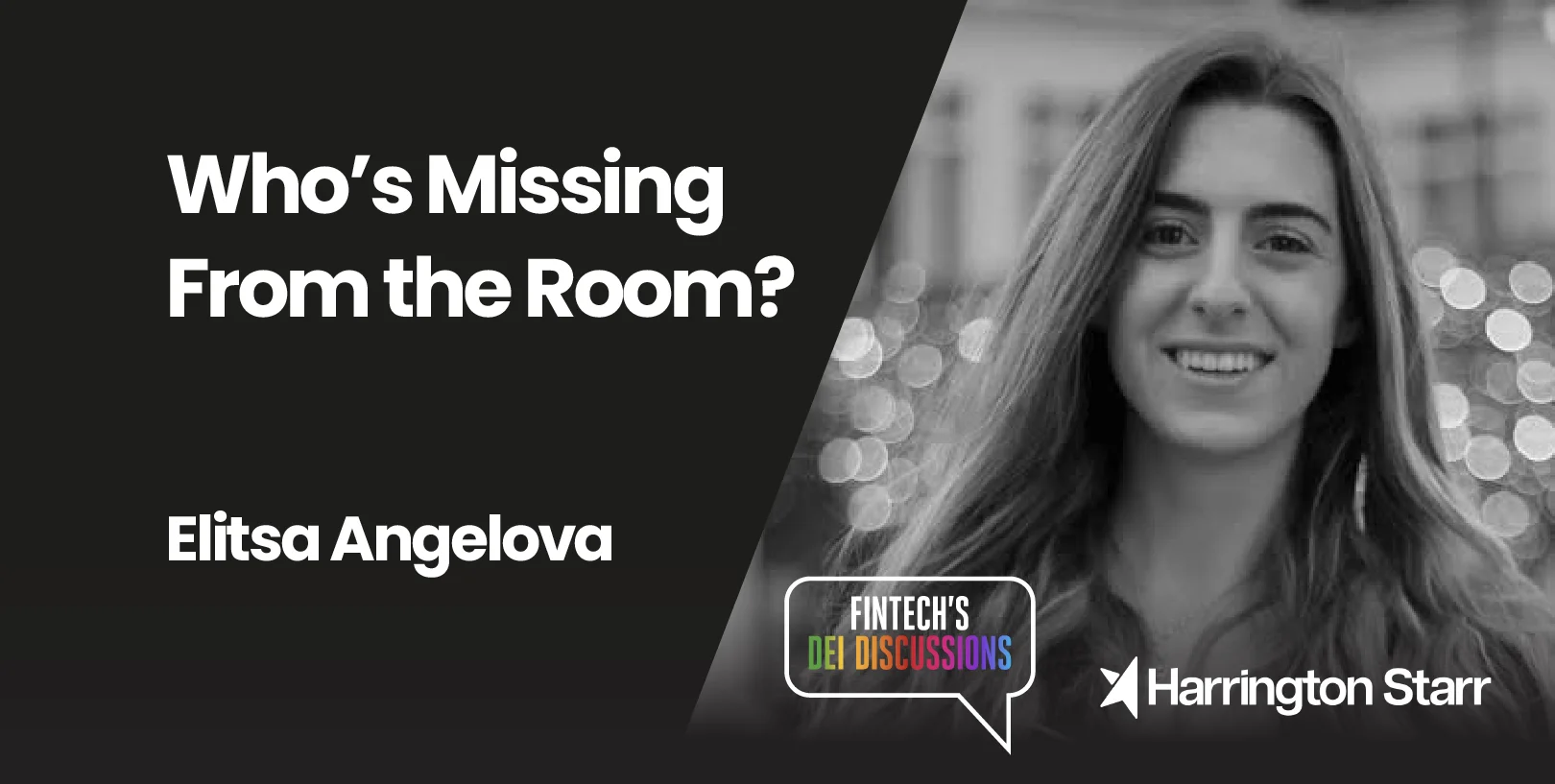
Who's Missing From the Room?
05 October, 2026

What does it really take to create an environment where different people, perspectives and ideas can drive innovation?
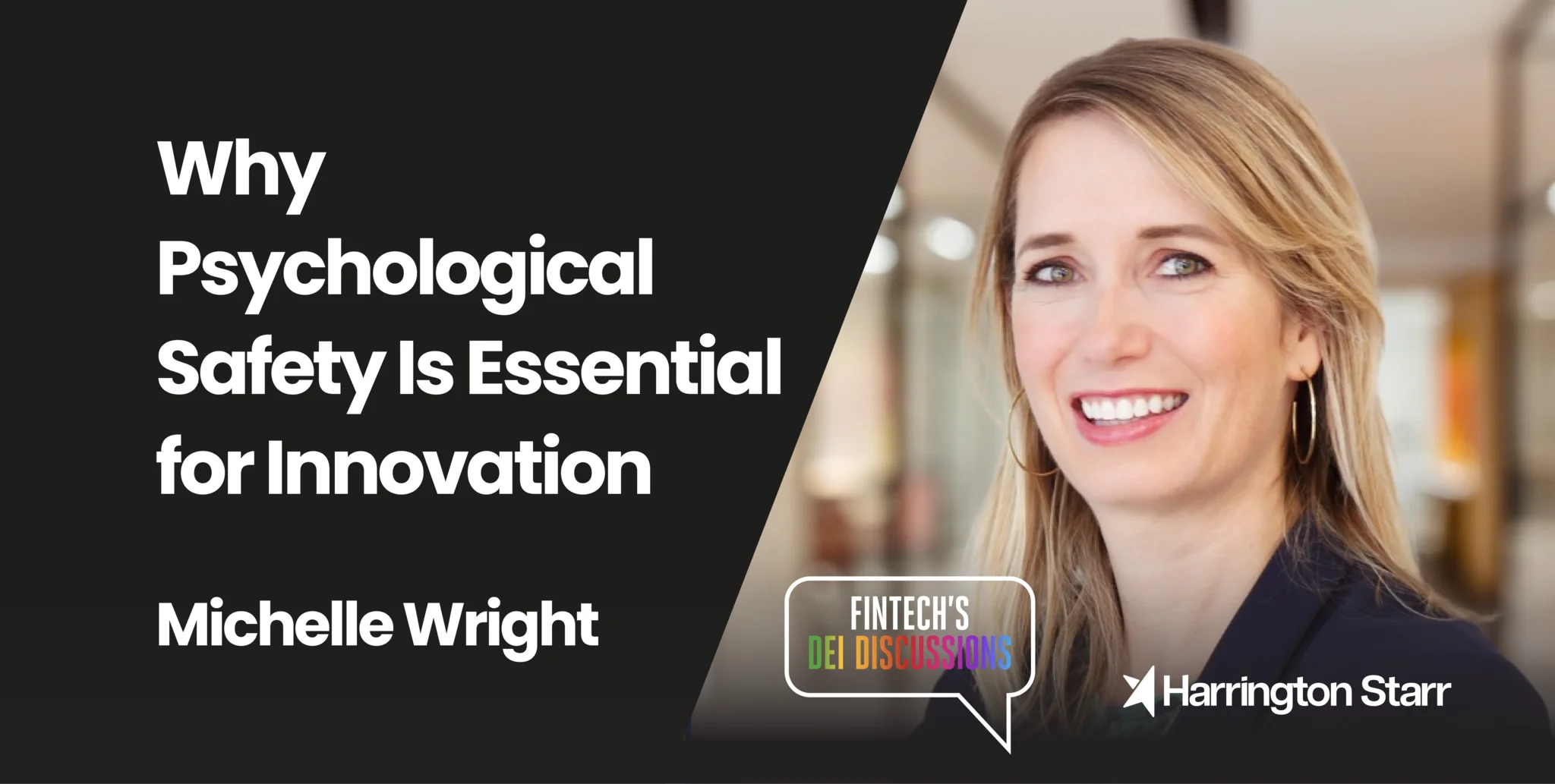
In this episode of FinTech’s DEI Discussions, Nadia Edwards-Dashti is joined by Michelle Wright, FinTech Chief Product Officer, for a conversation that moves between product leadership, commercial thinking, career development, diversity of thought and the importance of psychological safety in financial technology.
Having spent 20 years working in regulated B2B FinTech, Michelle has built a career spanning large banks, an AI start-up and, most recently, a scale-up where she worked on a product reset. That breadth of experience has given her an understanding of businesses at very different stages of growth, but there is a common thread running throughout her career: a desire to start things, build teams, solve difficult problems and approach challenges differently.
During the conversation, Michelle explains how this has repeatedly drawn her towards technically strong products that are difficult to sell. But as the discussion develops, that idea becomes about far more than product. It opens a conversation about understanding your own value, being willing to think differently, creating environments where people feel safe to speak and ensuring inclusion translates into meaningful action.
For businesses building their financial technology teams, and for professionals developing their FinTech careers, Michelle’s experiences highlight why technical ability alone is rarely enough. Commercial understanding, communication, different perspectives and the confidence to challenge existing thinking can all play an important role in building successful products and successful teams.
One of the central themes of Michelle’s career has been the challenge of taking a technically strong product and making it commercially credible.
Michelle has experienced this from both sides of the table. While working as a technology buyer inside a large bank, she saw vendors attempting to sell their technology by focusing on what they had built rather than the problems their buyers needed to solve. Later, moving to the vendor side, she worked alongside technically brilliant people who were passionate about their technology but did not always understand the underlying business problem.
For Michelle, the buyer ultimately does not care simply about how clever the technology is. They care about the outcome it can deliver.
Within banks and financial services businesses, those outcomes could include reducing costs, meeting regulatory requirements or creating additional value for the organisation. This makes understanding the buyer, their environment and the problems they are trying to solve fundamental to successful FinTech product development.
Michelle’s experience as a buyer also means she understands the complexity of getting technology approved inside a large financial institution. Multiple committees, forums and procurement processes can stand between an initial conversation and a signed agreement. Building something technically impressive is therefore only part of the challenge.
Product leadership, in Michelle’s view, should involve asking whether the organisation is solving the right problem, why it is building something and how that solution will ultimately be sold.
Michelle describes product as the “glue” that brings different areas of an organisation together.
Rather than seeing product as an isolated technical function, she positions it at the intersection of technology, commercial thinking and marketing. Successful product leadership means making sure these different groups understand what they are collectively working towards.
For Michelle, that process begins with business strategy.
Product teams need to understand how the business actually makes money and then anchor what they are building to that strategy. Once that is clear, teams can better understand the commercial drivers behind their work, whether those involve generating revenue, creating cost efficiencies, reducing client churn or improving retention.
That commercial understanding should influence prioritisation.
Instead of allowing a roadmap to be dictated by whoever is shouting the loudest or by the latest new technology, Michelle believes teams should return to the problems they are trying to solve and the outcomes that matter to the business.
“The commercial story” is central to her approach. As she explains during the episode, it is not simply about the feature; it is about the revenue model.
Her role in product is therefore partly one of translation: making product teams more commercially fluent while making commercial teams more product literate.
This ability to bridge different functions is particularly relevant as financial technology businesses continue to evolve and emerging technologies such as AI make it increasingly easy to build and replicate products. If technology itself becomes easier to create, understanding the customer, commercialising the solution and differentiating the product become even more significant.
Michelle’s observations about AI provide an important backdrop to the episode.
She argues that with AI making it cheaper and easier to build technology, replicating something that already exists is increasingly straightforward. The more difficult question is how that product will be commercialised.
That challenge requires a deeper understanding of users and markets.
Michelle discusses how growth can sometimes come from adjacency, taking an existing product and repositioning it for a different type of buyer. At other times, the opportunity can come from geographical expansion. But moving into different countries requires organisations to understand different regulations, languages and user requirements rather than assuming the same approach will work everywhere.
Michelle learned this firsthand while scaling a product inside a large bank from an initial pilot involving four users to 24 different markets.
The experience reinforced the importance of planning, understanding different users and adapting a product as it scales.
For FinTech businesses, this illustrates why hiring strong financial technology talent is not simply about finding professionals who understand technology. Successful teams also need people capable of understanding users, commercial requirements, regulation and the broader context in which products operate.
One of the most personal parts of the conversation begins when Michelle discusses what she wants from the next stage of her FinTech career.
Towards the end of last year, she began thinking about pursuing more of a portfolio career. She wanted the ability to flex work up and down, spend more time around her family and holidays, while continuing to do the work she genuinely loves.
Product remains a passion for Michelle. But acknowledging the type of career she wanted led to another realisation.
To achieve it, she would need to sell herself.
Michelle describes how difficult this can be, particularly for women. Being excellent at something and being comfortable telling other people you are excellent at it are two very different things. Self-promotion can feel uncomfortable or like bragging.
As she began thinking about what differentiated her and what she could offer CEOs, Michelle realised that her career could be distilled into the same problem she had spent years solving for products: taking something technically strong but difficult to sell and making it commercially credible.
Then came the realisation that she was, in her own words, exactly that product.
She knew she was good at what she did, but she found it difficult to sell herself.
The parallel forced Michelle to apply the problem-solving skills she had developed throughout her product career to her own professional positioning.
Michelle’s solution was not to simply “sell harder”.
Instead, she began thinking about what she was genuinely good at: diagnosing problems.
Rather than entering a meeting or interview and listing credentials, experience and achievements, she could demonstrate her value by identifying what she was seeing within the organisation and playing those observations back to the people in the room.
That shift changed self-promotion into demonstration.
Instead of claiming to be good at something, she could show that she was good at it.
Michelle later describes applying this approach while preparing for a high-stakes meeting with a CEO. Initially, she found herself doing exactly what she advises other people not to do: reaching for a list of credentials and thinking about how to explain why she was the right person.
She stopped and reframed the question.
Her strength was diagnosing problems, so why not demonstrate that strength during the conversation itself?
For professionals navigating FinTech careers, financial technology recruitment processes or senior leadership opportunities, it is a powerful idea. Experience and credentials matter, but showing how you think, what you notice and how you approach a business problem can reveal something a list of achievements cannot.
The conversation then turns towards one of the most important themes of the episode: diversity of thought.
Michelle has frequently found herself as the only woman in the room. She also speaks about being South African and about her ability to spot patterns quickly, sometimes recognising something before other people around her do.
She is comfortable naming what she sees, although she acknowledges that doing so can sometimes be dangerous.
Over time, she has become more comfortable holding uncomfortable conversations and accepting the discomfort that can come with thinking differently.
Michelle shares an example from an interim engagement where she was working across a partnership between two organisations with fundamentally different ways of operating.
One organisation worked in a more traditional, waterfall-style way, with a slower pace, greater emphasis on risk and control and significant governance. The other operated in a more agile way, moving faster and without the same formal authority structures.
When one side wanted a long-range milestone plan committing the partnership to a year of activity before they had fully defined what they were building, Michelle recognised the disconnect.
Without formal authority over the people involved, she had to become the person connecting the two sides and propose a different approach, including the use of OKRs.
It was uncomfortable, but that discomfort was also where her value existed.
Being the different voice in the room is not always easy. Yet if organisations genuinely value diversity of thought, they need people who are willing and able to challenge the dominant perspective.
Having different perspectives represented within a team is only the first step.
Michelle argues that diversity is not simply about having different people or different thoughts in the room. Those people also need to feel safe enough to express what they actually think.
That is where psychological safety becomes essential.
For FinTech innovation to benefit from different backgrounds, histories and ways of seeing a problem, employees need to know they can voice those perspectives rather than sitting quietly and agreeing with everyone else.
Michelle has experienced environments where the opposite was true.
She describes cultures driven by fear, where people were reluctant to put their hands up because they had seen what happened when somebody said the wrong thing. When people fear being torn apart for expressing an opinion, they learn not to become the different voice.
The organisation may technically have diverse people sitting around the table, but it loses the value those different perspectives were supposed to create.
For Michelle, creating a culture where people genuinely feel seen and heard has to come from the top.
This is particularly important in financial technology, where businesses rely on people who can identify problems, challenge assumptions and develop new approaches. Innovation requires more than different people. It requires an environment in which difference can actually be expressed.
Michelle’s experiences have also influenced the time she spends mentoring and supporting other women.
At the beginning of the year, she made a deliberate decision to spend meaningful time helping more women, whether through formal mentoring relationships, informal conversations or supporting people she had previously worked with.
Part of that decision came from recognising that many senior women have stories about being undermined, including experiences where the person undermining them was another senior woman.
Michelle wanted to consciously do the opposite and support women within the industry.
Interestingly, mentoring also challenged some of her own doubts.
When she was asked to mentor an already senior professional, her first response was to question how much value she could really provide. She describes experiencing the kind of doubt commonly associated with imposter syndrome before the mentoring relationship had even begun.
But their conversations revealed that experiences Michelle had begun to take for granted contained genuinely useful lessons for somebody else.
Mentoring therefore became a two-way experience.
Michelle could share what she had learned throughout 20 years in regulated B2B FinTech, while the process reminded her that she did have substantial knowledge and experience worth sharing.
For financial technology leaders, this demonstrates the value of creating opportunities for knowledge sharing and mentorship. Career development does not only benefit the person receiving support; it can also help experienced professionals recognise the expertise they have accumulated throughout their careers.
Towards the end of the episode, Nadia asks Michelle what she would like listeners to do to drive more inclusion within their workplaces.
Michelle offers two practical areas for change.
The first is directed towards senior men.
She would like more senior male leaders to be visible when family responsibilities affect their working day. That could mean openly saying they need to leave a meeting because their child is sick, the nanny has cancelled or they need to go home and cook dinner.
Michelle explains that when someone is physically present in an office or meeting room, they are visible. When a woman is the person called by her child’s school and subsequently has to dial into meetings from home, she can become quietly invisible.
Leaving early can still be noticed and, in Michelle’s view, can be interpreted as a sign of being less committed, particularly because these responsibilities still often fall disproportionately on women.
When senior men visibly demonstrate that family responsibilities are also part of their lives, it can begin to change those expectations.
For Michelle, real change will come when seeing a senior man leave work for a family responsibility stops being remarkable.
Michelle’s second ask brings the conversation back to psychological safety.
Different people need to be in the room, but they also need the confidence and security to say what they actually think.
This is where inclusion and innovation become closely connected.
Financial technology businesses compete by solving difficult problems, building new products and responding to rapidly changing markets. Those outcomes depend on people being able to question existing assumptions.
If employees have learned that disagreeing carries a personal or professional risk, organisations may lose precisely the ideas they hired diverse teams to contribute.
For leaders building FinTech teams, this means workplace culture cannot be separated from innovation. Psychological safety is not simply about making people feel comfortable. It is about creating the conditions in which employees can challenge, question and contribute different ways of thinking.
As Michelle explains, people with different backgrounds and histories will naturally see problems differently. That difference is the point. But its value can only be realised when people are able to voice it.
Michelle Wright’s conversation with Nadia demonstrates how closely product leadership, career development, inclusion and innovation can intersect within the financial technology industry.
From understanding the commercial problem behind a technically strong product to understanding how to communicate your own professional value, many of the themes return to the same principle: knowing what problem you are solving and having the confidence to demonstrate how you can solve it.
For businesses thinking about FinTech recruitment and building high-performing financial technology teams, the episode also provides an important reminder that hiring different people is not the end goal.
Organisations need cultures where those people can contribute what makes them different.
Technical expertise matters. Commercial understanding matters. Experience matters. But the ability to spot something other people have missed, challenge an established approach or bring two opposing perspectives together can be equally valuable.
That only works when leaders create the psychological safety necessary for people to use their voices.