Why Aren't Women Investing?
28 September, 2026

Diversity and inclusion can easily become conversations about numbers. But what happens when we look beyond representation and ask how different perspectives actually influence the decisions businesses make?
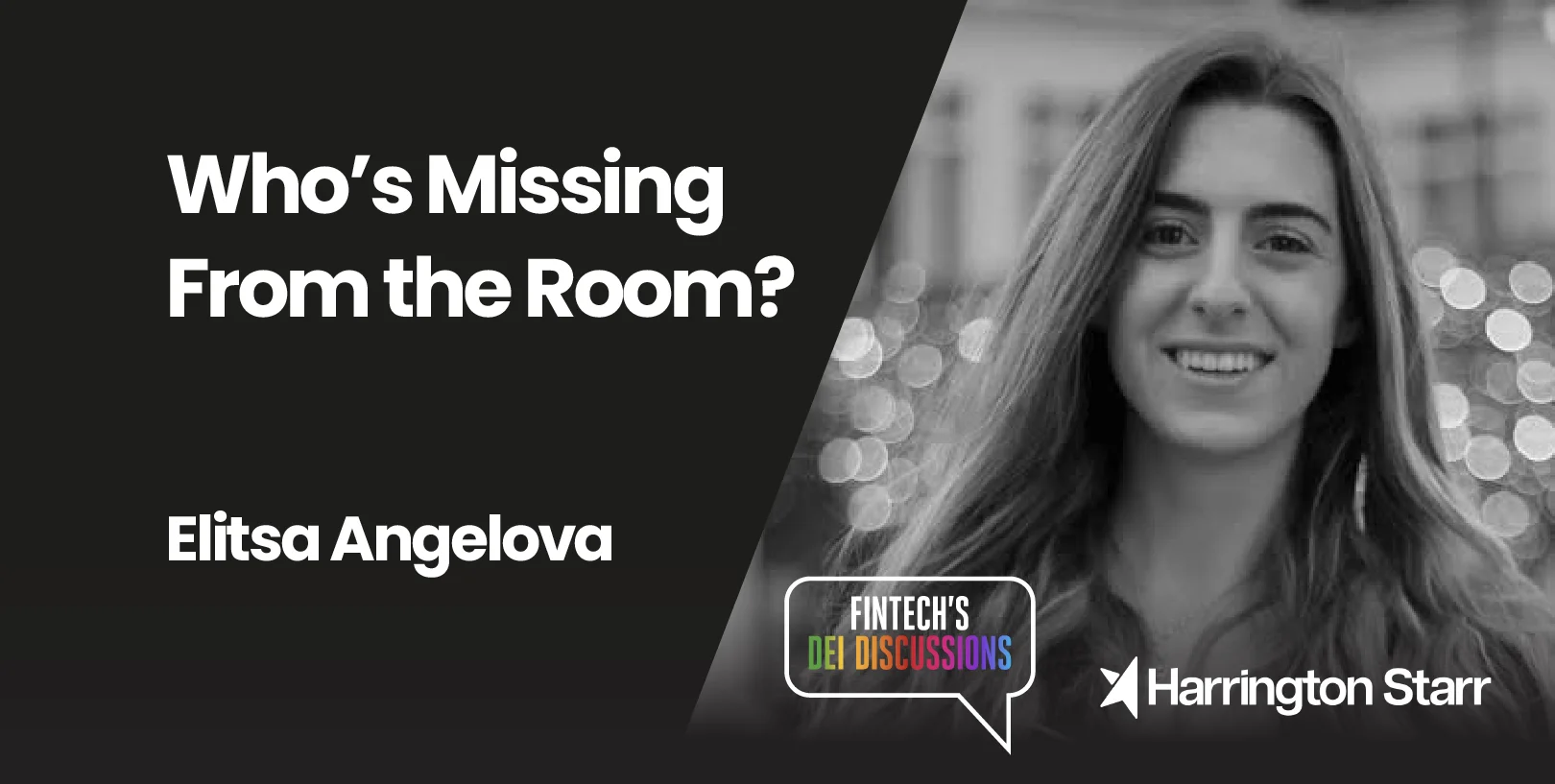
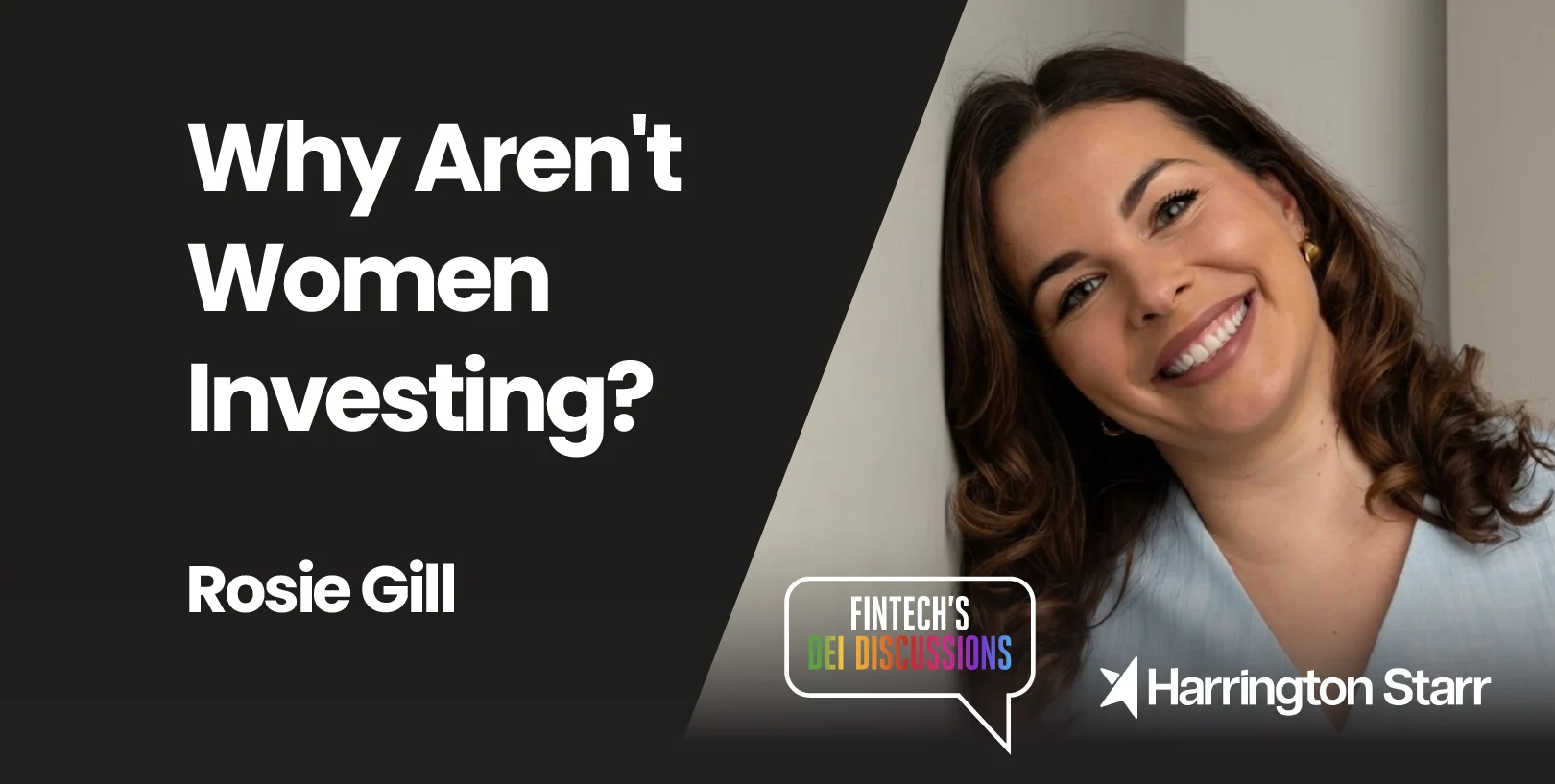
In this episode of FinTech's DEI Discussions, host Nadia Edwards-Dashti is joined by Elitsa Angelova, Chief of Staff at Mouro Capital, for a conversation spanning diversity of thought, inclusive hiring, venture capital, communication and the importance of creating opportunities for people who may otherwise be overlooked.
Throughout the episode, Elitsa draws on her experience across consulting, innovation and venture capital to explore what meaningful inclusion can look like in practice. From questioning how venture capital firms find founders to challenging how businesses assess candidates during the hiring process, the conversation highlights a recurring idea: different perspectives can lead to different questions, and different questions can lead to better decisions.
For businesses thinking about their approach to FinTech recruitment, inclusive leadership and building diverse teams, the discussion also raises an important question. Are we simply giving people a seat at the table, or are we creating an environment where different voices genuinely influence what happens next?
Elitsa describes her career through a mission she has developed over time: building the mechanisms through which capital reaches the people who build.
Her journey began at Sofia High School of Mathematics, where she developed an understanding of the logic and structure behind problem-solving. After coming to the UK to study, she completed several internships alongside her studies.
One of those was with LEK Consulting, where she worked with a client looking to expand into a new market where the available data was limited. The experience taught her that when the data does not exist, businesses need to speak to people. But crucially, who you choose to speak to shapes the picture you ultimately see.
That lesson around listening, questioning and gathering different perspectives would continue throughout her career.
Elitsa later joined Deloitte as a strategy consultant and worked on the COVID-19 ventilator challenge, helping to project manage an initiative involving 33 organisations. Thousands of ventilators were delivered within 12 weeks. For Elitsa, the experience demonstrated what can happen when people are united behind a clear mission and working in the same direction.
She subsequently moved into Deloitte's innovation work, first as a venture scout and then as a venture builder, working across more than eight incubation concepts. One of her biggest lessons from that period concerned ego and the importance of continuing to listen to what people are actually telling you.
She explains that teams can begin to fail when they stop listening to the truth and the responses of other people. Working with senior partners, she encouraged a non-leading approach to conversations with potential clients, helping teams understand whether genuine demand existed and what form a solution should take.
Today, as Chief of Staff at Mouro Capital, Elitsa works alongside the firm's two general partners across areas including the investment process, hiring, AI within operations and communicating the fund's story. She has also contributed to conversations at a European level around venture capital and entrepreneurship.
Across these different experiences, the principle remains consistent: keep the door open for the people who build.
One of the major themes of the episode is the idea that venture capital portfolios should not necessarily be viewed as a collection of completely independent investments. Instead, Elitsa describes an ecosystem in which lessons from one company can influence how investors understand opportunities and challenges elsewhere.
She points to Aline as one example. Mouro Capital led its $7.5 million seed round. The company helps regulated organisations deploy AI in a controlled and compliant way, addressing a challenge that is becoming increasingly relevant as financial services businesses look to introduce AI into both customer-facing and back-end processes.
The investment also helped Mouro Capital deepen its understanding of the infrastructure surrounding AI adoption. As similar questions around safe and compliant AI deployment appear across financial services and portfolio businesses, knowledge developed through one investment can become relevant elsewhere.
Elitsa also highlights Elliptic, an earlier Mouro Capital investment operating within crypto compliance and financial crime prevention. Both examples, she notes, are led by women working in highly complex industries.
Another example is Forage, which Elitsa describes as one of her favourite illustrations of inclusion being viewed as a market rather than a charity.
Millions of Americans rely on SNAP benefits for food and groceries, but historically those benefits have not always been widely accepted, particularly online. Forage has worked to change the infrastructure behind these payments, enabling their acceptance across more than 100,000 retailers in all 50 US states.
For Elitsa, seeing a business serving low-income families grow rapidly changes the mental model around underserved groups. Instead of seeing inclusion as a side issue, investors can begin recognising underrepresented customers as genuine markets and commercial opportunities.
It is a point she returns to at the end of the episode: underrepresented customers are real markets, while overlooked founders are real opportunities.
For Elitsa, balance means diversity of thought.
She discusses research into venture capital investment outcomes and uses it to illustrate why diversity should not simply be treated as a number on a page. One study she references examined tens of thousands of venture capital investments and found poorer outcomes among investment partners with certain shared backgrounds.
She also discusses research in which groups were asked to solve a murder mystery. Some groups consisted of people who already knew one another, while others had an external person introduced into the team.
The homogeneous groups were more confident that they had reached the correct answer. However, the groups containing a new person were ultimately more accurate.
That new perspective created enough discomfort to generate additional questions and discussion.
This distinction between confidence and correctness becomes particularly important later in the conversation when Nadia and Elitsa discuss inclusive hiring and FinTech recruitment.
Within Mouro Capital itself, Elitsa sees diversity of thought through several lenses, including geography and gender. The firm's international team spans locations including London, Madrid and San Francisco, while the London office itself includes people from a wide variety of countries.
When a venture capital firm is considering opportunities ranging from Latin American neobanks to Japanese AI companies, international lived experience can introduce questions that may otherwise never be asked.
For Elitsa, having somebody in the room who sees an opportunity or challenge differently provides reassurance that investment decisions are being properly challenged rather than simply reinforced.
One of the most relevant sections of the conversation for businesses considering their FinTech recruitment strategies focuses on hiring.
Elitsa explains that when she joined Mouro Capital there were two women on the team, whereas there are now five. Importantly, she stresses that this was not the result of quotas or targets. Each person hired was considered the best person for the role.
But reaching that decision can require hiring teams to think more carefully about how candidates present themselves.
Elitsa describes the contrast between two types of candidates businesses may encounter during an interview process. One candidate might comfortably fill every silence, communicate extremely confidently and be particularly good at selling themselves. Another might have significant achievements and be extremely capable on paper but feel less comfortable talking about themselves because they expect their achievements and experience to speak for themselves.
With the second candidate, an interviewer may need more patience. They might need to ask another question, allow more time or have an additional conversation to uncover everything that person could bring to the role.
The wider lesson is that confidence and correctness should not be confused.
Hiring processes should not automatically reward the loudest voice in the room.
For organisations focused on inclusive recruitment and building diverse teams, this has practical implications. Interview questions need to be objective and well structured, while hiring managers need to recognise that different candidates communicate their experience in different ways.
This is particularly important within financial technology recruitment, where organisations are frequently competing for highly specialised talent across technology, data, AI and other technical disciplines. A candidate's ability to sell themselves should not become a substitute for assessing the achievements, expertise and capability they could bring to the business.
Later in the episode, Elitsa develops the inclusive hiring conversation further with a simple change in terminology.
Rather than assessing candidates purely for "culture fit", she argues that businesses should consider "culture add".
If somebody fits perfectly into everything that already exists within an organisation, what new perspective are they bringing?
This does not mean abandoning culture when hiring. Instead, it encourages businesses to think about how a new person could enrich the existing team.
This idea connects directly to the wider discussion around diversity of thought. Different backgrounds, experiences and ways of approaching problems can introduce questions that existing teams may not have considered.
For FinTech employers and hiring managers, this creates another dimension to recruitment. Building an effective team is not necessarily about repeatedly hiring people who think, communicate and behave in similar ways. It can also mean identifying people capable of challenging existing thinking constructively.
Creating a diverse team therefore goes beyond representation. Businesses also need an environment where those differences are allowed to influence decisions.
The same challenge appears within venture capital when firms decide which founders and businesses receive their attention.
Elitsa explains that most venture capital funds rely heavily on their networks for sourcing opportunities. Networks remain extremely important to Mouro Capital too, particularly after years of specialising in the market and developing relationships with banks, portfolio companies and other parts of the ecosystem.
However, networks have natural limits.
If investors repeatedly source opportunities from similar people and places, the founders entering the investment pipeline can begin to look similar too.
Elitsa points to the small share of European venture capital funding reaching all-women founding teams as evidence that relying on networks alone is not producing balanced outcomes.
Mouro Capital therefore combines its network with a thesis-driven approach to sourcing.
Its research and investment teams work together to explore structural changes within financial services, regulatory developments and infrastructure gaps. Rather than beginning with a predefined image of what a successful founder should look like based on their university, connections or background, the focus can shift towards how deeply that founder understands the problem they are trying to solve.
This can create opportunities to recognise expertise that might otherwise be missed.
It also demonstrates how diversity in venture capital is connected to the mechanisms firms use to discover opportunities in the first place. If organisations want different outcomes, they may need to question whether their existing processes continually lead them towards the same people.
Finding diverse talent is only one part of building an inclusive workplace. People also need to be heard once they arrive.
Elitsa encourages organisations to consider the order in which people are invited to contribute during meetings.
If the most senior person in the room immediately gives their position, others can begin to follow that viewpoint. Instead, asking more junior colleagues to contribute first can create space for perspectives that might otherwise disappear once a senior position has been established.
Similarly, somebody being quiet does not necessarily mean they have nothing to contribute.
As Chief of Staff, Elitsa invests time in one-to-one conversations across the organisation, gathering perspectives on everything from investments to operational improvements. This can help uncover ideas from people who may be less inclined to speak first in a large group setting.
The conversation also explores the importance of challenging senior leadership.
Drawing on her experience at Deloitte, Elitsa discusses a reverse mentoring programme where junior colleagues from underrepresented backgrounds were paired with senior leaders. Those conversations helped leaders understand barriers they may never have personally experienced.
For businesses considering inclusive leadership, the principle is straightforward: creating diverse teams has limited value if organisations do not also create mechanisms through which different perspectives can reach decision-makers.
Communication is also central to how Mouro Capital works with its portfolio.
Elitsa describes communication as the connective tissue that allows the expertise inside a venture capital fund to translate into practical support.
Different parts of a fund possess different information. A partnerships team may understand the biggest challenges corporations are facing. Researchers may have insight into where the market is moving. Operations teams understand performance measures and KPIs, while investment teams have personal relationships with founders.
If that knowledge remains trapped in individual silos, it cannot systematically help portfolio companies.
Mouro Capital therefore aims to create a unified support network in which teams regularly communicate about portfolio challenges and identify the expertise that can help.
At the same time, founders are busy and board relationships are close. The answer is not simply to introduce an entire team whenever a problem appears. Instead, the fund needs to understand what support is required and connect the founder with the right expertise at the right moment.
Open communication with founders is equally important. Elitsa explains that conversations begin early around what founders want from their investors and the people they bring onto their cap table.
Trust then develops over time.
When founders believe investors are genuinely there to support them, problems can become visible earlier. Instead of discovering an issue months after it begins, investors may know within weeks and have a better opportunity to help.
The episode ultimately expands the definition of workplace inclusion beyond the people already inside a company.
Elitsa discusses Mouro Capital's long-standing support for Included VC, a fully funded fellowship helping people from overlooked and underrepresented backgrounds break into venture capital.
The programme encourages applications from groups including mothers, students and people without traditional banking backgrounds. Elitsa highlights examples of people coming from scientific and legal careers and successfully transitioning into venture capital.
She also points to the proportion of fellows actively seeking VC positions who have subsequently secured roles.
For Elitsa, initiatives like these matter because they can change the pipeline of people who ultimately make decisions about where capital is distributed.
This links back to one of the central themes running throughout the entire conversation. Inclusion is not a standalone initiative. Who gets hired can influence who participates in decisions. Who participates in decisions can influence which questions are asked. Which questions are asked can influence which founders receive investment and which markets businesses recognise as opportunities.
As the conversation draws to a close, Elitsa leaves listeners with practical principles that apply whether they work in venture capital, FinTech recruitment, financial technology or another part of the industry.
Businesses can structure hiring processes around evidence and achievements rather than confidence alone. They can assess candidates for culture add rather than only culture fit. Leaders can deliberately invite junior perspectives before senior voices shape the conversation. Organisations can create routes for quieter colleagues to share their ideas, while senior leaders can seek perspectives from people whose experiences differ significantly from their own.
Venture capital firms can also examine their investment pipelines more closely. Who receives a first meeting? Who progresses to a second? At what point do certain founders disappear from the process? And could that drop-off be happening because the right questions were never asked?
For founders, Elitsa encourages thinking about diversity from the beginning, including when boards are first established, rather than trying to change structures much later.
Ultimately, this episode of FinTech's DEI Discussions makes the case for looking beyond diversity as a target and considering how it changes the way organisations think.
Diverse teams can ask different questions. Inclusive hiring can uncover capability that a traditional interview process might miss. Broader venture capital sourcing can reveal founders who sit outside established networks. Better communication can ensure that expertise is shared rather than siloed.
As Elitsa puts it towards the end of the conversation, diverse teams make better decisions, underrepresented customers are real markets and overlooked founders are real opportunities.
For financial technology businesses competing for talent, investment and innovation, that makes inclusion relevant far beyond a DEI strategy. It influences who organisations hire, who they listen to, which problems they notice and which opportunities they are prepared to pursue.
The challenge for leaders is therefore not simply to ask who is already in the room.
It is to consider who might still be missing, whose voice is not being heard and what could change if the door were held open for someone new.