Who's Missing From the Room?
05 October, 2026

In a technology industry defined by constant change, the ability to learn is becoming more than an employee benefit. It is increasingly fundamental to how organisations grow, innovate and remain competitive. For businesses operating at the intersection of financial services and technology, that challenge becomes particularly important as artificial intelligence and other emerging technologies continue to change the skills, processes and expectations shaping the workplace.
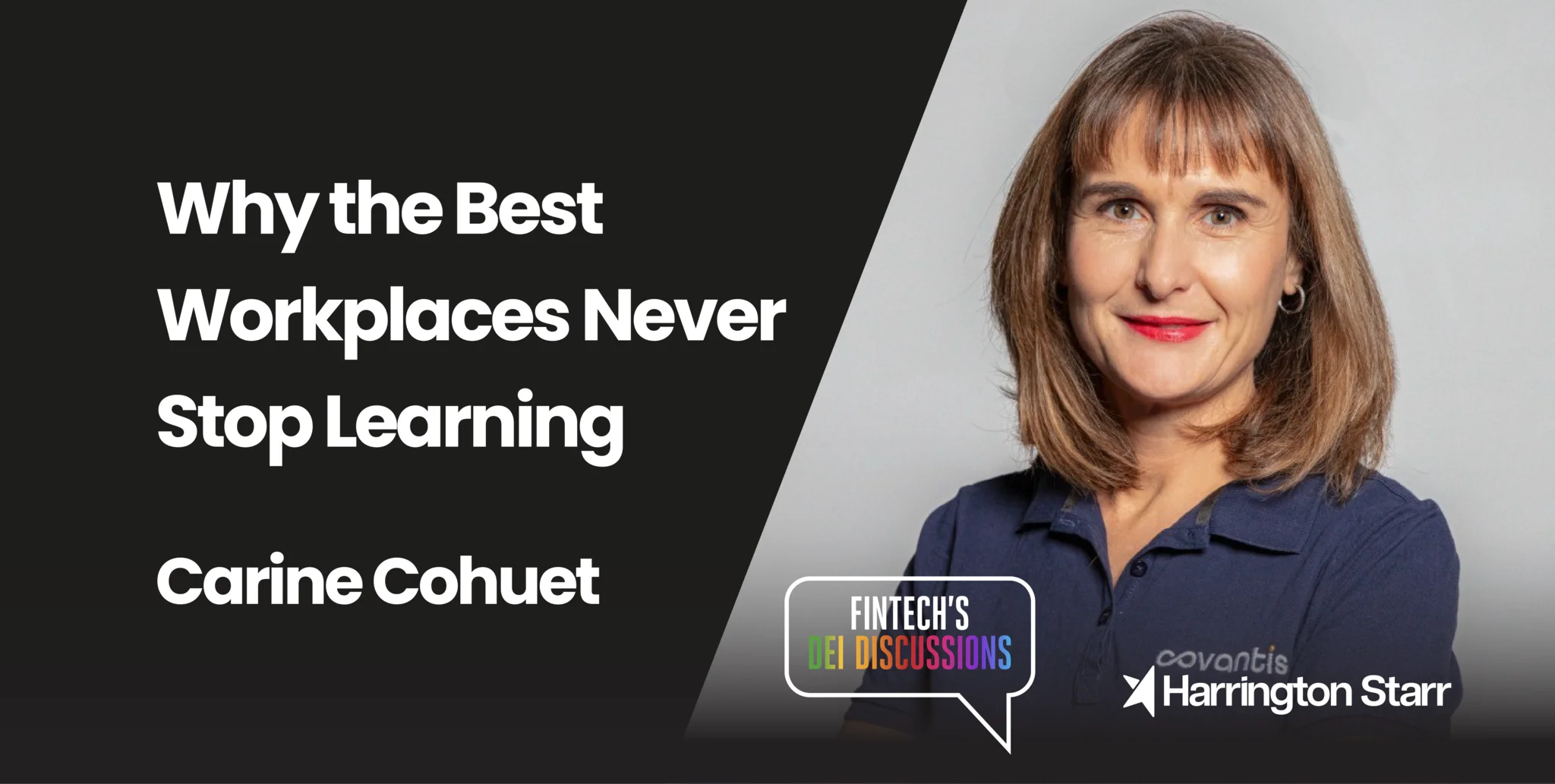
In this episode of FinTech’s DEI Discussions, host Nadia Edwards-Dashti speaks with Carine Cohuet, Head of HR at Covantis, about building a workplace where learning, growth and individual responsibility are embedded into the culture. Their conversation explores Carine’s career in HR, the creation and development of Covantis, continuous learning and development, the impact of AI on technology talent, the transition from startup to scale-up, remote working and the role diversity and inclusion can play in innovation.
Throughout the conversation, one message consistently emerges: organisations cannot expect to keep evolving unless their people are evolving with them.
Carine’s career began in France, where she studied international HR management before starting her professional journey in human resources within a medical devices company in the Bordeaux area. A period spent travelling and working in New Zealand followed, before she relocated to Annecy, close to Geneva.
It was there that Carine moved into HR within private banking before discovering the energy commodity trading industry. She explains that this transition significantly increased the scope of her HR responsibilities and gave her experience within an international and dynamic environment.
Carine has been connected to the commodity trading industry since 2009, working across different companies in regional and global HR roles. Her career later took her to Cargill, where she spent four years across several roles and assignments. During her final position there, she began working on the project that would become Covantis.
Covantis was officially founded in February 2020, although the project had begun before then. Carine explains that it was founded by major organisations within the agricultural commodity trading market.
The mission was to develop SaaS applications to digitalise agricultural commodity trade execution processes. Carine subsequently made the decision to join Covantis permanently as Head of HR, taking on the challenge of creating its HR function and developing a people strategy capable of supporting the organisation’s growth.
Six years later, she says she continues to learn and grow in the role every day.
That personal experience reflects one of the central themes of the conversation: learning is not something that ends once somebody has reached a certain level of seniority. Within fast-moving technology businesses, continual development can matter at every stage of a career.
Covantis has a clear mandate to make agricultural trade operations safer, faster and more cost-efficient. Its vision centres on finding new solutions to inefficiencies and outdated processes in post-trade execution globally, digitalising these processes and connecting participants across the agricultural trade supply chain.
Carine explains that Covantis established its mission and values early in its development because the team wanted alignment around not only what the organisation hoped to achieve, but how it wanted to achieve it.
Five core values underpin that approach.
Customers come first, with feedback incorporated throughout the development and launch of features and products. The organisation also places significant emphasis on caring for its people and partners. Carine describes Covantis’ people as its assets and highlights the importance of attracting the right talent, helping them grow and retaining them.
Transparency and honesty are another part of the culture, including communicating clearly and building trust. Leading change is equally important because the digital products Covantis develops can create significant changes for trade execution teams. Carine explains that employees across different functions need to be conscious of that disruption and help customers navigate it.
The final value is particularly relevant to the episode’s wider discussion around learning: progress over perfection.
Carine explains that waiting for perfection can mean launching a product too late. Instead, Covantis believes in developing and improving through phases and increments.
For organisations competing for technology talent, this connection between business strategy, workplace culture and employee development is increasingly significant. A company’s values are not simply statements about what it believes. As Carine describes throughout the conversation, they can influence how people work, develop, collaborate and respond to change.
When Nadia asks about Covantis’ commitment to continual improvement, Carine describes learning and growing talent as particularly important within the high-tech industry.
There are two sides to this.
Firstly, development is something people expect from their employer and can influence whether they remain with an organisation. Secondly, learning helps the company itself grow and succeed.
The speed of technological change makes this even more pressing.
Carine describes Covantis as operating within a disruptive environment and points specifically to AI as another major source of disruption. New technologies are evolving quickly, meaning the organisation needs to keep pace if it wants to remain competitive.
For Covantis, that creates a need for people with learning agility and an appetite to develop.
Rather than treating learning and development solely as the responsibility of HR or management, Covantis considers individual team members responsible for their own growth and development. Carine describes employees as being “in the driver’s seat” when it comes to their progression.
HR has supported this through a performance management process that includes development objectives and performance reviews. Managers and their team members are expected to discuss growth, development and learning at least every six months.
Carine is also working on a new talent framework designed to incorporate competencies linked to learning and growth across the company.
This approach demonstrates why learning and development can form an important part of a broader FinTech talent strategy. Technology professionals are operating in a market where technical requirements and business needs can evolve rapidly. Creating structured opportunities to discuss skills and development can help organisations understand what their people need as those expectations change.
Learning at Covantis is also being shaped by the organisation’s growth.
Carine explains that Covantis is no longer operating as the startup it once was. It is moving through a scale-up phase, and that evolution requires a different skill set from its people.
Employees need to think beyond their individual performance and develop their ability to scale the organisation. This includes greater cross-functional influence within a matrix organisation and ensuring that processes themselves are scalable.
For businesses recruiting technology talent during periods of growth, this distinction is important. The skills required when a company is small can differ from those needed as teams, products and processes become more complex.
Technical capability remains important, but the ability to collaborate across functions, influence others and create repeatable processes can become increasingly valuable as an organisation scales.
Carine’s comments also demonstrate why talent development cannot remain static. The competencies an organisation prioritises need to reflect where the company is today and where it is heading next.
AI is one of the clearest examples in the episode of why continuous learning matters.
Covantis develops digital products designed to address customer problems and pain points. Carine explains that doing this successfully requires the organisation and its people to continually look for new innovation.
AI is reshaping the high-tech world and changing the competitive environment around technology companies. Competition can come from broader and less expected sources than before, particularly as tools make it easier for organisations to develop capabilities themselves.
As a result, Carine argues that Covantis talent needs to continually update its understanding of new technologies to remain at the edge of what the technology industry can offer.
One of her strongest observations captures the scale of that challenge: not learning and growing on a daily basis does not simply mean somebody stops progressing; in such a fast-moving environment, it can mean going backwards.
This matters both to the company and to individual employability.
For financial technology employers, this highlights an increasingly important question around AI skills and technology recruitment. It is not simply about identifying people who already possess every skill a business requires today. Learning agility and the ability to adapt may become increasingly important characteristics as the technologies businesses use continue to evolve.
The conversation then moves from learning into another major topic affecting technology talent: remote working.
Nadia asks how Covantis has created a strong culture while encouraging remote work, particularly at a time when many businesses are reconsidering the balance between office-based, hybrid and remote working.
Covantis was created around the beginning of the COVID period, and Carine explains that many engineers within the high-tech environment were already accustomed to working remotely. For some engineering talent, the ability to work remotely was also an expectation.
This influenced Covantis’ approach to technology recruitment from the beginning.
Rather than limiting its talent search to a single city or country, remote working allowed the organisation to recruit from a broader geographical area. Carine explains that Covantis has hired people across ten countries, primarily keeping employees within similar time zones to support collaboration.
With the exception of its Geneva headquarters arrangement, the organisation works fully remotely. Geneva has a dedicated private area within a co-working space where desks can be booked.
Yet remote working does not mean removing human interaction.
Covantis places considerable value on maintaining connections between colleagues despite the physical distance separating them. Teams communicate regularly, supported by tools including Teams, Slack, Jira and Confluence, which help structure work and communication within what Carine describes as a desynchronised environment.
Covantis has also introduced a co-working policy that allows team members, within a defined budget, to use co-working spaces either temporarily or permanently depending on their circumstances.
Carine acknowledges that different employees have different needs. Some want a more social environment, while others may need an alternative workplace because their home environment or internet connection makes remote work difficult.
Alongside this flexibility, Covantis actively creates opportunities for people to meet face-to-face.
Teams come together every three to six months to work on areas such as discovery, brainstorming, innovative solutions, problem-solving and action plans. Once a year, Covantis also holds a company-wide face-to-face event for a week, giving employees an opportunity to work together, meet one another and have fun.
The HR team also conducts an annual engagement survey that deliberately includes questions about remote work. Employees can share their experiences, feedback and ideas for improving their experience as remote workers, while the broader engagement survey helps the company understand morale.
This continuous feedback loop connects directly back to the wider learning culture discussed throughout the episode. Covantis is not only asking employees to keep developing. The organisation is also gathering information from its people so that its own ways of working can continue to evolve.
Asked what advice she would give businesses looking to increase flexibility or adopt more remote and hybrid working, Carine focuses on two areas.
The first is structure.
Teams need to be able to align and communicate clearly, both within individual teams and across the organisation. Appropriate processes and tools are necessary so that employees understand where work stands, what they should be doing and what they need to achieve.
The second is human connection.
Carine warns businesses not to underestimate people’s need to meet and have fun together. She has seen how spending time together can change everyday working relationships, creating greater tolerance and respect between colleagues.
Her point is straightforward but significant: people remain human beings even when they work remotely.
Flexible working therefore does not need to mean choosing between autonomy and connection. Covantis’ approach described in the episode instead combines remote work with deliberate opportunities for communication, collaboration, feedback and face-to-face interaction.
For employers considering their own hybrid or remote work strategies, this distinction can be particularly valuable when thinking about attracting and retaining technology talent.
The final part of the conversation turns specifically to inclusion.
When Nadia asks what more workplaces can do to drive inclusion, Carine explains that Covantis does not have quotas or a specific inclusion and diversity policy. Instead, she describes an open-minded approach focused on accepting and encouraging diversity.
The organisation wants people to feel heard and not be afraid to speak.
Carine explains that Covantis looks for talent from diverse backgrounds and views inclusion and diversity as a strength for innovation. Different backgrounds, countries, genders and levels of seniority can all contribute different perspectives.
She also openly acknowledges that Covantis can improve further in this area and achieve more around inclusion and diversity, which she believes would benefit both the company and its innovation.
This connects inclusion directly to one of the biggest themes running throughout the conversation: improvement is continuous.
Just as technology changes, skills develop and organisations scale, workplace culture also requires ongoing attention.
Carine Cohuet’s conversation with Nadia Edwards-Dashti offers a compelling look at what continuous development can mean within a growing technology business.
Learning at Covantis is not presented as an isolated HR initiative. It connects to performance management, technology, AI, innovation, scalability, remote working, employee engagement and inclusion.
For financial technology businesses thinking about their future talent strategy, this creates an important consideration. Hiring people with the right experience remains essential, but organisations also need to think about the environment those people enter once they join.
Are employees encouraged to keep developing? Do they have ownership over their progression? Are managers regularly discussing growth with them? Can teams adapt as the organisation scales? Are people keeping pace with new technologies? And does the workplace give people the flexibility, structure and human connection they need to perform effectively?
As technology recruitment continues to evolve alongside AI and changing employee expectations, these questions are becoming increasingly relevant to both employers and professionals across financial technology.
For Harrington Starr, conversations like this on FinTech’s DEI Discussions form part of a wider dialogue about the people shaping financial technology. As a specialist FinTech recruitment business, we work across the financial technology ecosystem, connecting businesses with the talent they need while continuing to explore the workplace trends, skills and people strategies influencing the industry.