Artificial intelligence is changing how financial services operate, from automated payments and digital banking to risk management and customer decision-making. But as AI systems become more capable of acting independently, an important question is emerging across the Financial Technology industry: what does it actually mean to keep a human in the loop?
Human oversight is frequently presented as a safeguard for responsible AI adoption. Yet having someone involved in a process does not necessarily mean they have the knowledge, time or authority to challenge a decision.
For banking and FinTech businesses, this creates a challenge that goes beyond technology governance. It raises questions about inclusive leadership, employee participation, financial accessibility and the people who ultimately benefit from digital transformation.
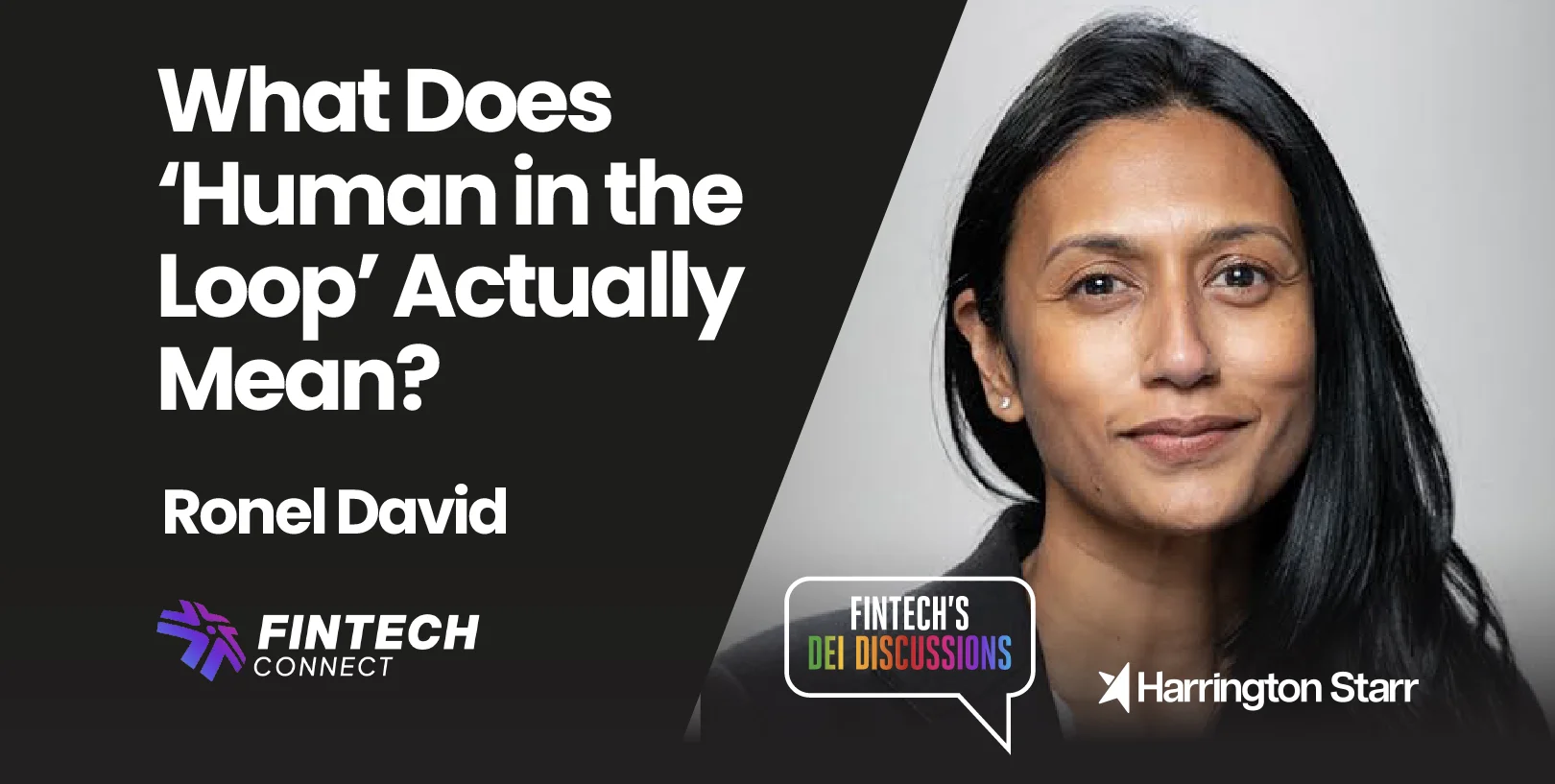
In a special pre-conference episode of FinTech's DEI Discussions, Nadia Edwards-Dashti speaks with Ronel David, Banking and FinTech Board Member, Non-Executive Director and FinTech Connect Advisory Board Member, ahead of FinTech Connect 2026.
Drawing on approximately 30 years of experience across banking, enterprise technology and FinTech, including HSBC, FIS and Investec, Ronel examines the responsibilities that come with AI-driven financial innovation. Her central message is that technological progress must be accompanied by meaningful accountability, genuine employee involvement and better outcomes for the people using financial services.
What Does Human in the Loop Actually Mean in Financial Services?
Human in the loop (HITL) describes an approach in which people remain involved in reviewing, guiding or intervening in the operation of an AI system. In financial services, this can include reviewing automated recommendations, approving decisions, monitoring unusual activity or stopping actions that exceed agreed limits.
However, Ronel challenges the assumption that the presence of a human automatically provides effective oversight.
Speaking about increasingly autonomous AI systems, she asks:
"Do they have the time and authority to challenge those actions? Can they stop it?"
These questions matter because the role of AI in financial services is evolving. There is a significant difference between technology that provides information, technology that recommends a decision and technology that can independently initiate an action.
As financial institutions adopt AI agents and more automated workflows, the distinction becomes particularly important.
An employee might technically be responsible for overseeing a system without having sufficient visibility into its decisions. They may be expected to intervene without understanding the underlying reasoning or having practical control over the outcome.
Ronel identifies the underlying problem:
"Sometimes we risk assigning responsibility without even providing meaningful controls."
This challenge has also featured in Harrington Starr's wider Financial Technology conversations. In The Evolution of Trust in Agentic AI, the discussion examines human-in-the-loop AI, explainability and auditability as organisations seek to build trust in increasingly autonomous systems.
Ronel adds an important perspective to this debate. Human oversight must be more than a governance principle. It requires people to have the practical ability to understand, challenge and, where necessary, stop an automated action.
For FinTech leaders, responsible AI governance therefore requires more than establishing a human approval stage. It involves defining decision-making authority, understanding system limitations and ensuring that employees can exercise meaningful judgement.
Why Human Judgement Remains Essential in the Age of AI
The importance of human involvement is also explored in Harrington Starr's The Financial Technologist: The Influence List 2026.
In his article, From Messi to Machines: Building Championship Teams in the Age of Artificial Intelligence, Krishna Nadella, Head of US Sales at ITRS, examines the relationship between human judgement, AI capability and effective teamwork.
A section titled The Human-in-the-Loop Is the Engine challenges the idea that humans should simply act as a safety mechanism for AI. Instead, it positions human direction, coordination and judgement as essential components of effective AI-enabled teams.
This perspective complements Ronel's argument that accountability must be supported by meaningful controls.
As artificial intelligence becomes integrated into financial services operations, organisations must consider not only what AI systems can achieve, but how people and technology work together to deliver reliable outcomes.
The challenge is particularly significant in regulated environments, where decisions can affect customers, financial stability and trust.
Rather than viewing human involvement as an obstacle to automation, financial institutions have an opportunity to design systems that combine technological capability with informed human decision-making.
Why AI Transformation Makes Inclusive Decision-Making More Important
One of the most important connections in Ronel's discussion is between AI governance and diversity, equity and inclusion in the workplace.
As businesses introduce artificial intelligence, they often focus on operational efficiency, productivity and technological capability. However, employees who understand existing processes, customer difficulties and operational exceptions can offer perspectives that technology teams or senior decision-makers might otherwise miss.
Ronel argues that these employees should be involved in shaping AI-driven transformation rather than simply being told how their responsibilities will change.
This distinction is particularly relevant to digital transformation in banking, where new technology can affect customer service, payments operations, compliance processes and internal decision-making.
An inclusive approach means engaging the people closest to those processes while changes are still being designed.
It also means recognising that diversity of perspective only creates value when those perspectives can genuinely influence an outcome.
Ronel encourages leaders to examine whose contributions can change a decision, particularly when someone challenges an established assumption or identifies a problem that makes implementation more difficult.
For employers, this has implications for organisational culture and the management of technological change. Employees need opportunities to question processes, explain operational realities and participate in decisions that affect their work.
This is where inclusive leadership and successful AI adoption become closely connected. Inclusion is not simply about representation within a project team. It is about whether different experiences and perspectives have a meaningful role in shaping how technology is implemented.
The Risk of Unequal Access to AI Skills and Training
AI adoption also raises questions about equity in professional development.
As Financial Technology organisations invest in artificial intelligence, access to new tools, training and practical experience can influence how employees develop their careers.
Ronel highlights the possibility that opportunities may be concentrated among a limited group of people, particularly where tools are expensive or access is restricted.
Her concern is not only whether employees can use new technology, but whether they receive the training and time needed to develop confidence.
If some employees gain early exposure to AI while others are excluded from training or implementation projects, organisations risk creating uneven opportunities for career development.
For Harrington Starr, which specialises in Data and AI recruitment, this discussion connects directly to the evolving capabilities required across Financial Technology.
Technical expertise remains important, but successful AI implementation also depends on professionals who understand business processes, communicate across functions, recognise operational risks and exercise informed judgement.
An effective workforce strategy should therefore consider both the recruitment of specialist AI talent and the development of existing employees.
Financial Inclusion Must Be an Objective of FinTech Innovation
Beyond workplace inclusion, Ronel examines whether financial technology is genuinely improving access to financial services.
The expansion of digital banking, modern payments infrastructure and smart data creates opportunities to serve individuals and businesses more effectively. Yet technological availability does not automatically translate into financial inclusion.
Ronel makes this distinction particularly clearly:
"Financial inclusion is something that is really close to my heart and it should be an objective of modernization, not something we assume will follow once we've built the technology."
Her argument challenges a common assumption within digital transformation: that making a service available online necessarily makes it more accessible.
A customer may have access to a banking application without understanding how to use it confidently. A small business may be able to receive digital payments while still experiencing difficulties accessing funds when needed.
Affordability, reliability, usability and the ability to resolve problems are therefore central to meaningful financial inclusion.
Ronel points to payments modernisation across markets including India, Brazil, the Philippines and South Africa as areas where the industry can learn from practical developments.
Through her non-executive role at PayInc, she is also connected to developments in South Africa, where payments modernisation is being pursued with the aim of improving accessibility, affordability and participation.
These international examples also demonstrate why financial technology innovation cannot be viewed through a single market perspective.
While Ronel highlights developments in payments infrastructure and financial accessibility, the growth of international FinTech ecosystems also raises questions about where organisations can access the specialist talent required to deliver transformation.
Harrington Starr's Financial Technology & Financial Services Salary & Hiring Report 2026/27 examines international talent hotspots including Singapore, Poland, the Netherlands and Barcelona, alongside the skills and hiring considerations shaping Financial Technology.
Although these are different markets from Ronel's examples, they provide a complementary perspective on the global development of financial services technology.
For employers expanding into new markets or building international technology teams, understanding local talent availability, specialist skills and regional market conditions is an important part of developing a sustainable growth strategy.
The broader lesson is that financial innovation must be evaluated through both its technological capabilities and the practical outcomes it creates for businesses, customers and communities.
Why Operational Resilience Is Also a Financial Inclusion Issue
Another significant insight from the conversation is the relationship between operational resilience and accessibility.
Digital financial services increasingly depend on interconnected technology providers, cloud infrastructure and third-party platforms. These systems can improve efficiency and support innovation, but they also create dependencies.
Ronel argues that reliable access is part of financial inclusion.
A service cannot be considered genuinely accessible if customers are unable to depend on it when they need it.
This is especially important for individuals managing limited household budgets and businesses relying on timely payments.
An interruption to a digital financial service may therefore have consequences beyond temporary inconvenience.
Ronel also highlights the questions boards should be asking about critical infrastructure, including who controls it, which jurisdictions apply and what alternatives exist if access changes.
These considerations connect financial inclusion with operational resilience, technology risk and responsible governance.
For banking and Financial Technology employers, they reinforce the importance of specialist capabilities across infrastructure, cyber security, risk management and business continuity.
Building inclusive financial services requires organisations to consider not only who can access technology, but whether that technology remains dependable under pressure.
Responsible AI Requires Accountability Beyond Individual Organisations
The increasing convergence of AI, payments, digital assets and data introduces another challenge: understanding how interconnected systems behave.
Ronel describes the possibility of AI-enabled services supporting an entire payment process, from interpreting an invoice and checking available funds to recommending payment arrangements and potentially initiating authorised actions.
She is careful not to suggest that this complete process is already operating reliably through AI. Instead, the example illustrates how technological convergence could change where and how decisions are made.
This matters because the risks associated with AI do not necessarily stop at organisational boundaries.
Ronel references her experience mentoring at a Cambridge hackathon, where participants explored how AI agents using similar models might respond under stressful conditions.
A system may function as intended within one financial institution while producing unexpected outcomes when interacting with other automated systems.
For financial services organisations, this raises questions about testing, oversight and accountability across increasingly connected markets.
Responsible AI governance must therefore consider system behaviour under abnormal conditions, including inaccurate information, provider failures and simultaneous automated responses.
This is particularly relevant to risk and compliance professionals working in Financial Technology, where regulatory expectations, operational controls and emerging technologies increasingly intersect.
It also reinforces Ronel's central point: human responsibility is only meaningful when people have the practical ability to understand, challenge and intervene in technological decisions.
What Inclusive Leadership Looks Like During AI Adoption
Towards the end of the episode, Nadia asks Ronel what she would like to see more of when it comes to workplace inclusion.
Rather than focusing on broad organisational commitments, Ronel offers a practical challenge to leaders.
"Choose one decision we're working on and ask whose views haven't we heard?"
The significance of this question lies in its simplicity.
It asks leaders to examine whether their decision-making processes genuinely accommodate different perspectives, particularly those that may challenge an existing plan.
In the context of AI transformation, this could involve consulting operational teams before redesigning workflows, involving customer-facing employees in product development or ensuring that people affected by technological change have opportunities to influence implementation.
Ronel also emphasises the importance of explaining what changed as a result of listening.
That final step distinguishes meaningful participation from consultation that has little practical impact.
For Harrington Starr, the connection to Financial Technology recruitment is significant. As employers develop AI capabilities, their success will depend not only on attracting technically skilled professionals but also on building teams where different experiences and specialist perspectives can contribute effectively.
Inclusive hiring, professional development and leadership practices all influence whether organisations can make informed decisions during periods of rapid technological change.
The challenge for FinTech employers is therefore to build workplaces where employees have both the capability and the confidence to participate in innovation.
The Future of FinTech Depends on People as Much as Technology
Ahead of FinTech Connect 2026, Ronel highlights the value of bringing together discussions around AI, payments, digital assets, governance and business transformation.
Her interest is particularly focused on the gap between a promising technological idea and a solution that delivers practical commercial value.
That distinction runs throughout the episode.
AI may improve financial services, but its success cannot be measured through automation alone. Digital payments may become more sophisticated, but their value also depends on whether they improve financial accessibility. Organisations may commit to inclusion, but those commitments matter most when employees can genuinely influence decisions.
For FinTech leaders, these are interconnected responsibilities.
The future of responsible financial innovation will depend on how effectively organisations combine technical capability, human judgement, inclusive decision-making and meaningful accountability.