Are We Getting AI Wrong? Why the Future of Work Is About Augmentation, Not Replacement
The debate surrounding artificial intelligence has become increasingly polarised. On one side are those who believe AI and agentic technology will fundamentally replace jobs, teams and even entire ways of working. On the other are those who remain sceptical about whether the technology can deliver on its promises at all. But what if both sides are missing the point?
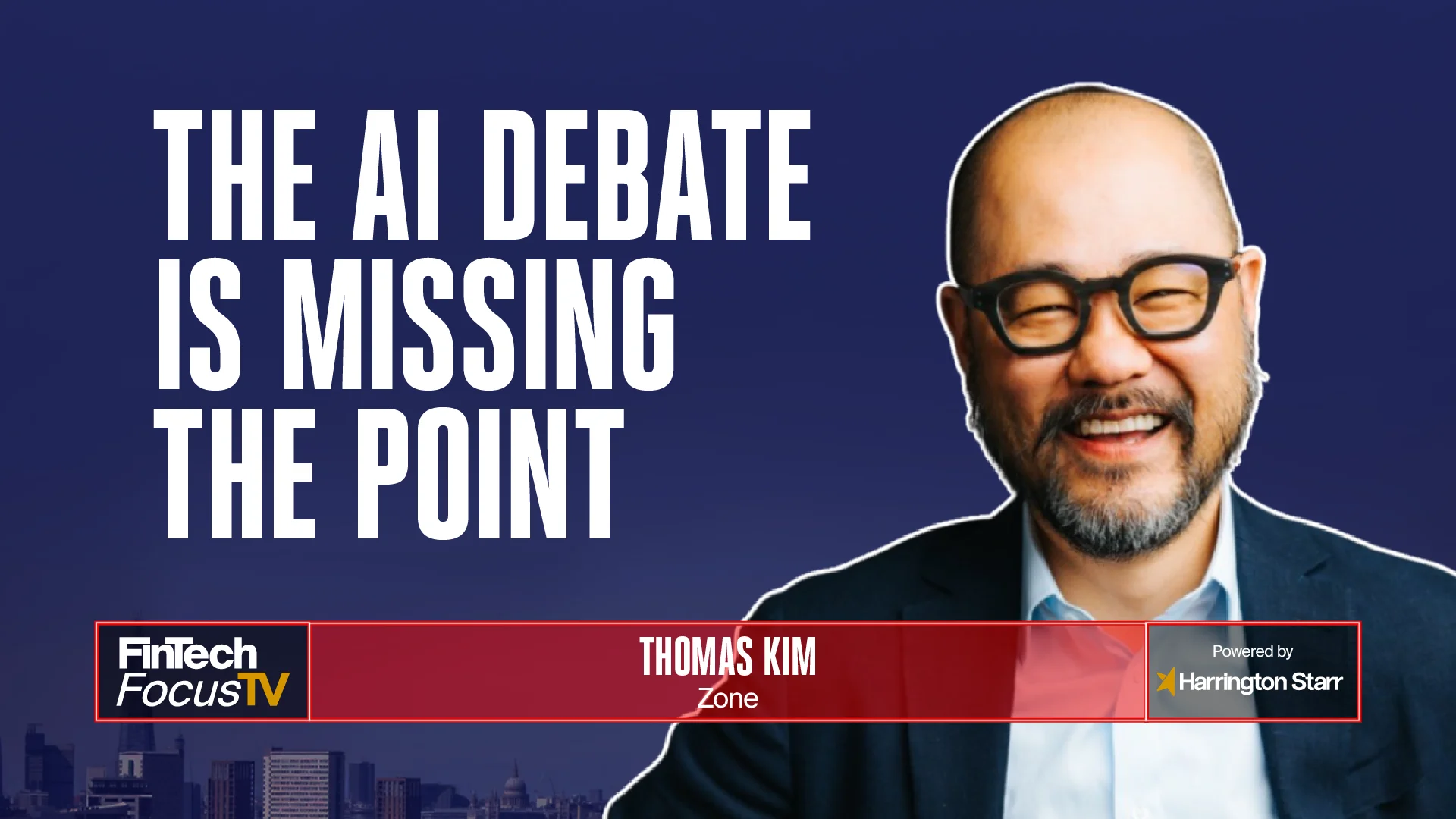
In this episode of FinTech Focus TV, Harrington Starr CEO Toby Babb is joined by Thomas Kim, Chief Executive Officer at Zone, for a wide-ranging conversation about AI, agentic technology, the evolution of SaaS and what these changes mean for businesses and their people.
Thomas returns to FinTech Focus TV several years after his previous appearance and at another significant moment of technological change. During his last conversation with Toby, the world was responding to COVID and businesses were being forced to reassess how they operated. Today, Thomas believes another major transition is underway, this time driven by AI and the agentic revolution.
The conversation moves beyond predictions about what AI might eventually achieve and focuses instead on how organisations can use it practically. From finance and operations to software engineering and product management, Thomas explores how AI is already changing workflows, increasing productivity and redefining the skills businesses need from their people.
AI and the future of work: moving beyond the extremes
One of the central themes of the episode is Thomas’s frustration with the way the AI debate has developed. He describes two opposing camps: the maximalists, who see AI as capable of replacing huge amounts of human work, and the sceptics, who question whether it can make a meaningful impact at all.
For Thomas, neither position reflects what businesses are actually experiencing.
He explains that AI and agents are not simply going to arrive and “obliterate” human beings and jobs across finance and operations. Equally, he does not believe AI is a fad that will disappear once the current excitement subsides. The real opportunity sits somewhere between these extremes.
AI can augment people’s ability to process information, automate repetitive work, reduce errors and access additional digital capabilities. Rather than removing the need for professionals, Thomas sees technology helping them perform their jobs faster and more meaningfully.
This distinction is particularly important for conversations about AI jobs, FinTech careers and the future of financial technology talent. The question is not necessarily whether a particular role disappears, but how that role changes when professionals have access to increasingly sophisticated AI tools.
Toby connects this to a broader business challenge. For years, companies have faced pressure to reduce costs. But there is a limit to how far organisations can continue cutting. The alternative is to improve productivity by enabling each person to achieve more.
AI therefore becomes not simply a cost-cutting exercise, but a potential tool for increasing human performance.
Agentic AI in finance: solving real business problems
The episode moves from the broader AI debate into a practical example involving finance teams.
Thomas discusses a conversation with a CFO about cash forecasting and scenario planning. Forecasting requires teams to gather information from multiple sources, build models and apply human intuition to understand what that data means. Even after hours of work across departments, forecasts can quickly change when real-world business conditions shift.
A delayed payment, for example, can immediately affect expected cash positions and force finance professionals to reconsider their scenarios.
Thomas uses this as an example of where agentic technology can sit alongside people rather than replace them. Zone has been iterating with customers on an agentic forecasting capability and a scenario-planning agent designed to perform parts of this work.
An agent could identify that a business is behind its targeted cash forecast, examine projected revenues across customers and suggest actions that might help move the organisation closer to its goal. That could include identifying customer groups where accelerating payments might make a difference.
The finance professional still owns the objective and applies judgement. The technology sits alongside them, helping analyse information and identify possible actions.
For organisations thinking about AI in financial services, finance technology and digital transformation, this provides a much more tangible picture of adoption than abstract predictions about what artificial intelligence could eventually achieve.
The value comes from identifying real problems and determining where technology can help people solve them more efficiently.
AI productivity and the challenge of legacy technology
Thomas says a recurring challenge appears in conversations with companies across industries: how can they do more with less and improve profitability?
Technology itself can sometimes become part of the problem. Businesses accumulate technical debt, workflows become increasingly complicated and systems become brittle. Changing one part of the technology stack can create unexpected problems somewhere else.
Organisations may also be operating technology that was originally built for a very different stage of the company’s growth.
This has prevented teams from participating as effectively as they could in driving growth.
Thomas believes the capabilities emerging through AI and agents can change this. AI is already altering how software is built, how it is delivered, how businesses interact with customers and the speed at which new capabilities can be released.
Zone itself has had to respond to this shift.
Thomas describes the company as having grown through a more traditional SaaS model before beginning its transformation towards a more agentic approach. This reflects a wider evolution in technology, similar to previous transitions from on-premise systems towards data centres and SaaS.
Rather than viewing the current disruption as the destruction of SaaS, the conversation presents it as another evolution in how technology businesses build and deliver value.
The evolution from SaaS to agentic technology
For Thomas, creating useful agents requires more than simply developing an AI tool and expecting it to transform a workflow.
The foundation matters.
He asks whether organisations have the context, data and infrastructure needed for agents, skills and workflows to operate meaningfully. An agent needs to interact with information rather than simply read it. It needs the right foundation to work with data and contribute to real operational processes.
This is where Thomas believes existing software companies can have an important advantage.
Zone works with around 6,000 customers globally and has accumulated significant amounts of workflow, data and context through its technology. Thomas describes this as a “treasure trove” that can now provide context to AI agents, skills and workflows.
Zone has built technology that sits on top of NetSuite, allowing information to be read, standardised and written to and from the ERP. Thomas describes the underlying ERP as the “system of record” and Zone’s additional layer as a “system of agency”.
The aim is to give finance and operations teams greater intelligence and capability while continuing to rely on the underlying data and workflows that matter to their organisations.
This shift also requires businesses to reconsider how they build products and structure their teams.
Software engineering jobs in the age of AI
One of the most striking moments in the conversation comes when Thomas discusses how AI has changed software development at Zone.
He estimates that 95% of Zone’s code is now being written by AI in some shape or form.
At first glance, a statistic like this could reinforce fears about the future of software engineering jobs and technology careers. If AI is writing the majority of the code, does a business still need developers?
Thomas’s answer is clear: Zone is hiring more developers and more product managers.
The roles themselves are changing.
Rather than engineers spending all their time manually writing code, AI can free them to understand workflows, investigate problems and establish the guardrails around what the technology should build.
Toby describes this as an opportunity to create genuine “business technologists”. He contrasts the emerging role with an older stereotype of developers working separately from the business with little commercial understanding.
As AI changes the technical element of software development, engineers can move closer to the problems their technology is designed to solve.
For the FinTech recruitment market, this is an important distinction. AI adoption does not automatically translate into lower demand for technology professionals. It can instead change the capabilities employers value.
Technical expertise remains important, but understanding customers, workflows, business problems and how to use AI effectively could become increasingly significant within software engineering recruitment, product management recruitment and financial technology hiring.
Thomas believes engineers and product managers remain “100% necessary”. Their work is simply becoming different, faster and more iterative.
AI talent and the changing skills businesses need
The transformation is not only technological. It also has implications for talent.
Thomas explains that the best people do not necessarily want to work in the same ways software organisations operated historically. Engineers may no longer want to sit separately waiting for a product manager to deliver a fixed set of requirements before beginning a lengthy development cycle.
AI enables a more interactive approach.
This is visible in the development of ZoneLiquidity, an agentic product focused initially on areas including cash forecasting and scenario planning.
Thomas describes holding short daily stand-ups involving the lead product manager, lead engineer and senior technology and product leaders. They discuss customer feedback, what users need and how the next iteration should change.
Rather than waiting months between major releases, the team can iterate rapidly and continuously expose new versions to customers.
This has also required Zone to change how it communicates with customers. Customers themselves may not yet know exactly what they need from AI. They can be understandably sceptical, particularly when concerns around hallucinations and accuracy remain.
By involving customers in the development process, Zone can allow them to interact with new capabilities, provide feedback and determine whether an idea genuinely solves their problem.
That closer relationship between engineers, product managers, customers and business problems demonstrates how AI skills and FinTech talent requirements are evolving together.
Why accuracy still matters in financial technology
The potential of AI does not remove the need for precision.
This becomes particularly clear when Thomas and Toby discuss the risks of hallucination within finance.
Thomas explains that organisations cannot allow AI agents to hallucinate information back into systems of record. Finance professionals require accuracy. A misplaced decimal, an incorrect million dollars or a nonexistent customer appearing as a major account could create serious consequences.
This is why Thomas repeatedly returns to the importance of the foundations beneath agentic technology.
It is not enough to create impressive demonstrations or theoretical AI projects. The systems need to connect with reliable data and established workflows in ways that make them genuinely usable.
This requirement for practical, accurate and well-governed AI is likely to remain particularly relevant across financial technology and capital markets, where technology operates within complex and highly consequential environments.
AI transformation is accelerating how businesses operate
Zone’s transformation provides evidence of how quickly these changes can affect business performance.
Thomas explains that the organisation previously completed roughly half a dozen releases per year. In 2026, that figure had already risen to around 40 or more at the time of the conversation.
He also describes improvements in margins and time to value.
AI has been introduced across finance and implementation processes, while products can reach customers more quickly. Implementations that previously took weeks or months can in some cases take days or hours.
Salespeople can build books of business and backlog faster, while developers and product managers can innovate more quickly.
These examples reinforce the central argument of the episode. AI’s impact is not simply about removing roles. It is about reconsidering how work gets done throughout an organisation.
That creates an important challenge for leaders. Technology can move quickly, but organisations, workflows and talent strategies need to evolve alongside it.
For businesses hiring within financial technology, understanding that shift will increasingly influence the types of FinTech skills, technology talent and leadership capabilities required.
The future of AI in 2026 and 2027
Looking towards the rest of 2026 and into 2027, Thomas expects customer understanding of AI to mature rapidly.
During 2026, he sees businesses becoming clearer about what is genuinely meaningful to them. Interest in experimenting with new technology and challenging existing workflows is already growing.
By the end of the year, Thomas expects that interest to translate increasingly into hands-on interaction with AI capabilities.
In 2027, he predicts customers will have experimented enough to begin choosing the technologies they want to use alongside existing products or as replacements for older capabilities.
Zone’s strategy is developing in parallel with that transition.
The business has been building an AI harness called Zoe and developing skills within existing products alongside new agentic products. Thomas discusses capabilities including ZoneLiquidity for cash management, forecasting and scenario planning, alongside Zone Receivables and wider workflows covering areas such as payments, treasury and record-to-report processes.
The intention is to bring an intelligent agent layer across these workflows while maintaining a connection to the underlying ERP system of record.
Thomas expects the wider industry to move in a similar direction: away from theoretical projects promising transformational outcomes and towards tangible capabilities that solve real problems.
FinTech recruitment and the human side of the AI revolution
Perhaps the most important takeaway from the conversation is that the future Thomas describes remains deeply connected to people.
AI can write code, automate processes, analyse data and help businesses iterate faster. But organisations still require engineers who understand problems, product managers who can connect technology with customer needs, finance professionals who apply judgement and leaders capable of transforming their businesses around new capabilities.
The relationship between people and technology is changing rather than simply disappearing.
For FinTech recruitment and financial technology hiring, this means businesses may need to think differently about what makes someone valuable. The professionals who succeed in an increasingly agentic environment may be those who can combine specialist knowledge with commercial understanding, problem-solving skills and the ability to work effectively alongside AI.
Thomas’s experience at Zone also challenges the simplest narrative around AI and headcount. Even with AI contributing to the vast majority of its coding in some form, the company continues to hire developers and product managers.
Technology can change the task without eliminating the need for the talent behind it.
As businesses across financial services and technology continue to explore AI, the challenge will therefore be broader than selecting the right tools. Organisations will need the right infrastructure, workflows, leadership and people to turn those capabilities into genuine business outcomes.
The future is unlikely to belong entirely to the AI maximalists or the sceptics. As Thomas argues throughout the episode, the reality sits somewhere in the middle.
AI is not nothing. But neither does it automatically mean the end of human work.
Instead, it offers businesses the opportunity to rethink how their people work, remove tasks that no longer need to consume their time and give professionals better tools to solve the problems that matter.