Why Aren't Women Investing?
28 September, 2026


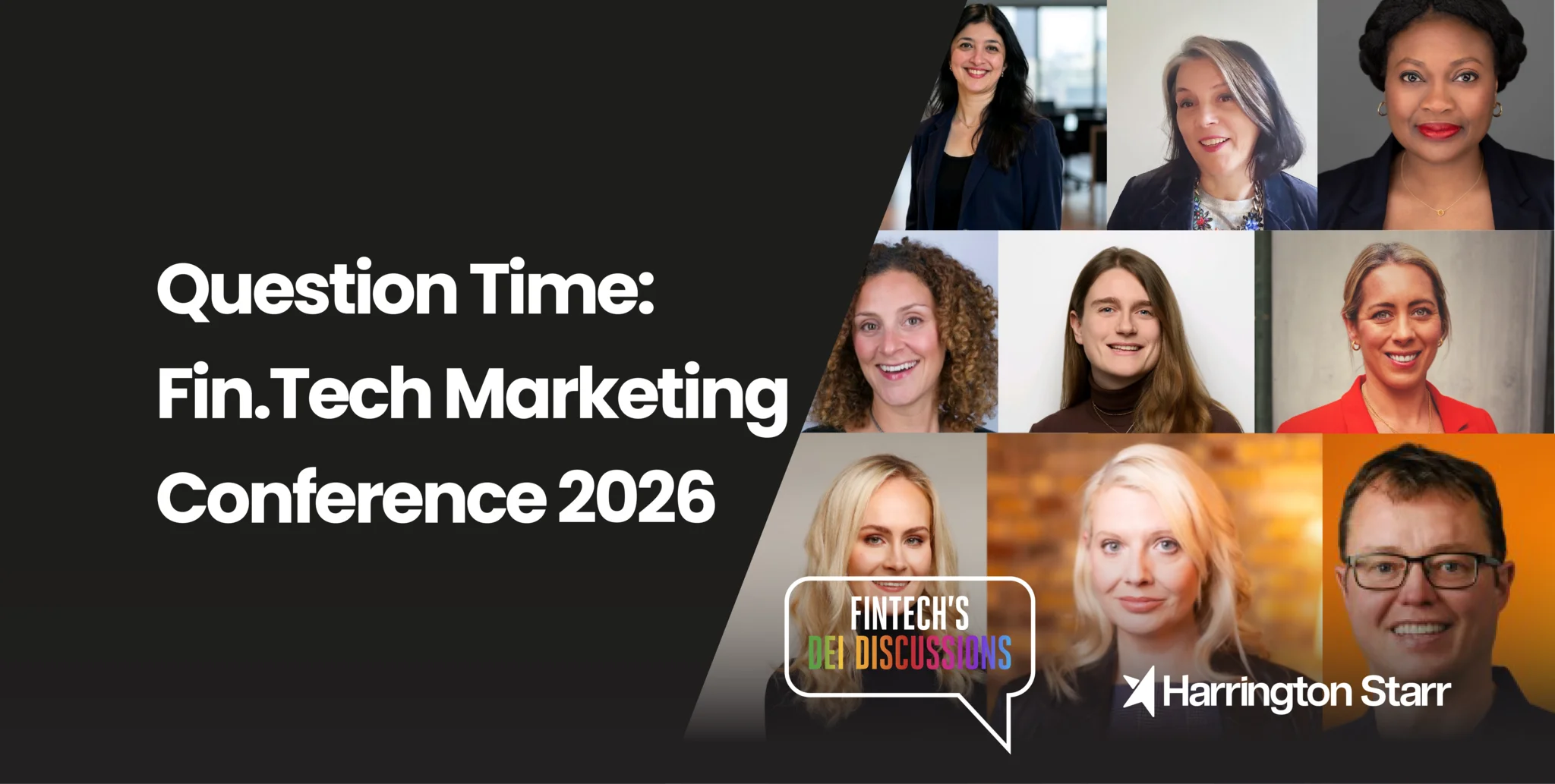
Recorded live at the Fin.Tech Marketing Community Conference 2026, this special episode of FinTech's DEI Discussions brought together leaders from across financial services, financial technology, banking, marketing, regulation and academia to discuss two important questions. Hosted by Nadia Edwards-Dashti, the conversation explored the future of inclusion, innovation and leadership in FinTech, before turning to one of the most debated business phrases of recent years: does culture still eat strategy for breakfast?
Featuring Conrad Ford of Allica Bank, Monika Kucharska of Quod Financial, Nicole Heringer of Enfuce, Sinead Lanyon of Symphony, Elaine Mullan of Corlytics, Franky Kentish of 10x Banking, Rashmi Prabhakar of Temenos, Dalia Nightingale of Vixio and Professor Iwa Salami of the University of East London, the discussion offered a range of perspectives on the challenges and opportunities facing the financial technology industry.
For FinTech businesses, financial services leaders and those responsible for FinTech recruitment and talent acquisition, the themes discussed throughout the episode are increasingly relevant. As organisations navigate AI adoption, changing workforce expectations, and the need to attract and retain diverse talent, leadership and culture are becoming critical differentiators.
The first theme to emerge from the discussion was the growing connection between inclusion and innovation. Rather than viewing diversity and inclusion as a standalone initiative owned by a specific department, several contributors argued that it is now a core business capability.
Sinead Lanyon, Chief Marketing Officer at Symphony, explained that organisations have moved beyond a model where inclusion sat with HR, innovation sat with research and development, and strategy sat with leadership teams. In her view, those traditional divisions no longer work. Instead, culture has become the force that connects them all.
Sinead argued that businesses need employees who think differently, act differently and bring different perspectives to the workplace. If every employee has the same profile and approaches challenges in the same way, organisations lose diversity of thought and become limited in their ability to innovate. According to Sinead, successful businesses require “sparks” from different people and different ways of thinking in order to build versatile, high-performing teams.
This theme was echoed by Monika Kucharska, Head of Marketing at Quod Financial. Reflecting on the growing influence of artificial intelligence across marketing and business operations, Monika highlighted the importance of maintaining a human perspective.
While AI is increasingly involved in content creation and communication, she noted that technical literacy alone is not enough. Businesses must also be capable of creating human narratives that connect people with people. For Monika, the future depends on diverse teams that can bring a broad range of skills, experiences and viewpoints together to support both the technical and human aspects of a business.
Elaine Mullan of Corlytics approached the topic from a business performance perspective. She argued that inclusion should not simply be viewed as a moral objective. Instead, organisations should recognise that greater inclusion leads to better decision-making and stronger business outcomes.
According to Elaine, a wider range of voices creates opportunities for better innovation because organisations benefit from a broader spectrum of ideas and experiences. However, she also warned that inclusion can quietly disappear if organisations stop paying attention to it. Unlike some business initiatives that fail visibly, inclusion can gradually erode without immediate signs, making leadership accountability particularly important.
Artificial intelligence was a recurring theme throughout the discussion, with several speakers highlighting its significance for the future of financial technology.
Conrad Ford of Allica Bank described the current moment as one of the most important leadership challenges in recent decades. He compared the emergence of AI to previous transformational technologies such as the internet, digital platforms and mobile technology.
While businesses have spent the last twenty years adapting to those developments, Conrad argued that AI represents a new general-purpose technology capable of changing everything. As a result, leaders have a responsibility to ensure their teams remain at the forefront of these developments.
What makes this challenge particularly urgent, according to Conrad, is the possibility that some teams may not survive if they fail to adapt. This places significant pressure on leaders to understand the implications of AI, help their organisations embrace change and ensure employees have the skills needed to succeed in an evolving workplace.
Dalia Nightingale, Chief Revenue Officer at Vixio, also focused on AI but approached the topic from an ethical perspective. She acknowledged that AI now sits at the heart of many industry conversations and will continue to influence how businesses operate.
However, she stressed the importance of ensuring that the people building AI systems represent diverse backgrounds and experiences. For Dalia, diversity across gender and ethnicity is essential if organisations want AI solutions to deliver meaningful and ethical personalisation rather than generic or potentially harmful outcomes.
Franky Kentish of 10x Banking raised another important consideration. While many discussions about AI focus on productivity gains and product transformation, she believes organisations also need to pay close attention to who is actually using these technologies.
Franky observed that women are not always adopting AI tools at the same rate as men within organisations. As a result, leaders must actively consider who has access to new technologies, who may be falling behind and how they can bring everyone on the journey together. For businesses focused on developing future-ready FinTech talent, ensuring equal access to AI capabilities could become a significant leadership responsibility.
A further theme running through the discussion was psychological safety and its relationship with innovation.
Rashmi Prabhakar of Temenos argued that inclusion should no longer be treated as an activity taking place alongside core business operations. Instead, she sees it as a business capability that should be embedded directly into leadership decision-making.
When discussing innovation, Rashmi highlighted the importance of creating environments where people feel safe to take risks, experiment and learn from failure. In her view, innovation flourishes when employees are given permission to explore new ideas and when organisations focus on turning those ideas into practical solutions for industry challenges.
Elaine reinforced this point by explaining that leaders play a critical role in creating the conditions necessary for innovation. Employees need to feel comfortable sharing ideas, raising concerns and contributing alternative viewpoints without fear of negative consequences.
Without psychological safety, organisations risk hearing only the loudest voices in the room. When leaders create safe environments, however, businesses gain access to a wider range of perspectives that can ultimately improve decision-making and drive innovation.