Who's Missing From the Room?
05 October, 2026


The conversation around diversity, equity and inclusion in financial services has evolved significantly over the past decade. While many organisations have embraced DEI initiatives, there remains an ongoing debate about how inclusion should be measured, embedded and ultimately valued within a business. Is it primarily a moral responsibility? Is it a compliance requirement? Or can it become something much more powerful: a genuine competitive advantage?
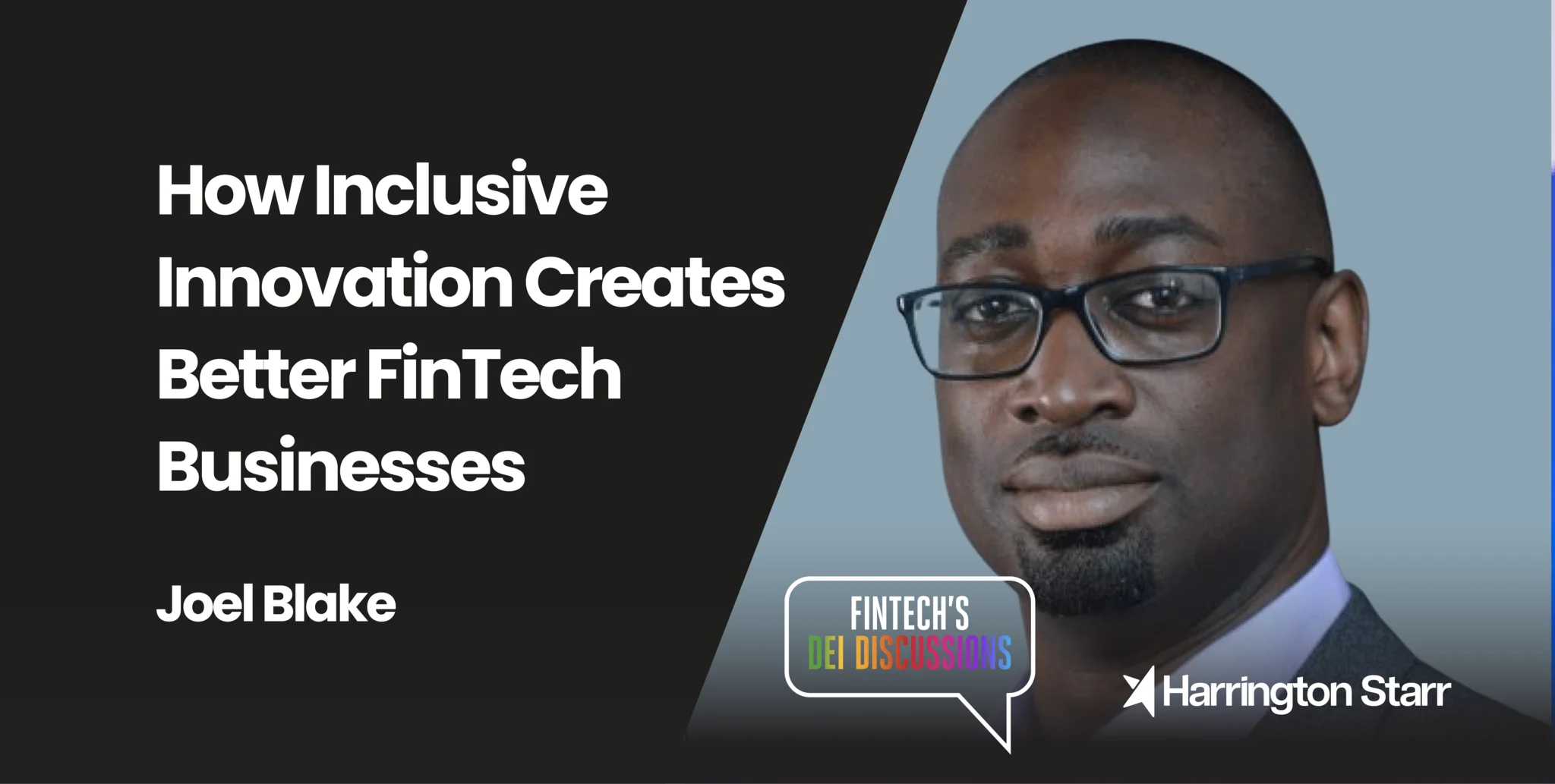
These questions sit at the heart of the latest episode of FinTech's DEI Discussions, where Nadia Edwards-Dashti is joined by Joel Blake OBE, Founder and CEO of GFA Exchange. Throughout the discussion, Joel shares his remarkable career journey and explores how inclusive innovation, governance, leadership and access to opportunity can help shape stronger, more resilient organisations.
For professionals across financial technology, financial services and leadership, the episode offers valuable insights into why inclusion should no longer be viewed as a standalone initiative, but as a strategic capability that influences growth, resilience, innovation and long-term success.
One of the most compelling aspects of the conversation is Joel's personal story. Rather than following a traditional path into financial services, Joel describes himself as someone who was determined from an early age not to become the statistic others expected him to be.
His career began working in factories before moving into temporary employment and eventually professional services, where he started as an office tea boy. From there, he entered the careers service and worked as an employment mentor, helping design corporate social responsibility programmes that connected organisations with talent from diverse and disadvantaged communities.
What followed was an entrepreneurial journey focused on creating opportunity and addressing barriers to access. Over time, Joel built a diversity consultancy, a recruitment business and eventually moved into entrepreneurship on a larger scale.
A recurring theme throughout the discussion is that Joel never set out with a rigid destination in mind. Instead, every stage of his career was guided by a mission to create fairer access to opportunity and to challenge systems that prevented talented individuals from reaching their potential.
That purpose-driven approach ultimately led him into financial services and fintech, where he identified a significant gap in access to capital for underrepresented entrepreneurs and business owners.
As Joel's understanding of entrepreneurship and business funding deepened, he became increasingly aware that conversations about diversity and inclusion were often disconnected from discussions about capital allocation.
While organisations frequently discussed representation and opportunity, there were fewer conversations about how finance itself could be made more accessible.
This became particularly clear during Joel's involvement with Start Up Britain and later through his work supporting SME lending. During this period, he helped fund hundreds of businesses, including a significant number founded by women, ethnic minority entrepreneurs and individuals with disabilities.
These experiences reinforced a fundamental belief that access to capital plays a critical role in creating economic opportunity.
For anyone involved in financial services, fintech hiring, leadership or investment, this perspective is particularly relevant. Discussions around inclusion often focus on workforce representation, but Joel highlights the importance of examining how financial systems themselves either enable or restrict growth.
This broader perspective sets the foundation for much of the conversation that follows.
Today, Joel leads GFA Exchange, a business that has developed a Bloomberg-style intelligence platform for the lower mid-market private credit sector.
During the discussion, he explains how private credit providers often lack the market-wide benchmarking data needed to accurately assess risk and performance across their portfolios.
Historically, many lenders have been forced to rely on periodic reporting and limited visibility into borrower performance. GFA Exchange aims to address that challenge by providing real-time benchmarking and intelligence across thousands of businesses.
While the technology itself is impressive, what stands out most is the philosophy behind it.
Joel views innovation not simply as the creation of new technology but as the creation of systems that improve access to information, support better decision-making and reduce unnecessary barriers.
This concept of inclusive innovation becomes one of the defining themes of the episode.
Rather than viewing innovation solely through a technological lens, Joel encourages organisations to think about how data, intelligence and technology can be used to create fairer, more transparent and more effective systems.
For organisations across financial technology, banking, capital markets and fintech recruitment, this approach reflects a growing recognition that innovation is most powerful when it benefits a wider range of stakeholders.
One of the most powerful moments in the conversation comes when Joel challenges traditional definitions of inclusion.
He argues that inclusion should not be viewed solely through the lens of protected characteristics or demographic representation.
While those elements remain critically important, Joel believes inclusion has a much broader role to play within organisations.
In his view, inclusion is fundamentally about creating competitive advantage.
This perspective represents a shift from seeing inclusion as a social initiative to recognising it as a strategic business capability.
Organisations that embrace diverse perspectives, encourage different ways of thinking and create environments where people can contribute fully are often better equipped to solve problems, identify opportunities and adapt to change.
As financial services becomes increasingly complex and technology-driven, this ability to draw upon a wider range of experiences and viewpoints becomes even more valuable.
For employers competing for fintech talent, software engineering professionals, data specialists, cyber security experts and transformation leaders, creating inclusive environments is no longer simply about attracting talent. It is about building organisations capable of outperforming competitors.
Another key theme explored throughout the episode is the relationship between inclusion, risk and resilience.
Traditionally, many organisations have treated inclusion as a separate agenda from business strategy. Joel argues that this separation is increasingly outdated.
In a world characterised by rapid technological change, global competition and evolving customer expectations, businesses must continuously adapt.
According to Joel, inclusion plays a critical role in that adaptation process.
He explains that organisations should embed inclusion into conversations, cultures, policies, processes and leadership practices. Doing so helps create environments where new ideas can emerge, blind spots can be challenged and risks can be identified more effectively.
This is particularly relevant within financial services, where managing risk is central to long-term success.
A lack of diversity in thinking can lead to groupthink, missed opportunities and an inability to recognise emerging threats.
Conversely, organisations that encourage broader participation and different perspectives are often better positioned to navigate uncertainty.
For financial technology leaders, hiring managers and recruitment professionals, these insights highlight the connection between workforce diversity and organisational performance.
Building resilient businesses requires more than technical expertise alone. It requires a culture that values challenge, encourages innovation and embraces different perspectives.
The discussion also explores an area that is often overlooked in conversations about diversity and inclusion: governance.
Joel shares insights from governance audits conducted across organisations of varying sizes and sectors. These experiences demonstrated how deeply embedded inclusion truly was within organisational structures.
For Joel, governance is the mechanism that transforms intention into action.
Without governance, organisations risk treating inclusion as a temporary initiative rather than a strategic priority.
Strong governance creates accountability, provides measurable frameworks and enables organisations to evaluate progress over time.
This is particularly important within financial services, where governance already plays a central role in managing risk, compliance and operational effectiveness.
Embedding inclusion within governance structures ensures it becomes part of how decisions are made rather than something that sits alongside business strategy.
Throughout the episode, Joel repeatedly returns to the idea that inclusion should be viewed as an opportunity lever.
This concept represents a significant departure from traditional narratives.
Too often, organisations approach inclusion from a deficit perspective, focusing primarily on problems that need to be fixed.
While addressing inequality remains important, Joel encourages leaders to think more broadly about the opportunities inclusion can create.
Those opportunities include access to new markets, stronger customer relationships, improved talent attraction and retention, enhanced innovation and greater organisational resilience.
For employers operating in highly competitive sectors such as fintech, trading technology, payments, digital assets and capital markets, these advantages can be significant.
The competition for top talent continues to intensify across software engineering, quantitative finance, artificial intelligence, cyber security, product management and data science.
Organisations that create genuinely inclusive cultures often gain an advantage in attracting and retaining the professionals needed to drive growth.
This is one of the reasons why inclusion increasingly intersects with recruitment strategy, employer branding and talent acquisition.
Towards the end of the discussion, Nadia asks Joel what practical advice he would offer leaders who want to make inclusion a reality within their organisations.
His response is both pragmatic and refreshingly honest.
Firstly, he encourages leaders to be clear about the commercial outcomes they hope to achieve.
Rather than being uncomfortable about discussing financial returns, organisations should recognise the measurable value inclusion can generate through growth, talent attraction, customer engagement and reputation.
Secondly, Joel emphasises the importance of humility.
He argues that many leaders spend too much time talking about what they believe they are doing well and not enough time listening.
Real progress requires organisations to engage with employees, customers and communities. It requires leaders to seek feedback, embrace challenge and remain open to learning.
This commitment to continuous improvement is particularly important in a rapidly evolving financial technology landscape where workforce expectations, customer needs and market dynamics continue to change.
The most successful organisations are often those that remain curious, adaptable and willing to learn from others.
As the conversation draws to a close, one message becomes abundantly clear.
The future of financial services will be shaped not only by technology, regulation and market forces, but also by the choices organisations make about people, opportunity and inclusion.
Joel Blake's perspective challenges leaders to think differently about DEI.
Rather than treating inclusion as a standalone initiative or a compliance exercise, he presents it as a strategic capability that can strengthen governance, improve resilience, support innovation and drive sustainable growth.
For organisations across fintech, banking, capital markets, payments and financial services, this represents an important shift in thinking.
As competition intensifies and technology continues to transform the industry, businesses that successfully combine innovation with inclusion will be better positioned to attract talent, manage risk and create long-term value.
In this episode of FinTech's DEI Discussions, Nadia Edwards-Dashti and Joel Blake explore exactly what that future could look like. Their conversation offers valuable lessons for leaders, hiring managers, entrepreneurs and professionals who want to build organisations that are not only more inclusive, but also more innovative, resilient and successful.