Why Aren't More Women Seen as Experts?
17 November, 2026


Unconscious bias can influence where investors allocate capital, whose ideas shape business decisions and which candidates secure career opportunities. For financial technology businesses operating in increasingly competitive global markets, overlooking potential can restrict innovation, workforce development and commercial growth.
But how can financial services leaders recognise opportunities beyond their existing experiences, challenge established assumptions and build more inclusive organisations?
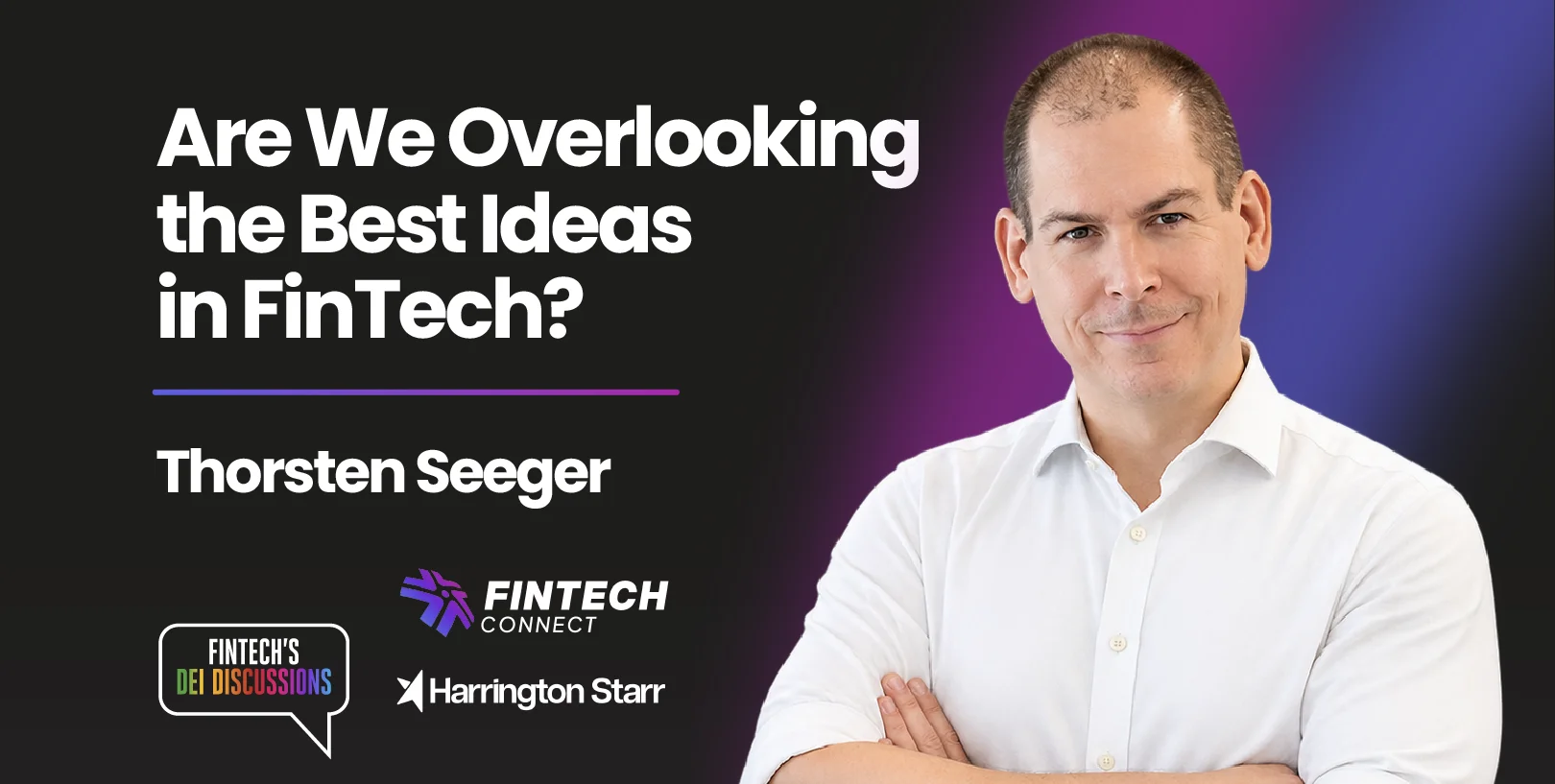
In a special episode of FinTech’s DEI Discussions, recorded ahead of FinTech Connect 2026, Nadia Edwards-Dashti welcomes Thorsten Seeger, Member of the Management Board at SME Bank.
Drawing on 20 years of experience in SME banking and lending, Thorsten explores financial inclusion, geographical investment bias, inclusive leadership and the changing nature of FinTech recruitment. Across these topics, a consistent message emerges: businesses must look beyond familiarity when assessing potential.
Financial inclusion is frequently associated with improving individuals’ access to financial products. However, Thorsten highlights another important dimension: the financial services available to small and medium-sized enterprises (SMEs).
Having worked across traditional banking institutions, including Barclays and Lloyds, alongside FinTech businesses such as Funding Circle and October, Thorsten has experienced SME lending from multiple perspectives.
He explains how smaller businesses can struggle to access appropriate financial services and guidance, particularly when their needs compete with the priorities of larger banking divisions.
Challenger banks and specialist lenders have an opportunity to address this by placing SMEs at the centre of their business models. However, Thorsten emphasises that financial inclusion does not mean approving every lending application. Responsible banking also involves communicating decisions quickly, explaining rejection and helping customers understand what needs to change.
For organisations operating across digital banking and commercial lending, delivering this approach requires more than technological innovation. It requires professionals who understand customer needs, credit decision-making and responsible financial services.
These capabilities are particularly relevant to corporate banking technology recruitment, where employers need talent capable of connecting financial expertise with technology and customer-focused service delivery.
Thorsten's experience across nine European markets has also shaped his understanding of how geographical familiarity influences investment decisions.
Investors operating within established financial centres may already understand the local ecosystem, business environment and growth opportunities. Businesses seeking investment from smaller European markets can face the additional challenge of explaining the environment in which they operate.
As Thorsten explains:
“Familiarity really plays a huge role.”
Using Lithuania as an example, he highlights the opportunities within smaller European financial technology ecosystems and the importance of communicating their capabilities to international investors.
His argument is not that investors deliberately discriminate against businesses outside established financial centres. Instead, unfamiliarity can create barriers that influence how opportunities are assessed.
This has parallels with FinTech talent acquisition. Employers relying heavily on familiar companies, professional networks or geographical markets may overlook candidates with valuable experience elsewhere.
For growing businesses, a broader approach to FinTech recruitment can help organisations access specialist capabilities beyond their existing talent networks and challenge assumptions about where high-quality financial technology talent can be found.
One of the episode's most compelling discussions concerns the relationship between seniority and decision-making.
Thorsten introduces the concept of HiPPO management, an abbreviation for highest paid person opinion. This describes an environment where seniority can disproportionately influence business decisions, potentially limiting contributions from other employees.
The solution, however, is not to remove leadership accountability.
“Business is not a democracy, and therefore, that decisions will need to be made by a person and not by a committee.”
Thorsten distinguishes between responsibility for making decisions and the opportunity to contribute towards them. Effective leadership requires both.
This is particularly important in financial technology, where employees across different functions may possess specialist knowledge that senior leaders do not have direct access to.
A related perspective appears in Tribeni Chougule’s article, Developing Empathy Without Lived Experience: A Leadership Responsibility, published as part of The Financial Technologist’s 2026 Influence List edition. Chougule examines how leaders relying exclusively on their own experiences risk overlooking employee concerns, valuable perspectives and emerging business risks.
Both perspectives demonstrate why inclusive leadership in financial services requires deliberate efforts to understand experiences beyond those of the decision-maker.
As financial technology businesses expand internationally, maintaining equal opportunities for employees to contribute becomes increasingly complex.
Thorsten highlights how remote working, international offices and different time zones can influence participation. Leaders must also recognise that extroverted and introverted employees may contribute differently.
Simply inviting everyone to a meeting does not necessarily create an inclusive workplace. Leaders need to consider how discussions are structured, whether employees have sufficient opportunities to prepare and whose contributions consistently receive attention.
Harrington Starr’s Financial Services & Financial Technology Talent, Salary & Hiring Report 2026/27 reinforces the importance of employee involvement. Its Career & Job Satisfaction findings reveal that 18% of respondents would choose greater input in decisions as the one thing they would change about their existing role, up from 9% the previous year.
For employers considering employee retention in financial services, these findings highlight the growing importance of understanding how individuals participate in shaping their working environment.
The challenge of protecting workplace culture during international expansion was also explored by Emma Hagan, UK CEO at ClearBank, in her FinTech’s DEI Discussions episode, How Do You Scale Without Losing Your Culture?. Her discussion examines how growing banking businesses can protect their people, values and sense of belonging alongside commercial and technological expansion.
As financial technology hiring requirements evolve, employers must distinguish between essential technical capabilities and skills that candidates can develop.
Thorsten reflects on occasions throughout his career when he recruited individuals who did not possess every required skill but demonstrated the attitude and learning ability he was seeking.
He acknowledges that this approach is not appropriate for every profession. Certain specialist roles require foundational knowledge and qualifications. However, within areas such as operations and strategy, an individual's adaptability and capacity to learn can be particularly valuable.
Vanessa Neal, Head of Product Compliance at Elavon Europe, explored a similar argument in her FinTech’s DEI Discussions episode, Stop Hiring the Same People, discussing how transferable skills and experiences outside conventional career pathways can bring value to financial technology businesses.
For specialist FinTech recruiters and employers, inclusive hiring involves understanding which requirements genuinely determine performance. Overly restrictive criteria can exclude capable professionals who could develop into successful employees.
This distinction is especially relevant across change and transformation recruitment, where professionals must often combine existing expertise with adaptability, problem-solving and the ability to navigate evolving business requirements.
Artificial intelligence is introducing another challenge for financial technology recruitment: differentiating candidates when generative AI can help produce polished CVs.
Thorsten describes this development as “a race to the middle”, where applications become increasingly similar, making it harder to identify individual strengths.
For hiring managers, this increases the importance of meaningful interviews, consistent assessment criteria and questions that explore motivation, learning ability and previous experiences. Thorsten also advocates carefully structured reference conversations that provide more useful insights than generic endorsements.
Nadia draws a further connection between financial inclusion and recruitment when discussing the responsibility to communicate rejection. Candidates who receive timely decisions and constructive feedback are better positioned to understand where they can improve.
As AI reshapes the future of FinTech jobs, maintaining transparency and meaningful human interaction throughout recruitment remains important. Technology can support hiring efficiency, but employers must still recognise the individual capabilities behind each application.
Ahead of FinTech Connect 2026, Thorsten will participate in a session examining how new players have captured the SME lending market and what this means for future lending.
His discussion with Nadia demonstrates how the principles of inclusion extend across banking, investment, leadership and recruitment. Each requires decision-makers to question established assumptions, recognise overlooked potential and create meaningful opportunities for others to contribute.
For financial technology businesses looking to grow, attract specialist talent and build more inclusive teams, challenging familiarity is an important part of recognising opportunity.