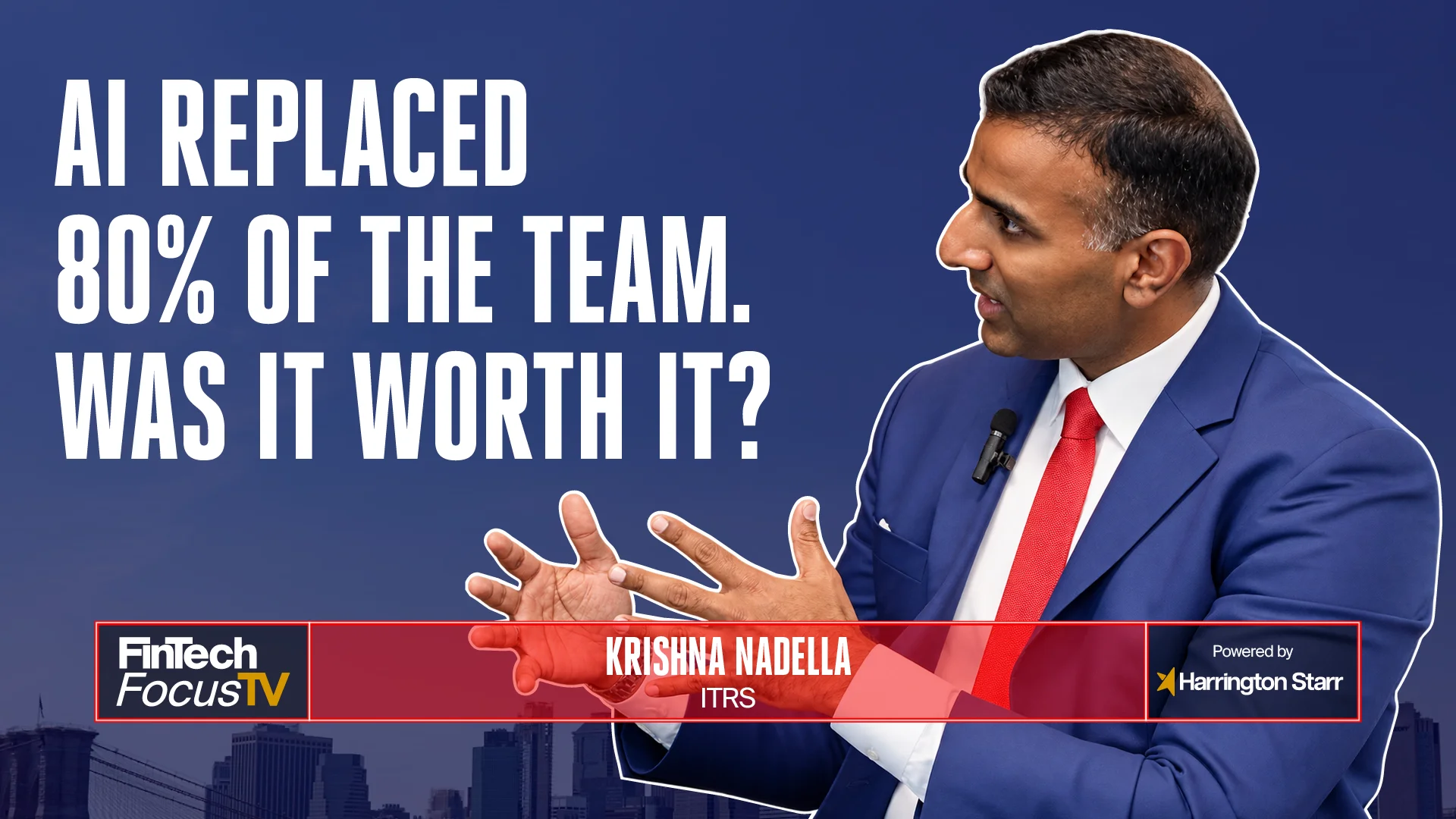
Artificial intelligence is changing how financial services companies operate, but one of the biggest questions facing the industry is whether AI should replace employees or make existing teams more valuable.
As financial institutions invest in agentic AI, automation and intelligent technology, the implications extend beyond productivity. AI is influencing workforce planning, financial technology recruitment, graduate opportunities and the specialist skills businesses need to remain competitive.
For employers, the challenge is no longer simply deciding whether to adopt artificial intelligence. It is understanding how AI can support sustainable business growth while retaining the human expertise needed to innovate, manage risk and deliver results.
In a recent episode of FinTech Focus TV, Toby Babb, speaks with Krishna Nadella, Head of US Financial Services at ITRS, about the realities of AI-driven workforce transformation.
Drawing on his experience at SigTech, Krishna offers a particularly interesting perspective on what happens when businesses replace traditional roles with AI agents, and whether the industry should reconsider how it balances technology and talent.
Their conversation raises important questions for FinTech recruitment, financial services leadership and professionals preparing for the future of work.
Is AI Replacing Jobs in Financial Services?
AI is already changing the responsibilities of employees across financial services. From software engineering and trading technology to infrastructure monitoring and business operations, automation can increasingly support tasks that previously required significant human involvement.
However, the relationship between AI adoption and employment is more complicated than the idea that every automated task results in a lost job.
Krishna explains that businesses are approaching AI transformation with different objectives. Some organisations see artificial intelligence primarily as a way to improve efficiency and reduce operating costs. Others see an opportunity to increase productivity, develop new services and accelerate growth.
That distinction has significant implications for financial services recruitment.
An organisation focused on reducing expenditure may use AI to reconsider existing positions and limit future hiring. A business focused on growth may instead invest in employees who can develop, deploy and manage AI-powered solutions.
Neither approach guarantees a particular outcome. However, the strategic decisions companies make today will influence the skills they need and the opportunities they create.
For FinTech professionals, understanding an employer's approach to AI could become increasingly important when assessing long-term career opportunities.
What Happens When AI Replaces Most of a Workforce?
One of the most revealing moments in the conversation comes when Krishna reflects on his experience at SigTech.
He explains that the company originally operated as a research and backtesting business before pivoting towards artificial intelligence for financial technology.
During that transition, its workforce changed dramatically.
"So we went from like 60 to 12 at one point with a lot of agents that supplemented that workforce."
Krishna describes this as an early period of AI adoption, when the business was developing agents and using its own technology internally.
The workforce reduction took place during that transformation. The conversation does not establish that AI alone caused every departure, but it demonstrates the scale of organisational change that can accompany an AI-led business strategy.
Toby challenges Krishna on whether retaining more employees and equipping them with AI agents might have created a stronger business.
Krishna acknowledges that his thinking has evolved.
"You can actually do more with the humans if you arsenal them with those agents."
He then considers how the company might have approached the transition differently with the benefit of hindsight.
"So maybe not 60 to 12, maybe 60 to 40 initially."
Importantly, Krishna also recognises the commercial pressures facing early-stage businesses, where leaders may not have the time or resources to test every possible workforce model.
The broader lesson is not that companies should never reduce headcount or automate roles. It is that organisations should carefully assess whether removing employees creates more value than developing their capabilities alongside AI.
For FinTech recruitment and workforce planning, this distinction matters.
Replacing a role may reduce immediate costs, but retaining an experienced employee and providing effective AI tools could create opportunities to increase output, improve service delivery or support expansion.
The right decision depends on the business model, the skills involved and the outcomes an organisation is trying to achieve.
AI Workforce Transformation Should Focus on Growth, Not Just Cost Reduction
Financial services companies have spent years investing in technologies designed to improve operational efficiency.
Artificial intelligence introduces another opportunity, but Krishna argues that employers should look beyond cost savings.
In the interview, he distinguishes businesses using AI to reduce their workforce from those investing in technology to help employees become more effective.
This creates an important question for financial technology leaders.
Can AI help an organisation achieve more with its existing workforce rather than simply operate with fewer people?
A growth-focused approach might involve using AI agents to support repetitive processes, accelerate technical investigations or improve access to information. Employees could then concentrate on higher-value responsibilities that require judgement, problem-solving and commercial understanding.
For recruitment teams, this changes how vacancies should be defined.
Instead of hiring solely to replace someone performing an established set of tasks, businesses may need to consider how responsibilities will evolve as AI becomes embedded in everyday operations.
A software engineer, infrastructure specialist or product manager may increasingly be expected to work with AI-powered systems while retaining accountability for the quality and impact of their work.
This makes workforce transformation a question of job design and capability development, not simply employee numbers.
Harrington Starr's FinTech hiring trends analysis provides further context on how financial technology employers are approaching specialist recruitment, including investment in Data and AI, software engineering and infrastructure expertise.
How Is Agentic AI Changing Financial Technology Jobs?
Agentic AI is a significant part of Krishna's current work at ITRS, where he leads US Financial Services.
He describes ITRS as a financial technology business specialising in observability and monitoring, particularly within complex environments such as electronic trading, payments and market data.
These systems operate in settings where reliability, speed and operational resilience are essential.
Krishna explains that ITRS is moving towards an approach he describes as transitioning from human monitoring to greater machine-led support.
He discusses the company's first agentic site reliability engineer agent, designed to support technical investigations and help teams resolve issues more efficiently.
This illustrates how AI could change responsibilities within financial services technology teams.
Rather than relying entirely on engineers to manually investigate every operational problem, intelligent agents can assist with analysis and troubleshooting. However, human expertise remains important when interpreting findings, assessing risk and deciding how to respond.
For financial technology recruitment, this creates an opportunity to reconsider the capabilities required across infrastructure, application support, DevOps and site reliability engineering.
Employers may increasingly value professionals who understand both the underlying technology and how to use automation responsibly within business-critical environments.
Harrington Starr's Application Support recruitment specialists work within this area of financial technology, where maintaining reliable systems remains central to business performance.
What Skills Will Employers Look for in AI-Driven FinTech Recruitment?
One of Krishna's most compelling arguments is that AI makes human capabilities such as critical thinking and creativity more important, not less.
Looking ahead to 2027, he emphasises the opportunities available to people who can challenge assumptions, develop ideas and approach problems differently.
"But now more than ever, I want your critical thinking. I want your contrarian beliefs, I want your imagination."
This has clear implications for financial technology hiring.
Technical knowledge will continue to matter, particularly in specialist areas such as software engineering, quantitative finance, cybersecurity and AI development. Yet knowing how to use a particular tool may not be enough to demonstrate long-term value.
Employers also need people who can identify worthwhile problems, assess whether technology is producing reliable results and understand how technical decisions affect the wider business.
For example, an AI-generated solution may appear efficient but still require an experienced professional to identify an operational weakness, challenge an incorrect assumption or recognise a potential risk.
The most valuable candidates may therefore be those who combine specialist knowledge with adaptability, independent thinking and an understanding of commercial outcomes.
This aligns with the broader discussion around the changing skills required of financial services engineers, particularly as employers reconsider how technical expertise contributes to business performance.
AI Spectators vs Operators and What It Means for FinTech Careers
Throughout the episode, Krishna returns to a distinction between AI spectators and operators.
Spectators observe technological change without meaningfully engaging with it. Operators actively use the technology, understand its limitations and apply it to improve their work.
He explains this through an example involving his children and the importance of learning mathematics before becoming dependent on a calculator.
The principle is straightforward. Technology can make tasks easier, but people still need enough understanding to recognise when something is wrong.
Krishna applies this thinking to professional development.
"It requires that ability to say, I'm not standing still."
For individuals working in FinTech, this is particularly relevant.
Professionals do not necessarily need to become AI engineers to benefit from artificial intelligence. However, understanding how AI affects their responsibilities and identifying opportunities to develop new capabilities could strengthen their long-term career prospects.
An experienced financial services professional might use AI to support analysis, improve workflows or accelerate research while relying on their own judgement to evaluate the results.
From a recruitment perspective, candidates who can demonstrate how they have used technology to solve genuine business problems may be able to communicate their value more effectively than those who simply list AI tools on their CVs.
Will AI Create More Opportunities for Graduates in Financial Services?
The impact of artificial intelligence on graduate employment is another important theme in the conversation.
Toby challenges the assumption that AI necessarily makes entering the workforce more difficult. He argues that graduates who understand emerging technologies could bring valuable capabilities to employers from the beginning of their careers.
Krishna agrees that AI creates opportunities, while stressing the importance of understanding the type of organisation someone is joining.
His perspective is also shaped by his experience as a parent.
Krishna discusses how his 11-year-old son attended a socially responsible AI camp and gradually developed a more critical understanding of large language models.
Initially, his son viewed AI as an almost magical technology. By the end of the programme, he understood that it was a tool that could make mistakes and required human oversight.
That experience became part of Artificially Intelligent, the book Krishna is writing with his son.
For graduate recruitment in financial services, the lesson is especially relevant.
Early-career professionals may arrive with greater familiarity with AI tools, but employers still need to help them develop foundational knowledge, judgement and practical experience.
A graduate who can generate an answer quickly is not necessarily equipped to evaluate its accuracy or understand its consequences.
Successful graduate development will therefore require a balance between technological fluency and the deeper capabilities that come from learning, practice and experience.
For employers, this may mean reassessing entry-level responsibilities rather than assuming that AI removes the need to develop junior talent.
What Does AI Mean for FinTech Recruitment Strategies in 2027?
As AI becomes more embedded in financial services, recruitment strategies will need to reflect the relationship between human expertise, automation and business growth.
Companies considering AI transformation should examine which capabilities they already possess, which responsibilities could be enhanced through technology and where additional specialist expertise is required.
For some businesses, this may create a need for AI engineers, machine learning specialists and data professionals. Others may prioritise infrastructure, cybersecurity, product management or experienced technology leaders capable of overseeing complex transformation programmes.
The recruitment challenge is not simply identifying people who understand artificial intelligence. It is finding professionals who can apply their expertise in ways that create measurable value.
Harrington Starr's research into the FinTech AI recruitment gap examines why specialist skills and effective workforce planning remain important as financial technology businesses adopt AI.
Employers also need to consider how these changes affect compensation, career progression and employee retention.
Harrington Starr's Financial Technology and Financial Services Salary Survey 2026/27 provides salary benchmarks and hiring insights across specialist disciplines, helping organisations understand the wider talent market as they plan their workforce requirements.
For candidates, the priority is to continue developing expertise that remains relevant as technology evolves.
For employers, it is to build teams capable of using AI effectively without losing the judgement, creativity and industry knowledge that support long-term performance.
The Future of AI in Financial Services Depends on People as Well as Technology
Krishna's experience offers a valuable perspective on one of the most important decisions facing financial services businesses.
AI can support automation, reduce manual workloads and create new opportunities for growth. It can also prompt difficult decisions about organisational structure and employment.
But the ability to automate a responsibility does not automatically determine the best workforce strategy.
The more important question is whether businesses can create greater value by combining intelligent technology with experienced, adaptable people.
For the FinTech recruitment industry, this reinforces the importance of identifying specialist talent, supporting skills development and understanding how roles are changing.
The organisations best positioned to benefit from AI may be those that recognise technology as a means of expanding human capability rather than viewing employees solely as costs to eliminate.