The Quant Advantage is Disappearing
14 October, 2026


Artificial intelligence is moving rapidly from experimentation to practical application across financial markets, but are firms truly ready to take advantage of what comes next?
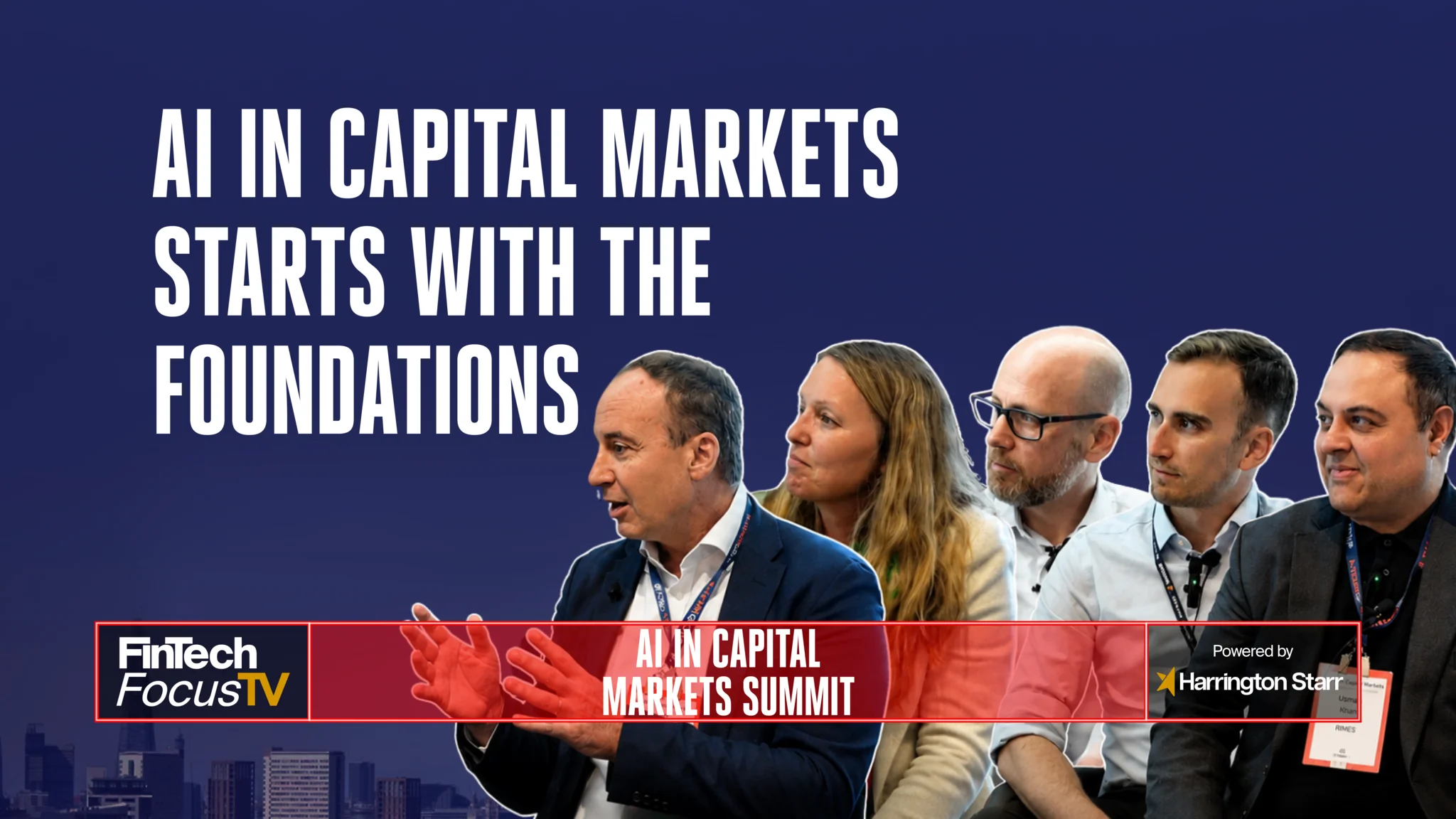
Recorded live at the AI in Capital Markets Summit in London, this episode of FinTech Focus TV brings together Andrew Capewell, Head of Product at ipushpull; Colin Strasser, CEO at Montrose Software; Stephane Rio, CEO and Founder at Opensee; Usman Khan, Founder & CEO of APEX; and Niketta Postlethwaite-William, Director, Strategic Accounts at Genesis Global. Hosted by Toby Babb, the conversation explores how AI is changing capital markets technology, where organisations are already seeing value, and why successful adoption depends on far more than access to the latest models.
Across the discussion, one message emerges clearly. AI is creating significant opportunities for automation, productivity and innovation, but technology alone is not enough. Firms need strong data foundations, effective AI governance, security, appropriate use cases and, crucially, people who understand both the technology and the financial markets in which it operates.
From agentic AI and data governance to software engineering, productivity and the future of talent, the episode examines what the next phase of artificial intelligence in finance could really look like.
As AI adoption accelerates, Stephane argues that firms should resist the temptation to begin with the latest model or agent and instead consider whether their underlying foundations are ready.
Reflecting on his panel at the AI in Capital Markets Summit, Stephane explains that the discussion centred on what organisations need to make their data AI-ready. His conclusion is that the foundations have to come first. Without them, even highly capable models can remain confined to proofs of concept and proofs of value rather than becoming trusted, production-grade systems.
This distinction between experimentation and scalable deployment runs throughout the episode.
Artificial intelligence can produce impressive results in isolated situations, but delivering those results repeatedly, reliably and across hundreds of users is a different challenge. This becomes even more important when AI is involved in regulatory reporting or decisions that could influence how capital is deployed.
For financial institutions considering wider AI adoption, the question therefore becomes less about what the newest technology can theoretically achieve and more about whether the organisation is prepared to use it safely and effectively.
Stephane describes firms as entering a period of discovery. Leadership teams are increasingly being tasked with finding automation opportunities and cost savings, but these mandates do not always arrive with concrete implementation plans. Before considering widespread adoption, firms need to understand what is possible, assess whether their organisation is ready and determine which use cases can provide credible returns while maintaining trust.
Andrew similarly cautions against treating AI as a magical answer to every business challenge. Artificial intelligence is still software, he explains, and should be considered a tool for solving clearly identified problems.
Rather than beginning with AI and searching for somewhere to apply it, firms should understand the problems they want to solve.
One area where Andrew sees significant potential is the unstructured chat data arriving on front-office desktops. Experienced and expensive professionals can still spend considerable time manually transferring information into ageing back-office systems, completing administrative processes rather than focusing on the activities where their expertise delivers the greatest value.
AI automation can help reduce that burden.
Removing repetitive administration could allow traders and other professionals to spend more time identifying opportunities, executing trades and focusing on higher-value work. In some cases, administrative overhead can even discourage people from undertaking additional activity because they know how much manual work will follow.
This is where the potential of AI in financial services becomes tangible. Rather than replacing skilled professionals, technology can remove friction around their work and allow them to focus more heavily on the areas where human knowledge and judgement matter.
That idea becomes increasingly important as the conversation turns towards the relationship between AI productivity and human expertise.
Agentic AI is one of the most prominent themes throughout the episode, with several guests discussing how autonomous and semi-autonomous workflows could transform the way financial institutions operate.
Niketta describes agentic workflows as an especially exciting opportunity. For businesses asking how they can generate greater returns from the resources they already have, AI agents could become an important part of the answer.
But she does not frame these workflows as a replacement for people.
Instead, she describes them as a way of “supercharging” humans.
Humans remain important within these workflows, particularly where systems are critical to the organisation. While lower-risk functions may eventually require less intervention, the idea of removing people entirely from important runtime workflows remains a long way from the reality described in the episode.
Colin also sees growing potential in agentic workflows within software development. Each generation of AI models has become better at understanding intent and generating code, but he highlights the development of iterative agentic loops as particularly exciting.
In these environments, one AI might generate code while another reviews that output against a specification. Models can work together towards a requirement established by a human, assessing whether the work meets the intended goal and identifying what needs to change when it does not.
That could mean adding code, fixing bugs, expanding unit testing, refining requirements or improving architecture, with human supervision ensuring that the agents remain aligned with the objective.
For software engineering in financial services, this represents a significant evolution. AI can increasingly participate across the development lifecycle, but the human remains responsible for defining the need and overseeing the direction of the work.
Greater autonomy also creates greater questions around AI governance.
Niketta explains that AI cannot simply be governed in the same way as deterministic technology. Traditional systems allow organisations and regulators to examine what happened at a particular point in time with a relatively clear factual record. AI introduces a different challenge: firms may need to demonstrate why a model made a particular decision at a particular moment.
That increases the importance of observability, auditing, timestamps and maintaining sufficient information to understand how models reached their conclusions.
The rules that worked for previous generations of technology cannot necessarily be transferred unchanged into the world of artificial intelligence.
Usman raises similar concerns around data privacy and security. As AI agents autonomously interact with organisational data, firms need to know where that information is going and ensure that data which should remain within their perimeter does not leave it.
The ability to control AI infrastructure becomes particularly important in this context.
Usman highlights the opportunity offered by open-source AI, where organisations can evaluate, benchmark and train models, build their own agentic code, connect those systems to datasets and run analysis at scale. This can help organisations create AI capabilities while retaining greater control over the technology and the information it uses.
But that opportunity comes with responsibility.
Security remains a significant challenge, and agents without appropriate controls can behave in unexpected or potentially damaging ways. For firms operating in highly regulated financial markets, understanding how AI systems work and establishing effective guardrails is therefore fundamental.
Data governance emerges as another major challenge for AI adoption.
Andrew discusses what he describes as “dark automation”, where employees gain the ability to automate elements of their own work. Empowering people to solve their own problems can be valuable, but difficulties emerge when individuals across an organisation begin creating separate solutions without common standards or oversight.
A small automation can gradually become increasingly important. More data feeds are added, other employees begin using it, and eventually the business may depend on a system that its technology teams cannot properly support. The person who created it may leave, documentation may be limited, and the organisation can suddenly face a substantial operational risk.
Colin draws a parallel with the era of “shadow IT”.
Years ago, financial institutions could find themselves dependent on Excel spreadsheets that had been copied, modified and reused across departments without clear source control or knowledge of who originally created them. AI could create a new generation of this problem.
Employees are already using AI tools to complete their work, whether organisations have established formal strategies around them or not. At the same time, pressure is coming from leadership teams that want to see greater adoption and productivity.
For capital markets technology leaders, the challenge is therefore not simply encouraging AI adoption. It is enabling innovation while ensuring systems remain governed, secure, documented and supportable.
AI is frequently associated with productivity, but the episode raises an important question: what does increased productivity actually mean?
Niketta recalls hearing the idea of organisations seeing “200% productivity, but 150% of effort”. Individual tasks may be completed faster, but that does not automatically mean the business is seeing the same improvement in overall returns.
If AI helps one person on one desk work faster, that is useful. But organisations also need to understand how those individual improvements combine into a broader AI strategy and how they ultimately move the dial for the business.
Andrew approaches the issue from another perspective. As AI allows professionals to spend more time on the parts of their jobs they enjoy, they may simply take on more work.
Greater capability can create greater ambition.
People realise they can achieve things that were previously difficult or time-consuming, so instead of working fewer hours, they use the additional capacity to do more. Andrew warns that continually increasing workloads is not sustainable. Eventually, organisations still need additional people.
This creates an important distinction in discussions about AI productivity. Efficiency does not necessarily translate into fewer employees. It can instead increase the amount an organisation is capable of achieving, creating new opportunities for growth and potentially new demand for talent.
The impact of AI on talent and hiring becomes one of the most significant discussions in the episode.
Despite widespread predictions that artificial intelligence will eliminate large numbers of jobs, the guests present a more nuanced picture.
Usman believes the impact has been highly exaggerated in some areas. Certain repetitive support tasks can clearly be automated, but more complicated work still requires human involvement.
Software development provides a strong example.
AI coding tools can help engineers achieve substantially more, but Usman argues that getting most of the way towards a solution is not the same as delivering a production-ready system. That final stage is critical, particularly within financial services, and requires people who understand what the technology is doing.
He also highlights the emerging phenomenon of AI burnout. AI tools can draw people deeper into projects because the end result appears tantalisingly close. Someone without an engineering background might use AI to build a dashboard or website and continue investing more time trying to reach the final outcome, only to discover that the technology cannot independently deliver a production-ready result.
Human expertise remains essential.
Perhaps one of the most important talent points comes from Colin, who questions the decision by some organisations to reduce entry-level hiring because AI can perform more junior tasks.
He believes this is a mistake.
The junior professionals entering an organisation today are the people who will become its experienced mid-level and senior talent in the years ahead. If businesses stop hiring at the beginning of the talent pipeline, they risk creating skills gaps later.
There is also a deeper issue around learning.
People need to understand how work is performed before they can effectively supervise AI doing that work. Colin compares this with students using AI to complete their assignments. The objective of education is not simply to produce the finished piece of work; it is to develop the ability to think.
The same principle applies in professional environments.
AI tools are extremely powerful, but people need the knowledge and experience to recognise when an output is wrong, understand how work should be performed and direct technology effectively.
For capital markets recruitment and financial technology recruitment, this could fundamentally influence how organisations approach early-career talent. Junior roles may change, but eliminating them could leave firms without the experienced AI-enabled professionals they will need in the future.
Stephane also sees the future as a combination of AI-native talent and experienced professionals.
Younger generations may be more naturally comfortable with AI tools, but they still need to learn from people who understand the business and have developed expertise through years of experience.
At the same time, experienced professionals need to embrace new technology.
The ability to manage AI agents effectively requires both an understanding of the business and an understanding of how those agents operate. The strongest teams may therefore be those that bring different generations and skill sets together, combining AI fluency with deep domain expertise.
Andrew similarly argues that AI could create new jobs rather than simply removing existing ones. Roles that are commonplace today, such as social media managers, did not exist in the same way two decades ago. AI could create its own new categories of work.
One example raised in the conversation is the potential emergence of forensic AI analysts: professionals responsible for investigating what an AI system did, reviewing logs and understanding the sequence of events that led to a particular outcome.
As artificial intelligence becomes embedded across capital markets technology, new specialisms like these may become increasingly important.
Niketta also rejects the idea of an employment “Armageddon”. Rather than seeing AI as the primary driver behind widespread redundancies, she sees opportunities for junior professionals to enter organisations and develop different skills, including understanding how AI should be governed.
Entry-level roles may evolve, but that does not mean they disappear.
For Harrington Starr, the conversation reflects a transformation already shaping FinTech recruitment and technology hiring across global financial services.
Financial institutions are exploring agentic AI, data platforms, automation, software engineering, AI governance and new approaches to productivity. But every technological shift discussed throughout the episode ultimately intersects with people.
Firms need professionals who understand the underlying data. They need engineers capable of building production-grade technology rather than relying on unsupported automation. They need leaders who can identify credible use cases and guide organisational change. They need specialists capable of governing increasingly autonomous systems, and they need emerging talent who can develop the expertise required to lead these environments in the future.
The skills organisations recruit for may change as artificial intelligence in finance develops, but the need for specialist knowledge is unlikely to disappear.
In many areas, it may become even more important.
As AI takes on more execution and automation, human professionals will increasingly need to provide judgement, oversight, domain expertise, governance and strategic direction. For capital markets recruitment, that creates an evolving talent landscape where AI capability and traditional financial markets expertise will need to coexist.
The excitement around AI in capital markets is justified. Agentic workflows can automate increasingly sophisticated processes. AI can help developers write and review code, allow front-office professionals to spend less time on administration, analyse enormous datasets and help organisations surface meaningful signals from noise.
But this episode of FinTech Focus TV makes clear that the technology cannot be considered in isolation.
AI readiness begins with data foundations. Scalable adoption requires governance and security. Productivity needs to be measured across the organisation rather than through isolated tasks. Automation needs guardrails. And increasingly capable agents still require people who understand the work they are being asked to perform.
Perhaps most importantly, AI does not remove the need to invest in talent.
The people entering financial technology today will become the senior engineers, product leaders, AI specialists and capital markets experts of tomorrow. Their roles may look different from those of previous generations, but developing their knowledge remains essential.
For organisations navigating AI adoption, moving quickly may be valuable, but moving with purpose matters more. The firms best positioned to benefit will be those that understand the problems they want to solve, build the foundations required to solve them and develop teams capable of combining technological capability with human judgement.
AI may be transforming financial markets, but the future described at the AI in Capital Markets Summit is not simply one of humans versus machines.
It is a future built around humans who know how to use increasingly powerful machines well.