AI Replaced 80% of the Team. Was It Worth It?
28 October, 2026

Artificial intelligence is making software development faster and more accessible. In capital markets, AI coding agents are helping businesses experiment with trading applications, automate workflows and reconsider what they need to purchase from specialist technology vendors.
But building a working prototype is very different from deploying a reliable trading system.
As financial institutions explore the possibilities of AI, the traditional buy vs build debate in capital markets is becoming more complicated. Firms can develop more technology internally, yet security, resilience, data quality and regulatory requirements continue to influence what can realistically be delivered.
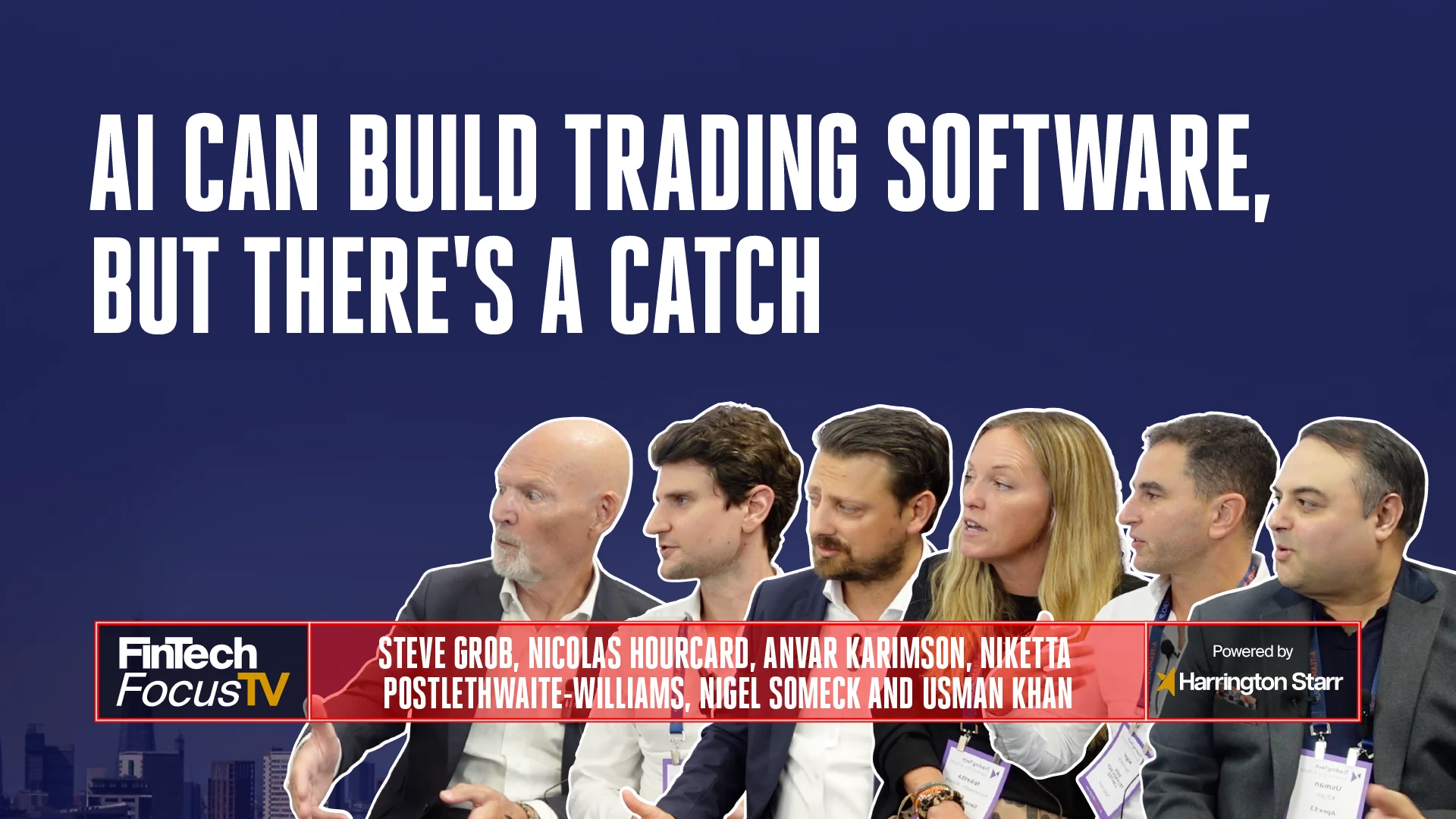
At A-Team's Buy AND Build: The Future of Capital Markets Technology conference in London, FinTech Focus TV host Ian Bailey spoke with Steve Grob of Vision57, Nicolas Hourcard of QuestDB, Anvar Karimson of Kepler Cheuvreux, Niketta Postlethwaite-Williams of Genesis Global, Nigel Someck of MDX Technology and Usman Khan of APEX:E3.
Across six conversations, the guests examined how AI is changing trading technology, why specialist vendors remain relevant and what financial institutions must consider before moving AI-powered applications into production.
Their perspectives reveal a central challenge, the ability to build software is improving faster than the ability to deploy it safely and reliably in complex financial environments.
The traditional choice between purchasing technology and developing it internally has always involved trade-offs.
Building proprietary systems can give financial institutions greater control over functionality and workflows. Buying established technology can provide access to specialist capabilities without requiring internal teams to develop and maintain every component.
AI is changing the calculation by making initial development considerably easier.
Usman Khan, founder of APEX:E3, explains that the widespread availability of coding agents has created a perception that organisations can now build almost anything themselves.
This presents a challenge for FinTech vendors. If prospective customers believe they can reproduce a solution internally, the value of purchasing established technology becomes harder to communicate.
However, Khan identifies a significant limitation:
"A lot of these coding agents are able to do 80% of the work and that last 20%, which is put the production, the security, uh, the resilience."
His point is that the remaining work is often what makes an application suitable for enterprise use.
The distinction matters in capital markets, where trading systems must meet demanding operational and regulatory requirements. A proof of concept might demonstrate that a particular workflow is technically possible, but it does not establish that the application is ready to handle live financial activity.
For firms investing in trading and exchange infrastructure, the decision therefore needs to account for more than development speed.
Technology leaders must also assess long-term maintenance, integration, security and the specialist expertise needed to operate a system successfully.
Khan offers a particularly revealing example of how AI coding tools are changing expectations inside financial institutions.
Business users can now develop prototypes without waiting for traditional software development teams. Some can create convincing demonstrations over a weekend.
The problem arises when those prototypes are compared directly with enterprise software projects.
Khan describes business users questioning why technology teams require months to deliver something they appear to have built in days.
His explanation is that they are seeing only a small part of the development process.
Production systems must satisfy compliance requirements, governance policies, coding standards and multiple layers of review. An AI coding agent may not understand the organisation-specific requirements that determine whether an application can be approved.
Niketta Postlethwaite-Williams of Genesis Global reinforces this distinction.
She explains that the rapid improvement of AI development tools initially created uncertainty among clients who began questioning whether they still needed external software providers.
However, she suggests that organisations are developing a clearer understanding of the limitations of AI-assisted development.
Specialist vendors continue to offer value through their capital markets knowledge and experience of deploying software into production environments.
This is an important distinction for financial technology employers.
As coding becomes more accessible, the capabilities required from experienced engineers may shift further towards system architecture, integration, testing and production reliability.
Harrington Starr's software engineering recruitment expertise is relevant to organisations building teams that can take applications beyond the prototype stage.
The question is not simply whether AI can generate code. It is whether a business has the people and processes required to turn that code into dependable technology.
Nigel Someck of MDX Technology offers one of the clearest explanations of why buying and building technology should not be treated as opposing strategies.
He describes MDX's role in providing real-time data distribution technology that can either be used through established interfaces or incorporated into a customer's internal systems.
This reflects a broader shift towards combining specialist vendor infrastructure with proprietary development.
Someck explains that clients are increasingly interested in building their own front-end applications and workflows, particularly as AI reduces some of the barriers to coding.
However, when it comes to middleware and the infrastructure connecting different systems, customers may still prefer to rely on experienced vendors.
His observation points towards a practical division of responsibilities.
Financial institutions can concentrate internal development resources on capabilities that support their particular business requirements while using established technology for components that do not need to be built from scratch.
This can also help organisations avoid duplicating complex infrastructure unnecessarily.
The approach is especially relevant to trading environments, where firms may need to connect proprietary applications with market data platforms, execution systems and other established technologies.
Rather than asking whether to buy or build an entire platform, technology leaders can assess individual components and determine where each approach delivers the greatest value.
For a related perspective, Harrington Starr's article The Drive for Modern Infrastructure in Financial Markets examines the importance of the underlying systems supporting modern financial markets.
Beyond software development, AI could also transform how traders interact with technology.
Steve Grob of Vision57 discusses the possibility of moving away from trading workflows centred on screens, prices and individual human decisions.
Instead, he describes a more objective-based model.
A trader could specify an intended outcome, including the exposure required, execution deadline and relevant constraints. An AI orchestration layer would then determine how best to achieve that objective.
In Grob's example, the system could consider different instruments and asset classes, adjusting its approach as conditions change.
This represents a potential shift in the relationship between traders and their technology.
Rather than directing each stage of execution, traders could increasingly supervise automated processes and intervene when exceptions arise.
Grob describes the prospect as both exciting and unsettling.
Importantly, he presents this as a possible evolution of trading workflows, not as an established operating model already deployed across the industry.
There are substantial questions about the reliability, accountability and oversight of systems making increasingly complex decisions.
Nevertheless, the discussion illustrates why agentic AI is attracting attention across capital markets.
Its potential extends beyond improving individual tasks towards coordinating workflows that currently require multiple applications and human interventions.
Harrington Starr's article When Everyone Has AI, Where Does the Edge Come From? provides further context on how greater access to AI tools may change competitive advantage in trading.
As AI becomes more deeply integrated into financial institutions, governance becomes increasingly important.
Anvar Karimson discusses the challenge of encouraging innovation without allowing uncontrolled experimentation.
From his perspective as a technology leader, the objective is to provide stable foundations that allow business users to develop new capabilities safely.
This includes reliable workflows, standardised data and a common platform through which AI activity can be managed.
Karimson explains that his organisation is investing in an AI platform designed to provide visibility over model usage, costs, governance and the protection of intellectual property.
He also identifies cybersecurity as a significant challenge.
For example, an AI agent might be asked to retrieve information from an internal database and automatically send an email to a client.
Although the task sounds straightforward, Karimson warns that prompt injection at any stage could create serious security exposure.
His concern demonstrates why AI governance cannot be separated from the technical architecture of automated workflows.
Usman Khan approaches the subject through AI sovereignty.
He discusses the importance of controlling where data is processed, where AI inference takes place and whether automated systems can operate beyond an organisation's intended boundaries.
His preferred approach involves keeping data and inference within an organisation's own controlled environment.
Together, these perspectives highlight two related priorities: financial institutions need the ability to innovate, but they also need clear control over what AI systems can access and do.
Nicolas Hourcard, CEO of QuestDB, examines the relationship between AI agents and financial data infrastructure.
He explains that systematic trading platforms have traditionally relied on particular combinations of proprietary technologies.
However, the introduction of AI agents is encouraging organisations to reconsider how those platforms are designed.
Hourcard points towards open-source tools, open data formats and established standards such as SQL.
His argument is that AI agents can interact effectively with widely used technologies and standards, potentially making open architectures more attractive.
For capital markets businesses, this matters because trading applications depend on access to reliable data.
Market data ingestion, historical analysis, quantitative research and post-trade processes all require infrastructure capable of supporting demanding workloads.
As AI agents become part of these environments, organisations need to consider whether their existing platforms are suitable for new methods of development and interaction.
Hourcard also describes changing customer expectations.
Rather than purchasing a narrow product, clients increasingly want technology providers to help solve specific problems and deliver outcomes.
For QuestDB, this is influencing discussions about how to support customers more directly, including the possibility of deploying engineers to work alongside them.
The broader implication is that AI may change not only which technologies financial institutions select, but also the relationships they expect to have with their vendors.
Niketta Postlethwaite-Williams argues that financial institutions need to move beyond experimentation and demonstrate tangible returns from AI.
Her focus is on understanding the business problem before introducing the technology.
An organisation might have access to sophisticated AI models and development tools, but that does not mean its proposed application will deliver useful results.
Postlethwaite-Williams emphasises the importance of understanding existing workflows, identifying the problems that need solving and ensuring that the required data is suitable.
Without those foundations, businesses risk creating applications that do not address the underlying issue.
She also raises concerns about growing token expenditure and the cost of repeatedly using AI models.
Her argument suggests that organisations should consider when AI is necessary and when a more structured solution could deliver the same outcome more efficiently.
This introduces a commercial dimension to the buy and build debate.
The objective should not be to maximise the amount of technology developed internally or the number of AI tools deployed.
Instead, financial institutions need to evaluate whether their investments improve workflows, reduce friction or deliver measurable business benefits.
Although AI is increasing the capabilities available to financial institutions, several guests stress the continuing importance of human judgement.
Steve Grob is particularly concerned about professionals relying on AI outputs without understanding the subject matter.
He describes instances in which AI models produced incorrect answers that he could challenge because of his own industry experience.
His concern is that less experienced professionals may not recognise those mistakes.
For people entering an increasingly AI-enabled financial technology workforce, Grob argues that understanding how trading businesses operate remains essential.
Knowledge of buy-side institutions, hedge funds and proprietary trading cannot simply be replaced by access to a sophisticated AI model.
Nigel Someck also emphasises the importance of human oversight, particularly in front-office trading environments.
He expects financial services firms to adopt agentic AI cautiously because existing systems can still be unpredictable.
In his view, the industry is likely to continue experimenting through controlled environments before introducing more autonomous systems into sensitive workflows.
This has important implications for recruitment.
Financial institutions need professionals who can combine technical capabilities with financial markets knowledge, governance awareness and sound judgement.
Harrington Starr's 2026/27 Financial Technology Salary & Hiring Report provides additional context on the skills, salary benchmarks and hiring considerations affecting specialist financial technology teams.
The relationship between people and increasingly capable AI systems is also examined in The Financial Technologist's Humans With AI edition, which brings together industry perspectives on technology, talent and human expertise.
The conversations at A-Team's Buy AND Build conference suggest that AI is changing the boundaries between internal development and specialist technology provision.
Coding agents are making it easier to create prototypes. Open technologies are influencing infrastructure decisions. Agentic AI could eventually reshape how trading workflows are managed.
However, financial institutions still need dependable systems, effective governance and professionals who understand the consequences of technology decisions.
The guests also offer different perspectives on the pace of change.
Grob sees the potential for a fundamental shift towards objective-based trading workflows, while Someck expects a more gradual transition as organisations test the reliability of agentic AI.
Hourcard identifies opportunities for faster adoption of open data infrastructure, while Postlethwaite-Williams stresses the importance of proving commercial value.
Karimson and Khan highlight the controls needed to prevent AI experimentation from creating unacceptable operational and security risks.
Together, these views point towards a more selective approach to technology investment.
Financial institutions may build more of their own applications, but that does not mean they should build every component themselves.
The organisations best positioned to benefit from AI will need to understand where proprietary development creates value, where specialist vendors provide essential capabilities and how to combine both approaches effectively.