AI Can Do the Work. Who’s Doing the Thinking?
26 Oct, 2026

The most efficient industries in the world operate as interconnected systems that span geogr...

The most efficient industries in the world operate as interconnected systems that span geographies, currencies, and time zones. By contrast, the capital markets that support them remain structurally fragmented – divided by venue, jurisdiction, and legacy execution rules. That fragmentation imposes hidden costs on investors and constrains GDP, as multi-trillion-dollar capital flows clear through mechanisms built for a world of isolated venues and single-asset trading.
The solution is not faster pipes or narrower spreads, but a different architecture altogether: periodic, combinatorial auctions capable of clearing portfolio-level intent across borders, with regulatory constraints embedded directly into the match.
Consider a common investment scenario: selling U.S. stock while buying Japanese equities, and converting U.S. dollars into yen to complete the transaction. Straightforward in theory, yet in practice, investors must navigate time zones, venues, and market structures independently. The result is execution risk, FX exposure, coordination costs, and slippage.
This structure is not accidental. Electronic markets are built around continuous limit order books optimised for speed and local liquidity. That design performs well for single-asset trading within a single geography, but becomes inefficient when trading is global and multi-asset or even fragmented across separate venues or “books”. Continuous matching rewards speed, fragments liquidity across venues and time zones, and introduces avoidable latency into cross-border execution.
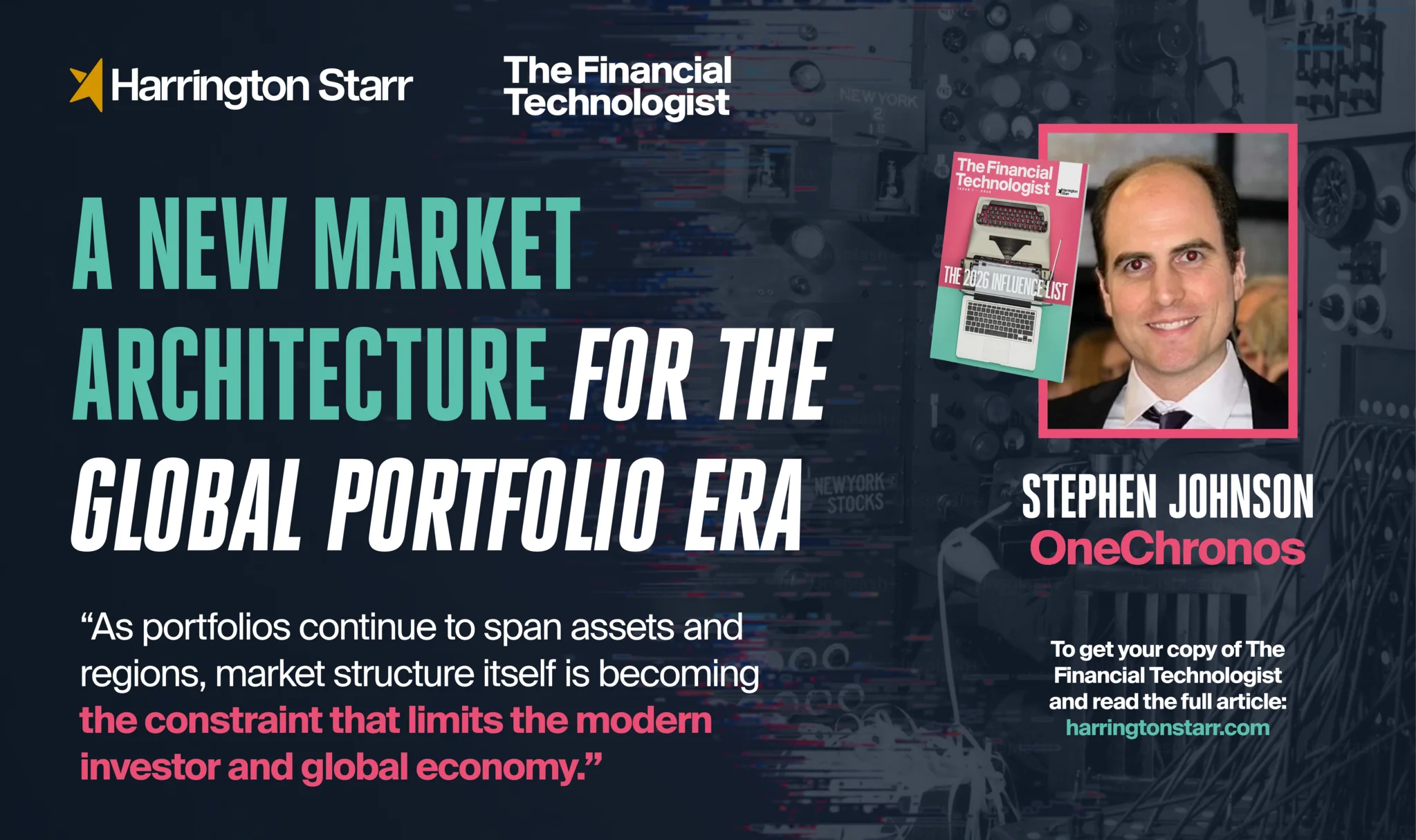
As portfolios continue to span assets and regions, market structure itself is becoming the constraint that limits the modern investor and global economy.
Smart Markets – auctions designed to clear complex, interdependent orders through optimisation rather than price/time priority rules – expand the range of problems that markets can solve. Orders are batched and cleared at set intervals, enabling the system to resolve constraints across all orders at once. And by batching orders, periodic auctions neutralise latency advantages and create a time window for smarter approaches to matching.
At the centre of Smart Markets is large-scale optimisation. Clearing auctions with interdependent orders across different assets, constraints, and objectives requires computational optimisation rather than traditional rules-based matching. In the case of the U.S.-Japan transaction, the instruction to sell a U.S. stock, buy a Japanese equity, and convert USD to JPY occurs as a single, conditional expression of intent. The Smart Market does not execute one leg and hope others follow, but instead clears the entire portfolio trade atomically, ensuring that exposure, currency, and timing risks are handled as an individual problem rather than three. By enabling these portfolio trades to match against a mix of other portfolios and single-instrument interest, Smart Markets can bring together more mutually beneficial offsetting interest. In other words, constrained portfolios don't have to match 1:1 with other portfolios, and can stitch together liquidity from multiple sources.
The expressive power of Smart Markets comes with a high computational cost: a “combinatorial explosion” of different possible matches for the optimisation to check. Machine learning can help markets quickly identify which sets of orders are likely to form high-quality matches. AI makes it possible to run complex portfolio-level markets where participants express conditional, multi-leg intent in a single order at a speed compatible with capital markets. Trades can be linked – an equity trade can depend on an FX conversion, or one leg can clear only if another clears – and the market can enforce portfolio constraints directly. Crucially, orders can also express economic substitutes, factors on which the investor is willing to be flexible, to increase the chance of finding a counterparty. This kind of coordination isn’t practical in today’s continuous markets, which typically clear one symbol at a time with as little latency as possible.
For the buy side, execution risk increasingly operates at the portfolio level rather than the trade level. Sequential execution creates timing gaps, basis risk, and partial exposures, creating challenges for buy-side firms to integrate multi-asset trading desks even as market structure lags behind organisational reality. Smart Markets allow for portfolios, rather than single tickets, to become the unit of execution.
Cross-border portfolio trades must also satisfy overlapping regulatory regimes, requiring compliance to be resolved as part of the transaction rather than as an afterthought. By encoding jurisdictional constraints directly into optimisation problems, Smart Markets ensure orders submitted by locally regulated entities only clear when all requirements are met, making compliance a property of the match itself, enforced on a transaction-by-transaction basis.
A market like this won’t come together overnight; it has to prove itself step by step. Adoption is typically incremental – building depth in one market before expanding across assets and regions – with a unified global view emerging over time rather than through a single launch or regulatory leap. This is how OneChronos has approached growth, establishing itself as a leading U.S. equities ATS before extending the same Smart Market architecture into new regions and asset classes, including Europe and Asia.
In fact, the name OneChronos reflects this long-term vision of markets that operate as one system rather than a patchwork of venues, assets, and geographies. “One” speaks to a single, coherent view of global liquidity, “Chronos” to coordination in time through periodic clearing.
As markets become more global and portfolios more complex, and as AI agents make their way into the economy, coordination will replace speed as the defining opportunity. Smart Markets represent a shift from markets serving as a way to accomplish complex or high-level investing goals, rather than just match orders, and align outcomes across an increasingly technological global financial system.
Lorem ipsum dolor sit amet, consectetur adipiscing elit. Etiam sit amet est id augue molestie pharetra suscipit et enim. Donec maximus hendrerit augue, eu posuere eros venenatis eu.