Is it Time to Scrap CVs? | FinTech Connect 2026 Preview
27 October, 2026


Is you financial crime team missing the warning signs?
For FinTech businesses operating across international markets, financial crime prevention depends on more than sophisticated technology and regulatory frameworks. It also depends on the people interpreting risks, questioning assumptions and making decisions when the answers are not straightforward.
As artificial intelligence transforms financial crime compliance, the skills required to build effective teams are changing. For employers, this raises important questions about FinTech recruitment, financial crime compliance hiring and the qualities that distinguish exceptional professionals from candidates who simply meet the requirements of a job description.
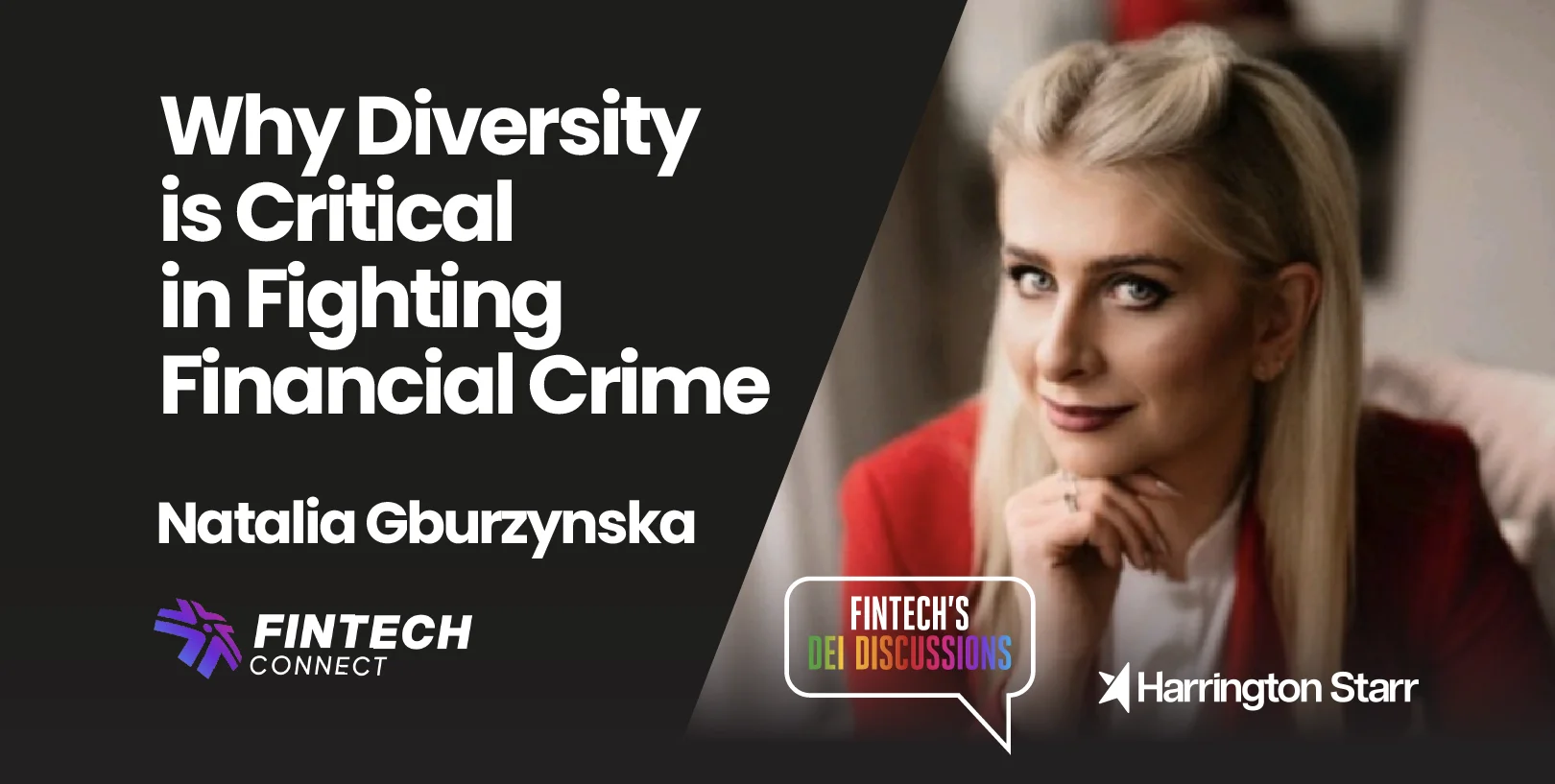
In this episode of FinTech's DEI Discussions, Nadia Edwards-Dashti, speaks with Natalia Gburzyńska, Deputy Money Laundering Reporting Officer (MLRO) and Senior Financial Crime Compliance Manager at Revolut, ahead of FinTech Connect 2026.
Drawing on more than a decade in compliance, Natalia explains why diverse perspectives strengthen financial crime prevention, how transferable skills can open doors to compliance careers and why integrity, curiosity and psychological safety should influence how FinTech organisations recruit and develop talent.
Her central argument challenges a familiar assumption, that the strongest financial crime teams are necessarily those with the most conventional experience.
Financial crime is not confined to one geography, customer group or transaction pattern. As FinTech organisations expand internationally, compliance professionals must recognise risks that can vary across markets, cultures and regulatory environments.
Natalia argues that this makes diversity a practical requirement for effective financial crime prevention, rather than simply a question of representation.
In the episode, she explains that financial crime networks operate internationally and that compliance teams need to recognise the cultural and systemic blind spots that can emerge when employees share similar experiences and assumptions.
A team with limited diversity of thought may become highly effective at identifying familiar risks while overlooking unfamiliar patterns.
For international FinTech businesses, this creates an important recruitment consideration. Employers need professionals who can understand different customer behaviours, regional transaction characteristics, localised fraud typologies and regulatory expectations.
That expertise cannot always be developed by recruiting people with identical professional backgrounds.
Natalia highlights the importance of understanding the communities financial institutions serve, particularly when operating across multiple countries.
This suggests that financial crime compliance recruitment should consider how candidates' different experiences could strengthen a team's collective understanding of risk.
A candidate who brings knowledge of a particular market, experience working across jurisdictions or a different approach to problem-solving may contribute capabilities that are missing from an otherwise technically accomplished team.
For hiring managers, the question becomes whether recruitment processes are designed to identify those differences or unintentionally filter them out.
Technical knowledge remains essential in financial crime compliance. Professionals need to understand regulatory obligations, internal controls, financial crime risks and the systems used to investigate suspicious activity.
However, Natalia believes that technical qualifications and previous experience should not be the only measures of candidate suitability.
Discussing her approach to recruitment, she explains:
"What matters the most is attitude, energy, and motivation."
Her reasoning reflects the changing nature of financial crime work.
As automation increasingly handles routine processes, compliance professionals are expected to investigate more complex problems, interpret ambiguous information and make judgements that cannot always be reduced to a checklist.
Consequently, Natalia looks beyond what a candidate knows at the time of an interview.
She considers how quickly someone can learn, how they respond to uncertainty and whether they have the motivation to develop their expertise.
Integrity is particularly important.
In a profession where employees may face pressure to approve decisions, challenge colleagues or escalate concerns, ethical judgement cannot be treated as an optional characteristic.
For FinTech recruitment teams, this raises a distinction between recruiting for existing knowledge and recruiting for long-term capability.
A candidate may have extensive experience with a particular regulatory framework but struggle to adapt when responsibilities change. Another may have less direct experience but demonstrate the curiosity, resilience and judgement required to develop into a highly effective compliance professional.
Neither technical competence nor attitude should be assessed in isolation. The challenge is to understand how they work together.
At Harrington Starr, our Risk and Compliance recruitment specialist, Andrew Nitek, works with financial institutions and FinTech businesses recruiting across compliance, financial crime, regulatory change and senior risk functions.
Natalia's perspective reinforces why specialist recruitment requires an understanding of both the technical responsibilities of a role and the behaviours that enable someone to succeed within it.
Natalia's own career demonstrates why transferable skills deserve greater recognition in financial crime recruitment.
Before entering compliance, she trained as an archaeologist.
Her move into financial crime followed a change in personal circumstances that required her to prioritise caring for her child. She began working as a Know Your Customer (KYC) analyst at Amazon and subsequently progressed through compliance roles spanning different types of financial and technology organisations.
Her experience includes moving from the first line of defence into the second line, developing knowledge of regulatory frameworks and working across different business environments.
What initially appeared to be an unconventional background ultimately provided skills she could apply directly to compliance.
Research, investigation, persistence and the ability to examine complex information were already familiar to her.
She explains:
"I'm a trained archaeologist and like the fact I had that background in research and and massively helped me to progress"
Although archaeology and financial crime compliance may appear unrelated, both can involve examining evidence, questioning assumptions and investigating problems until a clearer picture emerges.
For professionals considering a career change into FinTech, Natalia's experience provides an important example of how existing skills can support progression into a new discipline.
It does not mean that regulatory knowledge can be bypassed. Natalia is clear that compliance requires detailed study, patience and a commitment to understanding the mechanics of complex problems.
Instead, her story illustrates why career changers should not automatically be excluded because their previous job titles differ from those in a vacancy.
For employers, recognising transferable skills can broaden the pool of candidates considered for financial crime and compliance positions.
This connects with a wider challenge in inclusive FinTech recruitment, distinguishing between experience that is genuinely essential and experience that has become a familiar hiring preference.
Artificial intelligence is changing both the threats facing financial institutions and the capabilities compliance teams need to respond.
Natalia identifies AI-driven deepfakes, complex cryptocurrency-related activity and vulnerabilities associated with instant transactions as examples of increasingly sophisticated financial crime risks.
She also expects technology to change the way organisations investigate suspicious activity.
In her view, the traditional model of expanding large teams of analysts to review increasing volumes of alerts is becoming less appropriate.
Instead, she anticipates a growing need for compliance leaders who combine regulatory expertise with advanced technological understanding.
This has implications for financial crime compliance jobs and the way employers define future hiring requirements.
Understanding anti-money laundering obligations remains important, but professionals may also need to understand how data moves through internal systems, how monitoring tools operate and where technical weaknesses could affect risk detection.
Natalia particularly emphasises the value of understanding an organisation's internal infrastructure.
Professionals who know how systems connect, where bottlenecks arise and how operational processes function can become valuable partners across the business.
For employers, this suggests that compliance recruitment should increasingly assess candidates' ability to work with technology and collaborate with data, product and operational teams.
It also highlights the importance of developing existing employees.
Not every organisation will find candidates who already possess deep regulatory expertise, strong data literacy and extensive experience of emerging financial crime threats.
Training, cross-functional exposure and internal career development can help bridge those capabilities.
The relationship between AI and specialist hiring is also explored in Harrington Starr's article on the FinTech AI recruitment gap, which examines how technological transformation is changing workforce requirements across financial services.
Recruiting people with different perspectives is only valuable if those individuals feel able to contribute.
This is one of Natalia's most important messages about workplace inclusion.
She describes the need to create environments where even the most junior compliance analyst feels confident raising a concern in a room of senior decision-makers.
That ability to challenge matters because financial crime risks do not necessarily become less significant when identified by someone with less experience or authority.
A junior employee may notice an unusual transaction pattern, question an assumption or identify a potential weakness in a process.
If organisational culture discourages them from speaking up, that information may never influence the final decision.
Natalia explains:
"True workplace inclusion for me means that every single person feels safe enough to speak up and stop the line when it matters the most."
This is a practical definition of psychological safety in financial crime compliance.
It is not about avoiding difficult conversations or removing accountability. It is about ensuring employees can raise legitimate concerns, ask questions and challenge decisions without being silenced by hierarchy.
For FinTech leaders, this raises questions that extend beyond recruitment.
Are junior analysts encouraged to challenge assumptions? Do managers respond constructively when someone identifies a potential problem? Are different perspectives genuinely considered before decisions are made?
Hiring diverse talent without creating the conditions for meaningful participation limits the value of that diversity.
The relationship between inclusive leadership and effective recruitment is explored further in Harrington Starr's discussion of redesigning recruitment for equity in FinTech.
Another important theme in Natalia's conversation is the changing role of compliance within growing FinTech businesses.
She describes the evolution of compliance from a function traditionally associated with saying no, to one that helps organisations determine how innovation can proceed responsibly.
For businesses launching new products or entering new markets, effective compliance should not simply identify obstacles.
It should help design the controls, processes and safeguards required to manage risk.
This changes the expectations placed on compliance professionals.
Regulatory knowledge must be accompanied by commercial awareness, communication skills and the ability to work constructively with other departments.
Natalia stresses the importance of relationships between the first, second and third lines of defence, as well as collaboration with teams across data analytics, operations, finance and outsourcing.
Her advice is particularly relevant for compliance managers progressing into leadership positions.
As responsibilities become more strategic, leaders must remain connected to the operational challenges experienced by their teams.
Without that understanding, they may struggle to design controls that address real problems.
For FinTech employers, the recruitment implication is clear: strong compliance leadership requires more than expertise in interpreting regulation.
It also requires people who can build trust, communicate effectively and help businesses balance innovation with appropriate safeguards.
Natalia's discussion offers a useful framework for evaluating financial crime talent.
The strongest candidates need the technical foundations required for their responsibilities, but employers should also examine how they investigate unfamiliar problems, develop knowledge and respond to difficult decisions.
Curiosity matters because financial crime patterns evolve. Adaptability matters because technology and regulation change. Integrity matters because compliance professionals must sometimes make decisions that are commercially inconvenient but necessary.
Equally, candidates should be assessed for their willingness to collaborate across functions and listen to different perspectives.
These qualities become particularly important as organisations scale and responsibilities become more complex.
For senior appointments, hiring managers should consider whether prospective leaders can create environments where employees are comfortable escalating concerns and challenging assumptions.
For entry-level and developing professionals, recruitment processes should provide opportunities to demonstrate analytical thinking, transferable skills and learning potential.
This does not remove the need for role-specific knowledge. It encourages employers to make more deliberate decisions about which capabilities are essential from day one and which can be developed through experience and training.
As a specialist FinTech recruitment business, Harrington Starr works across financial technology and financial services markets where technical expertise, business understanding and leadership capabilities must come together.
For organisations building financial crime teams, the wider lesson from Natalia's experience is that effective hiring should strengthen the capabilities of the whole team rather than simply replicate the experience already present.
Financial crime compliance is becoming more technologically complex, but Natalia's perspective demonstrates why people remain central to effective risk management.
Technology can help organisations identify suspicious patterns and process information. Regulatory frameworks establish obligations and expectations. Yet professionals must still interpret evidence, exercise judgement and challenge decisions when something does not appear right.
That requires teams with different experiences, leaders who value constructive challenge and recruitment processes that recognise potential beyond conventional career paths.
It also requires a commitment to developing talent as the skills needed across financial crime compliance continue to evolve.
For FinTech employers, the question is not simply whether they have enough compliance professionals.
It is whether their teams possess the breadth of knowledge, integrity, curiosity and confidence required to identify risks that others might overlook.
And for professionals considering a career in financial crime, Natalia's journey demonstrates that an unconventional background need not prevent meaningful progression.
The ability to investigate, adapt, learn and act with integrity can provide a foundation for a successful career in this increasingly complex field.