Is This the End of Enterprise Architecture as We Know It?
07 October, 2026


The financial technology industry is experiencing one of the most significant transformations in its history. Artificial intelligence, new data distribution models, evolving client demands, and the emergence of AI-native workflows are forcing organisations across capital markets to rethink how data is created, consumed, distributed, and monetised.
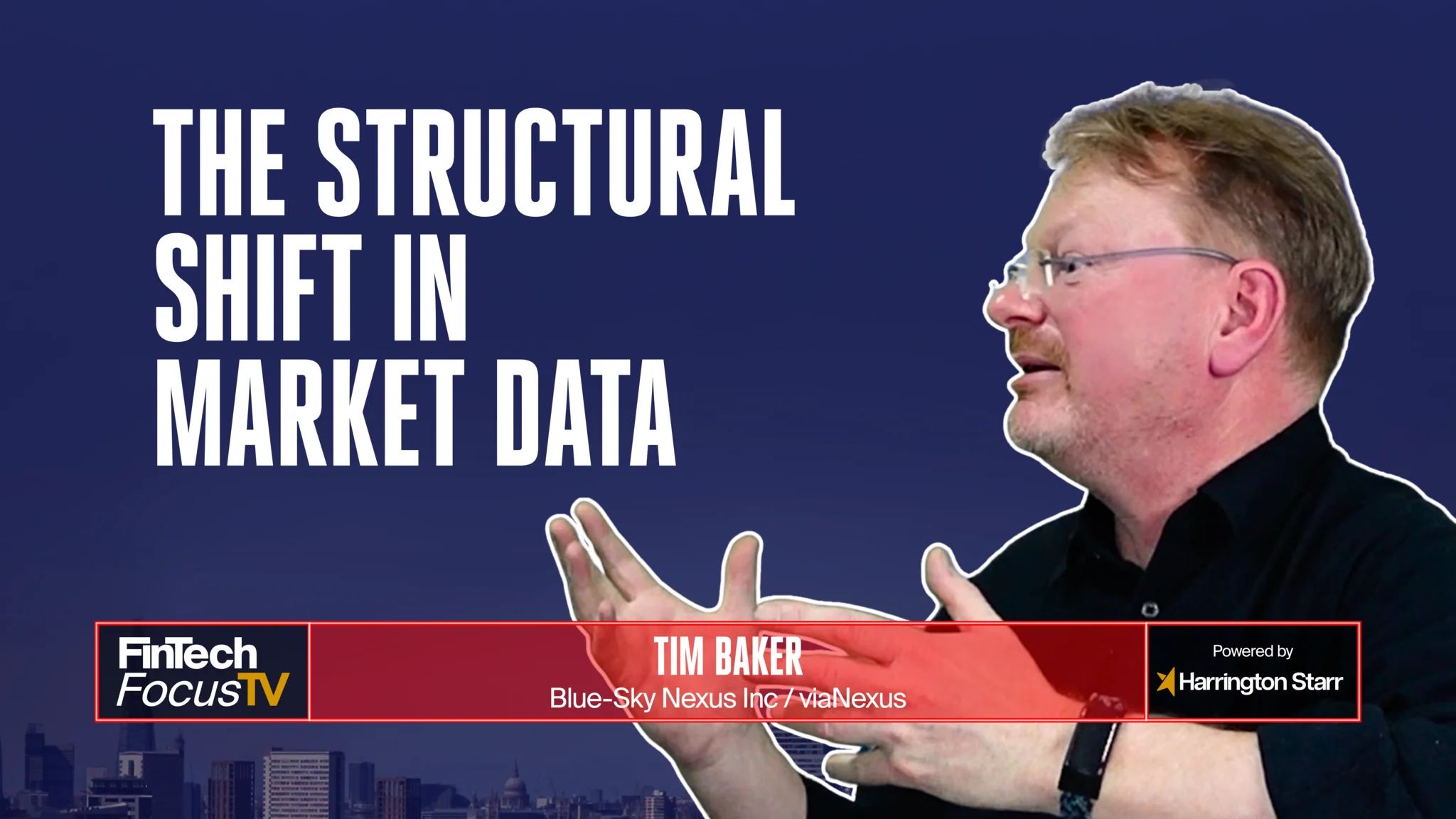
In this episode of FinTech Focus TV, host Toby Babb sits down with Tim Baker, Co-Founder and CEO at Blue-Sky Nexus Inc and viaNexus, to discuss what he describes as a structural shift in market data. Drawing on decades of experience across investment banking, financial technology, market data, and exchange businesses, Tim shares insights into how the industry is evolving and why the opportunities emerging today may be unlike anything seen before.
The conversation explores Tim’s journey from UBS and Thomson Reuters through to IEX and ultimately the creation of viaNexus, while also examining how AI is changing financial services, investment research, trading technology, and data infrastructure.
Tim’s career has placed him at the centre of financial technology innovation for many years. His background began in sell-side research at UBS before moving into fintech investing within the investment bank.
Following the financial crisis, he joined Thomson Reuters where he became involved not only in fintech investments but also acquisitions, partnerships, and content strategy. Working with one of the largest data organisations in the world gave him direct exposure to the challenges and opportunities surrounding financial data.
Throughout his time at Thomson Reuters and later Refinitiv, Tim witnessed the growth of numerous fintech businesses that were looking for data to power their products and services. These experiences helped shape his understanding of both the demand for data and the challenges associated with distributing it effectively.
After leaving Refinitiv, he joined IEX, the exchange made famous through the book Flash Boys. There he became involved in building an API-first data business focused on delivering real-time market data and other financial datasets.
The timing proved significant. As COVID accelerated digital adoption and innovation across financial services, demand for data-driven products increased dramatically. Developers, entrepreneurs, and fintech firms were building at speed, creating an environment where high-quality data became increasingly valuable.
The next chapter came when Tim and his co-founders acquired the assets of the former IEX Cloud business approximately fifteen months before recording this episode.
Rather than purchasing a traditional operating company, they acquired three million lines of code.
What followed was an intense period of rebuilding, repositioning, and strategic thinking. The team rapidly stood up the platform, leveraging relationships across the industry and support from technology partners to ensure continuity.
Importantly, the founders did not rush into defining the business model. Instead, they focused on understanding where the greatest opportunities existed within the evolving market data ecosystem.
Their conclusion was that traditional approaches to data aggregation were becoming increasingly difficult. Purchasing large volumes of wholesale data and attempting to compete directly with established providers was not the most attractive path.
Instead, they identified an opportunity to create something different.
One of the central themes discussed throughout the episode is the changing structure of the global market data industry.
According to Tim, the sector has experienced more than a decade of consolidation. Large providers have acquired valuable assets, strengthened their positions, and built extensive product portfolios.
While consolidation has created powerful organisations with impressive capabilities, it has also created demand for greater competition and innovation.
Customers increasingly want access to new datasets, alternative perspectives, and differentiated sources of information.
At the same time, technological advancements have dramatically lowered barriers to entry for innovators.
The result is an environment where demand for data continues to increase while the number of potential suppliers also expands.
This trend is visible across capital markets. Hedge funds, investment managers, fintech companies, and financial institutions are actively searching for new signals that can provide competitive advantages.
Traditional data sources remain important, but organisations are increasingly exploring alternative datasets, prediction market information, and previously untapped sources of intelligence.
The conversation highlights the growing importance of alternative data within modern investment and trading workflows.
Investment firms are no longer satisfied with relying solely on traditional filings, market prices, or standard financial information.
Instead, there is a growing appetite for unique datasets capable of generating differentiated insights.
Tim notes that organisations are seeking more data rather than less. Across hedge funds and investment firms, onboarding new datasets has become a strategic priority.
This trend reflects broader developments across financial technology and quantitative investing, where competitive advantage increasingly depends on identifying unique sources of information.
For firms operating in financial services recruitment, fintech recruitment, quantitative finance recruitment, and trading technology recruitment, these developments are particularly relevant because they are creating demand for entirely new skillsets.
Data engineering, AI implementation, machine learning, cloud infrastructure, and alternative data expertise are becoming increasingly valuable across capital markets organisations.
Perhaps the most significant discussion throughout the episode centres on artificial intelligence and its impact on financial data.
Tim argues that AI is fundamentally changing how information is consumed and utilised.
Historically, financial services relied on a combination of machine-readable data, custom-built algorithms, and human interpretation. Analysts, portfolio managers, and traders would spend significant amounts of time reviewing information, building investment cases, and making decisions.
AI is transforming that process.
Large language models now have the ability to analyse information, reason across datasets, generate recommendations, and increasingly automate tasks that previously required significant human effort.
Tim points to the emergence of AI-native workflows where the traditional desktop-centric model begins to evolve.
Rather than interacting exclusively through applications and interfaces, users are increasingly interacting through AI-powered systems capable of retrieving, analysing, and presenting information dynamically.
This shift has implications not only for fintech businesses but also for financial institutions, trading firms, asset managers, and technology providers.
One particularly interesting discussion focuses on the future of software and the suggestion that traditional SaaS models may be changing.
Tim references comments from Microsoft CEO Satya Nadella regarding software being delivered without conventional front-end experiences.
Rather than declaring the end of software-as-a-service, the conversation explores how AI may augment and transform traditional applications.
The key insight is that value increasingly resides in the underlying data and workflows rather than simply the interface.
AI systems can retrieve information, answer questions, generate outputs, and personalise experiences without requiring users to navigate traditional software environments.
For fintech companies, this creates opportunities to rethink how products are delivered and consumed.
For established providers, it introduces new competitive challenges.
For technology talent, software engineers, product managers, data scientists, and AI specialists, it creates entirely new opportunities for innovation and career growth.
The core strategy behind viaNexus revolves around creating what Tim describes as a marketplace for data.
The vision is to provide a platform where data providers can distribute content while consumers can access information through a consistent and standardised experience.
A major challenge within financial data has always been integration.
Different providers use different schemas, structures, formats, and delivery methods. Combining datasets often requires significant engineering effort.
viaNexus addresses this challenge through normalisation.
Regardless of where data originates, the platform standardises how information is delivered to end users.
This creates a more efficient experience for developers, fintech businesses, investment firms, and AI systems consuming the data.
As AI adoption accelerates, standardisation becomes increasingly important because it reduces the complexity associated with integrating multiple data sources.
Instead of spending time interpreting different formats, users and AI systems can focus on extracting value from the information itself.
One of the most forward-looking discussions in the episode centres on AI agents.
Tim describes AI agents as an entirely new category of data consumer.
Historically, market data was consumed by applications, algorithms, analysts, traders, and portfolio managers.
Today, AI systems are beginning to consume data directly.
These systems can analyse information, generate insights, perform research, and eventually take actions on behalf of users.
Tim believes this trend will continue to accelerate.
As AI capabilities improve, agents may eventually gain the ability to purchase datasets, evaluate information sources, and automate increasingly complex workflows.
For financial technology firms, this creates both opportunities and challenges.
Products, infrastructure, and data services must increasingly be designed not only for human users but also for AI-powered systems.
Another fascinating aspect of the conversation focuses on organisational structure and productivity.
viaNexus operates with a relatively small team, yet the company has achieved significant progress in a short period of time.
Tim attributes much of this capability to AI.
Development teams utilise AI-assisted coding tools, automated testing capabilities, and intelligent operational systems.
Tasks that previously required dedicated teams can increasingly be supported by AI-powered workflows.
This allows smaller organisations to operate with levels of efficiency that would have been difficult to imagine only a few years ago.
While Tim acknowledges that human talent remains essential, he believes AI dramatically increases what small, focused teams can accomplish.
This perspective reflects a broader trend across financial technology where companies are seeking highly skilled professionals capable of leveraging AI to maximise productivity and innovation.
The discussion concludes with a broader reflection on the future of financial data.
Tim is clear that major incumbents such as Bloomberg possess extraordinary strengths, deep client relationships, and valuable assets.
However, he also believes that the way financial professionals interact with data will evolve significantly.
The desktop experience of the future may look very different from today's environment.
AI-powered interfaces, intelligent workflows, data marketplaces, and agent-driven systems are likely to play increasingly important roles.
At the same time, the barriers to innovation continue to fall.
Smaller firms can build competitive products faster than ever before. New datasets can reach market more efficiently. Entrepreneurs can challenge established models in ways that were previously impossible.
For fintech companies, capital markets firms, and technology leaders, the opportunity lies in understanding these changes and positioning themselves to benefit from them.
The themes discussed throughout this episode reinforce a broader reality facing the financial technology industry.
As market data evolves, organisations require talent capable of navigating increasingly complex technological environments.
Demand for software engineering professionals, AI specialists, cloud engineers, data architects, product leaders, quantitative researchers, and trading technology experts continues to grow.
Businesses that successfully combine technology, data, and human expertise will be best positioned to capitalise on the opportunities emerging across financial services.
This structural shift in market data is not simply about technology. It is about how organisations build products, create value, serve customers, and compete in a rapidly evolving marketplace.
As Tim Baker explains throughout this episode of FinTech Focus TV, the pace of change is accelerating. Ideas that once appeared years away are arriving within months. New opportunities are emerging constantly, and the organisations willing to embrace innovation are likely to define the future of financial technology.
For anyone working across fintech, capital markets, AI, data infrastructure, trading technology, or financial services recruitment, this episode offers a compelling insight into where the industry is heading next.