IT is for Everyone
25 March, 2026

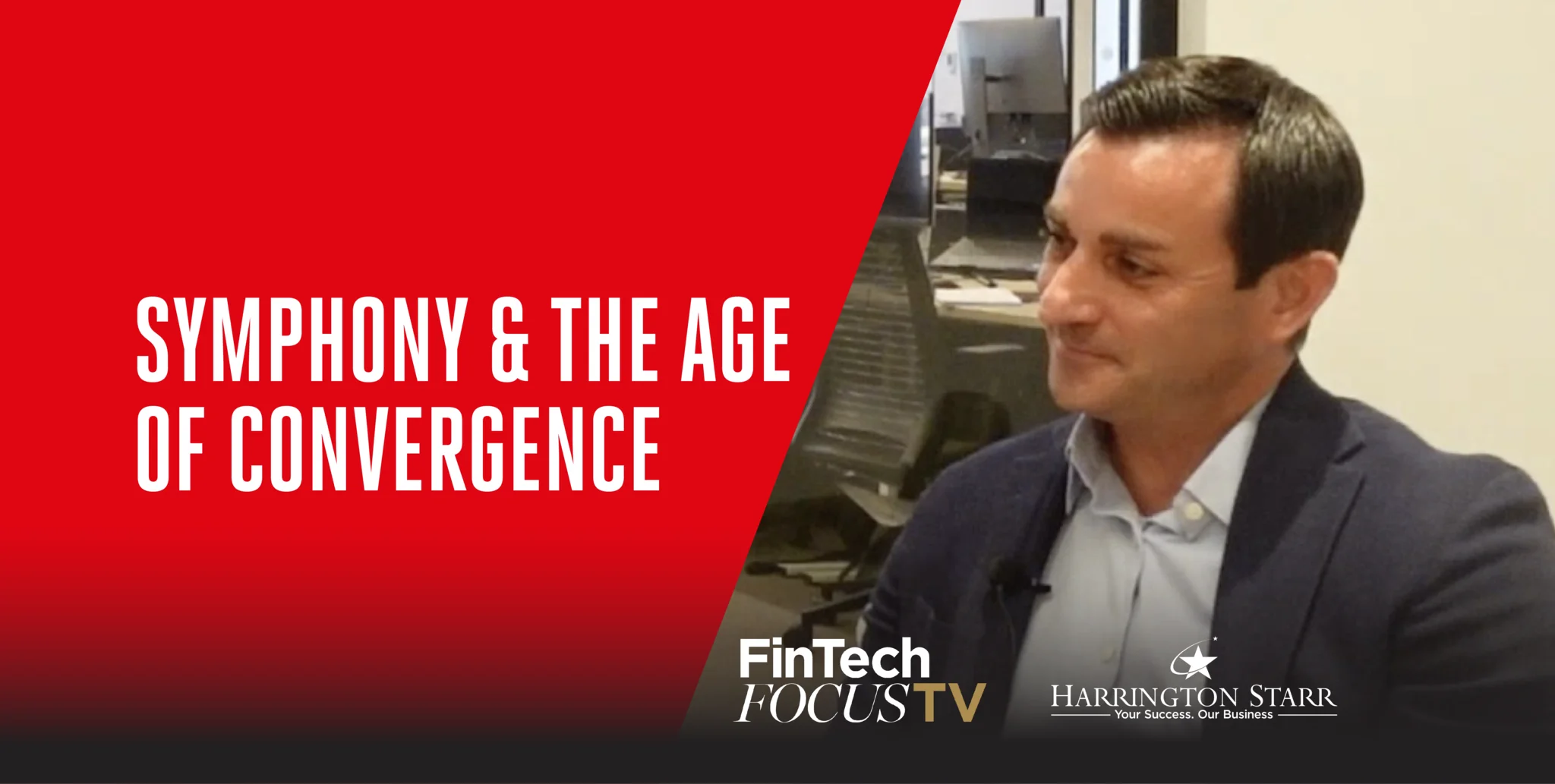
The latest episode of FinTech Focus TV brings a particularly compelling perspective to the future of financial technology, recorded on location at Symphony’s headquarters in New York. Toby meets with Brad Levy, CEO & Board Member at Symphony, for a conversation that delivers an unusually panoramic view of global markets, digital transformation, cloud adoption, communication infrastructure, shifting macroeconomic forces and the increasingly agentic workflows shaping tomorrow’s financial services landscape.
The episode is rich with themes that matter profoundly not only to FinTech leaders but also to the recruitment market that supports them. With financial institutions expanding their cloud capabilities, refining their approach to artificial intelligence, adopting new communication channels, rethinking digital assets and preparing for sweeping regulatory changes, the demand for skilled FinTech talent continues to rise. For Harrington Starr, whose remit spans technology hiring across software engineering, cloud, cybersecurity, infrastructure, quantitative trading, product management, and other specialist verticals, this conversation demonstrates how rapidly the expectations of modern technology teams are evolving.
What emerges throughout the discussion is that financial services is entering a period of convergence unlike anything seen in recent history. Multiple technological movements that have been developing independently, cloud computing, agentic workflows, encrypted collaboration systems, programmable digital ledgers and advanced automation, are now intersecting at the same moment. The results are transformative for communication, settlement, risk, compliance, trading behaviour and operational models across global markets.
To ground the discussion, Brad begins by walking Toby through the evolution of Symphony itself. The company, founded in 2014, entered the market initially as a secure communication platform. Its capabilities expanded dramatically in 2021 with the acquisition of Cloud9, a voice-trading communication system established the same year. With this integration, Symphony now stands as both a messaging and voice solution, with workflow tools embedded throughout.
Across the past decade, Symphony’s offering has shifted in shape as the industry itself has changed. At first, the platform was seen as a destination system. Over time, however, it became increasingly clear that traders, operations teams, analysts and salespeople do not want to switch constantly between disconnected interfaces. Symphony’s strategy evolved accordingly, focusing instead on embedding into workflows rather than forcing users into a dedicated environment. This shift reflects a deeper truth about financial services: the more interconnected systems become, the more valuable a communication layer is when it can operate across multiple points of interaction rather than existing in its own silo.
Brad also highlights that Symphony’s growth has coincided with a significant expansion in communication styles used across finance. Beyond traditional messaging and voice, teams now depend heavily on texting, WhatsApp and a range of external collaboration systems. Symphony increasingly acts as connective tissue between all these channels. This places the company in the middle of one of the most consequential shifts in financial markets today: the movement from fragmented communication to unified, encrypted, compliant and workflow-aware communication networks.
For organisations hiring engineering teams, compliance technologists, cloud specialists or financial infrastructure developers, Brad’s overview illustrates the increasing complexity of communication architecture across global markets and the necessity for talent capable of building solutions that span multiple systems concurrently.
One of the most eye-opening parts of the discussion emerges when Toby observes that cloud has become mainstream in financial services. Brad responds by reframing this perception entirely. He suggests that cloud adoption in finance is only at its earliest stage, despite the fact that cloud is deeply embedded in our personal lives. He notes that entertainment, shopping, food delivery and communication have all moved seamlessly into cloud-native, software-as-a-service environments.
Enterprise financial systems, by contrast, remain significantly behind due to structural complexity. Financial institutions operate under strict regulation, manage vast legacy infrastructures and depend on risk-sensitive processes that cannot be altered without deep consideration. Unlike consumer apps, financial platforms cannot simply be deployed overnight. Adoption must be precise, controlled and extremely secure.
Brad argues that the timing of cloud adoption is deeply connected to the rise of agentic AI and programmable ledgers. He describes an accelerating movement where digital transformation, automation and cloud migration are happening at the same time rather than sequentially. This marks a significant shift from the historical cycle where organisations built new systems, migrated from the old, and only then began innovating again. In the new model, everything is advancing in parallel.
For FinTech recruitment, this has profound implications. Teams now need cloud engineers who understand data sovereignty and encryption, AI specialists who can operate alongside compliance constraints, software developers who can build distributed systems and workflow layers simultaneously, and leaders who can drive change under constant regulatory and technological pressure. Clients increasingly need professionals who can work within this convergence rather than mastering any one isolated system.
The conversation moves from cloud into a broader discussion on the rate of technological change. Brad describes the last decade of financial technology as a period where disruptions occurred in rolling waves, each one influencing the next. He now sees something different: a world in which multiple explosions of innovation are happening simultaneously.
Brad believes the financial industry is halfway through a long arc of transformation that stretches from the early development of computing to a future around 2050, where many of today’s emerging technologies will be fully embedded. He expects the next 25 years to contain significantly more change than the previous 25, perhaps even an order of magnitude more. This acceleration is reflected across the industry, from digital market growth to the widespread advancement of autonomous workflows.
The implications of this acceleration are profound for how institutions recruit technology talent. A single transformation project no longer defines a business’s direction. Instead, firms must maintain constant momentum, adapt quickly to emerging workflows and build teams capable of delivering far more change at a much faster pace. The companies that succeed will be those that treat adaptability not as an occasional capability but as a permanent organisational discipline.
Toby raises an important question: if so much technology is emerging so rapidly, what does this mean for the people who must adopt it? Brad responds by observing that humans gravitate towards patterns and find disruption difficult. This is intensified by the regulatory environment of financial services, where mistakes carry immense consequences. As a result, the industry often avoids change until it becomes unavoidable.
Yet Brad is clear that resisting change is no longer an option. He describes how earlier eras treated “pivoting” as a sign of strategic weakness. Today, pivoting is essential. Firms must adapt continuously to survive. When Toby reflects on the enormous acceleration in cloud, digital assets and communication systems, Brad reinforces that adaptability must now be a central capability for every market participant.
He argues that many fears about technology eliminating jobs are misplaced. When interest rate swaps and electronic trading emerged decades ago, people predicted the decline of rates traders. Instead, the opposite happened. Human expertise moved into new areas and expanded the industry. Brad believes the same pattern will occur with AI, automation and digital workflows. The roles may shift, but the need for human capability will continue.
For FinTech recruitment, this is a crucial insight: emerging technologies will create new roles faster than they eliminate old ones. Talent strategy must anticipate areas of growth rather than simply replacing displaced roles.
Given Brad’s background in energy banking, it is unsurprising that the discussion moves into the relationship between energy, compute power and digital assets. He observes that Bitcoin operates on a foundation of compute, cooling and code, drawing parallels to the way gold once underpinned currency.
Brad notes that energy demands are increasing globally, contrary to earlier expectations. Nuclear power, grid development and global supply chains will all need significant expansion to sustain the next phase of digital transformation. He also highlights how slowly money still moves today, referencing examples from the 2008–2009 crisis, where large institutions relied on physical cheques for liquidity over weekends.
In contrast, he points out the rapid acceleration in digital payments and stablecoins during the past two years. With major institutions such as SWIFT, DTCC and NASDAQ adopting digital ledger technologies, it is clear that the structure of markets is shifting towards continuous, 24-hour movement of assets rather than relying on traditional settlement cycles.
As this shift accelerates, demand will grow for engineers with experience in blockchain, distributed systems, cryptography, market infrastructure and regulatory technology, roles that FinTech recruitment firms must increasingly prioritise.
Brad explains that Symphony is increasingly involved in market workflows impacted by T+1 settlement. Financial institutions must transition from batch-based processes to real-time coordination, and Symphony plays a central role in enabling the secure communication and exception management required to support this shift. The company has built partnerships with major market infrastructure providers and technology firms to ensure that communication, data and workflow layers are aligned with new regulatory timings.
He also describes Symphony’s involvement in capturing and managing off-platform communication such as WhatsApp chats, addressing both compliance and workflow challenges. As communication channels diversify, firms must gain visibility into conversations that inform decisions, risk and client interactions. Symphony ensures that these channels remain governed, auditable and integrated.
The future, Brad suggests, will involve hybrid environments where secure on-prem components sit alongside cloud-based systems. He describes Symphony’s development of confidential cloud systems that bring key management capabilities into cloud environments without compromising security, reducing the need for firms to maintain local hardware.
Towards the end of the episode, Toby asks Brad what he has learned in recent years as the industry undergoes rapid transformation. Brad describes how he has gained a deeper understanding of long-term and short-term thinking. He notes that leaders must balance generational arcs with the immediate demands of quarterly execution. He refers to this balance as patient urgency, describing it as a mindset that recognises the speed of change while accepting that deep transformation still takes time.
He also emphasises the importance of curiosity, hard work and teamwork. Curiosity drives innovation and discovery. Hard work creates momentum. Teamwork ensures that individuals are part of something greater than themselves. These qualities, Brad suggests, are essential for navigating the future of global finance.
The conversation widens to consider how society engages with technology more broadly, including the challenges faced by younger generations exposed to constant digital stimulation. Brad speaks openly about how behaviour is shaped by devices and how this influences not only personal habits but also the professional environment in which the next generation will work.
For the FinTech recruitment landscape, this underscores the importance of cultural alignment, leadership capability and emotional intelligence alongside technical skills.
This episode of FinTech Focus TV is more than a conversation about technology. It is an exploration of how markets, societies and institutions are transforming at the intersection of cloud, AI, digital assets, communication, regulation and macroeconomics.
For Harrington Starr’s clients and candidates across London, New York and global financial hubs, these insights reveal the capabilities organisations now require: teams that can adapt quickly, engineers who understand interconnected workflows, leaders who embrace patient urgency and innovators who can operate confidently in a world defined by convergence.
As Brad Levy and Toby Babb demonstrate in this discussion, the future of financial technology is accelerating rapidly. Firms that invest in talent, embrace modern workflows and commit to continual transformation will be the ones that thrive in the decades ahead.