Why You’re Hiring Wrong in FinTech
02 April, 2026


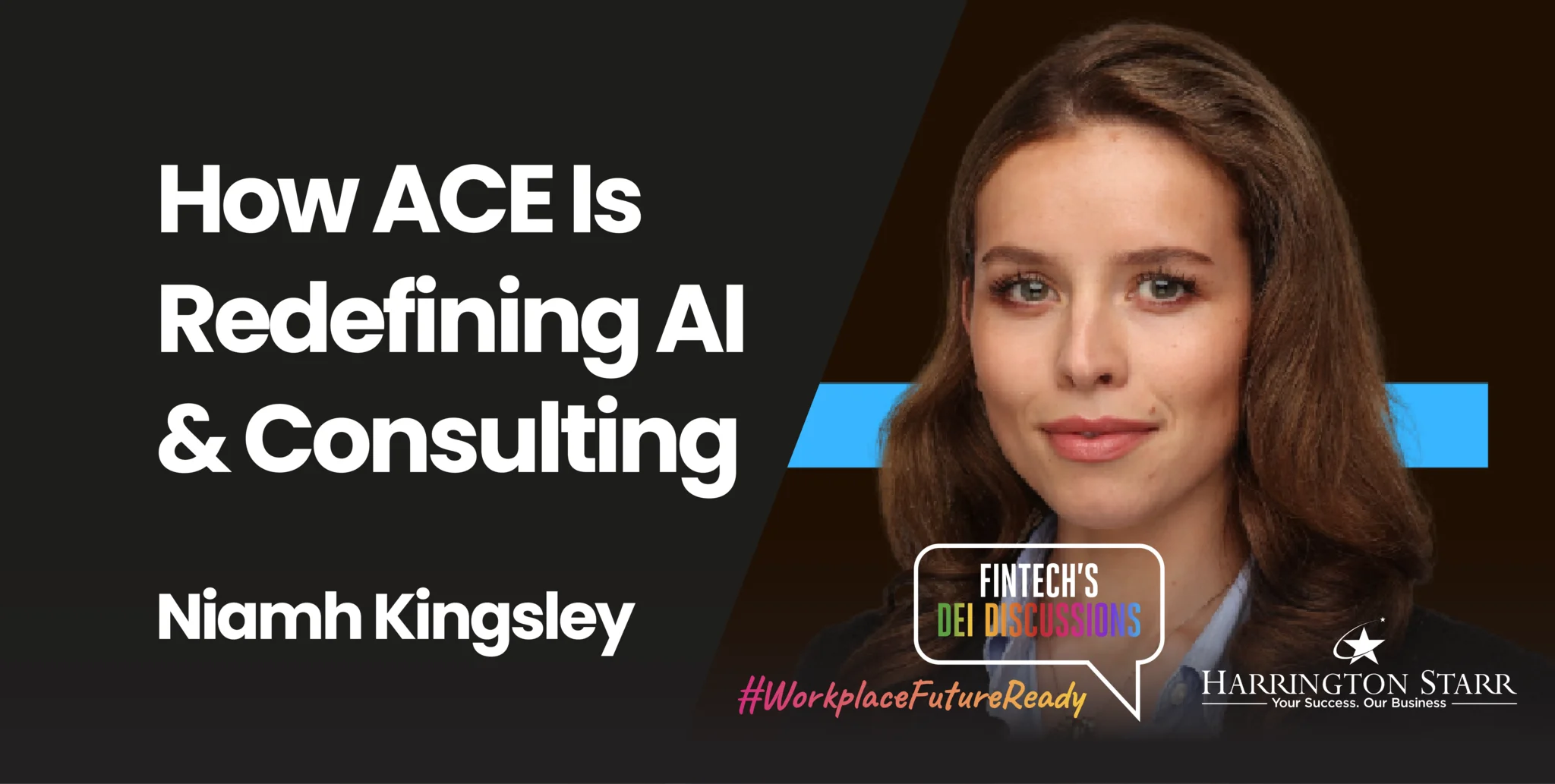
The latest episode of FinTech’s DEI Discussions, hosted by Nadia, introduces listeners to the remarkable journey and vision of Niamh Kingsley, Founder & CEO of ace and Chief Technology Officer at G MASS Consulting. In a conversation that bridges inclusion, AI, organisational culture, and the future of work in financial technology, Niamh demonstrates not only the strategic relevance of post-digital thinking but also the human realities behind achieving equity in one of the world’s most competitive industries.
For Harrington Starr, a global FinTech recruitment business, these insights offer a sharp and timely perspective: as technology evolves, so do the expectations of talent, leadership, and organisational readiness. Niamh’s reflections illuminate the cultural, structural, and technological challenges shaping the future of the FinTech workforce, and the opportunities businesses have to evolve.
Niamh’s career story, pulled directly from the transcript, challenges assumptions about what a typical technology leader looks like. She begins by explaining that she “wears two hats,” serving as CTO of G MASS Consulting while also founding and leading ace, the world’s first post-digital advisory firm. Her path to this point has been anything but conventional.
She originally studied international politics at the undergraduate level and worked as a Westminster-based researcher for a think tank. With no technical background and no experience in financial services, she eventually “fell into financial services consulting,” driven by curiosity and a personal connection to technology through her father, who runs an edtech company. She had always enjoyed the sciences but, like many young girls, was told implicitly and explicitly that her brain was “better suited to the humanities.” It was only years into her professional career that she began to dismantle this myth, ultimately pursuing computational neuroscience for her postgraduate degree.
This scientific training became a turning point. She discovered not only a passion for technology but also a talent for it. Her ability to bridge behavioural science, commercial realities, and advanced technology now sits at the core of her advisory work. As she shares with Nadia, much of her journey has been shaped by realising that the perceived divide between male and female aptitude is socially constructed rather than rooted in fact.
For the FinTech recruitment landscape, Niamh’s story underscores a critical truth: exceptional talent does not emerge from linear career paths. Harrington Starr continues to witness the growing value of candidates who blend multidimensional expertise, resilience, and lived experience, exactly the qualities Niamh now brings into her leadership roles.
Niamh founded ace out of a mixture of frustration and opportunity. While working in consulting, she observed a recurring pattern across organisations: ambitious talk about AI and digital transformation, but little in the way of genuine execution. The consulting models she encountered frequently relied on reselling frameworks, surface-level workshops, or “slideware,” with little connection to real-world technology architecture, workforce dynamics, or organisational strategy.
Ace was born to solve this gap. It is positioned as an advisory firm that deeply understands technology, intimately understands commercial realities, and helps clients execute effectively in a post-digital world. As Niamh explains in the transcript, post-digital refers to a landscape defined by a framework called Dream C: distributed ledger technology, robotics, extended reality, artificial intelligence, mutualisation, and cloud and quantum computing. These technologies together reshape not just tools but the environments in which businesses operate.
She also articulates three core values that differentiate ace. The first is a commitment to a post-digital strategy that avoids buzzword-led thinking. The aim is not to sell hype around AI or blockchain but to anchor recommendations in real outcomes such as resilience, growth, and reputation.
The second is execution over theatre. Ace refuses to engage in vanity pilots or superficial innovation experiences. If a solution cannot withstand regulatory scrutiny, workforce reality, or data integrity, it will not be proposed. Niamh emphasises that every client engagement begins with a free workshop, a deliberate move to “earn the right to work with a client as a partner, not just a vendor.”
The third value places people at the centre of all transformation. As part of the G MASS Consulting group, ace benefits from a legacy of resource and talent-focused engagement, and Niamh draws heavily on her neuroscience expertise to explore culture, behaviour, and the psychology of technology adoption.
This approach resonates strongly with Harrington Starr’s ethos as a FinTech recruitment business. Technology may drive efficiency, scale, and new business models, but talent determines whether transformation succeeds. Organisations that fail to align technical ambition with workforce capability risk falling behind in the competitive FinTech hiring market.
One of the most compelling sections of the episode comes when Nadia asks Niamh what inclusion means to her. Her response is deeply personal and highly relevant to the broader FinTech talent landscape. She defines inclusion not as who is merely present in the room, but as who has “access to power, safety, and opportunity.”
Her own experience in male-dominated finance, consulting, technology, and AI has been marked by barriers that are still widely under-acknowledged. Despite achieving C-suite roles at a young age, she notes that people often use her success to suggest that the journey could not have been difficult. This assumption, she says, “discredits the barriers to entry” that women face in obtaining senior leadership roles.
In addition, she highlights structural issues. Throughout her entire career, she has never reported directly to a woman. During a year of seeking investment for ace, she did not cross paths with a single woman in private equity, on investment boards, or in advisory capacities. She has been actively searching for another woman who has founded and still runs a financial services consulting business, but has yet to find one.
These insights reveal a powerful truth: representation is not simply a numbers issue; it is an issue of access. For industries like FinTech that rely on innovation and agility, failing to diversify leadership reduces cognitive diversity and limits strategic evolution. Harrington Starr’s commitment to inclusive hiring and industry-wide DEI advocacy is in direct alignment with the challenges Niamh describes so candidly.
During the episode, Niamh offers one of the clearest explanations of the shift from digital transformation to the post-digital world. Digital transformation relies on technology as a tool; post-digital is when technology becomes the environment. When Nadia asks for an example, Niamh compares ordering a taxi through Uber, a digital tool, to Waymo’s driverless taxi, which fundamentally changes the operating landscape.
In the workforce, digital transformation might involve tools like Teams or Zoom. Post-digital, however, includes the concept of “agent headcount,” where AI performs entire roles or processes behind the scenes. This illustrates a seismic shift in how organisations will allocate resources, design roles, and hire talent.
For a FinTech recruitment business like Harrington Starr, this shift signals a new era of hiring. The workforce of the future will not simply adapt to technology, it will coexist with it, be augmented by it, and sometimes be replaced by it. Talent strategies must anticipate emerging skill sets, modular technology architectures, and changing cultural expectations around work. Niamh’s insights reinforce the idea that organisations must prepare not for the technology of today, but for the environment of tomorrow.
When discussing how companies can future-proof themselves, Niamh stresses the importance of mapping the intersection between emerging technology and human behaviour. Technology adoption only succeeds when aligned with how people think, work, and respond to change. This is central to ace’s advisory methodology.
She outlines several critical priorities for organisations. First, businesses must get their foundations right, particularly around data architecture, ownership, and auditability. Companies still speaking about digital transformation today, she warns, are already behind.
Second, organisations must design for modularity. Locking into a single vendor or monolithic platform limits agility. Future-ready organisations must be capable of plugging in new capabilities as technology evolves, without embarking on multi-year rebuilds.
Third, the workforce must be brought on the journey. Organisations cannot afford to disregard the subject matter expertise embedded in their teams. People must feel they are valued partners in transformation, not collateral damage. As Niamh puts it, technology means nothing without people at the core.
This aligns closely with what Harrington Starr observes daily in the FinTech recruitment market. Companies with strong hiring strategies, modern data foundations, and inclusive cultures consistently outperform those that treat technology as a surface-level upgrade rather than a structural evolution.
As Nadia shifts the conversation toward responsible and ethical technology, Niamh explains the internal and external considerations companies must manage. Internally, businesses must ensure their people are supported, trained, and given opportunities as technology evolves. Externally, especially in finance, AI-driven decision-making must be transparent and auditable.
She references use cases such as insurance underwriting, loan assessments, and payment facility allocation. In each scenario, AI has the potential to scale capability but also risks reproducing or amplifying bias. The responsibility to mitigate those risks is substantial. Ethical AI requires robust governance, strong human oversight, and a culture that prioritises fairness.
This is particularly relevant to FinTech recruiters, clients, and candidates. As AI becomes increasingly embedded in financial services, technical skills, regulatory understanding, and ethical awareness will all become essential hiring criteria.
Near the close of the episode, Nadia asks what individuals can do to drive inclusion in their workplace. Niamh responds by emphasising that in the post-digital world, inclusion can become an engineering principle, something built into systems, workflows, and design from day one.
She encourages organisations to understand their decision points, who holds influence, and why. She reiterates the importance of normalising diverse leadership stories. For her, being transparent about her own career as a young female CEO is part of creating pathways for others. She wants her story not to be seen as exceptional, but rather as one of many possible journeys into technology and financial services.
This resonates strongly with Harrington Starr’s mission. As a FinTech recruitment business, we know that equitable hiring and inclusive workplaces are essential to unlocking innovation across the financial technology sector. Talent thrives when individuals see themselves reflected in leadership. Industries evolve when barriers are acknowledged, challenged, and removed.
This episode of FinTech’s DEI Discussions offers more than a window into the world of post-digital strategy. It sheds light on the lived experience of a woman navigating and transforming male-dominated environments, and it highlights the urgent need for organisations to rethink how they build teams, design systems, and lead people.
Niamh Kingsley’s insights remind us that FinTech’s future will be determined not only by the capabilities of artificial intelligence or emerging technologies but by the inclusivity, readiness, and ambition of the people who shape them.
As Harrington Starr continues to support clients across London, New York, and Belfast in scaling high-performing FinTech teams, conversations like this reflect the realities of the sector and reaffirm the importance of placing people at the centre of every transformation.
FinTech evolves fast. The post-digital world is already here. And as this episode makes clear, inclusion, leadership, and talent will define who succeeds in it.