Babb talks to BABB. London & The Future of On Chain Finance
01 April, 2026


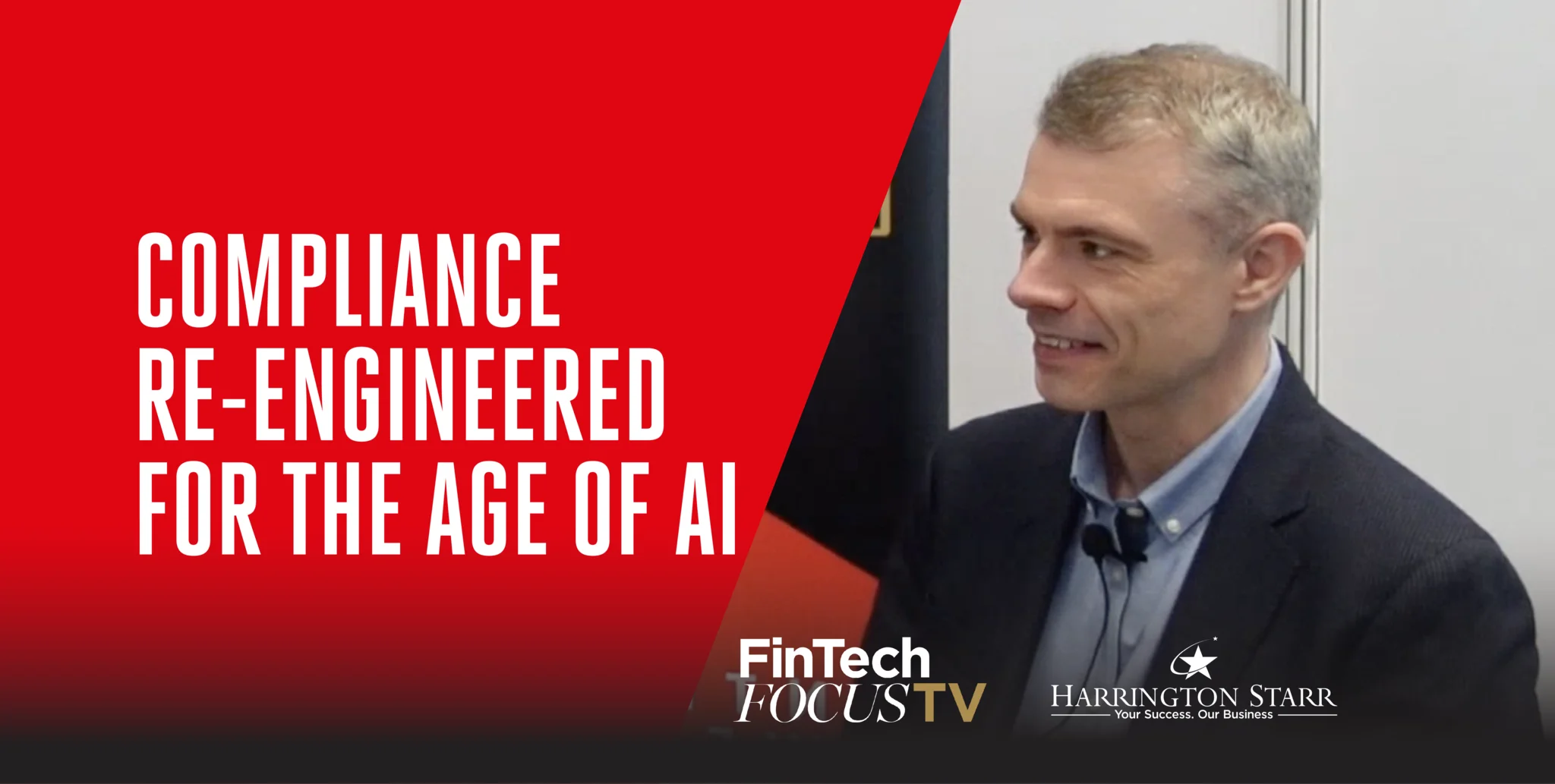
The latest episode of FinTech Focus TV, recorded live at Financial Crime 360 2025 at Old Billingsgate in London, brings together Toby and industry leader Iain Armstrong from ComplyAdvantage for a deep and compelling conversation on some of the most urgent challenges facing modern financial services. As a trusted FinTech recruitment partner across London, New York and global financial hubs, Harrington Starr is committed to spotlighting voices shaping the future of compliance, fraud prevention, financial crime technology and AI-driven innovation. This episode offers a rich and detailed exploration of how FinTech businesses, banks, payment firms and global institutions can strengthen their frameworks to stay ahead of rapidly evolving threats.
What unfolds is an insightful discussion spanning scam prevention, vulnerability awareness, the growing complexity of global sanctions, the launch of ComplyAdvantage’s AI-powered platform Mesh, and the dual impact of artificial intelligence on both criminal innovation and compliance advancement. This summary captures every key theme explored in this live episode, keeping faith with the transcript while optimising for FinTech, Financial Crime, Compliance, AI, Data, and wider recruitment-aligned search terms.
The conversation begins with Toby acknowledging the scale of Financial Crime 360 and the energy of the event, introducing Iain Armstrong, who is appearing on two separate panels in a single day. Iain explains that the first panel he is moderating. one he describes as the one he is most looking forward to, is centred around scams and deliberately uses a provocative title: “How could you be so stupid?” This arresting framing mirrors the type of victim-blaming language that fraud victims frequently hear, but Iain notes that the purpose of the title is to flip the narrative. Rather than directing blame at victims, the panel challenges financial institutions, law enforcement and technology companies to ask themselves how such scams were allowed to occur on their watch.
This section of the conversation speaks directly to a crucial theme across the FinTech industry: the shared responsibility between customers, institutions and technology providers in preventing scams. For recruitment audiences, particularly those looking to hire professionals in financial crime, compliance, risk, fraud analytics, data science or regulatory technology, Iain’s comments emphasise the growing expectation on teams to understand behavioural vulnerability. He explains that vulnerability is not a permanent characteristic but something that can affect any customer at any point in life, triggered by events such as bereavement or personal hardship. This situational vulnerability increases susceptibility to fraud, which means institutions must strengthen processes that recognise signs of vulnerability and place guardrails around customers during high-risk moments.
Toby reinforces this point by highlighting the common and damaging reflex of victim shaming and emphasises the importance of creating a more collective sense of responsibility across the ecosystem. The message is clear: for FinTech businesses and financial institutions to protect customers effectively, they must invest in tools, people and technology that make vulnerability detection part of everyday operational practice.
In the second part of the conversation, Iain previews his second panel of the day, which covers the Global Sanctions Report, where he will join what he describes as an extremely credentialed and experienced panel of experts. Sanctions compliance remains one of the most demanding and high-stakes areas across global financial services, and Iain underscores just how complex the sanctions landscape has become.
He explains that sanctions frameworks shift dramatically depending on changes in political leadership, particularly in the United States where different presidential administrations take distinct approaches to influencing international behaviour. While previous administrations leaned heavily on sanctions, the current administration has favoured the use of tariffs, creating noticeable divergence between the American, British and European approaches to sanctions policy. This divergence has significant implications for compliance professionals within global banks, FinTechs and financial institutions that operate across multiple jurisdictions. According to Iain, a business with operations in the UK, Europe and the United States must navigate three different regulatory systems simultaneously, each with its own philosophy and enforcement mechanisms.
This part of the discussion serves as a timely reminder for hiring managers within FinTech and banking that sanctions expertise is becoming an increasingly valuable skill set. Compliance teams must be capable of interpreting multiple regulatory regimes and understanding the operational impact of geopolitical change. For candidates building careers in compliance or sanctions roles, Iain’s comments illustrate just how dynamic and intellectually challenging this space has become.
The conversation shifts towards ComplyAdvantage’s most significant innovation: Mesh, the organisation’s new AI-driven compliance platform. Iain explains that Mesh represents a fundamental re-engineering of compliance for the age of artificial intelligence. Rather than continuing with the industry’s traditional siloed approach, where transactional data, customer data, name-screening data and due diligence processes all operate independently, ComplyAdvantage has unified these functions into a single, integrated system.
He notes that while this may sound simple at first, unifying these datasets produces outsized benefits. By analysing transactions and customer profiles in tandem, institutions can dramatically improve their ability to identify suspicious behaviour while simultaneously reducing false positives. For financial crime analysts, who currently lose substantial time investigating alerts that turn out to be meaningless, this unified approach offers an opportunity to focus on work that genuinely matters rather than administrative noise. Iain describes reducing meaningless alerts as the company’s “North Star,” acknowledging how essential it is for banks and FinTech companies to operate efficiently without sacrificing rigour in financial crime detection.
This conversation reflects a major shift in the skills required across financial crime and compliance hiring. FinTech recruitment trends increasingly point towards the need for hybrid professionals, those who understand compliance, data, AI, machine learning and risk simultaneously. As Toby and Iain emphasise, the combination of behavioural data, transactional insights and AI-driven analysis is creating a future where compliance roles require both technological and regulatory fluency. For hiring managers, this means that the competition for talent who understand AI-enabled risk modelling or complex data systems will continue to intensify.
Toby points out that artificial intelligence has dominated almost every FinTech event and discussion throughout the year, and asks Iain how AI influences their work and the wider industry. Iain acknowledges that while many organisations claim to use AI, not all genuinely do so. ComplyAdvantage has taken a deliberately rigorous approach by building a large data science function and focusing on measurable results tied to machine learning.
He raises an important challenge for the future of AI within financial services: explainability. Financial institutions cannot adopt black-box AI models where the logic behind an output cannot be explained to regulators. The industry’s dependence on governance and transparency means that any AI deployed in compliance processes must be fully auditable, traceable and interpretable. Iain offers a comparison to consumer-facing large language models such as ChatGPT, which are brilliant for everyday use but do not offer the level of explainability necessary for regulated environments. ComplyAdvantage, therefore designed its AI systems so that analysts can see precisely why an alert was generated or a decision was made.
This conversation reinforces a growing truth across the FinTech and Financial Crime recruitment landscape: AI literacy is no longer optional. Teams need people who understand algorithmic transparency, ethical AI, model governance, data quality and risk modelling. At Harrington Starr, we speak daily with hiring managers looking for compliance professionals who can work confidently alongside AI tools without relying on them blindly. Iain’s emphasis on explainability reflects what many institutions now consider a non-negotiable hiring requirement.
Towards the end of the episode, Toby reflects on how rapidly financial crime has evolved through 2024 and 2025, particularly with AI accelerating both positive innovation and increasingly sophisticated criminal behaviour. He asks Iain what he expects the financial crime landscape to look like in 2026. Iain responds candidly, explaining that his twenty-five years in financial crime have shown him repeatedly that criminals benefit from one major advantage: they do not require governance approval. Criminals can test, iterate and adopt new technologies immediately, whereas institutions must work within the constraints of regulation, internal approval processes and risk frameworks.
He shares a striking statistic: criminal use of AI has increased by almost 900% in the last two years, which illustrates the sheer scale at which threat actors are adopting machine learning tools. Yet he doesn’t take a defeatist view. Instead, he argues that while criminals will always evolve, compliance teams and technology providers can frustrate criminal activity by deploying AI defensively. He explains that criminals often get caught when they are forced to pivot after a loophole is closed. During periods of adaptation, criminals make mistakes, become sloppy and create opportunities for institutions to identify and intercept activity.
Iain highlights successful recent examples of international cooperation, such as the joint UK–US sanctions effort targeting drug trafficking networks, noting that the United States, particularly due to the fentanyl crisis, is deeply committed to strengthening international enforcement partnerships. He predicts that 2026 will likely see more cross-border collaboration as well as a continued need to “expect the unexpected,” acknowledging how unpredictable geopolitical and criminal developments can be.
For FinTech businesses and global banks hiring compliance, sanctions or financial crime talent, this future-focused perspective underscores the need for adaptable professionals who can navigate uncertainty while leveraging new technologies and understanding emerging threats.
As the conversation heads toward its close, Toby and Iain reflect on the importance of strong human judgement within a world increasingly shaped by AI tools. Though AI will continue to automate processes, detect patterns and enhance operational efficiency, the interpretation of those insights and the strategic decisions that follow still require highly trained compliance specialists.
Iain concludes by encouraging viewers to connect with him on LinkedIn or via the ComplyAdvantage website to learn more or request demonstrations of Mesh. Toby wraps up the episode by thanking Iain, praising both panels he is participating in, and acknowledging the level of insight shared throughout Financial Crime 360 2025.
This episode of FinTech Focus TV, recorded live at one of the industry’s flagship events, serves as a powerful reminder of how interconnected technology, regulation, compliance talent and financial crime innovation have become. For FinTech clients seeking to hire the best compliance and risk professionals, and for candidates looking to build meaningful careers in this space, the discussion between Toby and Iain Armstrong offers a real-time snapshot of where the industry is headed and what skills will define the next generation of leaders.
At Harrington Starr, our role as a FinTech recruitment partner is to help financial institutions, payments companies, RegTech innovators and global banks find the people who will strengthen their compliance frameworks, harness AI responsibly and build the guardrails that protect customers across the world. The themes from this episode, vulnerability, fraud prevention, sanctions complexity, AI transparency and the relentless evolution of criminal tactics, are shaping hiring strategies across the entire sector.
This conversation is timely, relevant and essential for anyone involved in FinTech leadership, compliance transformation or talent strategy. It captures exactly why financial crime roles are becoming some of the most dynamic and business-critical positions in the industry.