The Hidden Barriers for Women in Finance
21 October, 2026

Inclusion is a word used frequently across financial technology, but what does it really mean when someone is starting from a position of zero access? What happens when the barriers are not simply about entering the workplace, but accessing education, technology, banking and the infrastructure needed to participate in the global economy in the first place?
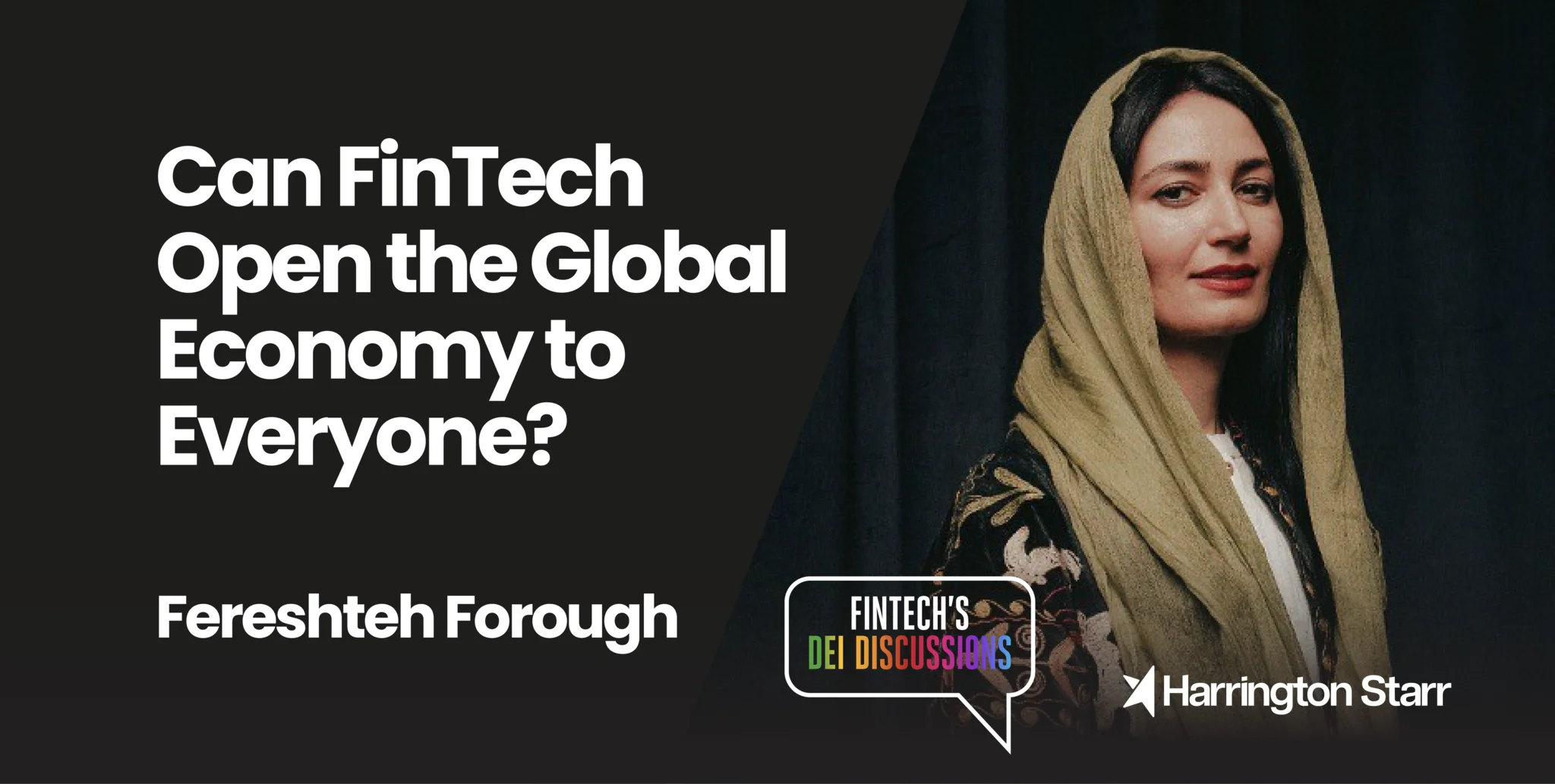
In this episode of FinTech’s DEI Discussions, host Nadia is joined by Fereshteh Forough, Founder and Executive Director of Code to Inspire, for a powerful conversation about financial inclusion, technology education, economic empowerment and the systems that can either create opportunities or reinforce exclusion.
Fereshteh shares her own experiences of exclusion, the story behind Code to Inspire and the work the organisation is doing to create opportunities for girls and women in Afghanistan. The discussion moves from education and coding to financial technology, cryptocurrency and the global economy, asking an important question for anyone building products, businesses or careers within FinTech: who are our systems actually designed to serve?
Fereshteh’s commitment to inclusion is deeply connected to her own experiences. She grew up as an Afghan refugee in Iran, where she explains that many Afghan refugees like her were denied the right to attend school. From a young age, this shaped her belief that education is a fundamental human right and should be accessible regardless of someone’s background.
After returning to Afghanistan following the fall of the Taliban in 2002, Fereshteh studied computer science at Herat University before later teaching there as a computer science professor. Her experiences continued to expose her to inequality, particularly as a woman working and studying within a male-dominated field and culture.
Today, the situation facing women and girls in Afghanistan makes that mission even more urgent. Fereshteh discusses the restrictions preventing girls and women above the age of 12 from accessing education and how this motivated her to challenge a system that removes educational and economic opportunities.
For Fereshteh, creating change therefore means building a pathway that connects education with economic independence. Access to knowledge matters, but so does the ability to turn that knowledge into a career, an income and greater control over your own future.
It is a perspective that broadens the conversation around diversity and inclusion in FinTech. Inclusion cannot only focus on the people already able to reach an employer, apply for a role or access a financial product. It must also consider those who have been prevented from reaching that starting point.
That ambition led Fereshteh to establish Code to Inspire, Afghanistan’s first coding school for girls and women. Founded in 2015 as a US nonprofit, Code to Inspire uses technology education as a pathway towards economic empowerment for women and girls in Afghanistan.
Initially, the organisation operated an in-person coding school in Herat. Following the Taliban’s return to power in Afghanistan in August 2021, however, Code to Inspire had to move its entire operation online. More recently, the organisation developed Code to Inspire Academy, its own online education platform designed to support more girls and women both inside and outside Afghanistan in a safe environment.
At the time of the podcast recording, Fereshteh says Code to Inspire had trained more than 1,420 students across coding, web and graphic design, mobile app development, motion animation, FinTech and crypto.
But education is only one part of the model.
Code to Inspire also works to connect women with economic opportunities. Fereshteh explains that the organisation outsources projects to Afghanistan, with more than $116,000 worth of remote projects collectively completed at the time of the conversation. At least one-third of its graduates are also the main or sole breadwinners in their households.
These outcomes demonstrate why conversations about women in technology, digital skills and financial inclusion are so closely connected. Learning a technical skill can open a door, but the wider infrastructure must exist for someone to walk through it.
One of the central ideas explored in the episode is whether our traditional definition of inclusion goes far enough.
As Fereshteh explains, inclusion often assumes there is an existing system and the challenge is bringing someone who has previously been excluded into it. But what happens when someone cannot access that system at all, or when the necessary system simply does not exist?
For Code to Inspire, the challenge is therefore much bigger than teaching someone to code and helping them find a job.
Does a student have a laptop? Does she have reliable internet access? Does she live within a family that supports her education or permits her to study? If she completes remote work, does she have a bank account through which she can receive payment? Can she access education safely? Does she have someone within her household who believes in her future?
These are the questions Fereshteh argues must be considered before organisations can even begin talking about equal access to education and employment.
Code to Inspire responds by creating an ecosystem around its students. Education is combined with technology, mentorship, career preparation and economic opportunity. Together, those components create a more inclusive environment for women who have otherwise been denied access to resources and opportunities.
In this context, inclusion becomes tangible. It means a young woman who cannot attend school being able to learn. It means being able to build something, work, generate an income and ultimately participate in the global economy.
The conversation also examines the intersection between technology, finance, education and human rights.
Fereshteh does not view these as separate challenges. Her own experience as a refugee and a woman in technology has shown how closely connected they can be.
Education provides knowledge. Technology provides tools. Economic opportunity can provide independence. Human rights connect all of those elements.
Financial independence can have consequences that reach far beyond employment. Fereshteh explains that when a woman can learn coding or graphic design, earn an income from home and contribute financially to her household, it can change both her life and the lives of her family.
But another problem then emerges: how does she get paid?
If somebody can complete digital work but cannot open a bank account, receive an international payment or safely transfer money, their ability to participate in the global economy remains restricted. Financial infrastructure therefore becomes a fundamental part of digital and economic inclusion.
For the financial technology industry, this raises significant questions. Creating digital products and employment opportunities is only part of the solution. The industry must also consider whether the systems surrounding those opportunities are accessible to the people who could benefit from them most.
This leads Nadia and Fereshteh into one of the episode’s most important discussions: how traditional finance should challenge itself.
Fereshteh argues that financial institutions need to ask a basic question: who was the system designed for, and who was unintentionally left out?
A woman may not have the documentation, credit history or physical access that a traditional bank expects someone to have when creating a financial profile. But, as Fereshteh explains, that does not necessarily mean she is financially incapable. Instead, it can expose a mismatch between the system that has been designed and the reality of the people attempting to access it.
This distinction is crucial for the future of inclusive finance and FinTech innovation.
Fereshteh argues that traditional financial institutions should stop treating underbanked or marginalised communities as a side project. Instead, their experiences and needs should form part of how systems and products are designed from the beginning.
Understanding the challenges facing marginalised communities can lead to different questions during product development. Are services affordable? Do people have the financial literacy required to use them? Can they safely access the resources being offered? What infrastructure does the product assume the customer already possesses?
Without those questions, financial products risk being designed primarily for people who already have access to the necessary tools and infrastructure.
For businesses across financial services and FinTech, this provides an important perspective on what meaningful diversity and inclusion can look like. It is not simply about who works within an organisation. It can also influence who participates in product design, whose experiences are understood and ultimately who a financial product is capable of serving.
The discussion then turns towards cryptocurrency and its potential role for people excluded from traditional financial infrastructure.
Fereshteh first encountered cryptocurrency, specifically Bitcoin, in late 2013. She was struck by the ability to create a wallet and send and receive cryptocurrency without experiencing some of the barriers she had encountered elsewhere.
Her interest eventually led Code to Inspire to accept cryptocurrency donations. From 2020, the organisation also shifted its payment operations to Afghanistan towards crypto and later stablecoins because of the speed, security and privacy they could provide.
Fereshteh describes humanitarian aid partnerships and explains how the organisation used digital assets to transfer money into Afghanistan. During a period in which the banking system had collapsed, crypto became what she describes as a lifeline both for students on the ground and for the organisation itself.
This experience shapes the way she views cryptocurrency today.
For women in Afghanistan, she argues, crypto is not necessarily an investment asset. It can instead function as a tool for financial freedom, particularly for people living under regimes where regulations and barriers restrict their access to traditional financial systems.
Digital wallets offered Code to Inspire’s students and graduates another way to send and receive payments and reconnect with the global economy.
Within the wider conversation around FinTech, digital assets and financial inclusion, this provides an example of technology being used to solve a very practical access problem. The value is not simply in the technology itself, but in what that technology enables someone to do.
As the conversation draws towards its conclusion, Nadia asks what more the wider industry can do to drive meaningful inclusion.
Fereshteh’s message is clear: inclusion should not be treated as a side project.
Whether someone is building a company, developing a financial product or designing a technology platform, inclusion needs to be considered as part of the design process itself.
For FinTech companies, that means understanding the audience they want to serve and asking difficult questions. Does this product genuinely serve everyone within that audience? Who cannot access it? Who cannot afford to use it?
These questions shift inclusion away from being an initiative added after a product has been built and towards becoming a consideration within how the product is conceived.
Fereshteh also discusses the role of investors and funders. She has observed that funding can gravitate towards well-established organisations because they may feel like safer choices. However, she encourages greater attention towards grassroots organisations and communities working directly on the ground, where there can be a deeper understanding of the challenges people actually face.
The message is relevant across the wider financial technology sector. Innovation becomes more meaningful when the people designing technology understand the different realities of those expected to use it.
The episode ultimately challenges the FinTech industry to think about inclusion more broadly.
For FinTech recruitment and financial technology recruitment, discussions around diversity often understandably focus on representation, hiring, progression and workplace culture. These remain important issues. But Fereshteh’s experiences demonstrate why the conversation can extend further into access itself.
Who has the opportunity to learn the skills required to build a career in technology? Who has access to the infrastructure required to work remotely? Who can receive payment for their work? Who can access the financial products being created? And whose experiences are represented when those products and systems are designed?
The answers can shape both the financial technology workforce and the customers that FinTech ultimately serves.
As a FinTech recruitment business, Harrington Starr regularly engages with the people and organisations shaping financial technology. Conversations such as this one on FinTech’s DEI Discussions provide an opportunity to look beyond hiring alone and consider the wider conditions that influence who is able to access technology careers and participate in the financial ecosystem.
Fereshteh’s story illustrates the connection between technology skills and economic opportunity particularly clearly. Teaching someone to code can create possibilities, but skills cannot operate in isolation. Education, technology, mentorship, career preparation, payment infrastructure and economic opportunity all have to connect if those possibilities are going to translate into meaningful independence.
For employers across FinTech and financial services, it is a reminder of why different experiences and perspectives matter. Understanding barriers that are invisible to one group of people can be essential when designing technology intended for a much broader population.
Perhaps the clearest message from the episode comes at its conclusion.
Fereshteh argues that inclusion should not be thought of as charity. It is something that must be incorporated into the products, projects and systems we create.
That statement captures the wider theme running throughout her conversation with Nadia.
True inclusion requires more than inviting people into systems that already exist. Sometimes it requires questioning the assumptions on which those systems were built. Sometimes it means providing the laptop, internet connection, education or mentorship required before someone can even approach the opportunity. And sometimes it means using financial technology differently so that somebody who has been excluded from traditional infrastructure can participate in the global economy.
Through Code to Inspire, Fereshteh has put that philosophy into practice by connecting technology education with economic empowerment for girls and women in Afghanistan. Her work demonstrates what can happen when coding skills, mentorship, career preparation and access to financial tools are considered as parts of the same challenge rather than isolated initiatives.
For the FinTech industry, the conversation leaves an important question behind: when we talk about building the future of financial technology, who are we building it for?
If financial technology is going to fulfil its potential to broaden access and create new opportunities, inclusion cannot be something considered once the technology has already been built. It has to influence the questions asked at the very beginning.
Who can access this? Who cannot? What barriers are we assuming do not exist? And whose reality has not yet been considered?