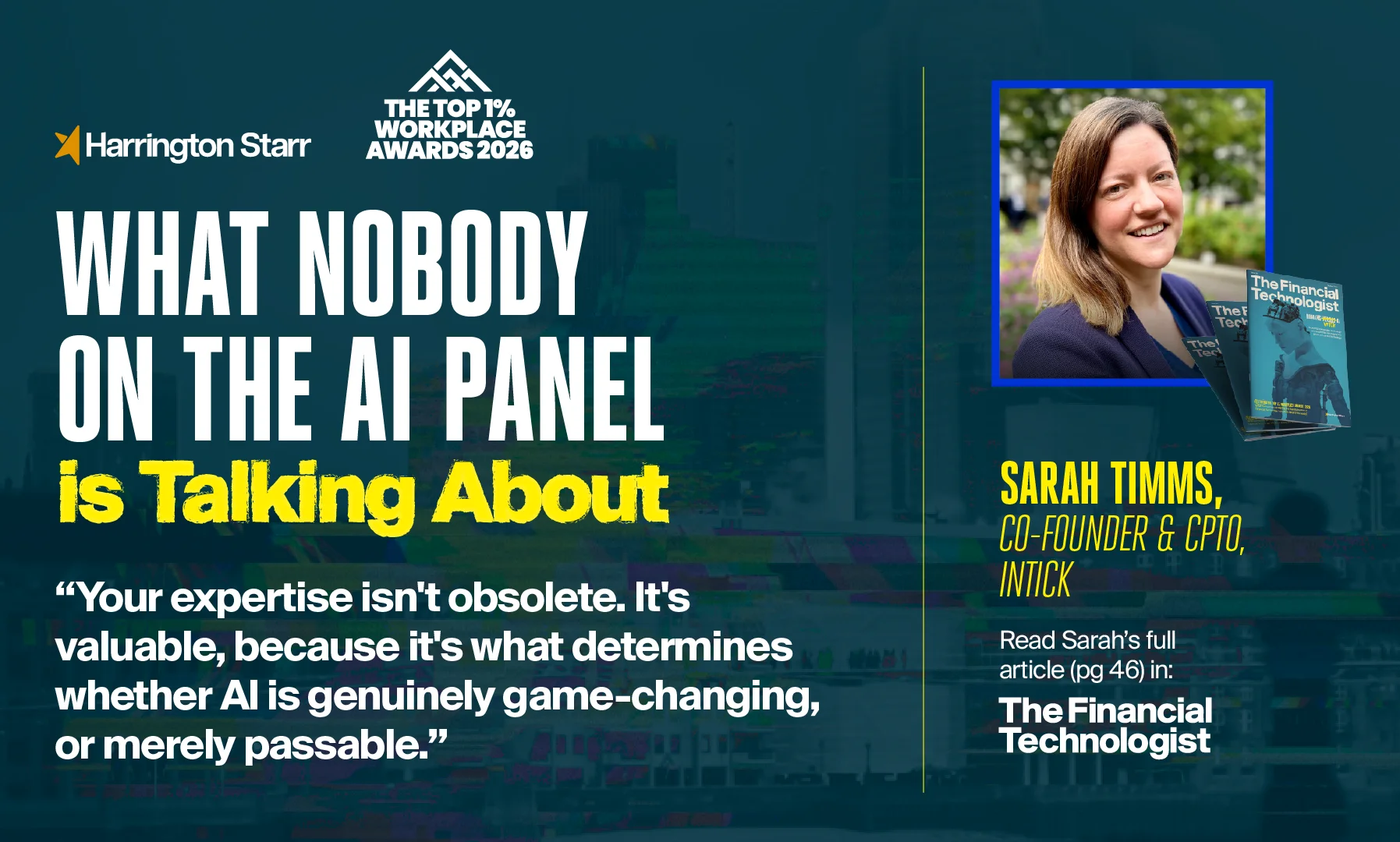
Every AI event I’ve attended focuses on productivity and competitive advantage - researchers explain models, and leaders describe their use cases for AI. But the topic that is never discussed - the one I most want to hear about - is how the people within those companies, especially those who believe their job may be impacted, react to the rollout of AI technologies and what those companies have done to support them. It seems to me that we’re so focused on discussing when AI makes mistakes that we’ve forgotten to talk about the lessons learned from the mistakes of the people leading the rollout of AI tools.
I'm the Chief Product and Technology Officer at InTick, a listed derivatives fintech startup. I don't claim special expertise in the infrastructure behind AI technology, but I do have first-hand experience of what happens when you integrate AI into a company, with real people and real anxieties. These are the lessons missing from the conversations that I wish had been discussed at the AI events. So, I'm offering them here for companies getting started, or facing workforce resistance, to hear what works and what doesn’t.
Make it fun and make it everyone's problem
One of the most useful things we've done at InTick is play with experimentation. We’ve run countless experiments to assess how AI tools perform in certain situations. My personal favourite was when members of our executive team competed to build a new deployable company website using whatever AI tools they chose. Different approaches, different tools, different instincts, and we freely invited employees to review the results. The point wasn’t to produce a perfect website but to model from the top, a culture of curiosity. We wanted to show everyone how to run experiments safely and be creative within their own domains and, crucially, highlight that this isn't any single department’s responsibility. We made it a cross-functional game and made sure employees felt comfortable that, as a company, we’re still figuring it out, just like everyone else. If you're looking for a place to start, start there. AI adoption stalls when it's treated as a specialist activity and it accelerates when it feels like something every function, level, and person can participate in.
The early adopters and detractors aren't always who you expect
The thing that surprised me most was the personalities who embraced AI tools or who fought against them. Early adopters emerged in unexpected places, and this matters enormously. If you assume any one function will lead adoption, you're missing a significant opportunity. Seek out the natural adopters, wherever they are, and help them become evangelists to their peers. Give them time and space to share what they're learning. The peer-to-peer sharing resulted in faster adoption in day-to-day use by those resistant to AI tools. Perhaps more importantly, pay attention to the people who are resistant, and work with them closely to ensure they receive the support they need. People have genuine fear about the future of their jobs, and failing to address this results in, at best, unhappy team members, at worst, individuals actively blocking team adoption or misusing the tools.
Move fast without skipping governance
Early on we decided to be very exploratory with tools, actively trialling a large number. If an employee wanted to try something, we said yes quickly to a temporary trial, so we could learn what worked, what tool was best for what job, and how different team members leveraged the same tool. This created a culture of immersion into the technology, and with it came significant learning. Operating this way requires strong procurement and governance processes. But speed and rigour aren't mutually exclusive if you're intentional about doing both. We rigorously reviewed a tool's data security, but we did it fast and then worked with team members on experimental design to ensure careful thought was given to data/IP leakage.
Start talking about the fear
To bring this back to the topic I most want to discuss: the AI talks where nobody is talking about the specific, personal fear that employees have, and what has or has not worked to address it. I have seen first-hand the emotional reactions from individuals fearful that by learning an AI tool and sharing that knowledge, they're making the case for their own role to be removed. The silence about this on the panels I attend is, frankly, a failure of the conversation.
My key learning is this: At InTick we’ve leaned in heavily and found AI to be a supercharger, not a substitute. The people who have gained the most from AI tools are those who already had strong skills in their domain. For people without that foundation, AI helped them produce an output that tended to be mediocre (I can show you the results of our website design competition!). AI changes what a skilled person can achieve, which makes for exciting opportunities. That's the message I'd want employees in every organisation to hear. Your expertise isn't obsolete. It's valuable, because it's what determines whether AI is genuinely game-changing, or merely passable. My message to leaders is simple: be more empathetic, don’t be afraid to talk about this subject and genuinely show how you, too, are learning to adopt these tools.
The intersection of AI and humanity
I started by saying I'm not an AI expert. But I've spent the last year leading InTick’s move towards being AI-native, and I’ve watched closely as our people navigate this. What I've concluded is that adoption is a human challenge - messy, emotional, and deeply personal. Companies treating AI as simply a technology rollout will get technology rollout results. The ones that approach it as the cultural transformation that it is and who lead with curiosity and honesty will, I think, see the same incredible results we’ve experienced at InTick.
------------------------------------------------------------------------------------
Why People Are Central to Successful AI Adoption
As AI adoption accelerates across Financial Technology, businesses must recognise that successful implementation depends as much on people as it does on technology. Employee concerns about job security, changing responsibilities and skills development cannot be overlooked. For organisations investing in Change & Transformation, creating a culture of trust, experimentation and continuous learning is essential to helping employees embrace AI with confidence.
At Harrington Starr, we recognise that workforce engagement and strong leadership are critical to making AI adoption sustainable. Across the FinTech sector, employers need leaders who can communicate openly, support professional development and recognise the value of existing expertise. As demand for Data & AI professionals evolves, organisations that invest in both specialist talent and the development of their existing teams will be better positioned to turn AI innovation into meaningful business outcomes.