Prediction Markets Are Changing the Rules of Trading
09 Nov, 2026

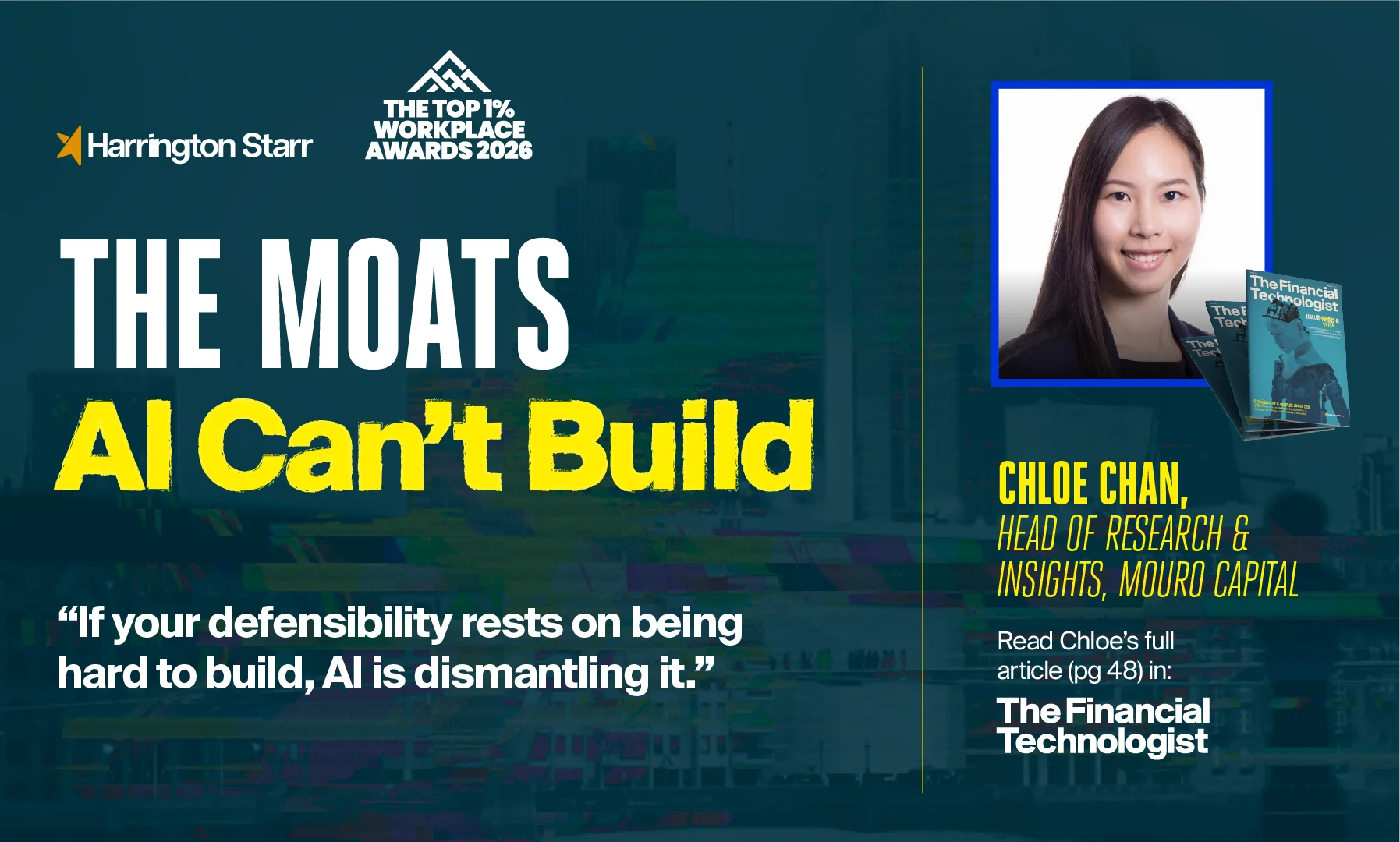
What Defends a Company When Anyone Can Build and Sell the Product We hav...
We have all seen the posts. One founder, no team, a product built over a weekend with Claude and Lovable, and an ARR figure that would have taken a venture-backed team years and dozens of hires to reach. The comments are ecstatic. The genre now writes itself: solo, AI-native, profitable. And technical credentials seem optional now. It's a good story, and the part everyone celebrates is real. The build genuinely has collapsed, from years to weeks. But "you can build it alone" and "you can defend it alone" are different claims, and the posts only ever make the first. The interesting question is the one they have not covered yet. Once anyone can build it, what's left to defend? What, exactly, is the moat?
In May 2025, Dario Amodei, chief executive of Anthropic, estimated a 70 to 80 percent chance that the first billion-dollar, one-person company could emerge as soon as 2026, possibly in areas such as proprietary trading or developer tools, where the business model requires relatively few human-run operations. While the true one-person unicorn has not arrived, the contenders are piling up.
For example, Base44, a vibe-coding platform, sold to Wix for $80 million six months after launch. Medvi, a direct-to-consumer prescription platform, booked $401 million in sales in its first full year. Both were started with one founder using off-the-shelf AI tools, operating purely on the application layer. Both also grew past the one-person shop, hiring people to keep the business running. So what has collapsed in the era of AI is the build. A product can now be assembled faster and cheaper by almost anyone, though running the business still takes more than just AI. If your defensibility rests on being hard to build, AI is dismantling it.
The obvious answer is distribution. Winning customers and scaling have always been difficult. The winner often out-executed on distribution: the acquisition engine, the sales motion, the servicing operation. That execution machine, expensive and slow to build, was itself part of the moat. But now with AI, a new entrant can automate much of the work of finding, winning, and serving customers, making commercial execution cheaper and faster. So being hard to build, or hard to sell, is no longer enough on its own. What does it take?
Increasingly, defensibility comes from structure: from the nature of the industry or business model, or from positions a company has accumulated over time. It takes forms such as licensure, deep operational integration, balance sheet strength, compliance credibility, and commercial incumbency. None of these can be stood up quickly, cheaply, or by prompting a model. And this structure is not spread evenly. Some industries are dense with it, and others have almost none. The first solo-AI winners Amodei named, prop trading and developer tools, sit towards the thinner end. Much of financial services sits towards the other end, with licences, capital, and regulation creating far more structural friction, which makes it the place to watch.
Start with licensure. The software is increasingly commoditised, but the regulatory permissions behind it are not. Securitize*, which tokenises assets for BlackRock, Apollo, and KKR and manages more than $4 billion in assets, holds a full regulated stack. Its SEC registrations span broker-dealer, transfer agent, and alternative trading system, alongside authorisation under the EU DLT Pilot Regime. Few, if any, competitors match that dual-jurisdiction footprint. A competitor can copy the product far faster than it can earn the right to operate it.
Then operational integration. DriveWealth*, an SEC-registered, FINRA-member broker-dealer, runs the execution, clearing, and settlement behind other companies' investing apps. It also holds the underlying customer accounts and records, clearing more than six million trades a day for the apps built on top of it. Displacing it means re-platforming a live, regulated brokerage, not swapping an app.
Balance sheet strength and compliance credibility create barriers of their own. A lender’s cost of capital and a KYC provider’s track record with regulated customers are earned slowly, defended structurally, and impossible to prompt into existence. Medvi reached hundreds of millions in sales with AI but skipped that credibility and soon drew an FDA warning over its marketing claims. Fast to build, and fragile exactly where the moat was missing. In enterprise markets, procurement history, approved-vendor status, and established relationships can compound into commercial incumbency, while long procurement cycles make that position slow to dislodge.
In horizontal, less structured markets, technology still defends a company. A better model can still be the edge, at least until the next one arrives. And these moats come with costs of their own. A licence or a balance sheet defends your position, but it also ties up capital, slows you down, and pulls the regulator into your business. You can avoid that by borrowing a licence or lending off someone else's balance sheet. But then the moat is not yours, and neither is the control. That can make companies easier to start, but the dependence creates a different vulnerability. If the provider fails, the failure is yours too. When the middleware firm Synapse collapsed in 2024, it froze roughly $160 million in customer funds, and the companies built on top of it were left unable to operate, some collapsing with it.
So here is a test. Can a well-funded, AI-native team replicate this in a year? If yes, it is a feature, not a moat. Product alone increasingly fails that test, so does distribution execution. The ones that pass are defended by something AI cannot readily recreate. Financial services makes this unusually visible, but the principle extends well beyond it. The harder questions are where the moats run deepest, and what makes some more durable than others. For founders, build toward what cannot be cloned, not what demos well. For investors, revenue proves the product works, not that it is defended. The question now is whether it rests on anything that lasts. AI did not kill the moat. It erodes the moats it can build and leaves what sits beneath them standing. And that is where defensibility now lives.
*Securitize and DriveWealth are portfolio companies of Mouro Capital
---------------------------------------------------------------------------
As AI makes it faster and cheaper to build financial technology products, sustainable competitive advantage increasingly depends on what competitors cannot easily replicate. In regulated markets, that includes specialist expertise, regulatory understanding, operational resilience and trusted client relationships. For businesses across the FinTech sector, attracting professionals who can navigate these complexities is just as important as developing innovative technology.
At Harrington Starr, we recognise that the right talent plays a critical role in building the capabilities that make a business difficult to displace. From Risk & Compliance specialists who support regulatory credibility to Sales & Marketing professionals who build lasting commercial relationships, businesses need expertise that extends beyond product development. As AI lowers barriers to entry, the ability to attract and retain people who strengthen trust, execution and long-term client partnerships will become an increasingly important source of differentiation.
Lorem ipsum dolor sit amet, consectetur adipiscing elit. Etiam sit amet est id augue molestie pharetra suscipit et enim. Donec maximus hendrerit augue, eu posuere eros venenatis eu.