Why Quant Hiring Remains Competitive in 2026/27
27 Oct, 2026


In an era of rapid digital transformation, the financial and technology sectors often obsess...

In an era of rapid digital transformation, the financial and technology sectors often obsess over the "what”: the algorithms, the blockchain protocols, the API integrations and, of course, AI. However, from years of advising startups and scaleups, in our work with entrepreneurs and co-founding teams, we see a recurring theme. It is a theme that surpasses technical skills. No matter how sophisticated the strategy, it will inevitably fail without the "how", found entirely within your people. This is confirmed on every conference stage I tread. Whether we’re talking trading strategies, enterprise-grade integrations, payments data, cloud-enabled transformation programmes - you name it - the topic of talent always comes up.
The research is clear, according to the World Economic Forum’s Future of Jobs Report 2025, employers expect that 39% of workers’ core skills will change by 2030, with employers citing analytical thinking as the most sought-after skill.
McKinsey’s analysis indicates that as AI and automation accelerates, the demand for social and emotional skills will grow by 26%, and the time spent using higher cognitive skills, such as creativity and complex information processing, will rise by 19%.
Here’s a third for good measure: Deloitte’s 2025 Global Human Capital Trends report reveals that over 50% of leaders and employees now consider human skills (like curiosity and emotional intelligence) to be a higher priority than technical skills alone.
We are moving toward a skills-based economy where technical prowess is an entry requirement, but human capability is the ultimate differentiator.
In short, the tasks that AI cannot replicate are becoming the most valuable assets in the professional market.
For the last 18 years, we’ve been helping clients with their two main priorities: growth and transformation. We have built corporate profiles and helped fill sales pipelines, and the most critical variable in every equation has always been the humans in the organisation, the teams that drive the engine. I have always loved how Jim Collins describes this in his book ‘Good to Great’. Great leaders of great organisations are great at figuring out ‘who’s on the bus?’
As I reflect on those businesses that have excelled along the way, aside from landing funding and product stability, it’s invariably attributed to the calibre of the leadership, focused on building a high-performance culture that attracts, retains and inspires a vibrant, diverse mix of talent.
Through my work as an executive coach and advisor to C-suite executives, rising talent keen to take those seats and co-found teams, I see recurring challenges. How do we lead under pressure, make ‘the boat go faster’, remain resilient as we grow at pace (founder burnout is real), resolve conflicts without damaging trust, lead with empathy while maintaining high-performance standards? Oh, and do all of this at a time when AI is reshaping how we work at a breakneck speed, and I could go on.
But this isn’t simply a discussion for the top of the tree. Everyone needs to skill up and hone their soft skills, aka professional or human skills.
For a number of years now, we’ve been talking about quiet quitting. Disgruntled employees taking steps to find new roles right under complacent leaders’ noses. A story on social media recently stopped me in my tracks. About ‘quiet building’ where employees are quietly investing in their skills to adapt, get ahead, out-compete, on their own time and on their own dime.
Learning shouldn’t be onerous and arduous; it should be easy to access, priced inclusively, even fun (I mean, just imagine?) And that’s exactly why I created SoftSkillingIt: to democratise professional learning for everyone. These professional tools, tips and techniques shouldn't be reserved for the few; they are needed at every stage of the professional ladder. Whether an ambitious school leaver, apprentice, or graduate trying to stand out in a sea of CVs, an emerging leader navigating the shift as they start to lead others, or a senior leader who is told they need to work on their people skills or emotional intelligence (seen a few of those lately?). The goal is to make this universally available. Think critical thinking and problem-solving, emotional intelligence, working with teams and collaboration, communication, adaptability and resilience.
I’m often asked, what works well? And there are three immediate shifts you could make right now.
Firstly, try the "really?” reframe: when a project hits a snag, or there’s a hiccup at work, rather than start with what went wrong, take a beat and ask why. And it is really powerful. Ask why the project really hit a snag. What was real, what was perception? Dig deeper, you might uncover hidden communication or cultural bottlenecks, process gaps or misalignment of expectations. Getting to the root cause really matters, otherwise we’re simply fixing the symptoms, not the cause. Go high to look at the bigger picture, become disciplined at building in time to think, reframe and reflect and dig deeper to get to the root cause. Why did this really happen?
Secondly, practice the five-second self-regulation rule. Under intense pressure, an intentional five-second pause before responding can be the difference between a reactive error and a measured leadership moment. Let me pass on great advice I’ve received: ‘never catastrophise, calibrate’ and ‘never react, respond’. Take 5 to reflect: Am I catastrophising? Am I reacting? Take a beat. Breathe. Recalibrate. Respond.
Finally, get great at reading the non-verbal cues, at reading the room. Actively listen - and we have two ears and one mouth for a reason. Practice actively listening for subtext, looking for the "iceberg" of unsaid concern that lies beneath the waterline. That will reveal the real truth. What do I mean? Just ask someone how they’re doing. An above-the-waterline reaction is ‘I’m fine’. At face value, a manager might report, ‘I asked them how they were doing, and they said ‘fine’, but it turns out that they were struggling, so the project was late’. What are the non-verbal cues and clues at play? Lean in on listening in.
The future of finance and technology is profoundly human.
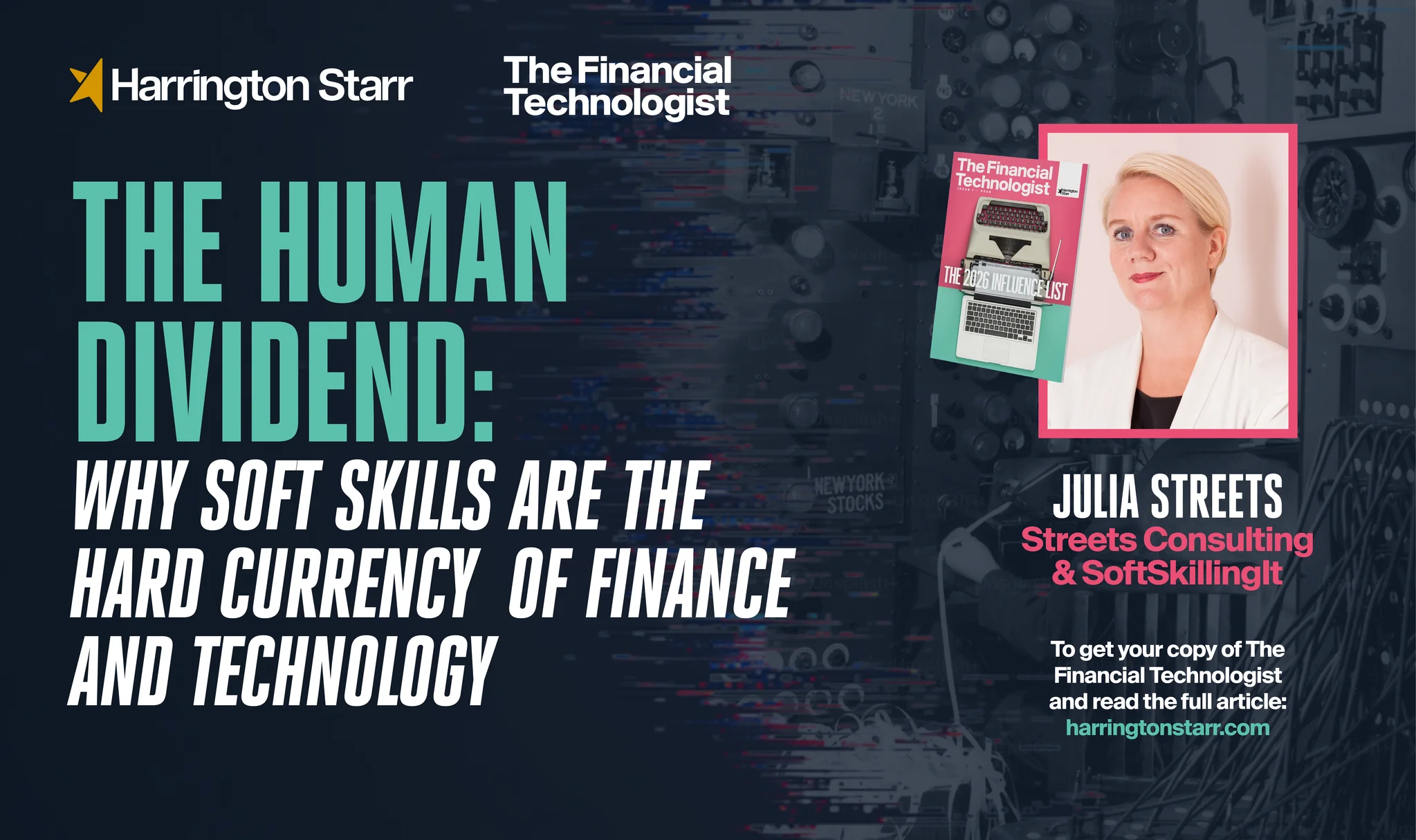
This is an article from The Financial Technologist: Influence List - page number: 44-45
Lorem ipsum dolor sit amet, consectetur adipiscing elit. Etiam sit amet est id augue molestie pharetra suscipit et enim. Donec maximus hendrerit augue, eu posuere eros venenatis eu.