Artificial Intelligence is entering a new phase in wealth management. Financial institutions are moving beyond isolated AI assistants toward AI-native advisory platforms, intelligent decision support, and autonomous AI agents that augment advisors across portfolio management, client engagement, compliance, and operations. The conversation is no longer about whether AI can generate insights; it is about whether those insights can be trusted.
As enterprise AI matures, a more fundamental question is emerging: What separates AI that merely impresses from AI that institutions can confidently rely upon?
The answer is not larger models or more sophisticated algorithms. It is institutional knowledge.
Many organisations have discovered that while modern AI systems excel at reasoning, summarisation, and automation, they often struggle in environments where decisions must be consistent, explainable, governed, and aligned with decades of accumulated business expertise. In wealth management, where every recommendation influences financial outcomes, client trust, and regulatory obligations, that distinction is critical.
The next generation of intelligent financial services will not be defined solely by artificial intelligence. It will be defined by intelligence grounded in institutional knowledge.
AI Can Reason, But Wealth Management Requires Context
Today's AI systems can analyse research reports, summarise market developments, draft client communications, answer complex questions, and support advisors with remarkable speed. These capabilities are transforming productivity across the financial services industry.
But reasoning alone is not enough.
An AI system may produce compelling investment commentary while lacking the contextual understanding needed to evaluate suitability requirements, interpret regulatory obligations, recognise tax implications, or understand how a recommendation affects broader portfolio objectives.
Wealth management is fundamentally a business of interconnected relationships. Every investment decision is influenced by a complex network of clients, portfolios, financial instruments, market conditions, risk tolerance, tax rules, life events, investment mandates, and regulatory policies.
Consider a portfolio rebalancing recommendation. Beyond identifying allocation changes, an advisor must evaluate capital gains exposure, liquidity needs, retirement objectives, concentration limits, market volatility, suitability requirements, and individual client preferences. None of these considerations exists in isolation. Together, they determine the most appropriate course of action.
Traditional AI models identify patterns within data. Wealth management decisions require an understanding of relationships between financial entities, business policies, and institutional knowledge.
That difference explains why many promising AI initiatives deliver impressive demonstrations but struggle to become trusted enterprise capabilities.
Why Enterprise AI Initiatives Often Stall
Across the financial services industry, organisations are investing heavily in AI-native advisor workspaces, autonomous research agents, intelligent compliance assistants, decision-support platforms, and multi-agent workflows. These initiatives promise to improve advisor productivity, accelerate decision-making, and deliver more personalised client experiences.
Yet many struggle to move beyond isolated use cases.
The challenge is rarely the intelligence of the underlying models.
More often, it is the absence of a trusted enterprise knowledge foundation.
Without an institutional context, AI relies primarily on statistical probability rather than organisational understanding. The result is inconsistent recommendations, fragmented reasoning, limited explainability, and growing governance concerns.
For wealth management firms, these limitations carry significant consequences.
Advisors need confidence that recommendations align with approved investment policies. Compliance teams require complete auditability. Risk managers need transparency into how conclusions are reached. Executive leadership must ensure AI operates consistently across products, business units, and regulatory jurisdictions.
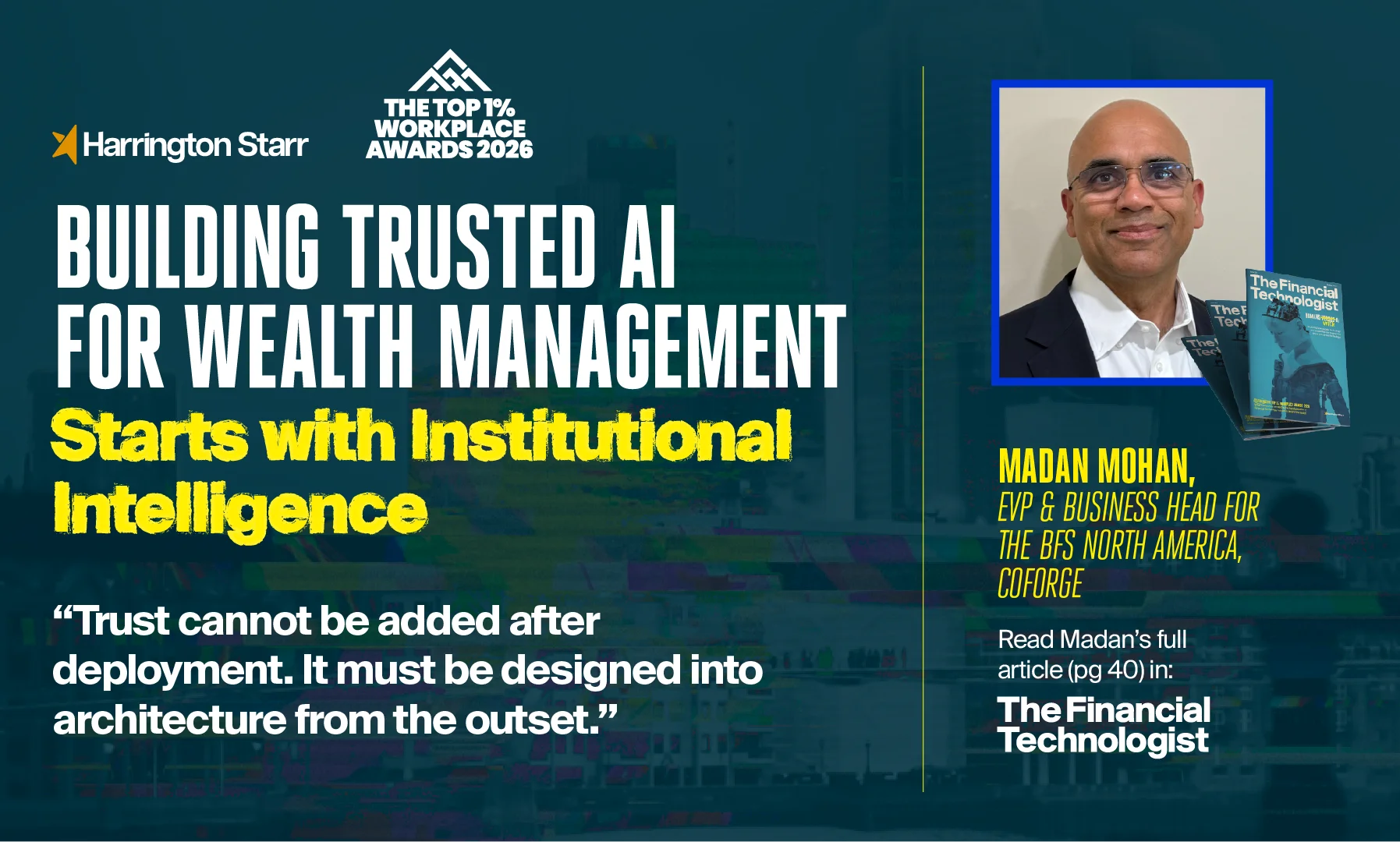
Trust cannot be added after deployment.
It must be designed into architecture from the outset.
The Shift Toward Knowledge-Centric Enterprise AI
The next evolution of enterprise AI is not about generating more information. It is about enabling better decisions.
Leading financial institutions are increasingly separating enterprise intelligence into three complementary capabilities.
Foundation models contribute reasoning and natural language understanding.
AI agents orchestrate tasks across enterprise workflows.
Institutional knowledge provides context, semantic relationships, governance, and organisational memory.
Together, they create AI systems capable not only of answering questions but of understanding why those answers are appropriate.
This distinction becomes especially important as organisations deploy multiple AI agents across advisory services, operations, compliance, and client engagement. While Retrieval-Augmented Generation (RAG) improves factual accuracy by retrieving relevant information, enterprise knowledge graphs go further by modelling explicit relationships between customers, portfolios, financial instruments, regulations, counterparties, market events, and business policies.
Rather than searching disconnected repositories, AI navigates an interconnected network of enterprise knowledge.
The result is greater consistency, explainability, and confidence in every recommendation.
Why Semantic Standards Matter
As AI expands across the enterprise, semantic consistency becomes just as important as computational capability.
Financial institutions have spent decades standardising business processes, reporting, and regulatory frameworks. AI should operate with the same discipline.
Industry standards such as BIAN (Banking Industry Architecture Network) provide a common representation of banking capabilities, allowing systems to interpret business functions consistently across the enterprise. Similarly, FIBO (Financial Industry Business Ontology) establishes standardised definitions and relationships for thousands of financial concepts, enabling AI to reason using a common financial language rather than isolated application-specific interpretations.
These standards create a shared semantic foundation that enables AI agents, enterprise applications, and decision-support systems to operate coherently.
Instead of every application maintaining its own interpretation of financial concepts, organisations establish a single source of business meaning.
That consistency becomes increasingly valuable as AI scales across advisory, operations, compliance, and risk functions.
Governance Is Becoming a Strategic Imperative
As enterprise AI adoption accelerates, governance has become a boardroom priority rather than simply a technology concern.
Regulatory expectations continue to evolve through frameworks such as SR 11-7, DORA, and the EU AI Act. Financial institutions are increasingly expected to explain how AI reaches decisions, demonstrate data lineage, enforce appropriate controls, and maintain transparency throughout the decision-making process.
Meeting these expectations requires more than model monitoring.
It requires a governed knowledge foundation.
This enables financial institutions to innovate with confidence while maintaining the trust of regulators, advisors, clients, and executive leadership.
The Future of Wealth Management Will Be Built on Institutional Intelligence
Many organisations assume that successful AI transformation requires replacing existing technology platforms. In reality, the greatest opportunity lies in connecting existing systems through a common layer of institutional knowledge.
When enterprise knowledge becomes accessible through AI, organisations can enhance advisory services, strengthen compliance, improve decision-making, and unlock greater value from decades of accumulated expertise, without rebuilding their technology foundations.
As wealth management enters its next phase of AI adoption, competitive advantage is shifting.
Success will no longer be determined by who deploys the largest models or the greatest number of AI agents. It will belong to institutions that combine AI with trusted knowledge, semantic intelligence, governance, and enterprise standards.
Financial institutions have spent decades building intellectual capital through products, processes, client relationships, regulatory expertise, and operational experience. The firms that lead in the AI era will be those that transform that institutional knowledge into an enterprise asset that every advisor, every AI agent, and every decision can leverage.
Artificial intelligence may power the future of wealth management.
Institutional intelligence will determine who earns and keeps the trust that defines it.