When businesses talk about being AI-native, they often mean one thing: a company that was built around AI from day one. In other words, a startup.
That definition is convenient, but it is also incorrect.
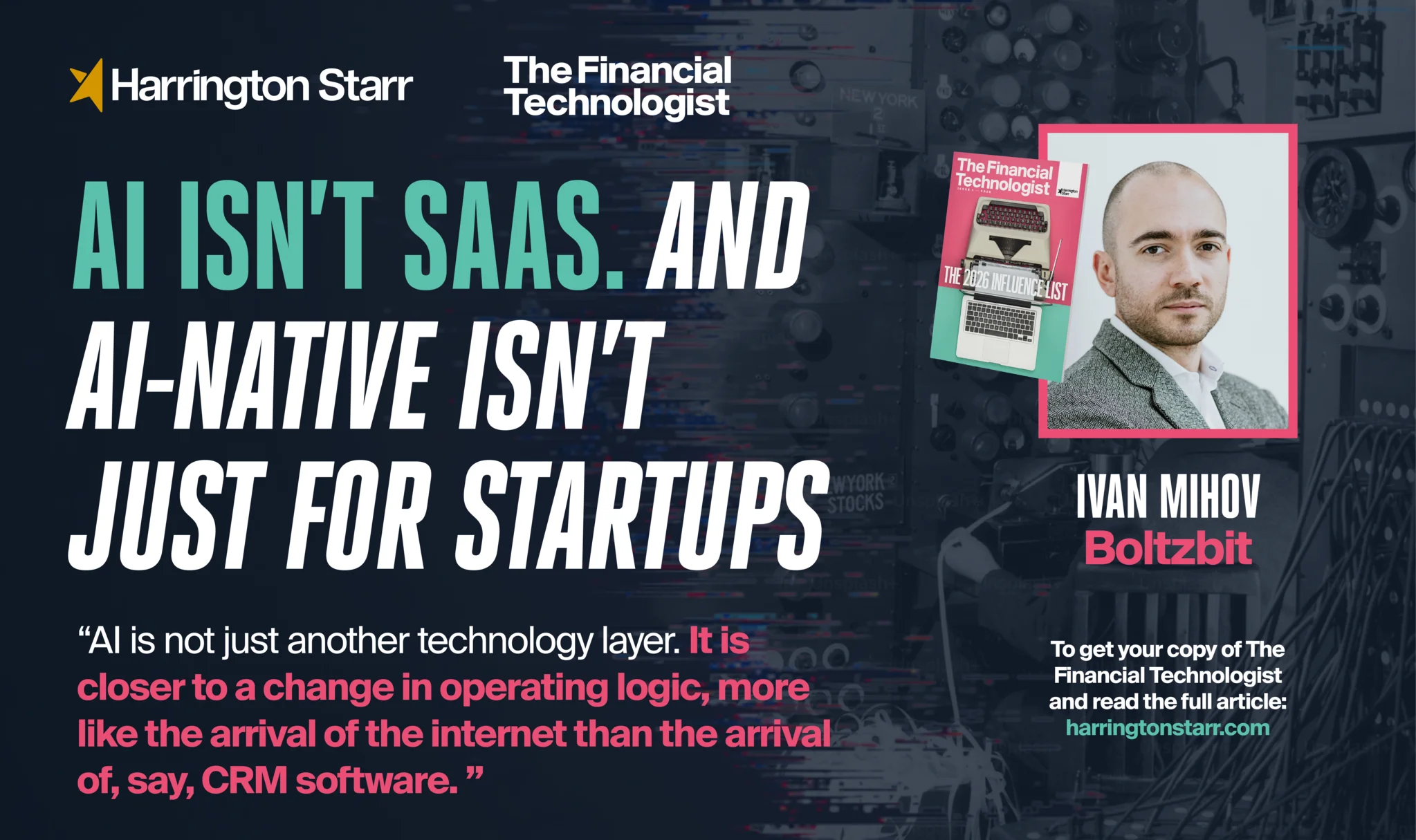
AI is not just another technology layer. It is closer to a change in operating logic, more like the arrival of the internet than the arrival of, say, CRM software. It changes operating models, decision-making and the way value is created and consumed.
If that is the case, and all evidence suggests it is, then becoming AI-native cannot be reserved for greenfield startups with venture funding and no legacy systems. Established firms will have to get there too.
And that is where the problems start.
Because in practice, many organisations are treating AI like just another feature. Something to bolt onto an existing workflow. A chatbot on top of the helpdesk. A summarisation tool in the inbox. A pilot project in a corner of the business where it can’t do too much damage.
A simple analogy helps. Before the internet, internal memos were typed and physically circulated around an organisation. When email arrived, companies did not keep mailing paper memos and sending an email saying, “It’s in the post.” They changed the system. Documents became digital. Distribution became instant. Workflows were rebuilt around the new reality.
Now imagine a firm that kept the old process but added email notifications. Technically, it would be “using the internet”. Practically, it would be missing the point entirely.
That is where a lot of AI adoption mostly sits today: visible at the edges, largely irrelevant at the core, and transformational nowhere.
Once we accept that AI-native is not a label reserved for startups, the harder question follows. What does it actually mean for a company that has existed for decades?
The honest answer is: it is messy.
Becoming AI-native is not a procurement exercise. It is not a matter of picking a vendor, running a pilot, and announcing a partnership. It means examining how decisions are made, how information flows, and where human judgment is actually required. In other words, it means looking at the operating model itself.
Only then does the technology question become meaningful. What kind of AI is appropriate? What outcomes should it serve? Where should it sit? And how should it evolve over time?
This is difficult to navigate in a market that is both crowded and noisy. New AI vendors appear daily, all promising transformation. Faced with that, many firms default to the usual logic: buy from the largest platform, run a proof of concept, customise a few screens, and hope the organisation adapts.
That is essentially the SaaS playbook and precisely the wrong model.
Most business AI needs are deeply company-specific. They require domain understanding, contextual awareness and an ability to adapt over time. Yet many organisations select AI partners using the same process they would use to buy enterprise software: impressive demos, light customisation at the edges, and then internal teams are expected to adjust their behaviour to the tool.
AI should not feel like traditional software. It should not be a black box dropped into an existing workflow. It needs to be treated more like infrastructure. Not a product, but a capability. Not a feature, but part of the architecture.
There is a fundamental difference between buying a finished solution and designing an operating model where intelligence is a structural property of the organisation. One is a tool. The other is a system.
And that leads to the question most companies would rather avoid: what makes us, us?
Not which product to deploy, but how AI should operate within existing systems. Who is responsible for its behaviour. How it evolves over time. How its outputs are explained, challenged, audited, and improved. AI is not primarily about features, it is about architecture, governance and intent.
This also explains why the debate about “AI replacing humans” tends to miss the point. Every major wave of automation has changed the nature of human work, but rarely eliminated it. Roles shift. Judgment moves up the stack. People spend less time pushing information around and more time deciding what to do with it.
AI is likely to follow the same pattern. The bigger risk is not mass unemployment, but mass mis-adoption: organisations deploying intelligence badly, in the wrong places, with the wrong incentives.
If AI is truly transformative, and there is little doubt that it is, then its adoption cannot be limited to startups experimenting at the edges of the economy. Banks, insurers, asset managers and critical infrastructure providers sit at the heart of our financial and social systems. Their failure to adapt responsibly would not be a competitive inconvenience, it would be a systemic risk.
This is the point to leave with: adopting AI is not optional. But adopting it poorly is dangerous. The technology matters, but the mindset matters more. Becoming AI-native is not about moving faster. It is about rebuilding intelligently and sustainably, from the inside out.
This is an article from The Financial Technologist: Influence List - page numbers: 46-47