AI Is Changing Financial Services Roles, But Transformation Is the Real Challenge
Artificial intelligence has quickly become one of the biggest talking points across financial services. Most conversations focus on what AI can do: improving efficiency, automating processes, and unlocking new capabilities across trading, operations, and customer experience. But one of the most important changes is happening behind the scenes, in how teams are structured and how roles are evolving.
Across the industry, roles are becoming less clearly defined than they once were. Where teams used to sit neatly in silos such as technology, data, or operations, those lines are now starting to blur. Engineers are expected to understand data, data teams are working more closely with product and business functions, and transformation professionals are increasingly sitting at the centre of it all, connecting strategy with delivery.
This shift is not just about new tools or technologies. It reflects a much broader change in how organisations operate. AI is speeding everything up, but many businesses are still set up in a way that reflects how things worked five or ten years ago. That gap is where a lot of the real challenges are starting to appear.
From a change and transformation perspective, adopting AI is rarely just a technology project. It is about people, processes, and how teams work together. In many cases, the technology itself is not the hardest part. The challenge is making sure the organisation is set up to actually use it properly. That means rethinking team structures, redefining roles, and creating closer collaboration between functions that may not have worked closely before.
We are also seeing a shift in what firms look for when they hire. Technical skills are still important, but they are no longer the only focus. Adaptability, curiosity, and the ability to work across different areas of the business are becoming just as valuable. In transformation roles especially, there is a growing demand for people who can manage change, bring different stakeholders together, and keep projects moving in environments that are often uncertain.
Another trend that stands out is how organisations are starting to think about transformation itself. It is no longer treated as a one-off programme with a clear end point. Instead, it is becoming something more continuous. As AI and data capabilities keep evolving, businesses need teams that can evolve with them, rather than trying to “complete” transformation and move on.
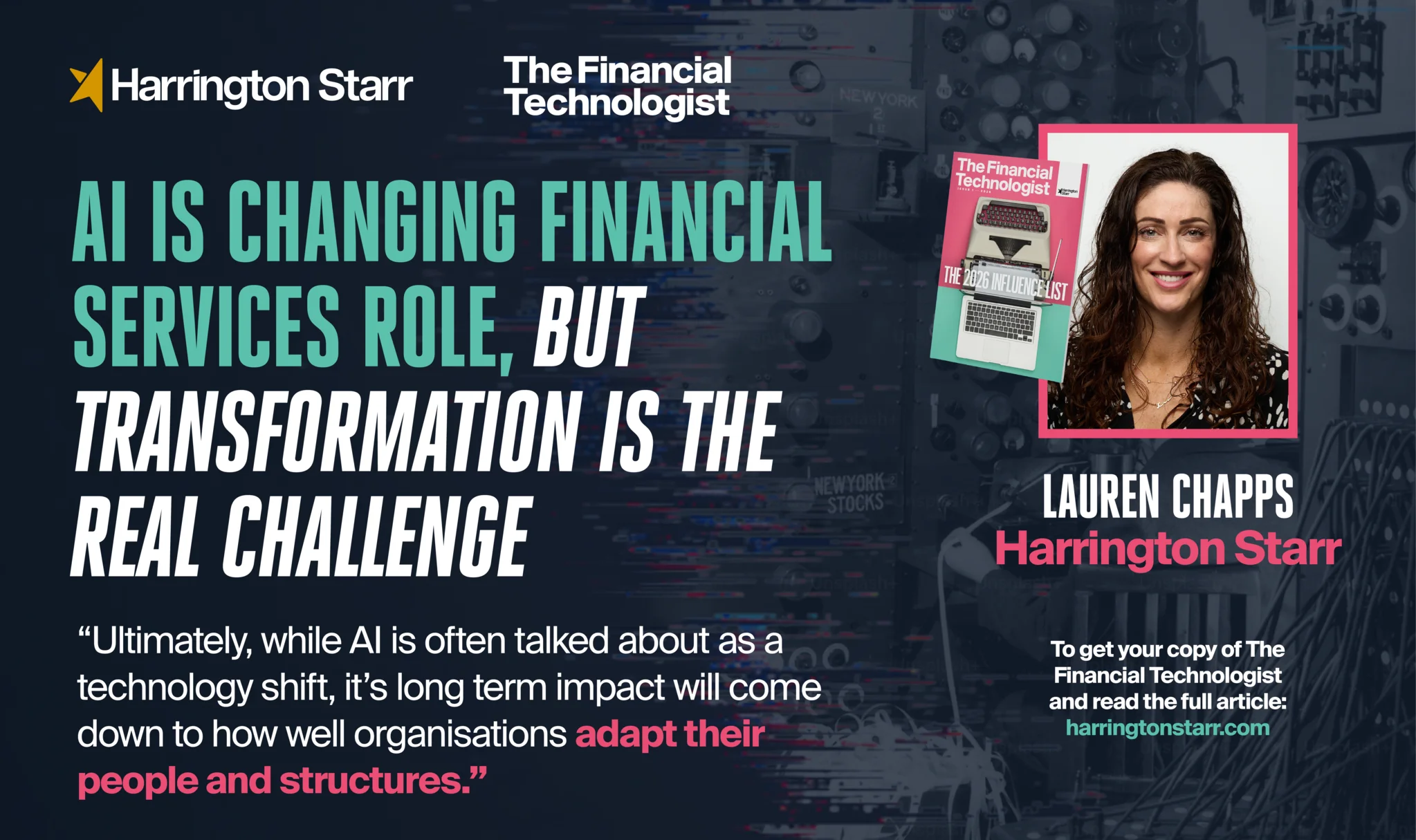
Ultimately, while AI is often talked about as a technology shift, its long-term impact will come down to how well organisations adapt their people and structures. The firms that get this right are not necessarily the ones with the most advanced technology, but the ones that are able to bring their teams with them and embed change in a practical, sustainable way.
For many organisations, the question is no longer whether AI will change roles and teams. That is already happening. The real question is whether they are set up to keep pace with that change, and whether they have the right people in place to make it work.
This is an article from The Financial Technologist: Influence List - page number: 42