Babb talks to BABB. London & The Future of On Chain Finance
01 April, 2026


For years, financial institutions have been told that legacy technology is the biggest obstacle to innovation. Core banking platforms are blamed for slow delivery, limited product agility, and the inability to compete with digital-first challengers. The accepted solution has been “rip and replace”, large-scale transformation programmes designed to tear out old systems and rebuild from scratch.
Yet despite billions invested, many of these programmes fail to deliver the outcomes leaders expect.
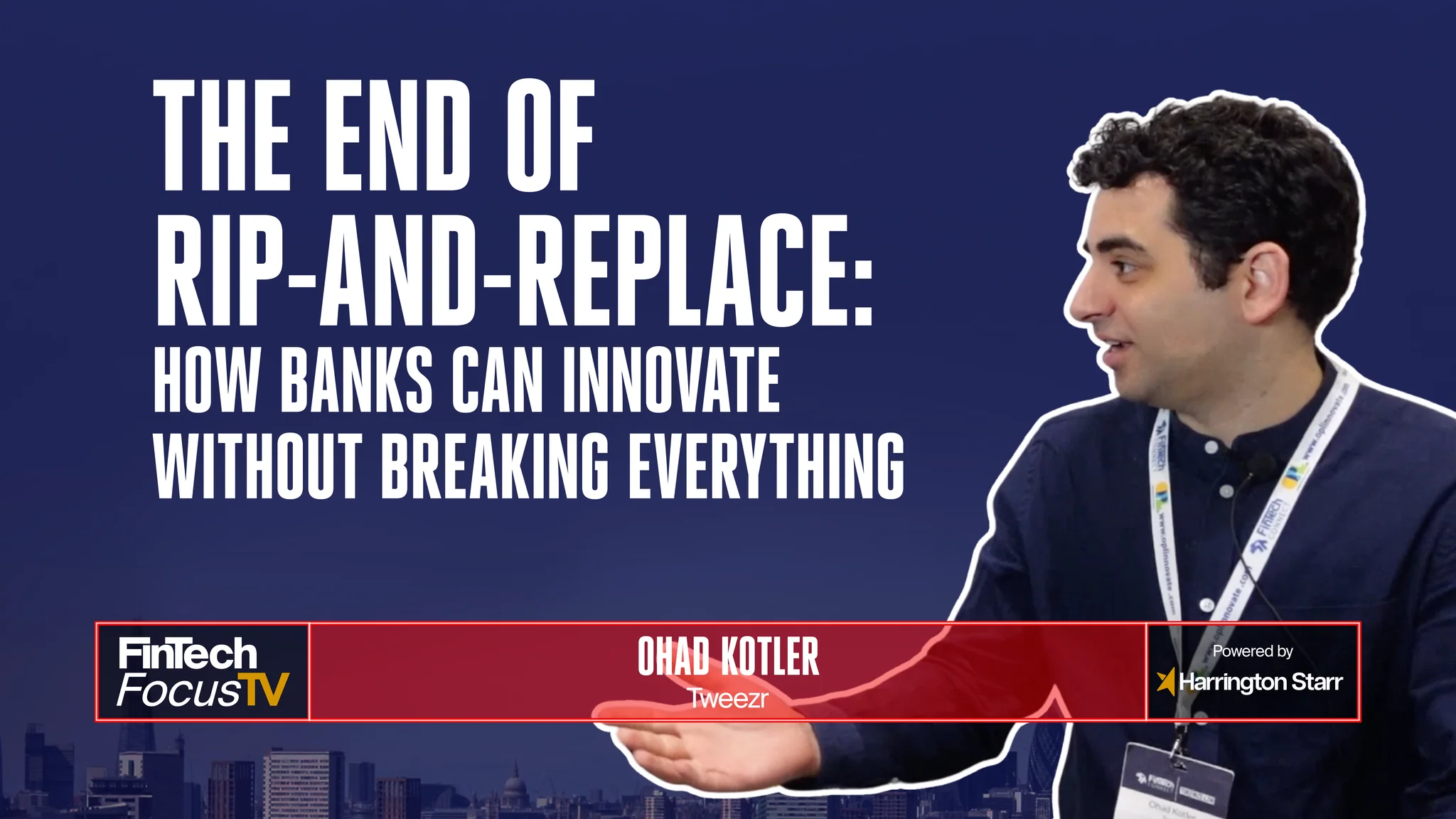
In this episode of FinTech Focus TV, recorded live at FinTech Connect 2025, Ohad Kotler, Co-Founder and CEO of Tweezr, joins host Carl Charlson to challenge one of the most deeply held assumptions in banking technology: that legacy systems are broken.
Instead, Ohad argues that legacy platforms are not the enemy, and that treating them as such may be the very reason bank modernisation continues to struggle.
When most people talk about legacy systems, they frame them as blockers. They are seen as outdated, fragile, and incapable of supporting modern product demands. Innovation teams often describe them as the reason new features take months, or even years, to reach customers.
But as Ohad explains, this view ignores a crucial truth.
Legacy systems are some of the most battle-tested, stable platforms in the world. They process vast transaction volumes, operate under intense regulatory scrutiny, and maintain resilience at a scale few modern systems have ever experienced. Customer accounts do not simply disappear. Money does not evaporate. These systems work, and they work reliably.
The issue is not that legacy systems lack capability. It is that they have been customised over decades to solve too many problems at once. This makes them difficult to change, hard to understand, and risky to modify without deep institutional knowledge.
In many organisations, that knowledge sits with a small number of individuals, often engineers approaching retirement, creating bottlenecks that slow progress even further.
Large-scale modernisation programmes promise a clean slate. By replacing core platforms entirely, banks hope to remove complexity and unlock faster innovation. In reality, these initiatives are among the most complex and high-risk technology projects in financial services.
Ohad highlights that a significant proportion of long-running transformation programmes either fail outright or fall short of expectations. Even when they succeed, they often take so long that the market has moved on by the time they go live.
There are several reasons for this:
The result is a pattern many technology leaders recognise: programmes that stretch over five, eight, or even ten years, consume enormous budgets, and still struggle to deliver meaningful competitive advantage.
This is why Ohad argues that the era of rip-and-replace is coming to an end.
Rather than tearing down legacy platforms, Ohad proposes a more pragmatic approach: understanding, improving, and evolving them.
He uses a simple analogy. Imagine living in a large, well-built house constructed decades ago. It may not meet every modern expectation, but the foundations are solid. Demolishing it entirely and rebuilding while still living inside is both disruptive and risky. A better option is to renovate selectively, upgrading individual rooms, improving infrastructure, and modernising where it matters most.
Applied to banking technology, this means identifying which parts of a legacy system need to change, and which parts already deliver stability and resilience. It is about enabling innovation without destabilising the core.
This approach allows financial institutions to move faster, reduce risk, and avoid the all-or-nothing mindset that has defined transformation efforts for years.
A key reason this approach is now possible lies in advances in artificial intelligence.
Historically, the sheer size and complexity of legacy platforms made them almost impossible to fully understand. Documentation was incomplete, system behaviour was poorly mapped, and knowledge was fragmented across teams. This made even small changes risky.
Ohad explains that AI is changing this dynamic. For the first time, it is possible to create meaningful semantic understanding of complex systems, mapping how components interact, how changes ripple through environments, and where risk truly lies.
This does not mean AI replaces engineering expertise. Instead, it augments it, enabling teams to analyse systems at a level of depth and speed that was previously unattainable.
As a result, banks can introduce new capabilities more confidently, reduce dependency on individual knowledge holders, and make better decisions about where and how to modernise.
One of the strongest themes in the conversation is speed.
Traditional banks are under constant pressure from digital-first competitors, fintechs, and evolving customer expectations. The ability to deliver new products, features, and experiences quickly is no longer optional, it is a core competitive advantage.
Yet speed has often been sacrificed in the name of stability. Transformation programmes slow delivery further, creating a paradox where institutions invest heavily in change but become less agile in the process.
By shifting away from full replacement strategies, banks can regain momentum. Incremental evolution allows teams to deliver value faster, learn continuously, and adapt to market demands without waiting years for transformation milestones.
This shift has implications not just for technology, but for organisational culture, operating models, and leadership mindset.
Looking ahead, Ohad suggests that 2026 will be a defining year for financial institutions.
The industry has seen an explosion of interest in AI-driven capabilities, from operational efficiency to new customer experiences. However, many of these innovations sit at the surface level, disconnected from core systems that ultimately determine what banks can deliver.
As AI investment begins to show real returns, the limitations of underlying technology will become more visible. Institutions that cannot connect innovation at the top with capability in the core will struggle to realise the full value of their initiatives.
At the same time, there is little appetite for another generation of eight-year transformation programmes. Leaders are under pressure to deliver results now, not at the end of a decade-long roadmap.
This makes the ability to evolve legacy systems, rather than replace them, increasingly critical.
Technology is only part of the equation. Ohad also highlights the human impact of this shift.
At an individual level, engineers and technology professionals are being asked to adapt to new ways of working. Tasks that once took weeks can now be completed in minutes. Expectations are rising, not falling. The role is changing, but not disappearing.
At an organisational level, leadership teams must move away from long-horizon planning and embrace continuous change. The pace of innovation across financial services means that standing still is no longer an option.
Institutions that succeed will be those that empower their people, invest in the right skills, and align technology strategy with realistic delivery models.
For Harrington Starr, conversations like this sit at the heart of how we support financial services organisations globally.
Modernisation is not just a technology challenge, it is a people challenge. Banks and fintechs need professionals who understand legacy environments, cloud platforms, data, infrastructure, and emerging AI capabilities. They need leaders who can balance innovation with resilience, and engineers who can navigate complexity without fear.
As a global financial technology recruitment business, we work with organisations across banking, payments, capital markets, quantitative finance, data, infrastructure, and cybersecurity. We see first-hand how demand is shifting toward talent that can bridge old and new — not simply replace one with the other.
This episode of FinTech Focus TV reflects a broader industry reality: transformation succeeds when expertise, technology, and mindset align.
This conversation with Ohad Kotler was recorded live at FinTech Connect 2025 and is available to watch in full above. You can also listen via the podcast player on this page.
If you are responsible for technology strategy, digital transformation, or hiring in financial services, this episode offers a grounded, experience-led perspective on what modernisation really requires, and why legacy systems may be more valuable than you think.