Why Career Pivots Supercharge Growth in FinTech
31 March, 2026

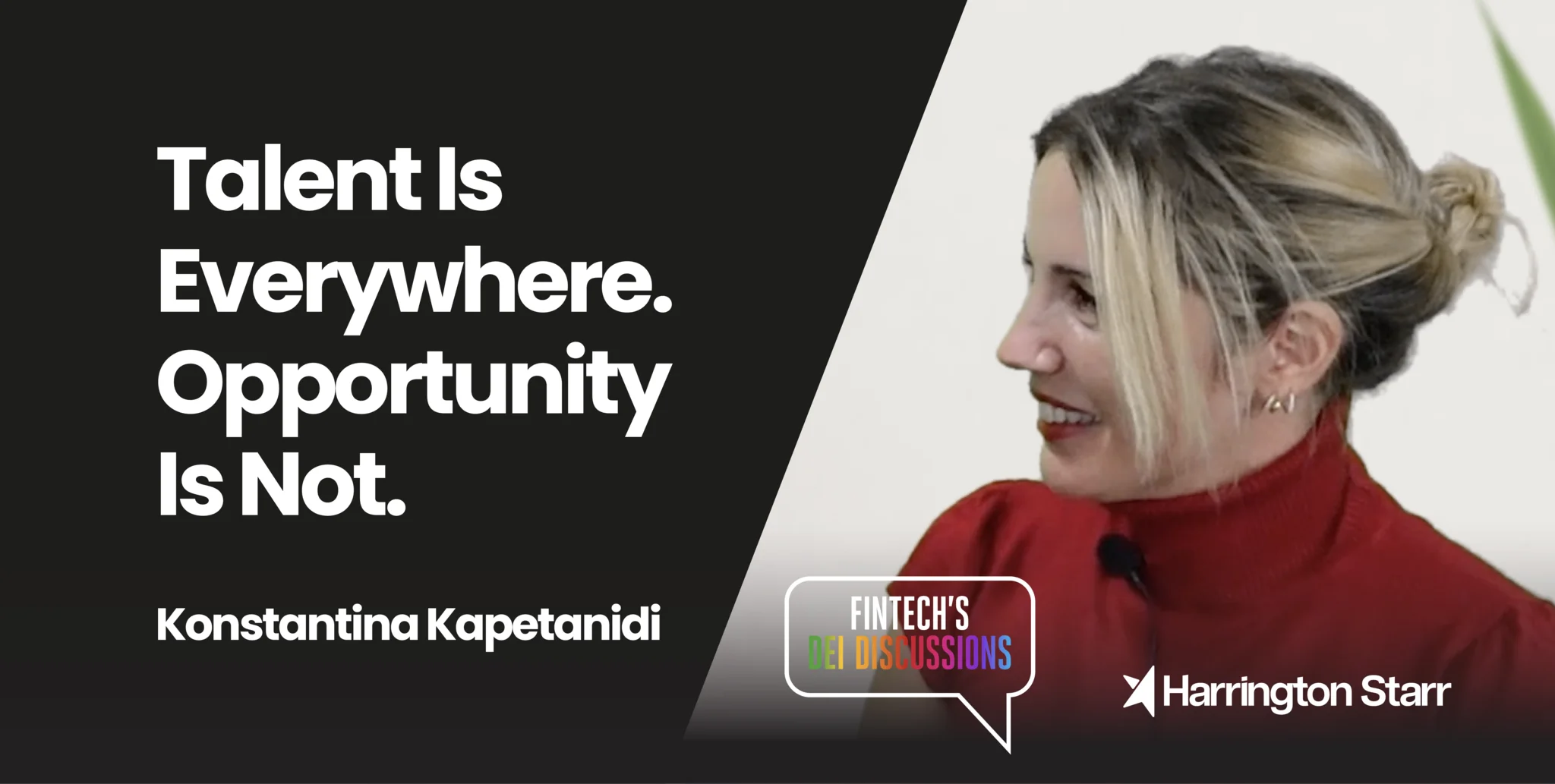
In this episode of FinTech’s DEI Discussions, hosted by Nadia Edwards-Dashti, we are joined by Konstantina Kapetanidi, VP, Global Data Solutions & Head of Data Science, Europe (VCA) at Visa. What unfolds is a deeply honest and reflective conversation about leadership in FinTech, the power of listening with intention, and why inclusion is not an initiative to be managed but a behaviour to be lived.
At Harrington Starr, as a FinTech recruitment business working across data, payments, financial services and technology, we speak daily with leaders navigating growth, innovation and transformation. What stands out in this discussion is how strongly culture, purpose and inclusive leadership shape performance in modern financial technology organisations.
Konstantina’s journey is not presented as a meticulously planned career path. Instead, it is a story of curiosity, instinct and recognising signals early. Her first professional steps were in Germany, working within an incubator where she was responsible for business development management across startups. It was there, building a data warehouse from Excel spreadsheets for one of the startups, that something clicked. She could see that data would become the next major trend.
Seventeen years in the industry later, long before “data” became a buzzword in FinTech and financial services, she remains clear that it is not about the data itself. It is about the signals data provides and how people interpret them. That distinction between raw information and human interpretation becomes a powerful theme throughout the conversation.
Her path moved from Germany to eBay, then to London, where she spent six years at Schroders before joining Visa. The move into payments, she explains, was not simply a job change. It felt like stepping into a mission. Visa sits at the intersection of technology and human impact. For Konstantina, this alignment between her core values and the organisation’s influence was critical. The ability to apply decisions, systems and innovation to billions of people globally represents a scale of impact that resonated deeply with her sense of purpose.
Inclusion is a word often used across FinTech, payments and financial services. Yet, as Konstantina explains, its meaning must go far beyond rhetoric. For her, inclusion is the sense of belonging without conditions and without boundaries. It is not about having inclusion as an agenda point in a meeting. It is about intertwining inclusion with business as usual operations.
This is particularly relevant in high-performance environments such as data science, global payments and financial technology. Leaders are often balancing revenue, assets under management, product innovation and regulatory pressure. The temptation can be to view inclusion as an add-on rather than a foundation.
Konstantina challenges this perspective directly. If leaders create safe environments where people feel able to speak up, contribute ideas and challenge constructively, performance follows. Psychological safety is not in conflict with commercial success. It enables it.
She makes a crucial distinction between having the right people in the room and ensuring those people feel safe enough to speak. In many organisations, representation has improved. Yet representation alone is insufficient. The real question becomes whether individuals trust that their voices will be heard and valued.
In a FinTech landscape defined by rapid digital transformation, global expansion and evolving data strategies, this trust becomes a competitive advantage. Diverse thinking drives better interpretation of signals, better risk management and stronger innovation. For firms hiring data scientists, product leaders and technology specialists, inclusion directly affects attraction, retention and productivity.
One of the most compelling insights from this episode is Konstantina’s ground rule for authentic inclusion: listen with intention. Listening, she suggests, has become something people perform rather than practise. Leaders may hear words but fail to understand what lies behind them. Intentional listening requires curiosity about people’s experiences, fears, ambitions and needs.
For data science teams, where communication styles vary widely, this becomes particularly important. Some team members may be introverted, others extroverted. Some may be early in their careers, others senior stakeholders. Every individual carries different expectations and perspectives shaped by their backgrounds.
Intentional listening enables leaders to create environments where people feel safe to express ideas. This is not about agreeing with every suggestion. It is about ensuring people feel heard. Even when decisions cannot be implemented immediately, transparency about why and when matters.
In the context of FinTech recruitment and talent strategy, this principle resonates strongly. High-performing candidates increasingly assess leadership quality and cultural alignment before accepting roles. They look for environments where their contributions will be valued and where communication is consistent and transparent. Listening with intention, therefore, is not only a moral imperative but a strategic one.
A defining moment in the conversation comes when Konstantina shares two key drivers behind her commitment to uplifting others. The first is a powerful statement: talent is everywhere; opportunity is not. This line encapsulates a core challenge across financial services and technology. Many individuals possess capability, but access to networks, sponsorship and visible opportunities is unevenly distributed.
Early in her career, she was fortunate to have people who opened doors. She was the one who had to walk through them, but the opportunity itself mattered. Today, she sees creating opportunities for others not as an obligation but as part of the legacy she wishes to leave behind.
The second driver emerged during her time at Schroders, when she was asked to define her personal purpose. Rather than framing her purpose in corporate terms such as delivering more for the company, she reflected deeply over three weeks to identify her personal North Star. For her, it became about paving the way and changing how the world sees women and professionals in data, finance and FinTech.
This mission is personal. As a mother, she wants her daughter to grow up knowing that pathways exist regardless of whether she chooses to become a ballerina or an astronaut. The idea of legacy here is not abstract. It is generational.
In the broader FinTech and financial services ecosystem, sponsorship remains critical. Leaders who advocate for talent, put individuals forward and create visibility can accelerate careers. For organisations looking to strengthen diversity across data science, product, cyber security and quantitative finance, embedding sponsorship into leadership practice is essential.
Another central theme of the episode is the relationship between purpose and performance. Konstantina believes teams thrive when their deliverables are anchored to a clear vision and impact. When individuals understand why they are doing something, not just what they are doing, engagement increases.
She describes herself as an over-communicator. She sends weekly newsletters to her teams, shares updates about where she will be and why, celebrates small wins and clarifies expectations. This consistent communication ensures transparency. If she promises an update by a certain date, she delivers it. If information is delayed, she informs her teams of what comes next.
This level of communication is not performative. It is foundational. It builds trust and manages expectations. In high-growth FinTech and payments organisations, where priorities shift rapidly, this consistency provides stability.
Importantly, she reiterates that inclusion and transparency are not special projects. They are part of business as usual. Good people leadership is not an optional extra. It is the basis of sustainable performance.
For firms investing in digital transformation, data strategy and AI-driven innovation, leadership style can determine whether technical talent thrives or disengages. Anchoring teams in purpose helps maintain momentum even during challenging periods. As Konstantina explains, defining her personal North Star has kept her afloat during storms and uncertainty. The same principle applies to teams.
Throughout the conversation, a consistent message emerges: inclusion should not be treated as an initiative separate from commercial objectives. It is embedded in how leaders communicate, how decisions are made and how teams collaborate.
When asked what advice she would give to businesses wanting to build more engaged and productive workforces, she returns to purpose and listening. Teams need clarity on direction. They need to understand the intention behind decisions. They need leaders who are present and consistent.
She also raises an important challenge for large organisations: how can they make it easier to onboard different voices and external partners? Processes and governance are necessary, but complexity can slow progress. Opening doors to new perspectives, faster, can create unexpected and valuable outcomes.
This idea is particularly relevant within FinTech recruitment and talent partnerships. External voices, whether specialist recruiters, consultants or advisory partners, can bring insights that internal teams may not see. Making collaboration smoother accelerates innovation and inclusion alike.
In the closing part of the episode, the focus shifts to actionable advice for individuals who want to help drive inclusion in their workplaces. Once again, listening becomes central. Leaders must understand that every team is different. Data scientists, engineers and analysts will have varied communication styles and needs.
At the end of the day, she emphasises, they are all people. They have their own fears, ambitions and experiences. Being present in a consistent way, showing up reliably and creating safe spaces for expression are practical steps anyone can take.
The conversation concludes with a reflection on listening as a lost art. In fast-paced financial technology environments, people often focus on what they will say next rather than fully absorbing what is being shared. Intentional listening creates depth in dialogue and strengthens collaboration.
For those of us working in FinTech recruitment, this insight is equally powerful. Understanding candidates’ motivations, aspirations and concerns requires intentional listening. Understanding clients’ strategic priorities and cultural context requires the same. True partnership begins with presence.
This episode of FinTech’s DEI Discussions offers more than inspiration. It presents a practical framework for inclusive leadership in data-driven, global organisations. From recognising early signals in data to recognising the importance of human interpretation, from defining a personal North Star to embedding inclusion into daily operations, the themes are directly relevant to the future of financial technology.
As a FinTech recruitment business operating across data science, payments, cyber security, infrastructure and quantitative finance, Harrington Starr sees first-hand how leadership behaviour shapes outcomes. Organisations that treat inclusion as business as usual, communicate transparently and anchor teams in purpose are more likely to attract and retain exceptional talent.
Konstantina Kapetanidi’s journey illustrates that inclusive leadership is not about perfection. She openly acknowledges that she has not always done everything one hundred percent correctly. The difference lies in intention and consistency. Listening with intention, communicating clearly and creating opportunity where it does not naturally exist are choices leaders can make daily.
The call to action at the end of the episode is simple but powerful: let’s listen, let’s learn and let’s walk the talk. In a sector defined by innovation and scale, human impact remains central. Whether in data science, global payments or broader financial services, the future of FinTech will be shaped not only by technology but by the environments leaders create.
For organisations seeking to build stronger, more inclusive teams in FinTech, and for professionals navigating their own leadership journeys, this conversation provides both reflection and direction. Inclusion is not separate from performance. It is foundational to it. And as this episode demonstrates, purposeful, intentional leadership has the power to open doors for the next generation.